


old man emu
-
Posts
5,297 -
Joined
-
Last visited
-
Days Won
78
Content Type
Profiles
Forums
Gallery
Downloads
Blogs
Events
Store
Aircraft
Resources
Tutorials
Articles
Classifieds
Movies
Books
Community Map
Quizzes
Videos Directory
Posts posted by old man emu
-
-
8 hours ago, onetrack said:
The idiot in the story below lost his 8 yr old daughter, because he believes 8 yr olds should have the right to drive "junior dragsters"
What was not reported in that story was the result of the investigation into the causes of the accident. Obviously because the story came out before the investigation was completed. We, as readers, don't know what the sequence of events was. Obviously there was a loss of control, but there are many things that can lead to that - the vehicle, the environment, or the driver. Perhaps the cause will be found to be the failure of a widget. That's a one-in-a-million.
Whatever the cause of that incident was, zeroing in on it detracts from the general propositions we are discussing. As Onetrack said, "All powerful machines are designed specifically for adult-sized bodies, weights, and head positioning" More specifically, transport machines are design for the target user. Go stand outside a primary school one afternoon and see how dangerous kids on bikes and scooters are to themselves and others. Even those on foot are prone to running into the paths of others in their haste to move.
-
 1
1
-
-
When you look at the numbers, using a factor of 1.3 makes a pretty big change. A factor of 1.3 is, in reality 30%.
I only have POH's for a C-172 and Piper Cub to get some speeds from, but according to them the flapped stall speed of the C-172 is 40 kts, so a 30% fudge factor takes that to 52 kts and the minimum manoeuvering speed fudge factor of 1.4 takes it to 56 kts. (For the Cub, stall is 37.5 1.3 = 49 and 1.4 = 52)
Those are pretty big fudge factors. Not that there's anything wrong with extra safety padding, but wouldn't they restrict operations at low speed - say during search operations?
-
Since I really don't know your criteria for categorising, I'll abstain from passing an opinion. Surely there are freighters that are not gigantic. Couldn't all aircraft that are generally used for freight be lumped together as Air Freighters? Makes it hard when the likes of a 747 can be used for multiple roles for civilian or military purposes.
I'm trying to think of early specific freighters, like the ME 363, or experimental biggies like the Russian Kalinin K-7. What about the Hadrian glider?
-
I recently learned that a child under 12 thinks in terms of what can be sensed. It is only after that age that they can begin to think in abstract terms. So there is no point in expecting a Primary school kid to fully understand responsibility. If you want to see this lack of grasp of abstract thinking, stand outside a primary school at 3:00 pm. Your heart will be in your mouth.
-
 1
1
-
-
1 hour ago, Thruster88 said:
This is a thread about a SIMPLE way to save lives by marking the airspeed indicator
C'mon Thruster. You have been around here long enough to know that the SIMPLE pretty soon drifts to the COMPLICATED, then to the HYPOTHETICAL and finally ad absurdum.
However, your point about marking the ASI to provide a visual reference to the boundaries of safe flight is quite valid and should be encouraged.
-
3 hours ago, facthunter said:
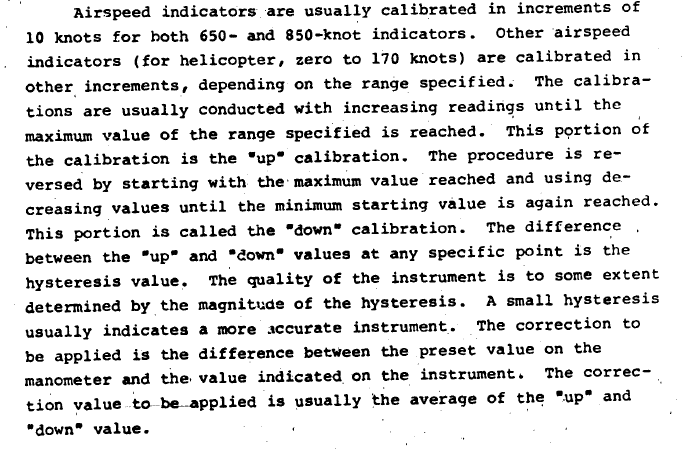
The Lag, sometimes called hysteresis, in an ASI is pretty minimal if able to be picked up at all.. At the rate of increase or decrease in our planes speed (acceleration) you can for all practical purposes IGNORE it. When in discussion one says "Indicated" airspeed takes account of this, you are talking principles. Not an individual instruments "possible" characteristics in some hypothetical situation... . Nev. .
I picked up that bit about Lag while reading about ASIs in military aircraft in this https://apps.dtic.mil/dtic/tr/fulltext/u2/a104830.pdf

You've probably never seen Lag because you have probably never watched an instrument tech do your four-yearly ASI check. Who does?
You are correct when you say, When in discussion, you are talking principles. Unfortunately people seem to have the need to drag in an individual instruments "possible" characteristics which bogs things down.
Hypotheticals are OK for discussing principles, but we do, in fact, live in a real world where reality rules. One just has to make it clear early on in the discussion whether the discussion is about principles or reality. Once that is agreed upon, the discussion can proceed accordingly.
-
The Air Speed Indicator is not a precision instrument. It is an "indicator"
CASA Aviation Order 108.56 says,
3 Test procedure and accuracy
3.1 Airspeed indicators
Airspeed indicators must be tested against an appropriate test instrument. The scale errors at the major graduations of the scale must not exceed ± 4 knots up to the maximum speed of the aircraft, when tested first with the pressure increasing and then with the pressure decreasing. Operation must be smooth and continuous.
Civil Aviation Order 100.5 (General requirements in respect of maintenance of Australian aircraft) 2011, Appendix 1 Additional maintenance requirements — pitot-static systems, pressure altimeters, airspeed indicators and fuel quantity gauges at Paragraph 5 says the same thing.
So, if an ASI can be in error of the correct value by plus or minus 4 knots, and the manufacturer's stated stall speed is X knots, based on design factors, how can you place your trust and your neck in what a needle is pointing to?
There is also another fly in the ointment - pneumatic lag and attenuation.
During unsteady flight, pneumatic lag and attenuation may affect pressure measurements. Pressure variations propagate as waves through the pneumatic tubing to the ASI The wave propagation is damped by frictional attenuation along the walls of the tubing and fluid viscosity. This damping produces a magnitude attenuation and a phase lag. After the wave reaches the ASI, it is reflected back up the tube. Depending upon frequency distribution of the incoming wave energy and tubing length, the reflected wave may cancel or reinforce incoming pressure wave. If the waves cancel each other out, further spectral attenuation occurs. If the waves reinforce each other, the power of the incoming wave is amplified and resonance occurs.
-
10 hours ago, CT9000 said:
Properly supervised they learn and safety becomes second nature over time.
It's the supervision that instils safety.
Nearly every day I hear cars and motorcycles roaring along my residential street (50 kph zone). Engines are revved to peak RPM and gear changes are done rapidly. Why? Because the operators spent too much time playing Grand Theft Auto and have come to expect the fast and furious is so macho. I'm appalled at the number of "burnout" marks on residential streets. Clearly, those who make them have absolutely no idea why a burnout has a purpose in only one type of motor sport. I cringe when I thing of the damage they are doing to the transmission systems of their cars. It's a wonder that we don't see more of them flipping their cars because the front driveshaft universal gives way and drops the shaft onto the road.
The poor standard of vehicle operation in a traffic environment throughout the whole population is deplorable. I see poor road positioning; poor sight distance management, and poor planning and review displayed every time I venture out on the roads. I pray to the Lord to ease the burden St Christopher bears in ensuring the safe travel of these incompetent drivers.
-
1
-
1
-
-
That's the way I took it. No sweat.
-
-
8 hours ago, skippydiesel said:
Not sure of my definition here but is this not a "troll"/"trolling" ??
Who gives a sh!t? I'll post something on the sister site, AFTER I HAVE DONE SOME RESEARCH and mulled over what I've picked up.
Whether 'tis nobler in the mind to suffer The slings and arrows of outrageous fortune, Or to take arms against a sea of troubles, And, by opposing, end them?' (Hamlet, Act 3, Scene 1)
-
33 minutes ago, APenNameAndThatA said:
Discussing things with you one one site is plenty, thank you.
Geez, It's bloody impossible to be nice to you. If I agree with something you say, you find fault with something else.
-
 1
1
-
-
Sorry, Gareth.
I posted this as an attempt at humour.
On 10/02/2021 at 5:10 PM, old man emu said:Is that why I had the shite ripped out of me by a LAME when I took a compass out of a plane and was whirling it around my head on a length of safety wire? Well, he told me to go out and swing it, didn't he?
Yenn dragged us into the forces discussion.
I'm still waiting for Kyle to answer my question here about magnetic fields generated by electrical currents., for which I apologise for pointing to a sidetrack.
4 hours ago, APenNameAndThatA said:you assume that they are dumb
I don't assume people are dumb. Someone, sometime in the distant past, got the idea all wrong and published an incorrect explanation which has become a physics myth.
4 hours ago, APenNameAndThatA said:A piece of string can only be under tension if it is being pulled from *both* ends in *both* directions
I agree with that, and it makes explaining the forces involved in the circular motion of a mass connected to a fixed point a bit easier.
I invite you to follow me over to the sister site where this discussion can be continued.
-
Didn't some Asian carriers simply take their trainee pilots and stick them in the simulators for Boeings and Airbuses, etc., and teach them only to fly a particular aircraft, without having them go through the step-by-step learning scheme that most other countries require? In other words, those Asian pilots couldn't fly a puddle-jumper for love nor money.
-
1
-
-
Can we get off this Centripetal/Centrifugal Force thing? It's obvious that nobody is willing to try to understand it and it is not getting an answer to the original question
On 19/01/2021 at 4:16 PM, gareth lacey said:To the avionics guru,s out there ,i have 8 panel switches powering from 8 thermal overload switches, can you loop ground to all switches and have 1 main ground to ground block or individual grounds to block
Thanks gareth
-
1
-
-
1. Centripetal: (adj) moving or tending to move towards a centre.
2. Centripetal Force: the force that is necessary to keep an object moving in a curved path and that is directed inward toward the center of rotation.
3. Centrifugal Force: the apparent force that is felt by an object moving in a curved path that acts outwardly away from the center of rotation.
Centripetal Force is an actual force, Centrifugal Force is an apparent force. In other words, when twirling a mass on a string, the string exerts an inward centripetal force on the mass, while mass appears to exert an outward centrifugal force on the string.
The difference between Centripetal and Centrifugal Force has to do with different 'frames of reference,' that is, different viewpoints from which you measure something. "Centripetal Force and Centrifugal Force are really the exact same force, just in opposite directions because they're experienced from different frames of reference. If you are observing a rotating system from the outside, ( watching someone whirl an object around their head), you see an inward centripetal force acting to constrain the rotating body to a circular path. However, if you are part of the rotating system (the thing being whirled), you experience an apparent centrifugal force pushing you away from the center of the circle, even though what you are actually feeling is the inward centripetal force that is keeping you from literally going off on a tangent.
-
17 hours ago, APenNameAndThatA said:
The V speeds are based on IAS.
After some more revision of the subject, I agree with that statement.
However, I went back to every post I made here. I never said anything about what V speeds were based on. I did say something about TAS in this statement:
On 09/02/2021 at 1:30 PM, old man emu said:NOTE:
On the illustrated ASI, there is a moveable scale to allow for IAS to be converted to TAS. Remember that the Lift formula is expressed in terms of TAS, so if you have one of these ASIs that has a moveable scale, the markings for V speeds should be on that scale.
I suppose I should have said "could" instead of "should" to allow for personal preference in the way the information provided by the ASI was displayed.
-
8 hours ago, old man emu said:
because the Lift equation uses TAS, not IAS"
Pull out your textbook and prove that statement incorrect.
-
1
-
-
2 hours ago, tillmanr said:
Wouldn’t it experience both centripetal as well as centrifugal forces?
Jeremiah 5:21 ('Hear now this, O foolish people, and without understanding; which have eyes, and see not; which have ears, and hear not').
-
2 hours ago, Yenn said:
swing has nothing to do with centrifugal force
It's CENTRIPETAL! CENTRIPETAL! CENTRIPETAL!
-
Is that why I had the shite ripped out of me by a LAME when I took a compass out of a plane and was whirling it around my head on a length of safety wire? Well, he told me to go out and swing it, didn't he?
-
2
-
-
I reckon Kyle can answer this best.
If a current is moving through a conductor, doesn't it create a magnetic field?
If a compass is affected by magnetic fields, wouldn't the flow of current through a metal airframe cause an error on the compass?
If the airframe was excluded from the circuit by the use of a dedicated return cable, would the compass be affected?
-
2 hours ago, facthunter said:
Are we talking about altimetry or AIRSPEED indication?
You have to go back to read what the person who was quoted said.
ARO said, "The important V speeds Vs0, Vs1, VFE are IAS not TAS."
To which I replied, "ARO, I specifically wrote TAS because the Lift equation uses TAS, not IAS" to explain why I had written what I had.
The ARO said," It's inconvenient to constantly adjust speeds for changing density"
Then I went off topic a bit to explain that what we know about air density and how it changes, especially with the movement of atmospheric pressure systems, usually has no huge effect as we potter around within one QNH zone in good flying weather. Indicating on an ASI face where the needle should point for an airspeed that is your aircraft's normal landing speed increased by a factor of 1.3 (30%) should work for 90+per cent of the flights we make.
57 minutes ago, skippydiesel said:Bit of a sweeping statement OME
It's getting so that before I post a comment I will have to provide a list of definitions, formulae and constraints so that people don't immediately shoot back with minute exceptions to the generality.
-
2
-
-
9 hours ago, aro said:
It's inconvenient to constantly adjust speeds for changing density
It is hard to reply correctly to that statement because we need to specify when the density changes. Normally we fly on Area QNH. The acronym QNH is one of the Q(uestion) code names developed, circa 1909, for use in morse code. To concisely ask for atmospheric pressure at mean sea level (MSL), the operator would transmit the letters QNH. This was understood to mean "I have a question. What is the atmospheric pressure at Nil Height", i.e. at mean sea level.
These are the boundaries of Area QNH for Australia. http://www.pilotpracticeexams.com/courses/wp-content/uploads/2016/09/Image-2019-02-26-at-10.22.52-AM.png
We know that pressure systems move across Australia from west to east, so while an Area QNH is current for three hours, commencing 0100 UTC and each three hours thereafter, an altimeter set to Area QNH will be representative to within ±5 hPa of any actual QNH of any location within the defined area. If a pressure system, usually a Low, is crossing the continent, the actual air pressure is constantly changing, but we don't usually keep adjusting the subscale as we fly along within a QNH zone.
Interestingly, if we are flying towards a low pressure area, and our altimeter is set to Area QNH, the altimeter will gradually overread our actual height because the air pressure is dropping and the altimeter interprets that as the aircraft climbing. So if we keep flying at a constant indicate altitude based on a QNH derived altimeter reading, we could fly into the ground.
So, getting back to the original quote, if we fly within a QNH Zone using the Area QNH, we don't alter the sub-scale until Air Services changes it at the end of the three hour validity period. However, if we cross a QNH Zone boundary, we need to check with Air Services for the current Area QNH in that zone, and possibly adjust the sub scale.
If an altimeter has reminder markings to mark Vso - Stall speed or minimum flight speed in landing configuration they have a safety factor of 1.3. In practice that should take care of local air density changes on altimeter indications at airfields in Australia, which for the whole continent average out at about 1000' AMSL.
-
1
-


A dumping of snow
in UK/Europe General Discussion
Posted
Lee-wave,
This is a family-friendly forum. Please avoid using obscenities when describing foodstuffs.