


old man emu
-
Posts
5,297 -
Joined
-
Last visited
-
Days Won
78
Content Type
Profiles
Forums
Gallery
Downloads
Blogs
Events
Store
Aircraft
Resources
Tutorials
Articles
Classifieds
Movies
Books
Community Map
Quizzes
Videos Directory
Posts posted by old man emu
-
-
Sea Mew (Larus canus) is a medium-sized gull, found in Alaska and western Canada. Small; mantle medium-dark grey; wingtips with little black and much white; iris pale. Wingspan 96–102 cm (38–40 in); mass 320–550 g (11–19 oz). The name "sea mew" comes from the Dutch name "zee meeuw"
-
17 minutes ago, Roscoe said:
Interestingly, at 2pm I was the only tyre kicker in attendance
Did you happen to ask if the aircraft has Reserve prices on them?
-
7 hours ago, pmccarthy said:
With no maintenance history can they ever be registered with CASA or are you buying a collection of parts?

-
8 hours ago, Garfly said:
But are they as good as barn-doors?
The answer is just a magic carpet ride away!
-
 1
1
-
-
5 hours ago, RossK said:
Mission for both of us it to get away regularly and see more of this great country of ours,
Tell me how many hours you fly in 2022

-
38 minutes ago, NT5224 said:
are there any legal implications
Caveat emptor would be the answer to that one.
I doubt if any legislation which sets rules for the operation of aircraft or qualifications of pilots would involve itself in a civil contract involving the exchange of title to goods. All the regulations would say is that if you gain title to an aircraft, and want to fly it, then you must advise the authority of the name and contact details of the owner. If you wanted to buy a plane and make a static display of it, you would not have to tell the authorities.
If Pickles are selling the planes, I think that you will find in their Ts&Cs that logbooks are available for inspection. I'm sure that someone has said that already.
-
 1
1
-
-
1 hour ago, RossK said:
, planes done 41hrs since acquisition in Nov 20.
That's a lot of time for recreational flying. Not many others would clock up times like that. It will be interesting to see how many months it takes to clock up the next 59 hours.
-
 1
1
-
-
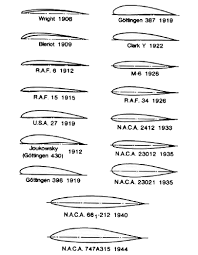
There's lots of illustrations of various wing designs like this one,
But I recently saw one illustration where there was what seemed to be a vented space in the top surface of the wing near the separation point. The vent opened into the inside of the wing, but
I can't find the illustration now, but I believe that the effect of the vent was to keep the boundary layer from separating from the surface of the aerofoil, thus increasing the AoA before separation.
Here is the precis of a paper on the subject
AERODYNAMIC DESIGN AND COMPUTATIONAL ANALYSIS OF VENTED NACA2412 AIRFOIL-A COMPARATIVE STUDY
In the field of aerodynamics over the past decades, numerous studies have been dedicated to develop airfoils that produce higher amount of lift over a wide range of angle of attack. The flow over the suction surface of the airfoil must remain attached in order to generate lift otherwise the aircraft is bound to stall. This paper aims to introduce a novel technique on passive blowing flow control, namely, 'vented airfoil'. In the vented airfoil, the high momentum fluid from pressure surface is injected into suction surface just upstream of the flow separation point.
Also US Patent B64C21/025) https://patents.google.com/?q=(B64C21%2f025)&oq=(B64C21%2f025)
-
 1
1
-
-
5 hours ago, RossK said:
Our Maintenance Manual says 100hrs +/- 5hrs, but if you do it at 102hrs, the next is due in 98hrs
What about calendar time? Surely you don't do 100+ hrs in a calendar year?
-
7 minutes ago, skippydiesel said:
Ethereal! - dont look like they would handle any sort of wind.
I reckon it would ... poorly.
-
Isn't all maintenance, airframe (including instruments) and engines for simple aircraft all based on the same times? Either annually by calendar or hours recorded by a TTIS system, usually tacho or Hobbs time?
As the aircraft gets more complicated, individual components can have their own schedules, but still based on TTIS, or cycles of operation (pressurization of cabins, landing gear).
-
Yeah, I did think that the bag did have an aerofoil shape. It must be filled with only just enough gas to lift the bag and puff it into shape.
-
Not an "airship", but a "blimp". A blimp (technically called a “pressure airship”) is a powered, steerable, lighter-than-air vehicle whose shape is maintained by the pressure of the gases within its envelope.
A blimp has no rigid internal structure; if a blimp deflates, it loses its shape.
Good to see that they are OK to fly in IMC, or my standards for classifying IMC too high?
-
Moral of the story is to get your maintenance done before you set out on a trip that could possibly longer than you think.
-
A LAME who is satisfied that the item, usually an engine, is still within manufacturer's specs can authorise "On Condition" use, but most LAMEs would only do that for aircraft they have serviced themselves over many years. Bring in your bargain purchase and it won't be a bargain much longer.
-
-
11 hours ago, kgwilson said:
Then there are those who just don't care
I have no objection to that opinion. I'm not pointing a gun at them telling them to follow or participate in the discussion. Sometimes I feel like this
Anyway, getting back to Lift.
We are used to equations in Physics being relatively simple: F = ma; Work = mad. Some equations contain a Coefficient. A number used to multiply a variable. Example: 6z means 6 times z, and "z" is a variable, so 6 is a coefficient. In most equations, the Coefficient is always the same - a constant value.
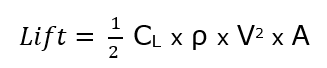
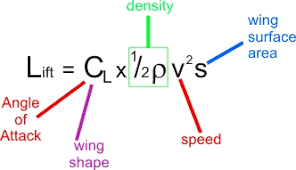
However, aerodynamics isn't a game that is played by the usual rules. The Lift equation contains a coefficient, CL
But unlike a some coefficients, such as the coefficient of friction in the frictional force equation ( F = CofF x ma), the Coefficient of Lift varies with the Angle of Attack.
You can deduce that for the same airspeed and the same air density, a simple wing will start to produce enough Lift to raise the aircraft from just above 4 degrees AoA, and up to maximum about 16 - 17 degrees AoA. We know that the wing will stall around 16 degrees AoA, but various devices seem to be able to allow operation above that angle.
-
What we tend to miss in all this Lift stuff is the actual difference in pressure that has to be generated per square centimetre of wing to keep an aircraft in the air. It's no much.
A Jabiru 160 has a wing area of 8.04 square metres. Its MTOW is 540 kg, giving a wing loading of 67.2 kg/m^2. That's 6.72 grams per square centimetre. 6.72 gms is the weight of one and two thirds teaspoons of sugar.
While I was trying to work out the units that you would use to report the amount of lift a wing produces, I think I found something interesting.
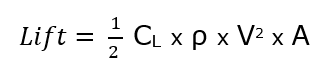
Here's our old friend, the Lift formula.
To make things a bit clearer the formula can be rearranged as
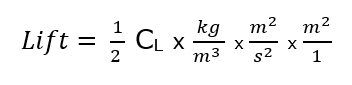
Writing this out to show the units each component is measured in, we get
If we consolidate the equation we get
which is which means that Lift is a combination of the Coefficient of Lift and a Force.
-
It would be nice to have the link to the full story that video comes from. Without an explanation, it's just an animation.
-
Oh Christ! Thelma and Louise are off again!
-
2
-
-
Isn't that +/- x Hrs just to cover rare contingencies?
Say you decide to fly around the country via the coast and do you planning to ensure that you will be back home by the time a 50 or 100 hourly bit of maintenance comes due. The while you are away, you do a bit more sightseeing than you expected and have clocked up five or six more hours than you had planned for. There's nothing wrong with coming home with the hours a tad overdue. You can do your maintenance , and then do it again 50 or 100 hours after the originally scheduled hours. It's a bit of a case of robbing Peter to pay Paul, but you've got to payback Peter.
-
1
-
-
4 hours ago, Panorama said:
Receivers don't nessasarily accept the best price on an asset more the most convenient offer.
Quite true. The job of the liquidator is to recover the most money to repay outstanding debt, as soon as possible. We forget that as soon as a Judgement is made, interest on the debt begins to come due.
-
1
-
-
3 hours ago, skippydiesel said:
The speaker contradicts himself on the range question
Don't shoot me. I simply posted a video I found. 😁 I thought people might like to see the plane in action.
-
The question to be answered is, "Has a Reserve price been set for each aircraft?" I dare say that the Receiver has set a reserve for each aircraft based on the open market price that could be found in Trader publications. Obviously the Receiver is looking to turn all assets into as much cash as possible. Those assets would even include the tea urn in the meal room. Pickles it trying to squeeze as much money out of the purchaser as possible for Pickle's profit line. I watch an auction-based show on TV and regularly the price achieved at auction falls below, or at, the price the object was purchased for. In that programme, it is only when the original seller has no idea of the value of the object does the auction room price skyrocket. In the case of these aircraft, the seller knows full well what each one is worth.
-
1
-




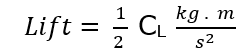 which is
 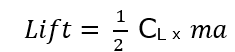 which means that Lift is a combination of the Coefficient of Lift and a Force.
Turns at low IAS
in Student Pilot & Further Learning
Posted
“There is a way which seemeth right unto a man, but the end thereof are the ways of death.” Proverbs 14:12