


old man emu
-
Posts
5,297 -
Joined
-
Last visited
-
Days Won
78
Content Type
Profiles
Forums
Gallery
Downloads
Blogs
Events
Store
Aircraft
Resources
Tutorials
Articles
Classifieds
Movies
Books
Community Map
Quizzes
Videos Directory
Posts posted by old man emu
-
-
It's amazing what a woman sees in a man.

Congratulations to you both
-
 3
3
-
-
Yep. Noah has a lot to answer for. One wonders if he did more to the detriment of Mankind than Eve's fruit salad diet.
-
16 minutes ago, facthunter said:
You can't freeze it in time and just not consider one of those forces
Actually I don't give a tinker's cuss whether it's a banquet, a roll or a bloody pizza. I'm not interested at all in what happens when and aerofoil is attached to box. I am going right back to the basic generation of a Lift force due to the movement of an airmass across a modified plate. If you want to drift the topic into what happens when a machine applying the principle of aerodynamic Lift operates in practice, please start your own thread. I will follow it with great interest.
WHAT I WANTED TO SAY WAS THAT THE COMMON DIAGRAMS AND PICTURES WE USE TO UNDERSTAND LIFT FORCE GENERATION ARE ALWAYS SIDE ELEVATIONS OF THE AEROFOIL. THIS IMAGE IS IMPLANTED IN OUR MIND'S KNOWLEDGE CACHE, SO THAT WHEN WE TRY TO UNDERSTAND THE CONCEPT OF RELATIVE AIRFLOW IN RELATION TO THE WING IN PLAN VIEW, THE IMAGE IN OUR MENTAL CACHE COMES OUT AND CONFUSES US.
22 minutes ago, aro said:That diagram is a turn not a roll
AGREED, but it was the quickest way I could find to illustrate the directions of the force vectors.
As for an aerofoil not producing any Lift force when at 90 degrees to the horizontal - look at the tail fin of an aircraft. Air moves across each side, which have the same shape on both sides. Therefore the aerodynamic Lift force must be equal on both sides, each side cancelling the other. It is only when the camber is changed by the movement of the rudder that these forces go out of balance and a desired result is achieved.
-
I believe that the training area, which could be used by both Camden and The Oaks will be south of Burragorang Road and west of the Hume Hwy down to about Tahmoor. I can see a lot of fixed wing training moving out of Bankstown to Camden, but that depends on the infrastructure support that Sydney Metro Airports gives to Camden.
The Oaks airfield is on a flood plain and after the recent flood along the Nepean/Hawkesbury system I can't see the local council approving any residential or industrial building on it.
-
This is one of those diagrams that I say is causing confusion:
While this is a totally correct way to explain why the pilot has to take action to increase the resultant lift in order to complete the desired manoeuvre, it does not illustrate how the relative airflow moves around the wing.
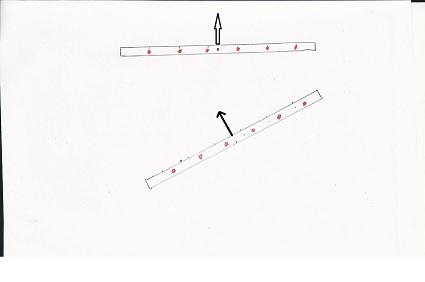
Here is a scrappy diagram of what I am getting at.
The rectangles represent the leading edge of a flat plate. The red dots represent the airflow meeting the leading edge, and you can assume that the air diverts over and under the wing as we know it does. In order to get a bit more Lift force we'll arbitrarily assign an AoA of 4 degrees. I don't have the CAD software to draw that in a diagram. Imagine that the plate is connected to some device that measures the magnitude of the Lift force, and that device allows us to tilt the plate around the halfway point of the span. I have drawn the lower rectangle with a 20 degree tilt down with respect to the top one - simply to fit the diagram on a page.
Now if we pass an airstream (relative airflow), having a known velocity and density of the air, at the top rectangular plate, a Lift force will be generated, which we can depict as an arrow pointing upwards. Our measuring device can tell us the magnitude of that force. Next, without changing AoA , airflow velocity or air density, we tilt the plate away from the horizontal and again obtain a value for the magnitude of the Lift force. The two magnitudes will be the same.
In other words, the angle of the plate relative to the horizontal datum will not affect the magnitude of Lift force generated by the plate. This is because no matter how the plate is orientated in relation to the horizontal datum the density and velocity of the relative airflow are the same. The plate is immersed in the fluid the same way that a fish is immersed in the sea.
It is incredibly hard to produce a two-dimensional diagram of this, that's why I said to use a three-dimensional object to help envisage what I am saying.
If this plate was set up at 90 degrees to the horizontal datum, would the Lift force be the same as in the other two cases? Yes, but when one wants to use that Lift force to balance the weight force of an aircraft, there is no vector component that is equal and opposite to the weight force. aro mentioned at one point that the horizontal vector of the Total Lift force is used to turn the aircraft. When the wing is at 90 degrees vertical, one would guess that it's all turn and no holding altitude.
Phew!
-
-
49 minutes ago, Jase T said:
3 makes little sense. How can it be at various angles to the airflow and still be at the same AOA?changing the angle to the airflow changes theAOA thats the very definition of AOA?
Are we ignoring the Total reaction on the aerofoil? Wind tunnels have no weight and no thrust so the TR will be different.
How can it be at various angles to the airflow and still be at the same AOA?
It makes sense if you put a modicum of thought into the set up of the experiment. Here's how you can visualise the set up. Pick up a ruler, say a normal 30 cm one. Hold it in front of your eyes so that the long lateral axis of the ruler is horizontal from right to left, and the short, longitudinal axis is level with your eyes, so that you can only see the thin edge of the ruler. Now hold it there with your finger at the 15 cm mark.
This is what we will call the "normal" angle of the ruler to air blowing at your face from the front. The deflection of the airflow across a flat plate will produce an amount of Lift force. We need to generate some Lift force for this experiment, so we will set the angle between the airflow and the longitudinal axis to an arbitrary 4 degrees. With the ruler set up thusly, we blow a steady airflow at the ruler. This airflow separates at the edge of the ruler and some goes over and some under the ruler generating a Lift force, which our incredibly accurate measuring devices can detect and display.
Now, without altering the angle between the airflow and the longitudinal axis which is arbitrary 4 degrees, drop one end of the ruler so that it is 10 degrees below the original horizontal. We haven't change any other factor. Because the ruler is immersed in the air, it will produce a Lift force. That magnitude of Lift force will be the same as when the Lift force was measured initially.
Are we ignoring the Total reaction on the aerofoil? Wind tunnels have no weight and no thrust so the TR will be different. Yes, because we are not trying to balance any other force. All we are trying to find out is what the magnitude of the force is when air flows over the ruler, which is representing a wing. In practice, a designer knows that this experiment will give the Total Expected Lift force of a wing, as well as knowing that this Total will be eroded by all the factors that people have mentioned. Having taken all those things into account, the designer can determine the MTOW of the aircraft being designed.
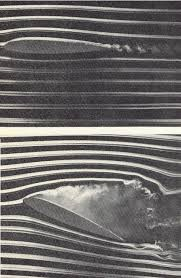
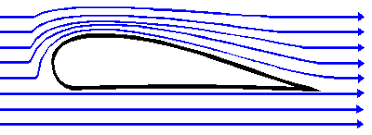
You said changing the angle to the airflow changes the AOA that's the very definition of AOA? What I am trying to get you to think about is "What diagram or picture have you seen that helps you visualise the airflow in this situation? I'm saying that these
have caused you confusion because the don't show the airflow from the plan view of the wing.
What I am saying is that one should be careful about which illustrations they plant in their mind to help understand concepts.
-
4 minutes ago, facthunter said:
I don't believe #3 is correct. There is a best angle for all aerofoils In your following comments the pilot anticipates what control input is required because he has been trained and the coordination is part of the art of doing it right or even the ability to do it at all without losing control. It's pretty easy when flying with somebody attempting these things to know who hasn't a clue and it's deadly at lower levels. Nev
For Sod's sake, will you forget about what Pontius Pilate is doing in the aircraft and go back to basics. A section of wing in a constant airflow device with measuring devices to measure the Lift force when the wing is at various angles to the direction of the Earth's gravitational force.
Will you discuss the proposition that sometimes the diagrams we use to illustrate one point can confuse the understanding of other propositions?
-
34 minutes ago, Thruster88 said:
I summarized all the above in one sentence for you in post #6
This is what you said, "Can't wait for your correct answer. In the real world the lift produced will depend on the angle of attack and airspeed, both pilot controlled. Angle of bank is irrelevant"
Can you see now that this is NOT what I was getting at? I'm not denying that what you say is true. All I wanted was an answer that compared the Lift force generated by a wing that had been rotated at an angle to the direction of the Earth's gravitational force with the Lift force generated when the wing was at 90 degrees to that gravitational force.
-
See John 11:35
I don't give a rat's arse about the further effect of the vertical and the lateral components of the Lift vector. I acknowledge every thing that you are saying about the further effects is correct. Will you acknowledge that
1. The Lift vector acts at 90 degrees to the direction of the airflow.
2. If the air in the vicinity of the wing, and here let's arbitrarily call "vicinity" anything within a sphere whose radius if which is (1/2 wingspan) + 5 metres, has consistent density then the lift generated by the wing is not dependant on the angle of the wing, or if you like, chord line, relative to the the direction of the gravitational force of the Earth.
3. If a section of wing, say 1 metre long, was to be placed in a wind tunnel, so that it could be held stationary at various angles to the airflow, with the AoA constant, the Lift force generated by the section would be the same for all angles that it was held at.
4. That when trying to grasp a new concept, we rely on our prior knowledge and experience to apply the old to the new. Therefore, if a person's old knowledge and experience has involved seeing diagrams where the wing is depicted in side elevation, then that can be a hindrance when considering a different situation where the wing is depicted in plan view.
1 hour ago, facthunter said:the best way of putting it across especially if it's the MAIN thrust of your presentation.
Nev, my big mistake is thinking that people can "think outside the box". In other words look at a situation from a different stance. What I see here is people not stopping to think more deeply. They have given replies (those that are not derogatory) that of themselves are quite correct, but show that they are not thinking deeply about what is proposed. That's why there has been all this stuff about rolling and banking and such. Those replies go further than the proposition raised. That's why I was careful to use the word "instantaneous" and to say that an infinitesimal time after a plane's wing reaches a nominated angle, the pilot has to work to maintain direction and altitude. I agree that as soon as the rotation of the wing starts, the Lift/Gravity pair goes out of balance, but in real life, as shown in the video, getting to 45 degrees is pretty quick, and the pilot wouldn't start acting to ensure that direction and altitude were maintained until the desired angle was reached - remember reaction time of the pilot, even one who knows what is going to happen and what has to be done.
-
Since it doesn't seem to be possible to encourage people to consider things from a different perspective, I'll go straight to the point I was raising. This will involve some cut and paste from earlier posts in this thread as I want to be quick. So here goes.
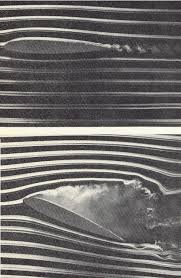
Which of you has not seen diagrams or photographs like this:
or this one:
In both, we are presented with a view of the side elevation of a wing. These images are implanted in our minds, and affect the way we think about situations. Now, if you are using a mouse, pick it up. If not use a pen or ruler to represent a wing. Put the thing down on the desk and look at the top side. Imagine that is a plan view of a wing. As it sits on the desk it represents a wing that is moving through the air, parallel to the Earth's surface.
We know that before the aircraft moves, it is being acted upon by a vertically downwards force caused by the acceleration due to gravity. Call it the "weight force" To get the aircraft into the air, we have to cause the wing to generate a vertically upwards force that, for level flight, has to equal the vertically downwards weight force. For the wing to generate Lift, air has to pass over and under the wing. For best Lift, that flow has to be from leading edge to trailing edge. A flat plate will generate Lift, but we have learned to get more Lift by better design.
An aircraft is flying with its wings parallel to the Earth's surface (By that I mean that the lateral axis of the wing is parallel to the Earth's surface. With reference to the longitudinal axis, the wing is tilted by an angle set by the designer to maximise Lift generation for the designed performance of the aircraft. This tilt provides the desired Angle of Attack for the designed performance of the aircraft.) For the purposes of this discussion I will refer to the direction of the air (which we call the relative airflow) as if our frame of reference is the longitudinal axis of the aircraft, not the designer-set AoA, is from directly in front. As a result of all the aerodynamic mumbo-jumbo, the amount of Lift produced by the wing is equal to the weight force acting on it. The forces are balanced, so the wing and attached aircraft neither rises nor falls.
Pick up you mouse, ruler, pen and hold it horizontally in front of you to represent the plan view of a wing. Now, lower one end of the "wing" 45 degrees. The relative airflow is still coming from the front. Therefore, at that instant, the Lift generated by the wing in relation to the relative airflow is exactly the same as when the wing was horizontal to the Earth's surface. That is at time,T0 . An incredibly short time later, (T0 + t) things go to pieces, and things have to be done if the pilot wants to keep the aircraft on the same heading and the same altitude. We know that because the Lift Force is a vector that is the result of adding (in a two-dimensional representation) the vertical component and the horizontal component, if the Lift vector is offset from the weight vector by 45 degrees, then the vertical component will be less than the weight force. There is a number of actions a pilot can take to increase the Lift force, but they are things most of us know and mentioning here does not add to this particular discussion.
The diagrams shown above make the initial understanding of Lift generation in situations where the aircraft is flying "one wing low". This is the point I was trying to make with this thread. We are so used to thinking of the generation of Lift, and things like Angle of Attack based on the side elevation images that have been planted in our minds from textbooks and whatever. We fail to have in our minds that the air is all around our wings, but our wings don't know up from down. All a wing wants is for the relative movement of air to be from leading edge to trailing edge.
We have to be careful about what images we put into our minds as illustrations of concepts since some images can lead to confusion if used in situations they were not meant to illustrate. Another example of misleading illustrations or sayings is the oft repeated description of the Otto 4-cycle combustion sequence - Suck, Squeeze, Bang, Blow. A more accurate description is: Suck, Squeeze, Burn, Blow. It is understanding that the combustion of the fuel creates a flame that takes time to envelope all the volume available, and not an instantaneous combustion that strikes the crown of the piston like a hammer blow that makes it possible to understand mixture control, ignition timing and detonation.
11 hours ago, aro said:You introduced the question with a video,
Yes. I suppose I should have commented on the point I wanted to illustrate, namely the movement of the lateral axis of the wing from "straight and level" to 45 degrees, and that lift is still generated. I was trying to get across the point that at the instantaneous value of Lift was the same in both cases.
I even reject that at if the wing is rotated to the 90 degree position that it produces no Lift. The wing doesn't care what angle it is to the direction of "down" when it is moving in the air. I do agree that the lift generated by a wing parallel to the direction of "down" produces no vector that can negate the down vector of gravitational force. In fact, as aro rightly put it elsewhere, a vector acting laterally to the vector of gravitational force will induce a curved motion.
-
7 minutes ago, APenNameAndThatA said:
This is ludicrous. You are presenting yourself as a teacher on this forum when you believe a) That a spirit level can be used to measure angle of attack and b) something with a weight of 3 kg has a mass of 0.3 kg. It would be fine, except some people will believe what you write. The more well-respected posters to this forum should not stand for it.
The sharks think that there is blood in the water.
a) That a spirit level can be used to measure angle of attack
If you bothered to read https://www.recreationalflying.com/topic/37354-will-someone-settle-up-on-a-bet/?tab=comments#comment-504372 I said, "I never said that a simple bubble spirit level would be the ultimate answer to the problem of indicating the proximity of the chord line to the stall angle. I said that it could be used to give an indication." I did a bit of work and asked someone from the Shuttleworth Collection for an opinion.
I get the impression that you have never had the experience of designing, planning and making anything. If you did, you would know that some ideas start off simply, but during the making show that modifications need to be made.
b) something with a weight of 3 kg has a mass of 0.3 kg.
Again, you didn't bother to look at this: https://www.topperlearning.com/answer/what-is-one-kg-wt-how-many-newtons-makes-1-kg-wt/ez2t3ii
By the way, can you show me where and when I purported to be a teacher? As far as I believe, I pose some questions and do the research to support answers I give.
I wait with bated breath for you to post something that leads to an intelligent discussion.
-
1 hour ago, aro said:
That is true if the aircraft is instantaneously rotated around an axis perfectly aligned with the airflow.
I really do give up. No matter how much I try to clarify and have people's attention hone in on the point I'm making they have to go past the point I want to stop at.
What is so unclear about this? If the Lift vector is offset from the weight vector by 45 degrees, then the vertical component will be less than the weight force, and things have to be done if the pilot wants to keep the aircraft on the same heading and the same altitude. Lower one end of the "wing" 45 degrees. The relative airflow is still coming from the front. Therefore, at that instant, the Lift generated by the wing in relation to the relative airflow is exactly the same as when the wing was horizontal to the Earth's surface. That is at T0 . At T0 + 1 things go to pieces.
And finally, There is a number of actions a pilot can take to increase the Lift force, but they are things most of us know and mentioning here does not add to this particular discussion.
Go back an look at the video. Can you accurately measure to time it takes for that plane to go from straight and level to the first 45 degree point?
How about this. We take a scale model wing and put it in a wind tunnel and do what needs to be done to measure the Lift force with the wing horizontal. Then we arrange the measuring system to measure the Lift force when the wing is at a number of different angles from the horizontal. In the wind tunnel we have airflow relative to the wing. We have a way of holding it so that it does not turn. Then we can look at the data and see if there is variation in the Lift Force.
And just to smooth ruffled feathers. What aro said is completely true and I agree with him. However, he has taken the discussion into an area where the question wasn't dealing with.
-
Back now to give the answer to the question I posed: how much Lift does the wing produce the instant that the aircraft is first paused at the 45 degree stage of the roll?
Before I go further let me say that my answer refers only to the very instant that the wing reaches 45 degrees from the horizontal. Call that instant "T0". Things happen at time (T0 + 1 unit of time) that are not relevant to the question as asked. I acknowledge that and as Jase T correctly said,
21 hours ago, Jase T said:At the instant its stopped at 45 degrees of roll there are a lot of other forces acting on the aircraft
but that is at (t1 + 1 unit of time), and that 1 unit of time can be a small as you like. I agree with Jase T, so it should be unbelievably small.
The cigar goes to
10 hours ago, Blueadventures said:C
C. Same
Here is why I come to that answer.
As I said,
9 hours ago, old man emu said:my point, which is about the psychology of learning. Here's another clue. Think about how you learned about Lift.
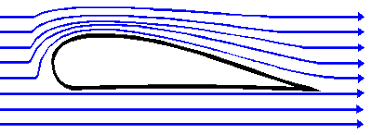
Which of you has not seen diagrams or photographs like this:
or this one:
In both, we are presented with a view of the side elevation of a wing. These images are implanted in our minds, and affect the way we think about situations. Now, if you are using a mouse, pick it up. If not use a pen or ruler to represent a wing. Put the thing down on the desk and look at the top side. Imagine that is a plan view of a wing. As it sits on the desk it represents a wing that is moving through the air, parallel to the Earth's surface.
We know that before the aircraft moves, it is being acted upon by a vertically downwards force caused by the acceleration due to gravity. Call it the "weight force" To get the aircraft into the air, we have to cause the wing to generate a vertically upwards force that, for level flight, has to equal the vertically downwards weight force. For the wing to generate Lift, air has to pass over and under the wing. For best Lift, that flow has to be from leading edge to trailing edge. A flat plate will generate Lift, but we have learned to get more Lift by better design.
So, let's go back to the 8-Point Hesitation Roll. Prior to beginning the roll, the aircraft is flying with its wings parallel to the Earth's surface. The direction of the air (which we call the relative airflow if our frame of reference is the leading edge of the wing from tip to tip), is from directly in front. As a result of all the aerodynamic mumbo-jumbo, the amount of Lift produced by the wing is equal to the weight force acting on it. The forces are balanced, so the wing and attached aircraft neither rises nor falls.
Pick up you mouse, ruler, pen and hold it horizontally in front of you to represent the plan view of a wing. Now, lower one end of the "wing" 45 degrees. The relative airflow is still coming from the front. Therefore, at that instant, the Lift generated by the wing in relation to the relative airflow is exactly the same as when the wing was horizontal to the Earth's surface.
That is at T0 . At T0 + 1 things go to pieces. We know that because the Lift Force is a vector that is the result of adding (in a two-dimensional representation) the vertical component and the horizontal component. If the Lift vector is offset from the weight vector by 45 degrees, then the vertical component will be less than the weight force, and things have to be done if the pilot wants to keep the aircraft on the same heading and the same altitude. That's where this comes in.
14 hours ago, Thruster88 said:Are we just looking for the trigonometry answer of 0.7071067812 times straight and level
The vertical component of Lift is ~ 70% of the straight and level component of lift. Therefore, as everyone knows, the amount of lift required to maintain a 45 degree bank is
(1/0.7) x weight
= 1.42 x weight.
There is a number of actions a pilot can take to increase the Lift force, but that are things most of us know and mentioning here does not add to this particular discussion.
To get to the psychology of learning, we are so used to thinking of the generation of Lift, and things like Angle of Attack based on these side elevation images that have been planted in our minds from textbooks and whatever. We fail to have in our minds that the air is all around our wings, but our wings don't know up from down. All a wing wants is for the relative movement of air to be from leading edge to trailing edge. We have to be careful about what images we put into our minds as illustrations of concepts.
-
 1
1
-
-
10 hours ago, Jase T said:
Is your intent to pose questions to spark discussion?
Yes. But first I want to get people to really think, and to question what they believe. I'm sorry that I had to keep modifying the question by adding refinements. I did that to stop people wandering away. All I wanted people to do was to answer the question with one of the four choices. You know - the same way BAK exams are set. I even have given a clue that this is a "trick question", so beware. I wanted people to give their answer, and then I was going to get to the point.
It will please some that I don't need to get into algebra or quantum physics to explain my point, which is about the psychology of learning. Here's another clue. Think about how you learned about Lift.
I've got to go out today, but I promise that I will give the answer and explanation of why I posed it tonight.
10 hours ago, Jase T said:Or is it just to prove you know more than everyone else and will word questions in 3 different ways to confuse and when people try to answer you will be condensing and arrogant?
Jase T, that smarts. I don't set out to show anyone up. I just try to expose general misunderstandings. Sometimes it's like trying to convert a rabbi to Islam.
10 hours ago, Jase T said:So when will you pose a question and accept someone's answer that is different to what you wanted?
Sometimes I ask rhetorical questions. Sometimes I ask questions to test people's beliefs and understanding. If I post in Student Learning, I'm obviously testing the latter. Would you accept an answer of "13" for the sum of 9 + 5?
See you all tonight!
-
2 minutes ago, Jase T said:
At the instant its stopped at 45 degrees of roll there are a lot of other forces acting not he aircraft including the aerofoil
When will people read what is written?
25 minutes ago, old man emu said:how much Lift does the wing produce
I have already agreed that other factors will come into play, but they all tend to relate to keeping the plane flying.
How about we add a further factor to the question? Consider this question in terms of a wing in a wind tunnel.
Does that eliminate all the extraneous factors so you can concentrate on the guts of the question?
-
Re-tyred before it was put to use.
-
Damn and blast! Whenever I try to frame a question simply, five minutes after I've posted it, I see a complication that I should have ruled out. I should have further restricted the parameters by saying
, how much Lift does the wing produce the instant that the aircraft is first paused at the 45 degree stage of the roll?
I hope that those additions will really fine tune the question.
8 hours ago, facthunter said:At the 90 degree points the wing's cannot provide lift.
3 hours ago, Thruster88 said:In the real world the lift produced will depend on the angle of attack and airspeed
Think about those statements in terms of the restated question. Just consider the very instant in time, the nanosecond, when the aircraft reaches 45 degrees. Forget about what the pilot does next.
-
1 hour ago, Jaba-who said:
This single ( probably genetic) change has probably been lifelong and as such is irrelevant
Just like mine. I bet it's genetic. Is his ancestry strongly Irish, Cornish or Welsh?
My uncle dropped dead at the cardiac specialist's desk immediately after a stress test.
-
4 hours ago, facthunter said:
More than one word there.
Nothing wrong with what you said, but you've crossed a bridge too far.
Here's the question again:
5 hours ago, old man emu said:If the aircraft's wing produces sufficient Lift in level flight equal to the kilogram-weight of the aircraft, how much Lift does the wing produce when the aircraft is paused at the 45 degree stage of the roll?
I'll make it multiple guess:
A. More
B. Less
C. Same
D. I don't know.
-
Before going on, view this video, there's a question to be answered
An 8-point roll involves rolling the aircraft around its longitudinal axis in a series of 45 degree stages with a pause between stages, and all the time maintaining the same altitude.
QUESTION: If the aircraft's wing produces sufficient Lift in level flight equal to the kilogram-weight of the aircraft, how much Lift does the wing produce when the aircraft is paused at the 45 degree stage of the roll?
Give your answer with one word.
-
15 hours ago, Marty_d said:
Actually I think the entire post was correct.
Definitely. But you know what happens to these threads if you present a fork in the road.
Also it is only a relatively new bit of knowledge, since we started putting satellites into orbit that we found that the strength of the Earth's gravitational force varies from place to place. Makes it easier to talk about weight if you use the Moon and planets as references.
aro, did you bother to look at this link?
On 27/03/2021 at 9:33 AM, old man emu said: -
39 minutes ago, Ironpot said:
CASA make decisions based on Liability - they do not intend to incur any Liability directly or on behalf of the Australian Government on any issue.
It would be very interesting to get the views of a legal eagle on just what degree of liability can be thrown onto a decision by a government body. Or it this attitude of "everyone must protect me", that seems to stem from the American legal system, giving rise to trivial litigation? Anyone with a pinch of common sense knows that using any means of personal translocation from walking to flying exposes us to risk. If a person decides to engage in that activity, surely they must accept the risk. Or is the liability of injury to someone through the actions of another so great that people must be prevented from acting?
Insurance companies have long employed people called actuaries who work out the risk to the companies of having to pay out money in the event of a a risk eventuating. It's simply the companies working out the gambling odds of losing a bet. From those odds, they workout how much money each insured party should put into the pot to cover the payout to a victim, plus enough to make profits. No different than a bookie.
CASA produces reports on accident rates. here is one: https://www.atsb.gov.au/media/32897/b20060002.pdf It seems from this report that the risks of injury or death whilst flying in Australia are incredibly lower than in most other countries where records are kept.
-
3 minutes ago, Kyle Communications said:
I will use the back stuff on all the mating surfaces.
What is the black stuff? How much work is involved in using it?



 have caused you confusion because the don't show the airflow from the plan view of the wing.

Lift and stuff.
in Student Pilot & Further Learning
Posted
Yes we could. Since Lift is a vector, it has direction. The name we have given to the force is "Lift", so that is the term we should use. It gains its "direction" from the angle between the direction it acts and the vertical extension of the direction of action of the weight force of the aircraft. We say that the value of the Lift force vector upwards is positive.
Yep. That's because, relative to the horizontal axis, the Lift force would be acting at either zero or 180 degrees relative to the horizontal axis and the magnitude of the Lift force in the horizontal axis is Lift x sin 0, or of Lift x Sin 180, which are both zero.