


old man emu
-
Posts
5,297 -
Joined
-
Last visited
-
Days Won
78
Content Type
Profiles
Forums
Gallery
Downloads
Blogs
Events
Store
Aircraft
Resources
Tutorials
Articles
Classifieds
Movies
Books
Community Map
Quizzes
Videos Directory
Posts posted by old man emu
-
-
9 hours ago, Kyle Communications said:
You could always stick this prop on
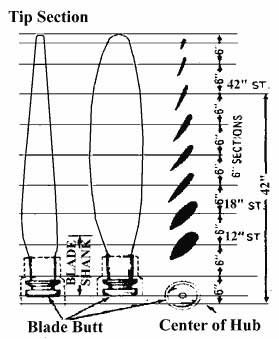
Clearly that prop is a compromise between torque application and blade span so that the prop has good ground clearance. Since the span is reduced, the chord length must increase to provide the same wing area as a "regular" prop.
-
I didn't want to "Off topic" Skippydiesel's thread on propeller shape, but while researching material to put in that thread I was called back to the idea of a single blade propeller.
We don't give much thought to the fact that propellers fitted to low horsepower engine have at least two blades. It's normal. It's been the way things have been done since Wilbur and Orville got their pilot's licences. But does a propeller for low horsepower engines really need two blades?
This thought occupied the mind of Baltimore-based inventor Walter Everts in the 1930's. While most engineers of the time were debating the performance advantages of three-blade props over two-blade props, or four-blade over three-blade, Everts must have been a contrarian, arguing that a one-blade propeller was the most efficient. He calculated that the single-blade propeller not only had less drag than its two-blade cousin. Everts took his eccentric innovation one step further, creating not just a counterweighted single-blade propeller, but one with a blade that freely pivots on an ingenious hub, allowing it to automatically change pitch in flight. As the center of pressure on the blade changes, the propeller’s pitch changes with it. At full power on takeoff, the blade pivots to fine pitch. At reduced power in cruise, it pivots to coarse pitch.

Here's a short video showing the operation of the prop and a comparison of takeoff performance in the 1930s.
The Everel propeller got a lot of publicity, but that publicity did not translate into a lot of sales. Only a hundred or so were sold. One of the issues with the propeller was that it was heavier than a two-blade propeller—a major drawback for an airplane with a 40-horsepower engine. A bigger problem was its cost. Where a two-blade Sensenich at the time cost around $27, the Everel cost around $270—a hefty price given that the cost of a Cub in 1938 was only around $1,000.
Modern testing seems to contradict the 1930's hype. Was the other pilot in the 1930s video pulling his punches?
The patent for the hub was licensed to the Koppers Corporation of Baltimore, which made the two-blade Aeromatic propeller with automatic pitch control. The Aeromatic design later was built by Univair, and it is manufactured by Tarver Propellers today for homebuilt aircraft only. By the mid-1940s, the Everel name was pretty much forgotten, and today the one-blade propeller has been relegated to a topic shared among RC modelers.
-
 1
1
-
-
7 hours ago, NT5224 said:
I've stupidly forgotten my flight bag with licence, POH, maintenance release, logbook etc...
-
59 minutes ago, skippydiesel said:
Just you & me OME
I think I scared people off with the algebra again! But let's press on, ever hopeful of igniting a discussion.
First of all, you have to recognise that the propeller is a complex wing, so the design of the blade is an application of the same Lift formula that is used in wing design.
What we have to consider is the velocity of the blade at various positions along the blade.
This equation tells us that the velocity of a point circling a central hub is dependant on the distance from the hub. Therefore, at each point along the blade the value of TAS in the lift formula is different from all the other points along the blade.
We would like the velocity (TAS) of each point, when applied to the Lift formula, to be the same, so, leaving air density as a constant for calculation purposes, and assigning it the numerical value of "1", the things that can be played with are Coefficient of Lift and the surface area of the blade at each point.
In simplest terms the area of a wing is given by (Span x Chord). That's for a rectangular wing as on a PA-28. For a trapezoidal wing, we need to know the semi-span (s), which is the distance from the root to the wing tip, and the chord length at the root (cr) and at the tip (ct). Then from the equation for a trapezoid, the area is one half the sum of the tip and root chords times the semi-span, A = .5 * [ ct + cr ] * s.
The hard part is working out the Coefficient of Lift of the aerofoil at each station along the length of the blade.
http://www.thaitechnics.com/propeller/tg8/prop_element.jpg
-
Not that my post answered the original question of what benefits (other than aesthetic) does blade shape confer on the performance of a propeller????
-
What is the link to the site that contained the picture?
If you want to get into the nitty-gritty, sit yourself down with a refreshing drink of your own choosing and read the attached pdf.
Here's another reference : https://www.sciencedirect.com/topics/engineering/propeller-blade
This diagram is from an article in the above reference. Can you C the error in the vector digrams?
-
Even after the use of jet-powered military aircraft took over from piston-engined ones into the 1960s, there were some real dogs, and Best in Breed was the Lockheed F-104 Starfighter. If the Luftwaffe had been given these before the end of WWII, Lockheed designer C. L. "Kelly" Johnson would have been called an Ace, and his "Skunk Works" would have got a unit citation. Between 15 and 20 German 104s crashed every year between 1968 and 1972 and continued at a rate of about 10 F-104s per year until it was replaced. The final tally was the loss of 292 of the 916 Starfighters and the death of 115 pilots.
It quickly became obvious in the late 1950s that it was not really what the U.S. Air Force wanted, and it was quietly shunted to the sidelines. But at the same time, several NATO nations needed a new fighter to replace their old first-generation jets, and they chose the F-104 under what was called the "Deal of the Century." Most -- more than 900 -- went to Luftwaffe and Navy air force. Lockheed had bribed officials in Germany and other countries in the process of selling the F-104, though the German Starfighter purchase documents had been destroyed in 1962 by the Ministry of Defence.
https://www.spangdahlem.af.mil/News/Commentaries/Display/Article/730527/f-104-germanys-widow-maker/
-
 2
2
-
-
The problem with scaring kangaroos is that they really don't have anything preying on them. There have been no large predators, apart from humans, for eons, so you can't use animal noises to scare them.
I wonder if they get the message to look up when they hear strange noises from above? Also, the roos that you have on and around your airstrips are the roos local to that area. That's your mob's territory, so they will soon get used to the noise you make and ignore it.
-
1
-
 2
2
-
-
Back in the Good Ol' Days, you had to go into Primary Airports as part of your Nav.
I suppose that traffic is so constant now that most of the slots are booked, so the irregular flights don't have a chance.
-
3 hours ago, IBob said:
the Savannah is put together with pop or blind rivets, not solid rivets
Fair enough!
Hope he's got a pneumatic riveter and a good sized compressor.
-
1
-
-
1 hour ago, IBob said:
The angle required to match the rivets is 120deg.
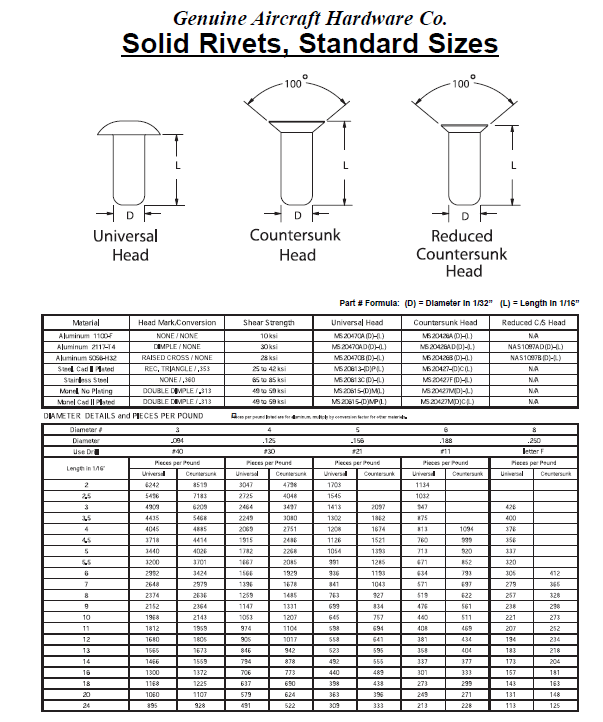
According to my parts Bible, the angle between the head of the rivet and the shaft for an MS20426A(D)-(L) rivet is 100 degrees.
Here is some information of riveting. Sorry that it is upside down, but it's copied from an American publication. It can be read correctly in the USA.
-
 1
1
-
-
39 minutes ago, Russ said:
Nope, nar, hell no
Please explaaaain.
-
So when we hear of a gyro crash, it is very likely to have been as a result of a power pushover during mustering operations?
-
Russ,
Can you answer these two queains?
What is the cause of loss of control whilst airborne?
What's a power pushover?
-
1 hour ago, facthunter said:
And that would change a few things.
I reckon there would be Titanic changes.
-
1
-
-
13 minutes ago, Russ said:
Blade flap
I might have to do some reading on how rotary wings work, but I can see the logic in what you are saying there.
So what is the cause of loss of control whilst airborne? What's a power pushover?
-
31 minutes ago, Russ said:
they “flap” blades etc
I think that is what I was getting at when I suggested that the lift of the rotor could be lost in a similar way to a fixed wing stall - AoA too great.
Would you enlarge on "flapping the blades", please?
-
18 minutes ago, Bruce Tuncks said:
Why so many fatalities?
Quite simply: many aircraft, inexperienced pilots, poor traffic control. Also a lot of deaths occurred when inexperienced pilots in high powered machines were practising dangerous, but necessary in war, manoeuvres.
-
1
-
-
I'll be corrected, but I believe that a lot of gyro crashes are the result of our old mate, stall/spin. People forget that a the spinning main rotors create a revolving "fixed" wing, and that the rotor will stall just like a fixed wing.
I hope a gyro pilot can expand on that.
-
1
-
-
Oh to be in England,
Now that Summertime is HERE!
-
Isn't it strange? You an do deadstick landings in a fixed-wing plane as part of training, but you can't do deadstick in rotorcraft. Although I can see why the insurance companies would shy away from covering damage from autorotation training.
-
-
26 minutes ago, Russ said:
Yet to find an instructor that will teach full auto rotations to full stop on ground in a helo.
Being serious here.
Is that because the full stop on ground is actually the result of the descent of the helicopter ending when it contacts the ground? And that contact is properly called a collision and one result of a collision is deformation of the aircraft in some way or another?
What is the rate of descent of Russ' helicopter in an autorotation? I expect that it would be less than the the rate due simply to gravity because of the Lift produced by the rotor.
If an object fell from 100 ft to the ground, ignoring wind resistance, it would reach the ground travelling at a speed of 24.5 m/sec, or 88 kph.
v^2 = u^2 + 2as
where: v = final velocity m/sec
u = initial velocity m/sec
a = acceleration due to gravity = 9.81 m/sec^2
s = distance metres (100 feet = 30.5 metres)
v^2 = 0 + 2 x 9.81 x 30.5
= 598.41
v= Sqrt(598.41)
= 24.5 m/sec
= 24.5/27.7 kph
= 88 kph
-
1
-
-
Civil Aviation Order 100.7 Instrument 2015
6.3 Unless otherwise agreed to by CASA, the load data sheet for an aircraft must be renewed before further flight whenever, as the result of a modification or as otherwise shown in the record of weight alterations, changes exceeding the following have occurred:
(a) for aeroplanes:
(i) the empty weight has changed by more than 0.5% of the MTOW or 10 kg, whichever is the greater; or
(ii) the empty weight CG has changed by more than 2% of the maximum permissible centre of gravity range or 5 mm, whichever is the greater;
BUT:
1 Application
This Order does not apply to the following:
(a) a balloon;
(b) an airship;
(c) an aircraft that:
(i) is registered by a sport aviation body; and
(ii) has been weighed in accordance with the sport aviation body’s procedures, as the procedures have been accepted or approved by CASA at the time the aircraft is weighed.
Is RAAus sport aviation body?


How do you take your Propeller? One blade or two?
in Engines and Props
Posted
Maybe we should meet at a phone box and carry on this conversation there. There would be room there for all interested parties!
The argument was that, if you label one blade "A" and the other "B", then B must pass through air disturbed by A, reducing the efficiency of B. However, that is only true when the relative airflow is not moving, that is, when the aircraft is stationary on the ground. Due to the forward motion of the aircraft, the path traced by a prop is a corkscrew-shaped in side view. That shows that after following A, B moves into undisturbed air.