


old man emu
-
Posts
5,297 -
Joined
-
Last visited
-
Days Won
78
Content Type
Profiles
Forums
Gallery
Downloads
Blogs
Events
Store
Aircraft
Resources
Tutorials
Articles
Classifieds
Movies
Books
Community Map
Quizzes
Videos Directory
Posts posted by old man emu
-
-
First.
You made me present my credentials. How about you doing the same?
Second.
You and your mate are so keen on precision. He said "If it works, you get the cash." It works. It works poorly. When it works it is not very practical, but it works.
Third.
It is not very practical. But consider this: early aircraft builders tended to be general practitioners. They made use of their experience in other fields to improve the performance of their planes. This often resulted in a bit of "outside the box" thinking whereby they took an existing idea and adapted it to do a job in the aircraft. Think of the "stick on a float" fuel gauge as one of these applications. As it became obvious that the problem wasn't being solved by these simple devices, experts from other fields took up the challenge.
One of these non-aviation experts was Elmer Ambrose Sperry Sr. (October 12, 1860 – June 16, 1930), an American inventor and entrepreneur, most famous for construction of the gyrocompass and as founder of the Sperry Gyroscope Company. He may have been brought to the periphery of aviation by his son, Lawrence Burst Sperry (21 December 1892, Chicago, Illinois, United States – December 13, 1923, English Channel) was an aviation pioneer. In 1917, Sperry solved the issue of magnetic compasses indicating the opposite position when an aircraft is turning, inventing the Gyro Turn Indicator. This turn indicator was later modified into what is known now as the Turn and Slip Indicator. With a Directional Gyro and Gyro Horizon added later, Sperry created a core of flight instruments that became standard equipment on all aircraft
Few can deny that gyroscopically operated devices are a lot better, but even they suffer from the inability to detect the direction of airflow in relation to the chord.
-
1 hour ago, Marty_d said:
Mass remains the same, weight is an effect on mass by gravity.
Marty, you should have stopped there, where you are correct.
Please don't confuse the matter by bringing in centripetal force. What you said in relation to you experiment is correct, but a lot of people here will want to wander off down a path we don't want to traverse. You could have used the values for the other planets to make your point.
Calculating g on Other Planets
The value of g on any other planet can be calculated from the mass of the planet and the radius of the planet. The equation takes the following form:
http://www.physicsclassroom.com/Class/circles/u6l3e6.gif where G = Universal Gravitational Constant = 6.674×10⁻¹¹ m3⋅kg−1 Using this equation, the following acceleration of gravity values can be calculated for the various planets.
Planet
Radius (m)
Mass (kg)
g (m/s2)
Mercury
2.43 x 10⁶
3.2 x 10²³
3.61
Venus
6.073 x 10⁶
4.88 x1024
8.83
Mars
3.38 x 10⁶
6.42 x 10²³
3.75
Jupiter
6.98 x 10⁷
1.901 x 1027
26.0
Saturn
5.82 x 10⁷
5.68 x 1026
11.2
Uranus
2.35 x 10⁷
8.68 x 1025
10.5
Neptune
2.27 x 10⁷
1.03 x 1026
13.3
Pluto
1.15 x 10⁶
1.2 x 10²²
0.61
That should bring the wanderers to heel.
-
While it is well known that cleaned aluminium will soon develop a layer of aluminium oxide, which is inert, it is wise to add an extra protective coating. I remember getting a biodegradable replacement for alodine from Aviall. The product was X-It PreKote from Fortune Chemical Company. http://pantheonchemical.com/prekote-surface-pretreatment/
It is a wise move to seal any material - wood, metal or synthetic - from the effects of the environment, especially where surfaces cannot be seen or accesses after construction.
-
17 minutes ago, IBob said:
It's an all aluminium aircraft,
OK. That would impact on the total restoration cost if you had to replace a lot of the sheeting.
Not knowing anything about the construction materials, is the frame steel or aluminium? Do the construction details advise treating the aluminium to inhibit corrosion before assembly?
I will admit there could be problems, but I don't see them as being insurmountable if labour costs are not an issue.
What is the asking price for that aircraft, and how does the price compare for the kit?
-
On 10th March , APenNameAndThatA at https://www.recreationalflying.com/topic/37167-turns-at-low-ias/page/15/ made two bets:
I’ll give you $500 if you can demonstrate that something with a mass of 0.3 kg has a weight of 3 kg. Same thing with the AOA meter. If it works, you get the cash.
Let's take the first one.
The reference I am giving you uses a mass of one kilogram in its calculation, but the same holds true for a mass of three kilograms. Also the calculation uses 9.8 m/s/s as the value of the acceleration due to gravity. It was agreed that for smplicity, that value could be rounded to 10 m/s/s
https://www.topperlearning.com/answer/what-is-one-kg-wt-how-many-newtons-makes-1-kg-wt/ez2t3ii
Now, having had someone else, whom I do not know, say exactly what I said, quod erat demonstrandum.
The second one - The simple bubble spirit level AoA indicator.
If one is prepared to accept the word of of Mr John Munn Chief Engineer (and Collection pilot) of the Shuttleworth Collection, then, in his words, "it could also be used give an indication of the AOA but that is of very little practical purpose," and "you could derive AoA but in each case it would only be for a given set of parameters". https://www.recreationalflying.com/topic/37345-regarding-angle-of-attack-indicators/?tab=comments#comment-504199
I never said that a simple bubble spirit level would be the ultimate answer to the problem of indicating the proximity of the chord line to the stall angle. I said that it could be used to give an indication. Consider a simple "stick on a float" fuel quantity indicator. They work well if the fuel tank is basically a rectangular prism, and the stick is visible to the pilot, but just about as useless as tits on a bull if the fuel tanks is in the wing of a high wing aircraft. As Facthunter reminded us, if you are going in the wrong direction you have to get back to where you started before you get anywhere.
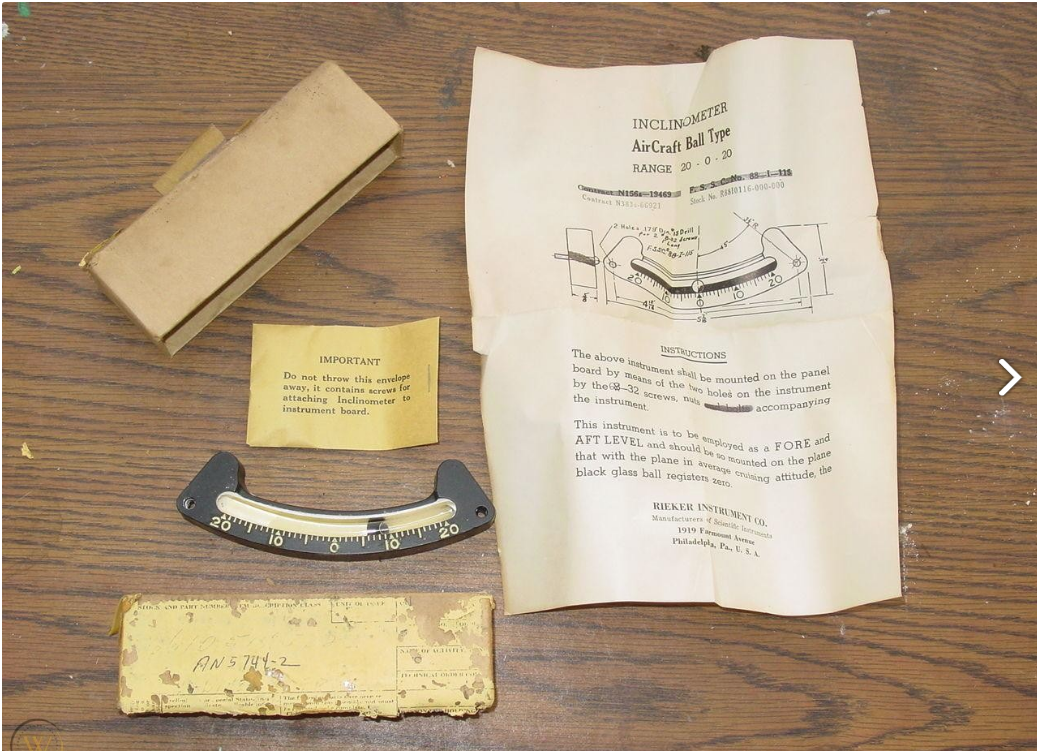
In the early years many patents were granted for devices to give the pilot an indication of the orientation of the aircraft. Some were simple liquid filled tubes and otheres more sophisticated pendulum designs like this one: https://patentimages.storage.googleapis.com/aa/f4/be/2a4f497f677243/US1308795.pdf of which the inventor says:
My present invention relates to improvements in inclinometers for use on aircraft. With such craft it is desirable at all times to know the angle or inclination of both the longitudinal and transverse axes, (my emphasis -OME) and this is especially difficult when the aircraft is in the clouds, or above the clouds, or at night. . . . . According to my invention I provide a simple, cheap and effective device for this purpose, which is not likely to get out of order, and yet which may be quickly and conveniently read by the aviator when desired.
Once again, having had someone else, whom I do not know, say exactly what I said, quod erat demonstrandum. There you have it. If it works, you get the cash. It works. It works poorly. When it works it is not very practical, but it works.
That's two bets of $500 each. I'm sure that $500 each for Reacreationalflying.com and socialaustralia.com.au would be well received.
-
17 hours ago, Kyle Communications said:
Dont touch it...I believe its been stored outside for 10 years
What if you did a complete recovering. You could do a good inspection of the airframe once the covering was off.
If the price was rock bottom, it could be a good purchase for someone who wants an "unfinished project". A real "barn find".
QUESTION: Who designed the aerofoil - Otis Elevators? It looks like a Clark-Y that needs Jenny Craig.
-
12 hours ago, Hugh said:
There is much history of this type of accident with Vixxens.
Will CASA respond in its true Bristell fashion?
-
And there is a group in the population who are wandering around Canberra without a brain that they are aware of.
-
 1
1
-
-
1 hour ago, Arron25 said:
Why haven't AvMed been pulled into the real world by the Mainstream medical fraternity?
It is a commonly held belief in the aviation industry that once CASA makes up its mind about something, all the rebutting facts produced to counter that decision mean nothing. That's why.
-
The Law belongs to those with the deep pockets. Morality has no worth.
-
 2
2
-
-
2 hours ago, Jerry_Atrick said:
What's the beef?
An open area of flat land that is ripe for residential development by developers closely associated with decision makers. Need one say more?
-
2
-
1
-
-
Talking about ECGs. I did one once to appease my doctor for another matter. The test showed that I had an anomaly - T2 inversion they called it. If it is found associated with other symptoms, it can be cause for alarm, but there is a small percentage of the whole population who have this inversion due to genetics, and it is no more life threatening that eye colour. Still, CASA would ground me for it.
What sort of cancers make you drop dead suddenly? If cancer brings you to Death's door, you are not likely to be engaging in piloting as you approach it.
I wonder what the medical qualifications the CASA people who make these irreversible decisions are. From the types of decisions they make, they must be the most highly qualified and knowledgeable person in the whole wide world. It seems that to CASA's way of thinking, since everyone dies eventually, then it is unsafe to pilot an aircraft due to the certainty of eventual death.
In the thread discussing the Bristell aircraft, the manufacturers commented on the poor response to CASA's questionnaire to owners by saying that it is a commonly held belief in the aviation industry that once CASA makes up its mind about something, all the rebutting facts produced to counter that decision mean nothing.
-
As Mr Morgan says, CASA has refused to state the safety basis for requiring such stringent medical standards.
If a pilot was to be accused of flying inverted at 300 feet above a football crowd, then the onus is on the Crown to prove all elements of the alleged offence. With these medicals, CASA is acting as judge and jury without providing even a definition of the elements of the offence of being medically unfit to pilot an aircraft.
Sun damaged skin - A vast majority of Australian pilots are ethnically Anglo-Celtic. This ethnicity expresses itself in pale skin, which is lacing in the protective chemical, melanin. Therefore, after having been exposed to stronger solar radiation in a country where their genetics are not suited to dealing with the radiation, they develop sun damaged skin. It is usually called basal cell carcinoma and that can be treated with freezing or certain topical creams. It is not a malignant condition.
Mental Health - Some people during their working lives are subject to workplace stress and develop depression. How long after leaving that type of employment does it take a person to overcome workplace related depression? It's been 15 years for me, but I have to keep putting down on medicals that I was diagnosed once with depression. It is like asking a widower if he is still beating his wife.
Sleep Apnoea - As you get older, the muscles in your throat lose their tension, so that when you sleep you snore, or stop breathing. It is a normal part of aging. The condition is readily controlled by the use of an air pressure pump (CPAP machine). Still having been diagnosed with sleep apnoea is another black mark on your health card, despite it's being controlled by the machine.
Like Kyle, I hold the highest level of heavy vehicle licence, plus a public passenger driver's authority. I do a medical every year and the GP simply says that my "depression" is treated. I also get a report from a sleep specialist. That lets me use the full privileges of my driver's licence, but I'd bet my left one that CASA would want specialists' reports every year.
As an aside:
If you do snore a lot, go get a sleep apnoea test and get a CPAP machine. Life is much improved by using one.
-
1 hour ago, pmccarthy said:
This is worth a read https://drive.google.com/file/d/0B1WyIFBvIVXGaVdfRkFGM0UtYjA/view
Yes. A good paper and to my mind clearly identifies the most difficult task - to identify the direction of airflow relative to the chord.
In my simple hypothesis I didn't take into account any other direction of the airflow than that parallel to the longitudinal axis of the aircraft, and by extension, the direction of the airflow relative to the chord. I just looked at the simplest scenario of obtaining enough Lift to maintain a desired altitude as airspeed decreased - the "straight ahead stall" situation. Having read the paper, I realise that, apart from a straight ahead climb out, or slow level flight in search conditions, there are other "normal" stages of flight - climbing turns and side-slips - where the direction of airflow is not parallel to the longitudinal axis of the aircraft. Since I was looking at non-aerobatic flight, I'll ignore high speed stalls when pulling out of dives.
As Mr Munn from Shuttleworth put it, you could derive AoA but in each case it would only be for a given set of parameters. So, my idea is not a final solution, but

-
A couple of months ago I started this thread: https://www.recreationalflying.com/topic/37152-learning-about-lift-generation-a-waste-of-time/ and in it I said " So all a pilot needs to know to maintain lift is to keep the angle of the chord line to relative airflow direction below 15 degrees." I followed that up with this: So, how does a pilot maintain that angle? In the majority of aircraft that the average private pilot would fly, there is nothing to use as a visual reference to compare the chord line with the relative wind direction. The obvious tool would be something like a bubble level set on the instrument panel when the aircraft was trestled in its cruise position, and calibrated to show position pitch angle from 0 to 20 degrees with reference to the chord angle.
This hypothesis started a flurry of comment which I tried to answer by describing how an indicator could be made by adapting the simple indicator that is usually used to show slip. That description seemed not to be understood. My original intention was to suggest a device that could be used during "normal" operations such as take off or level flight at low forward speed (eg while doing ground searches). There resulted many posts describing unusual flight attitudes that were beyond the scope of my hypothesis.
I went off in search of examples where similar devices had been used. I found that before gyroscopic attitude indicators became the norm, bubble type levels had been used.
Note the final paragraph.
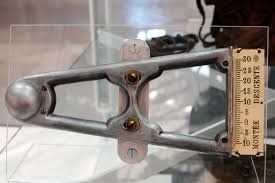
I also found that a similar device was used on the pre-WWI Bleriot XI aircraft.
And finally something similar was used in the Tiger Moth. That's the white thing with the red line.
Knowing that the Shuttleworth Collection had the oldest flying original Bleriot XI, I wrote to them for information about the use of the device, and this is the reply I got.
Hi,
This type of longitudinal clinometer (I sent a picture of the triangular one - OME) was used primarily in instrument flying as an indication of whether the aircraft was in a climb or decent attitude. We don’t have one on our Bleriot and I’m surprised to see that a pre-war aircraft would have one. This is because you don’t need one when you have a visible horizon - it’s much easier to see the position of the aircraft’s nose or the cabane struts relative to the horizon than look at a little instrument. But if they did do some cloud flying it would help and it could have been an aid to setting the right attitude. It may have been a bit of gimmick or an aid to students - I don’t know.
The triangular glass tube is continuous and half filled with a coloured liquid (normally long since dried up) therefore if the instrument is held level, the bottom half of the tube will be half filled with the coloured liquid with airspace above - there is no bubble as such (unless you consider the airspace above the fluid as being one large bubble). Normally it is mounted in the instrument panel with just the graduated quadrant showing and the point of the triangle is facing forwards. As the aircraft (relative to the earth) points nose down the fluid moves down the glass and vice versa. This one appears to be made to mount on the sidewall of the cockpit with the point facing aft.
The instrument has to be used with much caution as it only senses ‘g’ in effect or force acting on the liquid if you prefer. That force can come from gravity or any other ‘g’ force/acceleration experienced by the aircraft. For example an aircraft may be flying in a level attitude bodily speaking in relation to the earth but still descending towards it. It can’t tell AoA either- it has no way of knowing where the relative wind is coming from. An aircraft can stall at any attitude, even pointing straight down.
However, it can give an indication of decent or climb and you could derive AoA but in each case it would only be for a given set of parameters (My emphasis - OME). For practical purposes then, in steady/unaccelerated flight, at a given speed airspeed the instrument can be set at the right angle to give the pilot an indication of whether he is flying level or at a descending or climbing attitude (providing there are no significant up or downdrafts of course).
In unaccelerated, dead level flight, it could also be used give an indication of the AOA but that is of very little practical purpose.
Gyroscopic attitude indicators soon replaced these instruments for obvious reasons.
I hope this helps.
John Munn
Chief Engineer (and Collection pilot).
So, to sum up and end the discussion, my hypothesis that a bubble level, suitably fitted with reference to the angle between the longitudinal axis of the aircraft and the chord line of the wing, and with markings adjusted so that the zero point indicated the normal straight and level AoA of the wing, would work. However, and this brings the discussion to a close, as, in the words of John Munn, such an indicator is of very little practical purpose.
I think that all participants in this discussion can accept that assessment.
-
 1
1
-
-
OK. You and your mate have won. After years of trying to make positive contributions to this site and its sister site you and your mate have succeeded in your goal to stop me doing so. Therefore, I am going to withdraw from the field completely. The time I have spent preparing my posts for several parts of this forum will now be spent doing things for people who appreciate the effort.
I shall follow the advice of the Judean philosopher, Jesus of Nazareth as recorded in Matthew 7:6.
-
Piss off
-
The fictitious force F is due to an object's inertia when the reference frame does not move inertially, and thus begins to accelerate relative to the free object. The fictitious force thus does not arise from any physical interaction between two objects, but rather from the acceleration a of the non-inertial reference frame itself, which from the viewpoint of the frame now appears to be an acceleration of the object instead, requiring a "force" to make this happen.
This sounds like double-Dutch, and just as hard to visualise. See if this helps http://cseligman.com/text/physics/fictitious.htm
-
2 minutes ago, pmccarthy said:
This thread is like a Road Runner cartoon. Both sides think they understand physics, but haven't grasped cartoon physics.
There's got to be a Physics book here somewhere!
-
9 minutes ago, aro said:
Inertia isn't a calculated value. Also from that reference:
Mass is a measure of an object's inertia.
Inertia has to do with mass alone.
Inertia is a property of matter. According to Newton's Law of Inertia, an object at rest tends to stay at rest unless acted upon by a force. Likewise, an object in motion tends to remain at that velocity unless acted upon by some force.
The concept of an inertial force comes from Newton's Laws of Motion, which can be stated as:
I. Every object in a state of uniform motion—including being stationary—tends to remain in that state of motion unless an external force is applied to it (Law of Inertia).
II. The relationship between an object's mass m, its acceleration a, and the applied or external force F is: F = ma.
III. If a force is applied to an object, there is an apparent equal and opposite reaction or resistance (Action-Reaction Law).
That equal and opposite reaction is called the inertial force. It is a factious or pseudo force equal to −F = ma.
An inertial force resists a change in velocity of an object and equal to and in the opposite direction of an applied force, as well as a resistive force. What that means is that there is no such thing as a unidirectional force or a force that acts on only one object. There must always be two objects involved, acting on each other. One object acts on the other, while the second resists the action of the first.
https://www.school-for-champions.com/science/force_inertial.htm#.YEcUk2gza70
-
13 minutes ago, aro said:
By that argument my car follows a ballistic trajectory when I drive over the Westgate Bridge, if you ignore the influence of the road surface holding it up. It makes no sense to ignore the lift from the wings.
It makes no sense to try to explain things to people who have not the mental capacity to contemplate what has been said.
Mea culpa. Mea culpa, Mea maxima culpa. I ignored a multitude of factors that would alter the theoretical ballistic trajectory in real life when I started off with the simplest case.
-
9 minutes ago, aro said:
You asked for a reference, but did you actually read it? You are rejecting the definitions from physics and substituting your own.
I'm not substituting my own definitions. I was simply expanding on what you quoted. I have had a look at that reference.
From that reference -
Question (d) All objects have inertia.
Answer . (d) True - Bet money on this one. Any object with mass has inertia. (Any object without mass is not an object, but something else like a wave.)
Let's skip that bit in the brackets. We won't go into quantum physics.
We have to accept that zero, nothing, nada are acceptable answers in physics. If no Force acts on an object, then F = ma becomes 0 = ma. That's not illogical. It simply means that if no force is applied to a mass, then it will not accelerate (change velocity). The calculated inertia of the object is zero. That doesn't mean that the object cannot obey Newton's Third Law. It just means that there is no external force present for the mass to resist the application of the Force.
-
11 minutes ago, jackc said:
Maybe it’s time to start another forum dedicated to the complexities and debate on these subjects?
What a fine idea, and one that if put into practice would please many here for whom this has become boring. What if I start a thread in the Science section of the sister site?
-
Inertia
Meaning: lack of activity or interest, or unwillingness to make an effort to do anything
Etymology: 1713, "that property of matter by virtue of which it retains its state of rest or of uniform rectilinear motion so long as no foreign cause changes that state" [Century Dictionary], introduced as a term in physics 17c. by German astronomer and physician Johann Kepler (1571-1630) as a special sense of Latin inertia "unskillfulness, ignorance; inactivity, idleness," from iners (genitive inertis) "unskilled; inactive". Also sometimes vis inertia "force of inertia." Used in 1687 by Newton, writing in Modern Latin. The classical Latin sense of "apathy, passiveness, inactivity" is attested in English from 1822.
4 hours ago, aro said:Mass is a measure of an object's inertia.
Mass is a factor in determining an object's inertia, which is the result of a force accelerating the mass. One must measure the magnitude of the applied force as well as the acceleration that force causes in order to determine the mass of the object, since F=ma, by rearrangement
F/a = m.
4 hours ago, aro said:Any object with mass has inertia.
Any object with mass can exhibit inertia - resistance to acceleration - as a result of the Force applied. It has no inertia until the Force is applied.
4 hours ago, aro said:Mass is a measure of an object's inertia. Objects with greater mass have a greater inertia; objects with less mass have less inertia.
The second sentence is true. Relative to the magnitude of the acceleration achieved. The Force required to accelerate a brick from 0 m/s to 5 m/s is a lot more that the Force required to accelerate a pebble from zero to 5 m/s.
4 hours ago, aro said:The speed of an object has no impact upon the amount of inertia that it has. Inertia has to do with mass alone.
That's true if an object is moving at a constant velocity where there is no acceleration (v2 - v1)/t. If the velocity changes, there is acceleration, and the only way to change the acceleration is to apply an external force.
4 hours ago, aro said:- inertia (or mass) has nothing to do with gravity or lack of gravity. In a location where g is close to 0 m/s/s, an object loses its weight. Yet it still maintains the same amount of inertia as usual.
Best recognise the correct term, acceleration due to gravitational attraction or "Force of gravity", but we'll shorten it to "gravity". The Force of gravity is an external force that accelerates an object. It is true that with our concept of "weight" if the acceleration due to gravity is zero the value we call "weight" is also zero, despite the presence of mass. If there is no external force applied to the mass, the mass cannot exert an equal and opposite force (Newton's Third Law). The object has potential to have inertia, but at that time has none.
Compare it to a cup. If the cup is empty, it has the potential to accept liquid. Fill it with water and the cup's potential to hold water is satisfied.
4 hours ago, aro said:inertia is unaffected by alterations in the gravitational environment. An alteration in the g value effects the weight of an object but not the mass or inertia of the object.
Yes. if the value of the acceleration due to gravitational attraction changes, the value we call "weight" will change. The mass of the object will not change. However, the magnitude of the force required to accelerate the mass by the same amount will differ between the locations where the gravitational attraction differs. We know this from observations of astronauts on the Moon.
4 hours ago, aro said:The flight path is so different from a ballistic trajectory that it is unreasonable to describe it as ballistic, no matter what riders you apply. It's the difference between an aircraft and a cannonball.
When you started to learn Maths in Primary School, did you start at 1 + 1 + 2, or did you go immediately to the square roots of negative numbers? Because that's what you've done by not considering the riders. You've gone from the simple to the complex without accepting that the simple is a starting point.
I started with the simplest case where no other factors affecting the motion of the aircraft. Then I said that the simplest case would not be exhibited by an airplane because of a multitude of factors, one of which you identified as being the lift produced by the wings. One thing the cannon ball and the aircraft have in common is the retarding force of of the collisions with particles of air. Another thing is that both objects would cause the formation of vortices, which we know are retarding forces.


 There's got to be a Physics book here somewhere!
Will someone settle up on a bet?
in AUS/NZ General Discussion
Posted
So, instead of simply identifying a simple arithmetic error you launch into statements like this "Someone might have been looking for a higher level of proof than OME declaring himself correct." Rather discourteous.