


old man emu
-
Posts
5,297 -
Joined
-
Last visited
-
Days Won
78
Content Type
Profiles
Forums
Gallery
Downloads
Blogs
Events
Store
Aircraft
Resources
Tutorials
Articles
Classifieds
Movies
Books
Community Map
Quizzes
Videos Directory
Posts posted by old man emu
-
-
Unfortunately, as with all biologically established limits, the levels KG has shown are averages. Each person could respond differently. Keeping 50 ppm as an allowable maximum, each person should monitor their own responses to CO to see at what level they start to notice deterioration in their well being.
Absorbed carbon monoxide is eliminated from the body by exhalation and oxidative metabolism. Oxidative metabolism of carbon monoxide has been estimated to be a relatively small fraction (<10%) of endogenous carbon monoxide elimination. Under most conditions, the dominant route of elimination of absorbed carbon monoxide is exhalation. The decline in blood %COHb following cessation of an inhalation exposure to carbon monoxide exhibits at least two kinetic phases. The fast phase is thought to reflect a combination of exhalation of carbon monoxide along with slower distribution of blood carbon monoxide to tissues that continues after cessation of exposure. The elimination half-time for the slow phase is approximately 100–300 minutes. That means that a person will still have half the inhaled CO in their system from 2 to six hours after exposure ends.
Apart from the CO combining with haemoglobin to reduce the amount of oxygen that cold be carried in the blood, CO is not a cumulative poison like lead or mercury. It is eliminated if the blood is not overloaded. However, if a person is exposed constantly to CO at higher levels, the body will acclimatise to those levels. In the operation of an aircraft, the exposure to CO is not constant and long-term enough to allow acclimatization.
Here's an interesting article on unnoticed CO poisoning. The title sounds all scientific, but the article is written is a style suitable for a magazine article.
-
 2
2
-
-
11 hours ago, waraton said:
You could try these guys. https://www.aaestore.com.au Haven't used them myself but have lots of goodies and seem pretty fair with pricing.
No good trying them. They don't list a dash 27H.
-
There are two parts to operating any vehicle, car, plane, boat, bicycle etc. The first part is learning how to operate the vehicle. Basically, this means being able to begin moving, changing direction and stopping before reaching a certain point. There's a helluva lot to learn in this part, and it's best done somewhere isolated, eg in a paddock for car and motorcycle operation.
The second part is how to operate a vehicle when travelling amongst other vehicle users. This is where one needs to learn to anticipate the expected situations - like traffic light changes or travelling far enough away from the vehicle in front, and also to be able to "read" the actions of other drivers.
Don't you agree that given the right conditions for learning a student pilot should be able to solo in at least 15 hours? But at that stage the student has only learned to operate the vehicle. There's a lot more learning to do before the same student can say he can "fly a plane" in its broadest sense.
-
2
-
 1
1
-
-
The CO patches are working all the time, so have to be checked during pre-flight, and replaced regularly as routing maintenance. If you've got an battery-powered device, you only have to include turning it on and off in your pre- and post-flight checklist.
10 hours ago, skippydiesel said:Placed it near the floor of my foot well (CO being heavier than air) in a relatively draft free location
Good point. You can do that with a device that sound an alarm. Look where the patches are put - on the instrument panel, above the level of greatest CO concentration.
-
-
2 hours ago, facthunter said:
Spacey has to be aiming for stand up Comedy as his new day job
Too bad that his hips can't stand it.
-
 1
1
-
-
OK. No more "deep theory". No more providing explanations. No more Old Man Emu.
-
These performance figures always beg the question - can they be achieved by the pilot who does not fly on an almost daily basis, or are they produced by a pilot who gets a couple of hours over the course of a week's employment?
What fudge factor would you think reasonable to add to the published figures to account for real world operations?
-
-
51 minutes ago, RossK said:
This thread has too much of this^^
and not enough of this
Isn't Bruce allowed to be provided with new information?
20 hours ago, Bruce Tuncks said:I have to say that I have never heard of centrifugal and centripetal forces as "imaginary ".
In our day-to-day lives, where the knowledge of the intricacies of the Laws of Nature are not essential to our activities we use borrowed words to name, or explain things. I've used a machine called a centrifuge to separate solids from a mixture of solids and liquids. I use a centrifuge to get the majority of water out of my clothes before I hand them out to dry completely. As Humpty Dumpty said

or Shakespeare,
However, when we enter the specific context of an area of study, we must give the words the meanings that they are meant to have in that context. If someone does not know the meaning that a word has in that context, then they are entitled to have it explained to them
-
2 hours ago, Bruce Tuncks said:
I have never heard of centrifugal and centripetal forces as "imaginary ".
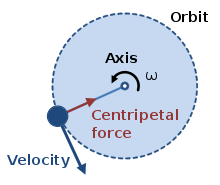
Centripetal force is a real force. Think of this. Put a weight on a length of string and toss it away from you (to set a starting position). All set? Now pull the weight towards you . The force you are applying is pulling the weight towards you. That's called the centripetal force - from modern Latin centripetus, from Latin centrum (see center) + -petus ‘seeking’ (from petere ‘seek’).
Next test. Put the weight away from you as before. Get a helper to pick it up and start walking in a straight line that is not towards you. The string will tighten and the helper will feel a continuous pull towards you. That's the centripetal force that you are exerting on the weight and the helper. The helper will not feel any force pushing the helper in the opposite direction along the outwards extension of the line of the string. If the helper feels the centripetal force, but no force sending the helper in the directly opposite direction, then there is no force.
Final test. Get out in an open area. Now start swinging the weight around your head, parallel to the ground. Look along the arm that is holding the string and pick a reference point that is at a right angle to the direction you are facing. When the weight approaches the line between you and the reference point, let go of the string. The weight will not fly off towards the reference point because there is no force acting on it to make it go that way. We think that because of Newton's Thirds Law - equal and opposite forces - there should be. So to satisfy ourselves we make up a force and call it Centrifugal Force - from modern Latin centrifugus, from Latin centrum (see center) + -fugus ‘fleeing’ (from fugere ‘flee’). These two words come into the English language in the early 1700s, after Newton had published his three laws.
When the weight is whirling around your head, it wants to keep moving in a straight line (Newton's First), but you are exerting a force on it to pull it towards you (centripetal force) This force is acting on the weight at every instant it is moving around over you head in a circle. Every instant its inertia wants it to go in a straight li line that is a tangent to the circle, but it can't because you are exerting on it. If you let go of the string, the centripetal force is gone and the weight continues along the straight line that is tangential to the point where the weight was when the centripetal force was removed.
-
2
-
-
Jack,
The market in Australia is too small for manufacturing low demand stuff such as your tailwheel assembly. Anyone who sells them in Australia is an importer. Your option is to investigate the cheapest freight costs from the USA and buy from a US supplier.
Another option is to buy used from an aircraft dismantler, or fellow owner. Try this mob http://aviationsalvage.com.au/contact.html
-
1
-
1
-
-
I rest my case, M'Lord.
-
3 hours ago, skippydiesel said:
The Oaks airfield, has had, on occasion, goats, cattle and the odd miracle of modern medicine, the brain dead pedestrian.
Making its way home to Nattai?
On the topic of sonic animal repellers, it seems that the scientists can't prove that they work, but people in rural areas reckon they do.
https://caravan.hemax.com/Reviews/1854/Sonic_animal_guards_Product_Test
These things usually cost around $10
At the landing speeds of small (as in Rec Flying types) the devices would be in the operating speed range for cars that they were designed for. The units come with double-sided tape to stick to the body of a vehicle, but I'd look at securing them with something better.
And don't forget to get an Engineering Order to make the fitting all legal-like.

-
1
-
-
3 hours ago, aro said:
You specifically said making a turn
No I didn't. I said,
So if an aircraft of mass m, is flying along, straight and level, at velocity, v, then it has momentum of mv. If anything happens to change v, then the momentum of the aircraft changes. Making a turn is, in physics, a change in the vector value of velocity, so we say that the aircraft's momentum has changed.
Please don't quote me out of context.
Also,
3 hours ago, aro said:A change in the mass due to fuel burn is one of the changes it is simpler to ignore.
Agreed. That's why you've probably never considered it in this discussion of momentum. Actually, the realisation that fuel burn would affect aircraft mass in an ever changing way simply popped into my head as I was writing.
3 hours ago, aro said:But the force resulting in THAT momentum change is drag.
Whoa there, cowboy! If fuel is being consumed in order for the engine to produce a constant amount of thrust, the fuel of itself is not creating any force. It is simply being introduced to an engine where one unit of fuel is combusting in approximately 14 units of air, resulting in the conversion of a mixture of long chain carbon molecules and oxygen into a mixture of very short chain oxides of carbon, nitrogen and some trace elements.
It's the same as if there was a leak in the fuel lines, or the fuel caps came off wing tanks. The mass of the fuel is removed from the overall mass of the aircraft, but no force is created by that action.
-
1
-
-
4 minutes ago, aro said:
The source of the force that makes the change is the wing.
We bank the aircraft, which means that there is a sideways component to the lift force. This sideways force turns the aircraft.
Well, yes. But as I intimated, I was talking then about momentum in general terms and trying to list factors that could alter the momentum of an aircraft. Actually, in straight and level flight in nil wind the momentum of the aircraft is continually changing. "How?, you ask.
Because you are burning off mass at the rough rate of ( 0.75 x fuel burn rate)/3600 kg per second.
Bloody Reality. Nothing ever stays the same!
-
1 hour ago, Bruce Tuncks said:
We should however always state the frame of reference we are using.
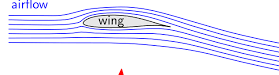
That is indeed the source of confusion in this debate. What you have to do is think of the aircraft occupying a bubble of air and that bubble is floating in the general airstream. It is so hard to create an analogy for this frame of reference especially when people are so used to seeing this diagram
CONCERNING MOMENTUM
According the Newton's First - an aircraft flying straight and level will continue to do so until an external force is applied to it. Because of its mass and velocity, the aircraft has an amount of momentum, determined by (m x v). If you measure the momentum at an initial time, T1, and again later at T2 and compare them, then you will find that since they are the same, the change in momentum is zero.
If you apply an external force to the aircraft you will alter its momentum. You could apply the force "instantaneously", say by flying through an air pocket which would alter the velocity of the aircraft - not going into the complex details of that now. Otherwise you could apply a force over a longer time to change the direction of the aircraft by making a turn. The application of a force over a period of time is called "Impulse", represented in physics shorthand by the letter J
J = F x (T2 - T1)
When you turn an aircraft, the movement of control surfaces produce forces which eventually result in one force called Centripetal Force. This is the force that you generate in your arm when you swing a weight on a string around your head. While you are swinging the weight on a constant length of string, you are pulling it towards you. Centripetal force depends on mass, velocity and radius of turn.
F = m(v^2) r
If we substitute centripetal force into the impulse equation we get
J = m(v^2) r x (T2 - T1)
If the mass and velocity of the aircraft do not change during the turn, then it is acceptable practice to recognise their involvement, but to give them each the numerical value of one (1). This makes the impulse equation
J = 1 x 1 x r x (T2 - T1)
which tells you that the Impulse is inversely proportional to the radius of the turn and/or the time taken to complete the turn. You can feel the impulse in your body. A wide, slow turn doesn't push you into your seat as much as a sharp, quick turn.
Just to clear up what seems to be a logical result of Newton's Third - equal and opposite forces, but is in fact a myth. We have Centripetal Force, which is a force tending to move a mass to the centre of its circle of rotation. We expect there to be an equal and opposite force, and have given it the name, Centrifugal (centre fleeing) Force. No such force exists. What our logical thought has invented in order to seemingly comply with Newton's Third, is called an Imaginary Force.
-
1
-
-
There is a general law of physics according to which the quantity called momentum that characterizes motion never changes in an isolated collection of objects; that is, the total momentum of a system remains constant.
Basically this says that if two objects, J & K will collide in the future, the sum of the individual momentum of J + the individual momentum of K has a value. After the collision the individual momenta can change, but the sum of the changed momenta will be the same as the total pre-collision momentum of the system. In analysing the collision, one accepted assumption is that all forces act through the centre of mass, as if all the mass of the object was condensed into a point.
If the two blocks of equal mass m, were both travelling at equal velocity v, then each would have the same momentum, mv. However if we assign positive velocity to velocity in the left to right direction, then if the other block is travelling right to left, its velocity is -v.
If the blocks collide the final momentum will be mv - mv = 0. The blocks will stop at the point of impact. Note also that the pre-impact total momentum was also mv - mv = 0. This is as unique case in the real world. Collisions usually occur with both objects approaching the point if impact from an angle. This means that to calculate the post-impact momentum of each object, you have to do a vector analysis in two dimensions (plot the movements on an X-Y coordinate system.
I'm not going to write out the equation for this vector analysis as it involves using the sine and cosine of approach and departure angles, and a lot of readers here wouldn't be able to see the forest for the trees without experience working with X-Y coordinate systems.
Now here's a confuser. Momentum involves a vector - velocity - which has both size and direction. So if an aircraft of mass m, is flying along, straight and level, at velocity, v, then it has momentum of mv. If anything happens to change v, then the momentum of the aircraft changes. Making a turn is, in physics, a change in the vector value of velocity, so we say that the aircraft's momentum has changed. It's a bit hard to spot the source of the Force that makes the change, but it could be change in engine power (chemical energy) or use of controls (mechanical energy)
Phew! I need a Bex and good lie down.
-
14 minutes ago, Garfly said:
But I'm here to learn
Trouble is that if people start using terms in the wrong way, we'll end up only learning how to confuse.
It's hard to carry on a conversation about a topic that is strongly practical in application, but has an equally strong theory background. Half the people get bored by the theory and the other half by the practical. You've just got to decide how deeply you will dive in.
-
Velocity - This is a value that is described in terms of magnitude and direction. It is a VECTOR quantity
Mass - This is a value that is described in terms of magnitude only. It is a SCALAR quantity.
Acceleration - This is a value described in terms of CHANGE in the magnitude of Velocity after an elapsed period of time. Because velocity is a Vector, acceleration is a vector.
Time - Since we usually consider time to go from the past to the future, we consider it linear and having magnitude only, therefore it is a scalar.
Distance - Has magnitude only. It is a scalar.
Momentum - is the product of a scalar and a vector, mass and velocity, therefore, momentum is a vector.
Force - is the product of a scalar and a vector, mass and acceleration, so it is a vector.
Scalar quantities of the same item can be treated by simple arithmetic. Vector quantities, having both direction and magnitude are treated by the method of addition of vectors (Pythagoras).
-
Methinks that some people need a course in the definitions of terms used in Physics.
-
1
-
-
3 minutes ago, RFguy said:
that will be going from some headwind to zero headwind
I know that you were writing this as I was writing mine, but if you have read mine, can you repost yours, indicating the frame of reference, please?
-
43 minutes ago, Garfly said:
to accept the 'parcel of air' concept is to accept that 'wind' only refers to this parcel's movement across the land below.
This debate can only reach a sensible conclusion if we define the Frame of Reference that the air mass and the aircraft are in, since "airspeed" is the speed of an aircraft relative to the surrounding air.
If we take as our reference point an observer on the ground, then what is easy to observe is the aircraft's ground speed. If, however our observer is in the aircraft, then the observation is of airspeed, and that is relative to the observer in the aircraft.
So, in my opinion, turns from headwind, through crosswind to tailwind and their effect on airspeed have to be considered from the frame of reference of the aircraft.
Let's take the simplest case - nil wind and constant height.
The aircraft travels on a heading of 180 M at an airspeed above the stalling speed. If a turn is made to 090 M, the airspeed remains the same throughout the turn. This turn takes time, and the track made good is a curve. Likewise if, after flying on the 090 M heading for a few minutes, another turn is made to 000 M then the airspeed still remains the same.
Now, let's observe that flight from the frame of reference of an observer on the ground. Since the air mass the aircraft is in is not moving, the observer on the ground will see the aircraft fly a neat rectangular course, with curved corners.
Now, let's give the air mass a velocity, relative to the observer on the ground of, say 10 kts. In the frame of reference of the aircraft in the air, the airspeed remains the same as in the nil wind situation because the airspeed is a measure of the speed of the aircraft relative to the surrounding air mass. The aircraft can fly the same manoeuvres as in the still air condition and the airspeed will be constant.
HOWEVER, to the observer on the ground, as the aircraft flies into the wind, it will take longer than before because the aircraft is moving in the air mass in a backwards direction over the ground. It's groundspeed has been reduced. As the turn to 090 M is made, the airspeed remains the same, but the ground speed might increase as the wind is no longer coming from the side (I'm open to comment on that statement). Finally as the next turn is made and the air mass and the direction of travel align, the groundspeed will increase, but the airspeed will remain the same.
From the observer on the ground's frame of reference, the aircraft flies slowly into wind then makes a turn that results in a track at an angle towards the observer, and an increase in ground speed. Finally, the aircraft turns to travel with the wind, relative to the observer on the ground, and the aircraft's ground speed increases. The track made good is a little bit like a triangle.
At no time during either example does the airspeed change as a result of the aircraft's heading relative to the direction of movement of the air mass. Therefore, if an aircraft is flown at the recommended airspeed for its weight, angle of attack and angle of bank, it can't stall.
-
4 minutes ago, RFguy said:
moderate speed steep descending < 30 deg turn
Just enlighten me here. Are you saying that the Base and Finals turns are not Rate 1 turns, but higher Rate turns? I'm not looking for an argument. I just don't know. I do know that a Rate 1 Turn in an aircraft flying a low speed only required a bank angle of a few degrees.



HELLO EVERYBODY HELP WITH MY RADIO
in Just Landed - Welcome
Posted
And M'Lord, that's when the radio fully complied with Murphy's Law.