


old man emu
-
Posts
5,297 -
Joined
-
Last visited
-
Days Won
78
Content Type
Profiles
Forums
Gallery
Downloads
Blogs
Events
Store
Aircraft
Resources
Tutorials
Articles
Classifieds
Movies
Books
Community Map
Quizzes
Videos Directory
Posts posted by old man emu
-
-
The problem with discussing things by written communication is that written communication lacks the assistance of body language and vocal tone, and sometimes context is obscure.
How do you interpret, "He's a bastard."
-
 1
1
-
-
15 minutes ago, Jase T said:
You do realise you can reset your BFR by learning a new skill??
That's been mentioned and it is true, but I think a BFR should be an examination and review of a pilot's basic flying skills. The BFR is part of the Safety Management System which aims for the continual improvement of the level of safety in aircraft operation. It is based on a continuous cycle described by a fellow named Deming, the Plan-Do-Check-Act cycle, where the BFR is the "Check" part and if anything is below standard, then "Act" means remediation. As each cycle is completed there are measurable indicators of improvement.

-
1
-
-
2 minutes ago, kgwilson said:
I am the only person who has ever flown my aircraft from the first test flight. That is the way it will stay unless I sell it. End of story.
I think that the incident in the video would be cause for concern amongst the majority of us who have to use hired aircraft for all the reasons that stop us fulfilling the dream to own our own aircraft.
-
 1
1
-
-
It's going to be a lot cheaper to replace some chin skins than bulk strip two engines, overhaul two propeller assemblies and six blades. I watched the video and thought that the pilot did not hold the nose off long enough. He seemed to drop it about the same time that you would normally drop it on a normal landing. But then, who gets tested on landing gear failures during a BFR?

The video is here: https://www.abc.net.au/news/2021-01-27/emergency-landing-at-parafield-airport/13093958
-
1
-
-
48 minutes ago, derekliston said:
Why do they like to dramatise minor problems to that extent?
Because everyone, except pilots, knows that planes, which are always Cessnas, always plummet from the sky, and it is only through the self-sacrifice of the pilot that a major disaster was averted. And witnesses who reside in the area always are in dread of this sort of catastrophe occuring.
-
1
-
 2
2
-
-
Instructors have one thing that the average pilot doesn't -experience. In another thread, someone mentioned that the aircraft he has owned for so long the engine is coming up for its calendar TBO has something like 350 hours TTIS. Compared to an instructor, this owner has a lot less experience, and one would assume, a lot less experience flying in not the best of conditions.
It's true that the ability to communicate effectively as a teacher is what marks the difference between god and bad instructors, so there is the need to find an instructor who can identify how YOU learn and mould your training accordingly. As I said earlier, you are paying for the BFR, so you have the right to some input. As Mike said, " If that is done right done right you'll be your own most severe critic ". How many pilots discuss the exercises in a BFR with the instructor before the flight? Or do they just cop what is dished out?
9 hours ago, Mike Borgelt said:if YOU think you'll benefit from flying with an instructor, go to it
Who is going to have the knowledge and more importantly, the experience, to identify faults in your technique? If you are self-critical with your flying, then a few quick whizzes around the circuit will be enough to take care of the administrative requirements of your Certificate. But many of us are not into self-incrimination and need another pair of eyes to point out the mistakes that might creep into our performance as a pilot.
It has been explained that you can't actually "fail" a BFR and have your certificate revoked. All the instructor can do is indicate where skill levels are low and to recommend that work be done to raise those skill levels.
-
1
-
-
I'm paying for the use of the aircraft, one way or the other. I'm paying for a qualified person to observe my technique and offer positive criticism. Therefore, I'll want to brief the qualified person on what sort of flying I've been doing, and what areas I think need checking. I want those areas included in whatever else the qualified person wants to observe.
Anyone who has been following the several discussions on performance and such should have a multitude of situations to explore. Instead of an engine failure, why not a magneto failure. You need to go through the steps to identify what the problem is and to provide realistic solutions of it. I said earlier that the BFR is not simply done on the day of the review. A wise pilot would put in a bit of practice beforehand.
I agree that a bit of circuit work is a necessary part of the review, but I suggest that the majority of the period should be spent out in the training area where handling can be explored.
And what about a bit of flight planning? Is anyone ever given a W&B calculation to do, and a performance analysis? We've discussed the things that are involved in those two facets, but who has been tested on their application any time after sitting the relevant licence exam?
-
1
-
-
1 hour ago, New2flying said:
Such raw emotion in this video.
Wouldn't you be emotional if you found out some dickhead had possibly damaged your aircraft to the extent that you had to pay for a thorough airframe inspection, all the while hoping that it would pass?
-
1
-
-
59 minutes ago, Student Pilot said:
You called? 😁
Ha! Got you all stitched up.
-
Has RAAus defined in any official document or manual what the term "On Condition" means? If there is such a definition, then that's the end of the discussion. If not, the discussion continues.
My reading of that letter from Continental suggests to me that if a part is still within the limits described in its specifications, than it is OK to keep using it until
(a) it has, or is likely to, exceed specification limits before the next scheduled inspection, or
(b) a calendar time, or number of operation cycles, prescribed by the manufacturer is reached.
A good example of a part that is more likely to exceed calendar time than hours are fuel and oil hoses.
This is what CASA Airworthiness Bulletin 85-004 says This AWB provides guidelines for procedures to be followed to ensure continued airworthiness of the engines that have exceeded the calendar time overhaul limits specified by the manufacturer. These guidelines are in addition to the recommendations by the manufacturers relating to inspections for corrosion.
https://www.casa.gov.au/sites/default/files/_assets/main/airworth/awb/85/004.pdf?acsf_files_redirect
-
I put this in a thread in Student Pilot etc.
-
1
-
-
30 minutes ago, skippydiesel said:
Cant help myself
Matthew 6:19
"And lead us not into temptation ..."
-
2
-
-
More people die in air crashes because the pilot is being a show-off dickhead. We all know the scenario - buzzing a group on the ground, pulling up and into a stall/spin. But what happens is that the dickhead does what is done and comes to no personal harm. But what about the aircraft, and what about the costs to the owner or the person who flies it a few hours down the track?
This is the story of the effects of a dickhead's action on the proud owner of a plane for hire. It would certainly give an owner fears of renting their aircraft.
-
1 hour ago, APenNameAndThatA said:
if it still flies as well as a new one
Based on that comment, and the fact that the owner is considering updating it would be reasonable to conclude that the aircraft has been maintained to a high standard and operated within parameters. Therefore , unless keeping up with the Joneses has a higher priority, then an upgrade would be a better choice economically.
Continental recommends that, along with the engine’s published TBO, to determine the engine’s continued airworthiness, consider whether the engine has been operated regularly or has been in storage, as gaskets, seals and synthetic and natural rubber goods deteriorate over time. Environmental corrosion can occur internally and externally on the engine. This naturally occurring process can affect continued airworthiness of the engine and engine mounted components and accessories.
It was asked, "When does TBO start?". For one method of calculation, TBO begins when the engine is first fitted to the airframe. That gives you calendar TBO. With a TTIS of 350 hours and approaching calendar TBO, this engine has stood idle more than it has been running. The problem there is degradation of the seals, engine mounts and hoses. That in itself would indicate an overhauls is necessary.
16 hours ago, skippydiesel said:BRP Rotax GmbH Rotax & Co (Rotax) also set out how this is to me measured ;-
- Calendar time; if your engine is a fairly recent one (I forget the manufacturing year) this will be 15 years. If an older engine could be 12 or less. For people that take some time between purchase & installation, there is an allowance, I think 2 years is the max before the calendar starts.
- Engine hours/Hobbs time; Again set by Rotax , who say this is from engine start to shut down (no other measure applies eg air time or oil pressure reaching a certain level indicative of high power). This has risen progressively up to 2000 hrs for more recent engines and less for older ones.
Once again, a simple bit of wording is open to misinterpretation. According to CASA, "On-condition" maintenance means an inspection/functional check that determines an item's performance and may result in the removal of an item before it fails in service. It is not a philosophy of fit until failure or fit and forget. Maintenance tasks (inspections/checks) used to detect potential failures, and consequently to avoid a total functional failure, are called "on-condition" maintenance tasks. This is because items are left in service on the condition that they "continue" to meet a desired physical condition and performance standards.
Aircraft and component manufacturers can make "Hard Time" recommendations usually referred to as Time Between Overhaul (TBO), which specify how long they consider their product should remain in service. These recommendations are based on average utilisation and conditions and usually recommend that the item be fully stripped and returned to the original specifications.
-
-
3 hours ago, skippydiesel said:
The above is a legally condition
I've had a look at CASR and FAA legal documents and I have been unable to find anything in them that says that what the manufacturer recommends as a TBO has any legal standing in Aviation Law.
Continental Engines has produced a Service Information Letter (SIL98-9C) on the subject of TBO hours. http://www.continental.aero/uploadedFiles/Content/xImages/TBO Page SIL98-9C.pdf
In that letter is this:
The TBO periods listed are predicated on the engine having been maintained according to the Instructions for Continued Airworthiness, accepted by the FAA, specified in the engine Maintenance Manual, Overhaul Manual, and Service Bulletins and operated within the limitations published in CMI Engine Operators Manual and the aircraft manufacturer’s Aircraft Flight Manual / Pilots Operating Handbook (AFM / POH).
And also,
TBO periods were established on most CMI engines beginning in the 1960s. Since that time, CMI has made significant engineering improvements to virtually all major engine components. CMI has refined manufacturing processes and implemented computer numerical controlled (CNC) machining tools enabling CMI factory engines to meet higher standards than possible when CMI engines were originally granted FAA Type Certificates. These improvements have enabled CMI to increase TBO limits for many of our new and rebuilt engines.
So, when an engine manufacturer provide the purchaser with an estimated TBO, it it only information of a commercial nature that can be used by the purchaser to choose between manufacturers. Ultimately, TBO is determined by how the engine is used, and how it is serviced. We have a great deal of experience with a certain engine that regularly was failing to meet manufacturer's TBO for reasons not associated with manner of use or maintenance. We have also had experience of engines that you couldn't destroy with a sledgehammer.
-
1 hour ago, skippydiesel said:
you would have to be a complete nincompoop
Can you manage to do it if you are only a half-wit?
-
1
-
-
21 minutes ago, Blueadventures said:
Can you get the bolts and drill the holes yourself?
Anything is possible, but you have to ask yourself is it realistic to do it? You would probably spend more on broken bits.
Besides, if you drill through a bolt, have you damaged its heat treated characteristics?
-
20 minutes ago, BirdDog said:
ALSO here's a question.... When does the clock start on the TBO?
Basically from the first time an engine is started after being installed in an aircraft.
Now the argument starts.
The Red Camp - Time in Service is that time recorded on an engine time meter (Hobbs meter or Tacho)
The Blue Camp - Time in Service is that time recorded from wheels off to wheels on - ground operation is not counted.
The problem is which rule do you follow? The American FAR says, Time in service, with respect to maintenance time records, means the time from the moment an aircraft leaves the surface of the earth until it touches it at the next point of landing. However EASA says it's from the time you light the fire until you put it out. CASR 61.010 says the same as the Yanks. So the answer is: Time in Service is wheels off to wheels on.
The Tacho Time meter is set to record time by interpreting the number of engine RPM. It is calibrated so that, say at 75% power, 2600 impulses equals one minute. Idling or taxying around at RPM below that 2600 impulse rate causes the meter to "run slow". So you could start up and go taxying for ten minutes, and the meter will indicate less than 10 minutes (probably eight or so). When you give the engine full rev for take off - say 2750 - the meter will "run fast". Over the course of a typical long distance flight, the differences even out. Doing circuits would mess with the times as for a long time in the circuit you are not at 75% power.
A Hobbs meter works from the time you turn on the Master switch and is simply an electrically powered clock.
The wheels off to wheels on measurement can be made by using an air pressure switch which throws an electrical switch when the air pressure reaches a certain level. It can be plumbed into the airspeed indicator tubing and set so that when the dynamic pressure in that tubing reaches a value equal to the stall speed, it switches on the circuit for a Hobbs meter.
Some people get into a panic about TBO and TIS. Neither system is going to give you a precise record of the time an engine has actually been running. They give a "best estimate" As long as routine maintenance is carried out at close to the recommended times, then the engine can be relied upon. It is only the Regulation that makes it an offence against CASR to operate an aircraft over time. A properly maintained engine won't disintegrate at one second after the Manufacturer's recommended TBO.
-
No apologies for posting this as a copy from elsewhere, but it puts things in a nutshell, but I did add some stuff myself.
Climbing Flight
For an automobile to go uphill at the same speed that was being maintained on a level road, the driver must "step on the gas;" that is, power must be increased. This is because it takes more work to pull the car's weight up the hill and to maintain the same speed at which the car was moving along the level road. If the driver did not increase the power, the automobile might still climb up the incline, but it would gradually slow down to a speed slower than that at which it was moving on the level road. Similarly, an airplane can climb at the cruise power setting with a sacrifice of speed, or it can, within certain limits, climb with added power and no sacrifice in speed. Thus, there is a definite relationship between power, attitude, and airspeed.
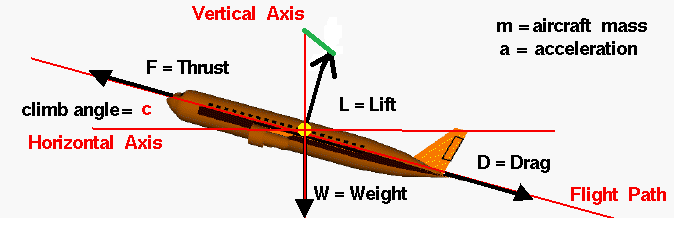
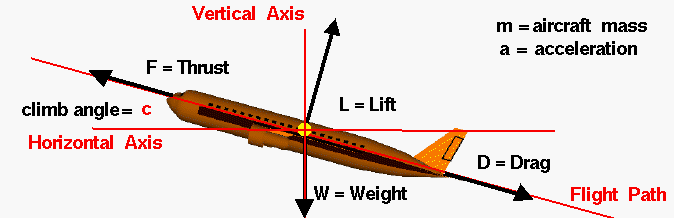
We all know that for straight and level flight, Lift must equal Weight. The sum of the vectors of Force of Lift and Weight are equal, so that the aircraft does not go up or down, and the vector of Thrust is greater than the vector of Drag in order for the aircraft to move forward. For the sake of discussion, let's say that the magnitude of the vector of Drag in level flight is 10% of the available thrust. Right or wrong in practice, 10% is OK for illustration purposes.
However, when an aircraft moves into climb (or descent) the vector of Lift moves away from the vertical, so that, in comparison with the magnitude of is vertical component in level flight, the vertical component is less. Due to the offset of the Lift vector from the vertical, there is a force created which is parallel to the Thrust/Drag vector line (Green line). This is called "Induced Drag". In essence, the magnitude of the Force opposing the Thrust Force increases.
Since drag is acting in a direction opposite to the airplane's flightpath during a climb, it is necessary for thrust to overcome both drag and gravity. The primary factor which affects an airplane's ability to climb is the amount of excess power available; that is, the power available above that which is required for straight and level flight.
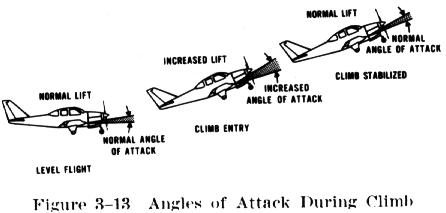
When transitioning from level flight to a climb, the forces acting on the airplane go through definite changes.
The first change, an increase in lift, occurs when back pressure is applied to the elevator control. This initial change is a result of the increase in the angle of attack which occurs when the airplane's pitch attitude is being raised. This results in a climbing attitude. When the inclined flightpath and the climb speed are established, the angle of attack and the corresponding lift again stabilize at approximately the original value with respect to the direction of flight through the air. At this stage, the wing doesn't care what its relationship is to Up and Down as defined by gravity. All the wing knows it that air is moving over it at its "straight and level" angle of attack. It's a relativity thing.

-
1 hour ago, APenNameAndThatA said:
That is counter intuitive ... I’m confused.
There is an explanation, but I'd like to mull it over before expressing my opinion.
However, consider this. As you are flying along straight and level for a long time, why do you have to adjust the pitch trim of the aircraft?
Facthunter said, "You don't increase lift to climb except a tiny bit to initiate it. Lift stays close to weight unless you have lots of power.
What actions, and in what sequence, do you carry out to initiate a climb from straight and level?
-
5 minutes ago, facthunter said:
I think I've had more close associates die in aircraft than in cars.
That might be due to your being more closely associated with aviation over the years than the average Joe Blow. One possible comparison method is fatalities per distance travelled. You also have to define the limits of your sample. If you included all aviation fatalities world-wide, you would also have to made vehicle related deaths worldwide. Since our bias is towards what happens in Australia, then you have to limit the data to that generated i Australia only.
-
2 minutes ago, Jabiru7252 said:
Go fix your typos.
I have. Now can I go, please Sir? It's lunch time and my mates want to play marbles, but I lost mine.
-
1
-
-
Back to the Algebra, but this time I've done the arithmetic for you.
We'll start with old mate, Lift formula:
Lift = {1 x (density x TAS)^2 x 1} /2
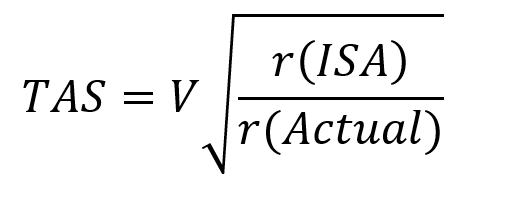
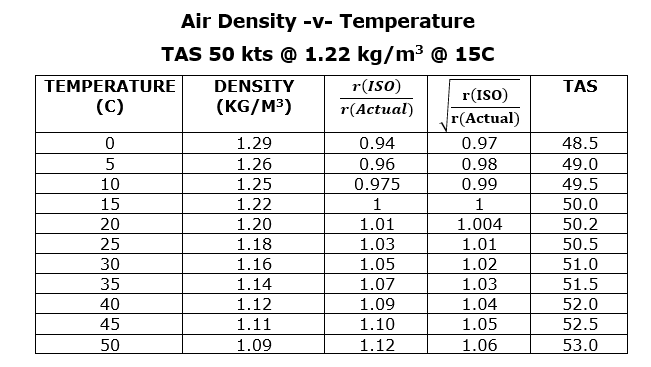
The amount of Lift we are going to get is dependant on two variables - the density of the air in which the aircraft is operating and the True Airspeed in air in which the aircraft is operating. Let's look at TAS.
Where
V = Indicated Airspeed
r(ISA) = air density in ISA (
103.21013.2 mb and 15C) = 1.22 kg/m^3r (Actual) is air density in which the aircraft is operating.
From this equation, the following table can be constructed:
The next step is to calculate the difference in Lift between that generated at ISA to that generated at higher temperatures.
Where:
r = Actual air density
TAS = True Airspeed
k = (Coefficient of Lift x Wing Area) all the things we must acknowledge but do not vary, so we give them a value of one (1)
Can I have a rest now?




OK - Give us your 2 bobs worth
in AUS/NZ General Discussion
Posted
The aircraft doesn't have to only be a VH experimental. As long as you get an Engineering Order from an authorised aviation engineer, you can do whatever you want to do. A change might require a new W&B determination if the change in weight is substantial (over 5kg, I think).