red750
-
Posts
8,104 -
Joined
-
Last visited
-
Days Won
71
Content Type
Profiles
Forums
Gallery
Downloads
Blogs
Events
Store
Aircraft
Resources
Tutorials
Articles
Classifieds
Movies
Books
Community Map
Quizzes
Videos Directory
Everything posted by red750
-
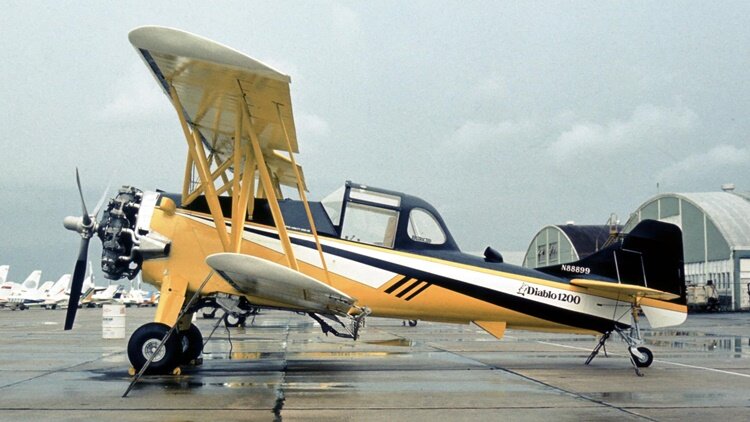 The Emair MA-1 Paymaster was a 1960s American agricultural biplane aircraft built by Emair, which was part of the Hawaiian Murray company. The prototype was constructed and flown in New Zealand, with production aircraft built in the United States at Harlingen, Texas. The prototype Murrayair MA-1 was built by Air New Zealand on behalf of Murrayair Limited of Hawaii, United States. Based on the Stearman 75 Kaydet, it had an increased wing area and modification to the forward fuselage to accommodate a pilot (in a raised cockpit for better visibility), a jump seat (used to carry an assistant or mechanic between stations), and a chemical hopper. The fixed tailwheel landing gear was strengthened and a more powerful Pratt & Whitney Wasp radial engine fitted. It first flew in New Zealand on 27 July 1969, then it was dismantled and shipped to Hawaii to obtain United States type certification; certification was awarded on 14 April 1970. Emair began production of the aircraft at Harlingen in Texas. The production aircraft were named Agronemair MA-1 Paymaster at first, then designated the Emair MA-1 Paymaster. Production ended in 1976 after 25 had been built. In 1975 Emair developed an improved version, the Emair MA-1B Diablo 1200, which was essentially an MA-1 with a more powerful Wright R-1820 radial engine. The more powerful engine did not increase the maximum takeoff weight but allowed operations at higher altitudes, and its lower output speed helped reduce propeller noise. Forty-eight MA-1s had been built by early 1980, with production being suspended by the end of the year due to poor market conditions. At the end of the 1980s the company halted production after a further 23 Diablos had been built. Variants Murrayair MA-1 New Zealand-built prototype with a 600hp (447kW) Pratt & Whitney R-1340-AN1 Wasp radial engine. Emair MA-1 Paymaster Production aircraft, 25 built. Emair MA-1B Diablo 1200 Improved version with a 900hp (671 kW) de-rated Wright R-1820 radial engine, 48 built.
 -
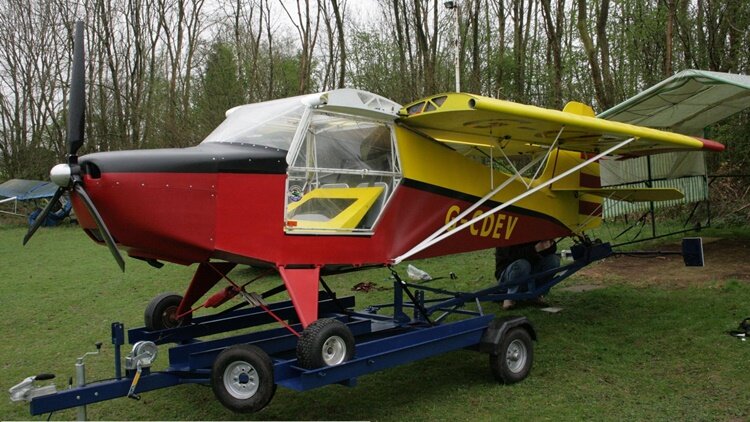 The Just Escapade is a single-engine, high-wing light aircraft, seating two in side-by-side configuration. It was jointly developed in the United States and the United Kingdom in the early 2000s and by 2010 some 145 Escapades and its "bush plane" variant, the Highlander, had been built and many more kits sold. The Escapade design can be traced back to that of the Avid Flyer, via the Denney Kitfox and Reality Easy Raider, marrying the Easy Raider's wing to a stretched Kitfox Lite fuselage. The key differences between the two types are the Escapade's side-by-side seating in a widened cabin, dual controls, and the option of a tricycle undercarriage It was developed jointly in the United States and United Kingdom by Just Aircraft and Reality Aircraft respectively, the American prototype flying in February 2003, four months before its British counterpart. These prototypes differed to fit into local classifications. The Escapade has a Chromoloy steel frame and is largely fabric covered. The wings have constant chord, ending in Hoerner-type wingtips; the trailing edges are aluminum. The ailerons and flaps have glass fiber leading edges. The wings are braced to the lower fuselage longerons with V-form struts and vertical jury struts. The fuselage is polygonal in section, sloping inwards above and below the center line, with a flat aluminum upper surface that slopes upwards from the tail to the wing trailing edge, at the rear of the cabin. The empennage is conventional, the low aspect ratio tailplane with its swept leading edge and rounded elevators located at the top of the fuselage. There is a portside flight-adjustable elevator trim tab with optional electric drive. The unbalanced rudder extends to the keel, moving in a V-shaped gap between the elevators. The seating is under the leading edge of the wing with a cabin roof window in the wing center section. Access is through side transparencies. Engine options include several Rotax or Jabiru units in the 37-89 kW (50-120 hp) range, driving two- or three-blade propellers and enclosed in a cowling manufactured from composite materials. Both undercarriage versions have the main wheels on faired-in V-form struts mounted on the lower fuselage longerons, with rubber-sprung half axles fixed to a compression frame. The conventional tailwheel is steerable but the alternative nose wheel castors freely, though a steerable version is planned. The Highlander version, intended for rough airstrips and marketed only in the United States, is designed to fly slowly and has a more robust undercarriage. Its wing has a 3 ft (910 mm) greater span, with vortex generators over the whole upper leading edge, and the fin is square cornered and 8 in (200 mm) taller. Its tail control surfaces are horn balanced and increased in area. The Highlander always has the conventional undercarriage, strengthened, with tundra tires and enhanced brakes. A 99 hp (74 kW) Rotax 912 ULS engine is fitted and allows a maximum takeoff weight of 1,320 lbs (598 kg). The Jabiru-engined United Kingdom prototype Escapade gained its permit to fly in September 2003 and the SLA prototype received British Civil Aircraft Rules section S approval from the Light Aircraft Association in April 2008. The Highlander was introduced in 2004. For details of Operational history and Variants, click here. Tailwheel variant Tricycle variant
 -
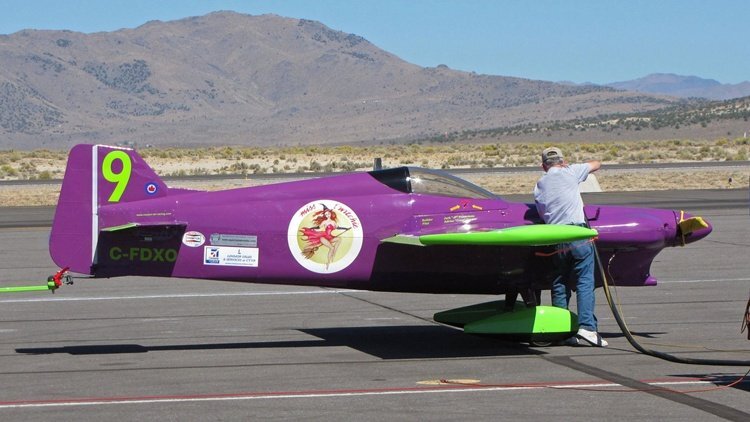
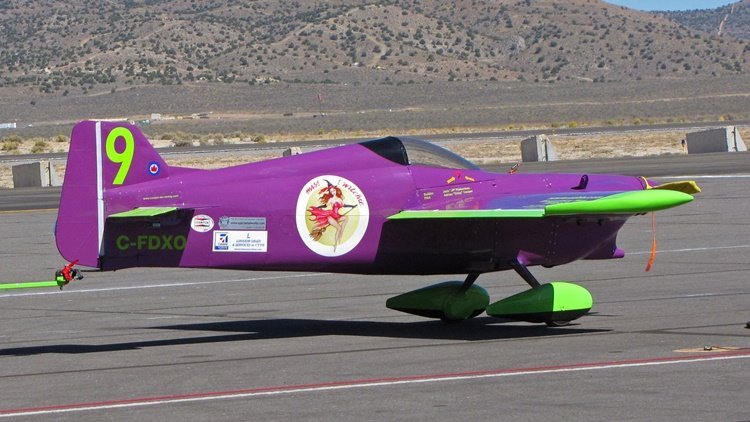
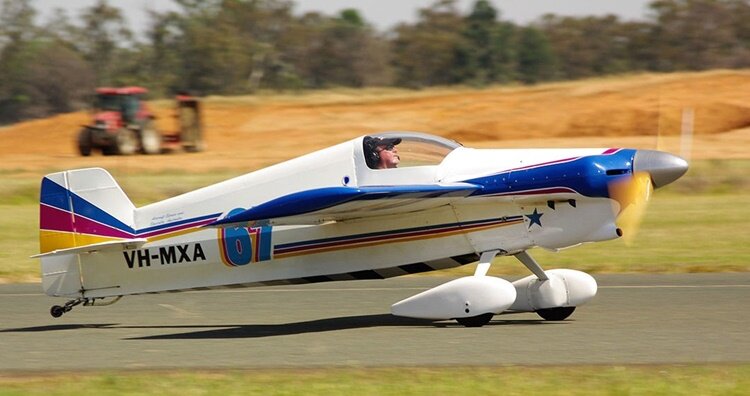 The Cassutt Special is a single-seat sport and racing aircraft designed in the United States in 1951 for Formula One air races. Designed by ex-TWA captain Tom Cassutt, it is a mid-wing cantilever monoplane with fixed tailwheel undercarriage. The fuselage and tail are of fabric-covered steel tube construction, and the wings are built from plywood over wooden ribs. An updated taper-wing design was first flown in 1971 on Jim Wilson's "Plum Crazy". The aircraft is built with a 4130 tubular steel spaceframe fuselage and a plywood-skinned wing with solid spruce spar and built-up ribs. The design lends itself well to modification, there being several different wing options of wood or composite construction. Several different tails have been built, including T-tails. The standard engine used for competition is the 100 hp (75 kW) Continental O-200, while other, lower-powered engines can be used for recreational flying, including the other small Continental A65 and Continental C90. Cassutt Aircraft discourages the use of auto conversions or larger Lycoming engines. Lycomings have been successful in several builds but the increased weight rarely gives the desired performance boost. Plans and parts were last available from Creighton King in Utah, for amateur construction. King also offered plans for the Stockbarger tapered wood wing. King has since withdrawn the plans from the market. Variants Cassutt I Developed in 1951, First race at Dansville, New York in 1954. Cassutt II Casutt IIM 13.67 ft (4.2 m) wingspan Cassutt IIIM 15 ft (4.6 m) wingspan Cassutt IIIM Sport 17.00 ft (5.2 m) wingspan
 -
You're right, there is something there. I didn't notice it before. Here's another photo which shows it more clearly.

-
How can this taildragger stand unsupported with it's tail off the ground and the engine stopped?
-
Done that. Instructor congratulated me on the turn.
-
An interview with Richard De Crespigny on the news last night.
-
The problem lies in the aircraft that are grounded in more remote areas where there are no qualified LAME's to do the upgrade. They have to be flown in.
-
Apparently the software malfunction was caused by solar flares.
-
Like a supermarket shopping trolley.
-
-
It has just been announced the new website cost $96 million, 23 times the original estimate.
-
Jetstar has two new Airbus A320 simulators, worth $20 mill each. The other item reported was that they have also developed a virtual reality training system, using virtual reality headsets, for maintenance staff, so they don't have to travel to Brisbane for training and procedure checks. Apparently NASA are so impressed they have asked if they can use them. The company built a virtual model of Boeing 787 and Airbus 320 aircraft and made programs where maintenance staff could conduct training sessions on these aircraft models via VR. Using VR has enabled company training to be conducted remotely and without the need for a physical aircraft. Jetstar has found that using VR has resulted in operational efficiencies in the VR training sessions only require about 30 minutes compared to 3 to 3.5 hours for training sessions in the real world, and as such has decided to increase the size of the program.
-
Facebook images of Flying aps.
-
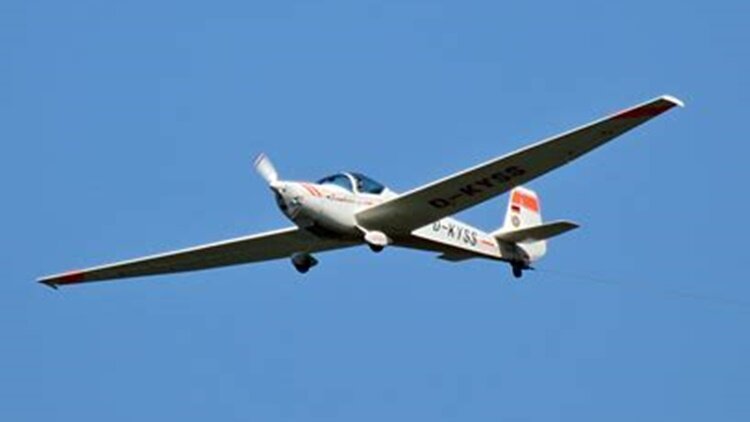 The M&D Flugzeugbau AVo 68 Samburo is a two-seat motor glider, first designed and manufactured in Austria. The aircraft is of typical motorglider configuration, with a tractor propeller and long, tapering wings. As originally designed, it also had a sailplane-like undercarriage consisting of a single mainwheel and a steerable tailwheel; however, later versions have a fixed taildragger undercarriage with two spatted mainwheels. The pilot and passenger sit side by side. With numerous design changes - including modern Rotax engines, state-of-the-art avionics, and aerotow capabilities, it is still in production by the M&D Flugzeugbau company in Germany. Variants AVo 60 Samburo The initial prototype powered by a 60 PS (44 kW) Limbach engine. AVo 68 Samburo Production aircraft powered by 68 PS (50 kW) Limbach engines.
 -
It was a bad day for this new KingAir
-
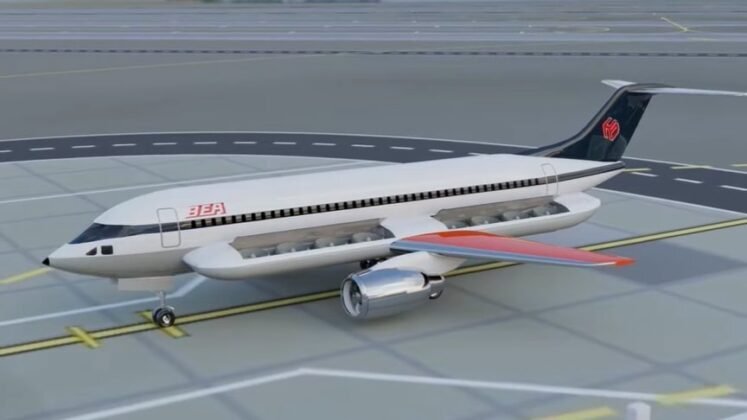
The Hawker Siddeley HS.141 was a 1970s design study and submission for a British V/STOL airliner requirement. Designed by Hawker Siddeley Aviation and tested in wind tunnels neither prototypes nor production aircraft were produced. In 1969 the British Transport Aircraft Requirements Committee (TARC) issued a design study "Outline Requirement" (OR) for a 100-seat VTOL airliner capable of a range of 450 miles (725 km). Emphasis was to be on noise reduction by using steep approach and departure profiles, much like those used today at London City Airport. It was thought at the time that money would be better invested on designing new aircraft types than building a third London airport. Hawker Siddeley investigated various configurations of aircraft, powerplant and control systems including an early proposal using ogival delta wings and twin fins, before submitting their draft design proposal to the TARC in January 1970. At the March 1970 German Aviation Show in Hanover, the first official details were released of the newly named HS.141 project. The HS.141 design was a jet airliner of all-metal construction with a T-tail and a low-mounted swept wing with a quarter-chord sweepback of 28 degrees. The design featured two wing-mounted "cruise" engines and 16 lift jet engines mounted in sponsons either side of the fuselage (eight per side). The engines under main consideration were the Rolls-Royce RB.220 turbofan for forward propulsion and the Rolls-Royce RB.202, a high bypass ratio lift turbofan engine using technology developed for the Rolls-Royce RB.162 lift jet. Both engines were themselves design studies by Rolls-Royce and it was feared that there would be delays in their development due to the company's problems at the time. One new engine type also considered for main propulsion was the 'SNECMA M.56', which became the CFM International CFM56. Variations using fewer lift jet engines for STOL operations only were also studied as it was realised that the engines could account for 15% of the total weight of the aircraft and 35% of the final cost. During the design stage many solutions involving high-lift devices were explored including flaps blown by the "cruise" engines. The flight control system proved the greatest challenge to the design team, systems had to be devised to control the aircraft in slow or hovering flight. This was to be achieved by swivelling the lift engines in their mounts combined with varying the thrust of each engine to provide control in pitch, roll and yaw. The lift engines were said to be a useful safety feature in the event of failure of the main 'cruise' engines. Significant design information was gained from flight trials with the Dornier Do 31 aircraft being developed at the same time in Germany. The passenger cabin was conventional with five or six seats abreast, luggage and freight was to be loaded in pre-packed pallets and raised up into the lower fuselage using a system similar to the Douglas DC-8. Extensive wind tunnel testing with 1/10 scale models was carried out.
-
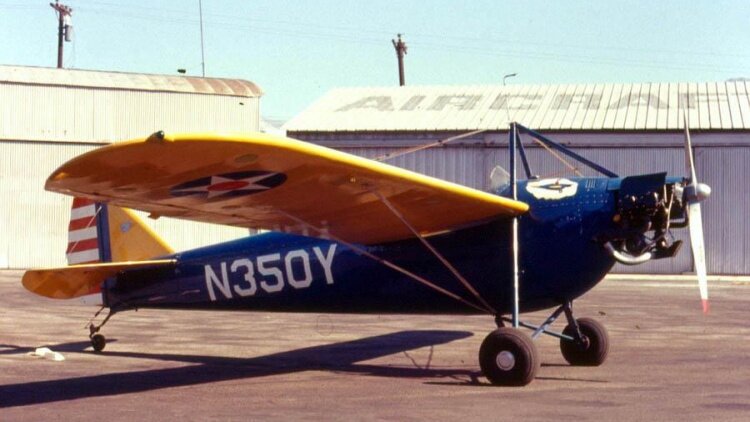 The Buhl LA-1 Bull Pup was a light sports airplane developed in the United States in 1930. It was a mid-wing wire-braced monoplane with fixed tailskid undercarriage and an open cockpit for the pilot. Buhl developed the Bull Pup as a cheap aircraft through which the company hoped to remain in business as the onset of the Great Depression was felt. However, as the economic situation worsened, it became evident that there was no demand for even such a basic aircraft; when production ceased in 1932, all aircraft still in stock were sold off at half price as the company folded. Approximately 100 units were completed. Variants LA-1 Bull Pup LA-1A Bull Pup – version for competition flying with 28 ft wingspan LA-1B Bull Pup – version for high-altitude flying with 32 ft wingspan LA-1S Bull Pup – floatplane version
 -
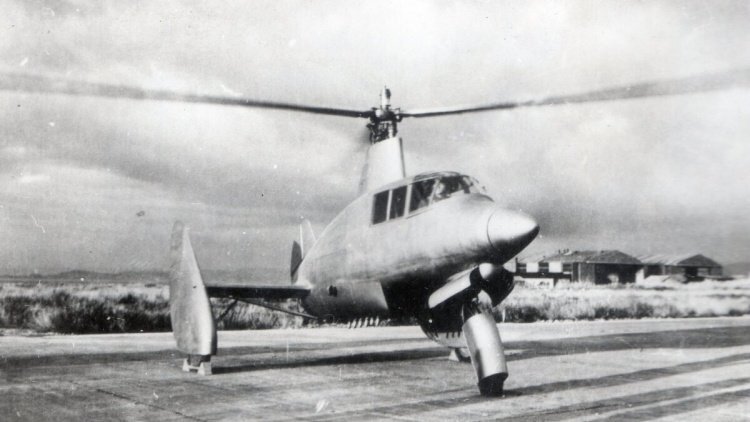
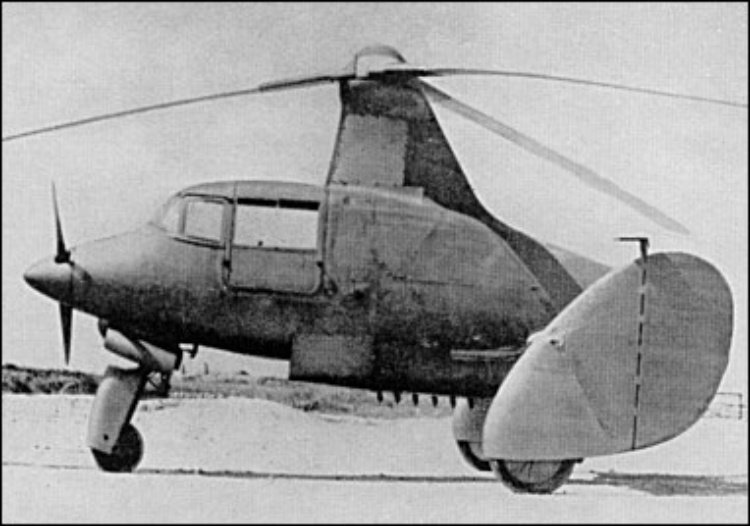
The SNCASE SE-700 was a three-seat passenger autogyro designed during World War II. Two were completed but only the first flew and the programme was soon abandoned. Design of the SE-700 began in 1939 but World War II delayed its completion and first flight until 25 May 1945. Compared with most autogyros of its time it had a very advanced appearance, with a sleek, streamlined fuselage, an enclosed central engine and a three blade rotor on a straight edged, aerofoil section pylon. The enclosed cabin, which seated three, was ahead of the engine and behind a nose which tapered smoothly into the spinner of the two blade propeller. At the rear of the short fuselage was a low aspect ratio tailplane, externally braced to the fuselage underside and fitted with elevators. It carried swept, oval tail fins taken from the SNCASE SE-100 twin engine fighter at its tips, which were externally braced to the tailplane underside. The fins were fitted with rudders and, more unusually, wheels; the SE.100 had fin mounted tail wheels but the SE.700 had tricycle gear so these became the main wheels, tidily faired into the bottom of the fins. Its nosewheel retracted backwards, placing the wheel partly in the fuselage and its leg within a small ventral fairing. The first prototype, piloted by Stakenburg, flew with a 164 kW (220 hp) Renault 6Q-01 six cylinder, inverted air-cooled inline engine. It proved difficult to control and crashed after a few test flights. Though the damage was not great, the SE-700 was not repaired and SNCASE decided instead to complete a more refined second prototype, the SE-701 or SE-700A. This was fitted with a more powerful 246 kW (330 hp) Béarn 6D-07 engine, another six cylinder, inverted air-cooled inline. However, the company then decided that the post-war market for small commuter autogyros was too limited to proceed, so the SE-700A did not fly and a proposed production series of four SE-702s or 700Bs were not begun.
-
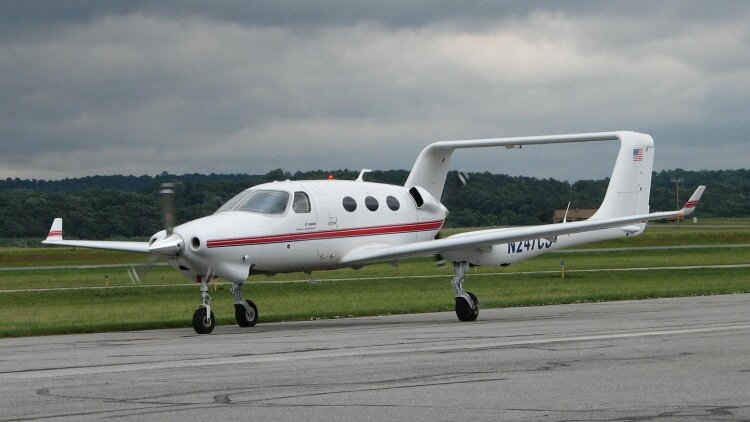 The Adam A500 is an American six-seat civil utility aircraft that was produced by Adam Aircraft Industries. The aircraft is of pod-and-boom, push-pull configuration with its two Continental TSIO-550-E piston engines mounted to provide centerline thrust. The A500 was developed from the M-309 CarbonAero technology demonstrator designed by Burt Rutan and built by Scaled Composites at the Mojave Airport. The "309" designation refers to this being Rutan's 309th aircraft design. The 309 first flew in March 2000, but the aircraft has since been gutted and was used as a static display outside the Adam Aircraft Industries headquarters. In 2006 the 309 was loaned to the Wings Over the Rockies Air and Space Museum and is now on display. Compared to conventional twin-engine installations, the centerline thrust arrangement reduces drag and maximizes the controllability of the aircraft should one engine malfunction or fail. This engine configuration was used by the similar Cessna Skymaster. The A500 airframe is largely built of carbon fiber epoxy composite materials with a Nomex honeycomb core. Other features include cabin pressurization. The prototype A500 first flew on July 11, 2002, and was FAA certified in May 2005. Adam Aircraft ceased operations on 11 February 2008, and filed for Chapter 7 bankruptcy on 19 February 2008, having delivered seven A500s. In April 2008 Adam Aircraft was purchased from bankruptcy by AAI Acquisition Inc. At the time of purchase this new company indicated that they would pursue certification of the A700 jet as a priority and that the A500 would not be produced due to the continuing poor market for piston-engined aircraft. AAI went out of business in April 2009 without producing any aircraft. In April 2011 Triton Aerospace announced that they had acquired the assets of Adam Aircraft including the aircraft type certificate and intend to return the A500 to production. In April 2011 Triton Aerospace announced that they will redesign the aircraft using what Thomas Hsueh, owner of Triton Aerospace, termed "proper engineering" to shed 1,000 lb (454 kg) of empty weight and recertify it with the intention of putting it back into production. The aircraft will also be changed to a turboprop, with twin engined and rear-engined-only versions. A new prototype was expected in 2013 with re-certification to follow. Hsueh indicated that for now production is planned for the US, but costs may require moving the assembly line to China or even a lower cost country such as Mexico. By 2013 the Triton website had been taken down and the URL sold. It is likely that the company has gone out of business. Wikipedia lists that 7 aircraft were built, but serial numbers 1 to 22 were registered according to airport-data.com. A500 A700 powered by two Williams FJ33 turbofans.