

red750
-
Posts
8,261 -
Joined
-
Last visited
-
Days Won
79




red750's Achievements

Well-known member (3/3)
-
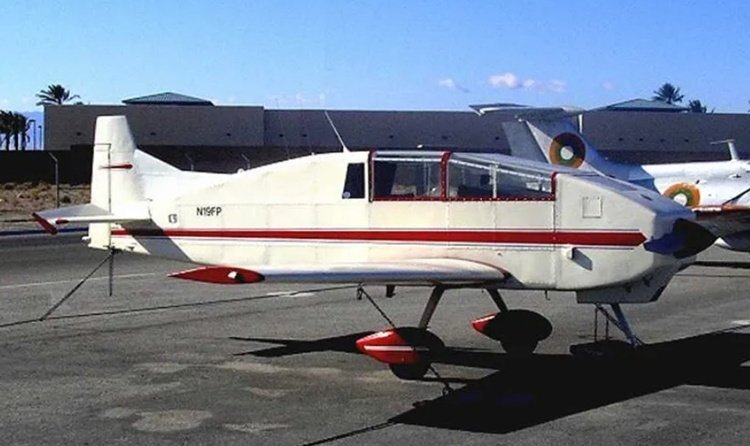
The Rand Camber-1 is a unique, amateur-built experimental aircraft from 2003, often nicknamed the "flying pencil case" or "box with wings" due to its distinctive rectangular, flat-surface fuselage design which simplifies construction. Registration N19FP: The specific aircraft N19FP is recorded as a 2003 Rand Camber-1 (C/N 1), a single-seat, single-engine fixed-wing plane powered by a Franklin 4A235 reciprocating engine. Construction History: It is widely believed that this airframe originated as a Rand Robinson KR-2 (registration N19FP was previously assigned to a KR-2) that was significantly modified or "reincarnated" into the Camber-1 design, retaining the original tail and likely wings with added fuselage modifications. Design Philosophy: The "pencil case" shape utilizes no curved surfaces, allowing builders to use simple materials like steel or aluminum sheets with tin snips and pop rivets, prioritizing ease of manufacturing over aerodynamic elegance. Current Status: The aircraft holds an Experimental certification issued in 2006, with its last known location recorded at North Las Vegas Airport (VGT).

-
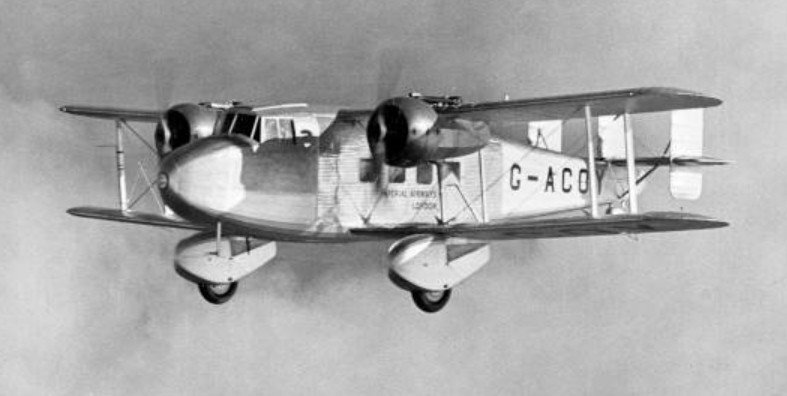
The Boulton & Paul P.71A was a 1930s British twin-engined all-metal biplane transport aircraft by Boulton & Paul Ltd used by Imperial Airways for feeder-line work. The P.71 was development of the P.64 Mailplane which had not met the airline's specifications. Two aircraft entered service in early 1935 but both were lost to accidents by end of 1936. The P.71A was the successor to the Boulton & Paul's first attempt to meet the airline requirement, the P.64 Mailplane. The P.71A was lighter, slimmer and longer and used Armstrong Siddeley Jaguar IVA radial piston engines. Two aircraft were built and delivered to Imperial Airways at Croydon Airport in February 1935. The airline had lost interest in using them as mailplanes, so the two aircraft were converted as VIP transports with 13 removable seats.
-
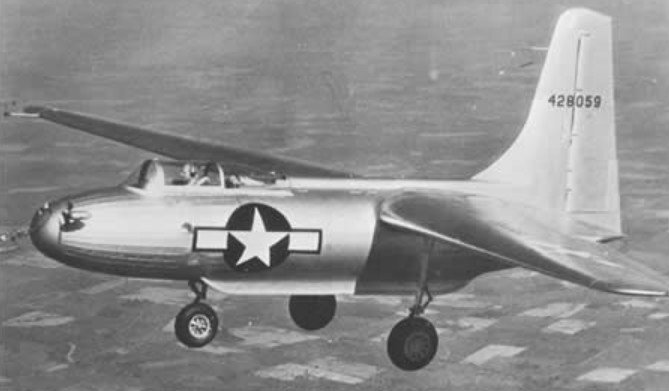
The Cornelius XFG-1 was an American military fuel transporting towed glider, without a tailplane and with a forward-swept wing. Two were built but development ended in 1945. The Cornelius XFG-1, developed under the project designation MX-416 was an aerodynamically unusual aircraft intended for an unusual military role. George Cornelius had been experimenting with aircraft featuring differentially variable incidence since the 1920s. His first two machines were otherwise conventional but the third, the Cornelius Mallard from 1943 was not, being without a horizontal tailplane and having low aspect ratio and strongly forward swept wings. Though very different in detail, the XFG-1 built on the Mallard experience. A 1/4 scale model of the XFG-1 was built for wind tunnel tests. The FG in its designation stood for fuel glider and its role was as a fuel transport. It was to be towed behind another aircraft rather like contemporary troop carrying gliders, but its two fuselage tanks held 677 US gal (564 imp gal; 2,560 L) of avgas. Unlike other troop carrying gliders, e.g. Waco CG-4, the XFG-1 could be towed by modern bombers or transports at a cruise speed of 250 mph (220 kn; 400 km/h). Proposals seem to have included a piloted tow version behind a large transport, the glider landing loaded on skids having jettisoned its wheels after takeoff; or a pilot-less version towed behind a B-29 bomber, disconnected and abandoned after fuel transfer was completed; the intent of the scheme being for the glider to act, essentially, as a giant, winged drop tank for extending the range of the towing aircraft. The XFG-1 was a high-wing monoplane, its wing set far back towards its vertical stabilizer. The wing was quite high aspect ratio and of modest forward sweep. Though the earlier Cornelius aircraft had wings that had their incidence variable in the air, the incidence on the XFG-1 could only be adjusted on the ground, with two settings of 3˚ and 7˚. There was no horizontal tail. It had a simple fixed tricycle undercarriage and a conventional single seat cockpit; two examples of the type were built.
-
https://7plus.com.au/7news-spotlight?episode-id=7SPL26-021&autoplay=true
-
- 2
-

-

-
https://simpleflying.com/1-billion-upgrade-turned-remote-australian-airbase-usaf-answer-guam/?link_source=ta_first_comment&taid=6ab31fe4fd12400001668f6f&utm_campaign=trueanthem&utm_medium=social&utm_source=facebook
-
 7,700 次播放 · 1,113 个心情 |... WWW.FACEBOOK.COM Why_Boneyard_Jets_Are_Not_Recycled_Into_New_American_Military_Hardware!
- 1 reply
-
- 1
-
-
‘I'm not going to let it stop me’: Crash survivor’s incredible return to the sky 7NEWS.COM.AU Four years after losing his mum and his leg in one of Australia's worst aviation disasters, Nicholas Tadros has done the unthinkable.
-
- 3
-
-
Stockliegh in logan aircraft down
red750 replied to gareth lacey's topic in Aircraft Incidents and Accidents
Barambah Organics founder Ian Campbell and daughter Hannah identified as victims of fatal Logan plane crash. Father and daughter identified as pair killed in light plane crash 7NEWS.COM.AU A neighbour heard the plane ‘not sounding great’ moments before it crashed into a field. -
Stockliegh in logan aircraft down
red750 replied to gareth lacey's topic in Aircraft Incidents and Accidents
A witness on tonight's news said she heard the plane fly over her house with a spluttering engine, then heard the crash. Two deceased. -
Were you thinking of the Beagle/Scottish Aviation/BAe Bulldog? See profile here:
-
Another very pointy plane - the Chudzik CC-02
-
Unfortunately, when I clicked on the "Order here" button, my antivirus blocked it, saying Site Not Available.
- 1 reply
-
- 2
-

-
-
BrenDan sidetracked the thread with his photos of Moorabbin Aircraft Museum, further diverted by skippy's question.
-
The DH Heron 1 had fixed landing gear, the DH Heron 2 had retractable gear. See Variants here: de Havilland Heron - Wikipedia EN.WIKIPEDIA.ORG
-
https://www.bbc.com/news/articles/c4g6pdem336o
-
- 3
-
-