


old man emu
-
Posts
5,297 -
Joined
-
Last visited
-
Days Won
78
Content Type
Profiles
Forums
Gallery
Downloads
Blogs
Events
Store
Aircraft
Resources
Tutorials
Articles
Classifieds
Movies
Books
Community Map
Quizzes
Videos Directory
Posts posted by old man emu
-
-
16 hours ago, bull said:
we where taught to EXPECT the fan to stop at at any time
That's 1920s - 30s expectation, when all engines - aircraft, motor vehicle and marine - were not as accurately made as they are now. The materials were not as good. The oils were not as good. the petrol was not as good and the ignition systems were not as good. And engines failed. Nowadays an engine failure still remains a 100% possability, but the probability could be thought to be well below 5%. Telling a student pilot to EXPECT and engine failure is scaremongering. Advise them that it could happen, but not that it must happen.The same goes for most things students are told will kill them - stall/spins at below 2000' AGL excepted.
A NASA study done in the late 1970s proved that the average altitude loss in spins done with a Grumman American AA-1 (Yankee) and a Piper PA-28R (Arrow), two popular single-engine aircraft, was nearly 1,200 feet. (It should be noted that neither aircraft is approved for spins, but NASA was testing them for possible improvements in spin handling characteristics.) I know that these are heavier aircraft than RAAus types, but also factor-in that the pilots were test pilots who expected the stall/spin and who knew how to recover from it.
In the Yankee, it took an average of 210 feet for entry, 340 feet for stopping the turn, and another 550 feet for recovery, for a total of 1100 feet. In the Arrow, the figures were 140 feet for entry, 400 feet for stopping the rotation, and 620 for recovery, for a total of 1160 feet. In short, the average vertical recovery distance was just short of 1200 feet. Pilots allowing a spin to develop at or below traffic pattern altitude are nearly certain to crash, no matter how quick their reflexes or skillful their recovery.
Getting back to controlling the glidepath, no one has mentioned making small changes to attitude by the use of the elevator trim control. Surely that control can be used for more delicate alterations to trim than pushing and pulling the control column and getting coarse adjustments.
.
-
 1
1
-
-
Isn't that the standard wet field takeoff procedure for all tricycle u/c aircraft? Get the front wheel off the ground with thrust and elevator, then continue the ground roll a usual.
-
 1
1
-
-
1 hour ago, Student Pilot said:
.I don't understand the theory, does that make me a bad pilot?
I wonder why no one has shot back at me, "Those who can, do. Those who can't, teach."
33 minutes ago, facthunter said:IF the power applied just increased the airspeed you don't necessarily regain the glide path just by opening the throttle.
In this case, the aircraft was happily coming down the glidepath at the desired speed, not too fast, not too slow, just right. You know, Newton's First. Then something happened to knock it off the desired path. Newton's Third. What I'm saying that you don't shove the throttle knob to the wall and get the aircraft speeding up. You give it a nudge to halt the descent until, by flying parallel to the original track over the ground, you intersect the desired glidepath and re-establish the desired airspeed by un-nudging the throttle.
A side issue that has struck me in this discussion is that there does not seem to be a method taught by all instructors for carrying out flight down the glidepath that is consistent with all. From responses here, some have been taught to control descent with elevators and some have been taught to use the throttle. Is it any wonder that discussions reach no end?
-
38 minutes ago, facthunter said:
How does a flock of birds or a school of fish know how to turn as if they are ONE entity?
Buggered if I know, but I'm not interested enough to research it.
However can you give examples of birds, bats and butterflies using sound to discuss the intricacies of how they are able to fly?
-
1 hour ago, facthunter said:
If you are maintaining a glide path at 70knts (stabilised) and you reduce power to slow a bit you have less lift at the slower speed and will drop below the path
I fully agree with that statement as it stands. However, if the glide path has been established at a determined speed and with a certain engine RPM, if, due to some mistake in setting up the glide path, or an unexpected upsetting force (gust, shear) and the aircraft goes either above or below the desired glide path, then the glide path can be regained closer by the manipulation of THRUST.
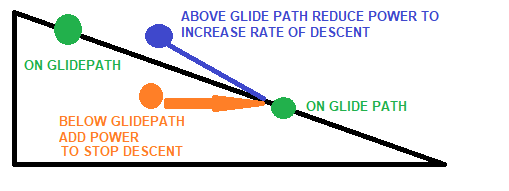
Look at this side-on circuit depiction. The final leg,, or glide path to runway, can be described as the hypotenuse of a right triangle.
Here's a depiction of a plane flying that glidepath to the runway.

The green dots represent the aircraft at points along the desired glidepath, with attitude and power set. The orange dot represents the aircraft a little closer to the runway, but it has gone below the desired glidepath for some reason. To stop making matters worse, the pilot increases THRUST which stops the descent until the actual flight path intersects the desired glidepath at the lower green dot. Then the extra THRUST is removed and flight on the desired glide path continues.
The Blue dot represents the aircraft that has risen above the desired glidepath for some reason. The aircraft can be returned to the desired glidepath by increasing the rate of descent by reducing THRUST until the actual flight path intersects the glidepath at the lower green got. Then the THRUST is returned to the level it was at the first green dot.
In other words, instead of pushing and pulling on the elevator controls, they are left untouched, but the throttle is the control that is pushed and pulled, until it comes time to flare, when it's pull back on both.
Yes. I know I am describing the "normal" landing approach where THRUST is available. I fully agree that a deadstick landing would be conducted using the elevators.
-
2
-
-
44 minutes ago, onetrack said:
It was proven that these comic-book style booklets improved students learning rapidly
Simple application of the process whereby animals gain information. Homo sapiens is the only animal that has been able to take noise making for communication beyond a very basic aid to survival. However, we gain more information about our environment through our eyes, and to a lesser extent smell, touch and hearing. And then there's the old adage, a picture is worth a thousand words.
-
I'm puzzled. Let's say that we are flying a plane with a cruise speed of 80 kts and a stall speed of 30 kts IN NO WIND. Just after the turn from crosswind to downwind, the plane gets to 80 kts at cruise power for the downwind trip. At the end of downwind you make a co-ordinated descending 90 degree turn and reduce power, but maintain pitch with the elevators until you are 500' AGL. Then make another 90 degree descending turn onto Final, while maintaining the elevators in a constant position to achieve a flight line to the aiming point. If the aircraft drops below the desired flight line, then add power to stop the descent until the aircraft flies into the desired flight line. Pull power if above the flight line. At all times the position of the elevators remains constant. At the aiming point, the power comes right back and the Flare is initiated.
If my technique is correct, and I'm open to correction, how can this description of the way a student has been taught to land a PA-28 be correct?
Holding steady at 70kts down final on an even profile with the plane trimmed sets us up in the correct configuration without having to fiddle with power changes too much. But reaching the point where we need to start slowing down to get back to 66kts over the threshold is where it gets busy as I pull back on the power and simultaneously increase back pressure to maintain a straight approach path.
Am I wrong in thinking that one sets the pitch angle to a desired flight line with the elevators and maintains the flight line with thrust?
-
We are all a bit weird in our own ways. I like to look at the physics of flying and much of the rest of the math-based stuff. The mathematical descriptions associated with flight should provide a simple answer to the question "How does a plane fly". Unfortunately, at every twist and turn there are additional variables to complicate the answer.
I'm coming to the conclusion that the answer to the question is, "Because they do." For the majority of pilots that's answer enough in relation to the Theory of Flight. For that majority it is the practical aspects of flying that are paramount. Flight instruction should be based on "If you do this, you will have a safe flight. If you don't, you die."
-
18 hours ago, skippydiesel said:
much lighter/low inertia aircraft
Now that's something I'll have to address - inertia.
So far my research has introduced me to:
- Angle of bank and its relation to stalling
- Angle of Attack in climb and descent
- Radius of turn in relation to speed and angle of bank
- Now Inertia as it more greatly affects low mass aircraft.
I'm interested to study the Procedure Turn principle for doing a 180 degree turn to reciprocal heading
As I said, I'll avoid Human Factors, but welcome someone else starting a sister thread to deal with HF and Stall/Spin.
However, as i delve deeper into this Lift thing, I am being swamped with the number of variables that can affect the creation of Lift. It's a wonder that a plane can fly at all.
-
Searching for an answer to the question "What is relative airflow", I came across this site which has short videos on a theory topic that are well created and delivered in an Australian accent.
-
 1
1
-
1
-
-
1 hour ago, Thruster88 said:
I hope we are not going into some long winded dodgy mathematical bs.
When have I ever done that!!!???
I think we could end up riding on the rim of a two-sided coin. The mathematics tells us that it's going to happen, while the Human Factors lets us ask why does it happen to people who have been shown the mathematics. One side of the coin is objective and can be show mathematically within a virtual reality as well as practically in reality. The other side of the coin is subjective and the results of any test cannot be replicated exactly, only "on average". The subjective side deals with human psychology where "All the world is queer save thee and me, and even thou art a little queer." --Robert Owen, 1828
-
 2
2
-
-
Let's keep it simple. The circuit is at Old Mate's place at Wattagai.
-
The Wright Bros were probably the most experimental aerodynamicists of the few years both sides of 1903.
-
1
-
-
Can we leave the engine failure scenario out? I know it happens, but that's taking the starting point of what I would like to discuss a step beyond where I want to be.
I'll take your response and restrict it to "On climb, up and/or crosswind", if it's OK with you.
Is there a danger in turning from downwind to cross wind in descending flight at low speed?
-
I'm considering starting another controversial thread, but I need some clarification, please.
When flying circuits, where is an aircraft most in danger from a stall/spin incident?
-
There's the BFR, and then there's the practising for the BFR. The whole process has got to sharpen a pilot's skills.
-
1
-
 1
1
-
-
2 minutes ago, spacesailor said:
CAN I GET PERMISSION TO USE MY PLANE ?.
And I shouted it out loud !.
spacesailor
No! It hasn't got one of them bubble things.
-
2 hours ago, Kyle Communications said:
This is easily answered...for god sake someone take a spirit level with then when they fly next and orientate it down the centreline of the aircraft and tell us what you see
Took the letters right off my keyboard.
-
There's a time and a place for everything. Sitting in the left hand seat commiting aviation is not the time to be doing calculations involving multiple variables. However, logged into a forum, with access to reference material and calculators is the time to ponder the intricacies of the physics.
-
1
-
-
42 minutes ago, spacesailor said:
IS " centripetal force, similar OR the same as Centrifugal force.
Spacey, the answer is NO, not because they are different forces, but because Centrifugal Force is what is called a "fictitious force" - any force invoked by an observer to maintain the validity of Isaac Newton’s second law of motion in a reference frame that is rotating or otherwise accelerating at a constant rate.
Take the situation where you have a weight on a string and you start whirling it around over your head. You feel a force in your hand. That's your feeling of the force you are exerting on the weight to keep it moving in a circular path. You are pulling the weight towards you. That force is called CENTRIPETAL FORCE, which means "center seeking" force.
This quick video explains what is going on
-
1
-
-
Too much of this discussion has been taken up with AoA -v- pitch angle and what tools could a pilot have to gauge how close to that magic number the chord line is.
Once again, I posed a simple question, only to have fired back situations that the average private pilot, flying sensibly and with an eye to safe operation, would be unlikely to encounter.
My simple question was:
So why should the myths, falsehoods and the Newton/Bernoulli debate about lift generation of a body with one curved surface and one relatively flat surface, continued to be pounded into pilots when they do not advance the the skill level of pilots in operating an aircraft?
Why is it critical to the practical application of piloting skills that the pilot knows that
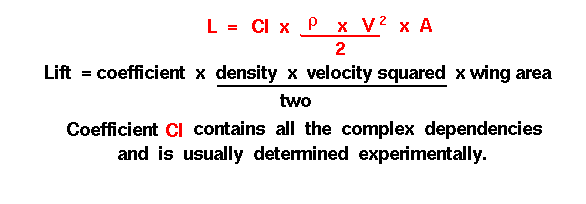
Do you know the CL of the aerofoil used by your regular aircraft? Do you know the density of the parcel of air you are currently in? Can you do the mental calculation to convert knots to metres per second? What is the wing area of your aircraft. Oh, and what is the weight of your aircraft at the instant for which you want to know the lift the wing is producing?
One can only agree wholeheartedly with the sentiment expressed here:
" ... though many of the pilots I fly with understand intellectually that an airplane can stall/spin at any airspeed and in any attitude, their only practical stall experience consists of performing a contrived, wings-level stall to a Practical Test Standard. Such limited stall experience imparts little practical experience vis–vis real-world stall/spin accident scenarios. As a result, many pilots never realize just how close they may be to stalling the airplane when performing a so-called dumb stunt, or how close they may be to a stall/spin departure when skidding a turn in the traffic pattern."
It's like being able to recite the Karma Sutra by rote, but still being a virgin.
-
Do they still go as far as demonstrating incipient spin recovery?
That was fun to do in the ol' C-150. The only trouble was that with incipient spins, and stalls, they wouldn't let you wait before you had to recover. It was a bit silly really. The instructor would tell you that now you are going to do an spin entry, or a stall and you'd set up for that to happen. When it did, you reacted incredibly fast and put in the corrections.
I'd live to put a plane into a straight ahead stall and see what happens if you did not correct for, say, ten seconds. I don't know how I'd go in a fully developed spin. Grins would be replaced with technicolor yawns in my case.
-
17 minutes ago, Garfly said:
Could you explain your resistance to the idea that pitch angle and angle of attack are 2 different things?
Where, Oh where, did I ever say that? We both know that the AoA is the angle between the wing (wing chord to be precise) and the direction of travel (undisturbed airflow). The angle of pitch is the angle between the main body axis and the horizon. The angle of the chord in relation to the longitudinal axis of the aircraft is set by the designer and set by the rigger. The designer normally fixes that angle so that, in straight and level flight, the angle between the longitudinal axis of the aircraft and the chord line of the wing is the same as the angle between the undisturbed airflow and the chord line of the wing. This angle is expected to result in the creation of the most Lift the aerofoil can create.
The angle of pitch is controlled by the pilot, mainly by the use of the elevator/s, or control of thrust. The angle of pitch can vary from zero to 360 degrees (or 180 up and over and 180 down and around). Using the device in the way I have described provides the pilot with a source of reference for the upwards pitch angle of the aircraft. The device has been calibrated to give an indication of the angle of attack. It is never supposed to give a true, accurate reading of the AoA at any instant, but simply to give an indication of the range of AoA's in which it is possible for the aerofoil to produce sufficient Lift from the combination of aerofoil design and Thrust to counter the force of gravity and remain at a predetermined height above a reference point (the ground)
Have you even read my description of calibrating a level indicating device in order to show pitch angle. If you have, but don't understand what is being done, please ask me to expand on the method.
-
6 minutes ago, Yenn said:
the actual amount of air that flows in the system is miniscule.
I agree that the amount of air (mass flow) is miniscule, but so is the degree of movement in the diaphragm as well as in the gearing and needle movement. Each movement takes time and those movements must reach equilibrium. That's where the lag comes from, isn't it?


Turns at low IAS
in Student Pilot & Further Learning
Posted
My legs are a bit sore for me to stand, so this time, do you mind if I just "sit corrected".