


old man emu
-
Posts
5,297 -
Joined
-
Last visited
-
Days Won
78
Content Type
Profiles
Forums
Gallery
Downloads
Blogs
Events
Store
Aircraft
Resources
Tutorials
Articles
Classifieds
Movies
Books
Community Map
Quizzes
Videos Directory
Posts posted by old man emu
-
-
If you get yourself a C-150, or C-152, you are entering the realms of Vintage and Classic aircraft. Whether an aircraft is classed as Vintage or Classic depends on which side of the Atlantic you are on. In Britain, a vintage aircraft is one that first flew 40 or more years from present, and a classic first flew between 25 and 40 years. The Yanks have different criteria
II. DEFINITIONS
A. Antique Aircraft
An aircraft constructed by the original manufacturer, or his licensee, on or before August 31, 1945, with the exception of certain Pre-World War II aircraft models which had only a small post-war production shall be defined as Antique Aircraft. Examples: Beechcraft Staggerwing, Fairchild 24, and Monocoupe.B. Classic Aircraft
An aircraft constructed by the original manufacturer, or his licensee, on or after September 1, 1945, up to and including December 31, 1955.C. Contemporary Aircraft
An aircraft constructed by the original manufacturer, or its licensee, on or after January 1, 1956, up to and including December 31, 1970.Whichever definition you accept, if you own a C-150 you own a piece of aviation history. It might not be the Ace of Aces, but each Ace of Aces needed the rest of the Flight to get the job done. So your plane as "Red 4" is just as worthy a plane to keep and treasure as "Red 1"
-
 1
1
-
-
I'm all for using modern aids for many tasks. How much more have I learned since I got a computer and was able to connect to the Internet? However I don't believe that one can benefit from them without knowing the basic principles of the job they are doing for us. We have to know the simple things, like addition and multiplication tables and basic trigonometry. From these we can understand the more complex calculations we require.
One should master the art of calculation on paper to visualise the path by which one reaches an answer. Once that is done, use modern devices for what they were intended - making Life easier. One day you might find that you have no electricity and must fall back on ancient methods.
-
 2
2
-
-
-
Yep. Like that explanation.
At sea level, air density at 10C is 1.2466 kg/m^3 , while at 30C it is 1.1644 kg/m^3. The cold air is 7% denser. I was thinking along the lines of Conservation of Momentum in a collision. In this case, the collision is that of a cubic metre of air colliding with a square metre of sail. You would have to work out the area of the profile of the ship (sails and exposed hull) to work out how many cubic metres of air are colliding with the ship and from that, the mass of the air striking the ship. You also have to assume that all the mass of the cubic metres of air is in the square metre that first meets the ship. (Think of an infinitesimally thin wall having all the mass of the cube). 10 kts = 5.1 metres per second
From the Law of Conservation of Momentum:
mair1 x vair1 + mship1 x vship1 = mair2 vair2 + mship2 x vship2
When the cubic metre of air collides with the ship, the wind is stopped. Therefore all its momentum is transferred to the ship, resulting in an increase in the velocity of the ship.
This question has not raised the point that RossK alluded to in that with denser water there is less hull on the water, hence less Drag. So in colder water, less of that velocity change is lost to drag that would be the case in hotter water.
RossK has also flagged another aspect of the movement of a solid body through a fluid, which is worthy of consideration in aircraft design. That aspect is "hull speed".
-
4 hours ago, lee-wave said:
You could simplify the whole question
I should have simplified the whole bloody thing by not posing the question at all. I pose a serious question and get stupid responses. There are times and places for wit and repartee. One of these is called socialaustralia.com.au.
The point of the question, and, dare I say, the title and location where it exists, indicate that it is something to be contemplated in light of pilots' supposed knowledge of the properties of the atmosphere and the effects those properties have on Man and machine.
-
Yes. A balloon, within an air mass is stationary relative to it. If the air mass moves at 10 kts, then the balloon will move at 10 kts in the direction of the wind flow.
Why can't people accept, for the purposes of the simple exercise, that the air mass adjacent to the ships is moving at 10 kts from directly astern and leave it at that?
3 hours ago, Thruster88 said:the hot wire anemometer sound like a mass flow sensor in a efi engine.
I don't know, and, frankly my dear, I don't give a damn!
-
1 hour ago, RFguy said:
Relativistic effects and varying density of the earth and gravimetric effects included or disregarded ?
Short run length, say 10 Nm should allow those to be ignored.
1 hour ago, Student Pilot said:What about the Coriolis force?
Ditto
1 hour ago, Jase T said:at 10 knots then the same number of molecules are hitting the sale area per sq meter with the same force
A flaw in my otherwise flawless conditions. However, from here on in, I will specify that the wind speed is measured by a hot-wire anemometer. They take advantage of the fact that air cools a heated object when it flows over it. In a hot-wire anemometer, an electrically heated, thin wire is placed in the wind. The amount of power needed to keep the wire hot is used to calculate the wind speed. The higher the wind speed, the more power is required to keep the wire at a constant temperature.
Just to eliminate two more variables, let the humidity and air pressure be the same for both ships.
I will say that Student Pilot and Jase T are thinking along the same lines as I am. They just need to expand their replies to give their reasoning.
-
Here's a little puzzle to divert you attention for a while.
There are two identical sailing ships. Their masses and rigging are exactly the same.
One of the two is sailing from the Alaskan island of Kodiak (58 degrees North), while the other is sailing from Mackay, Queensland (21 degrees South)
If both ships have a direct tailwind of 10 knots, which ship will be expected to go faster? (disregard the effects of water density)
-
I'm amazed at my stupidity. I get these wild ideas for thread topics, then express it in general terms.
On 29/11/2020 at 1:50 PM, old man emu said:I wasn't talking about that at all, yet the discussion has drifted into that specific area of flight.
What I am advocating is that instead of grabbing a plane for a session of circuits and bumps, people should go out to where aerobatics are safe and spen a good bit of time just messing around with the aerodynamic performance of their aircraft at near zero engine power.
Now this thread is concentrating on landing techniques. That's not what I meant. Since aerobatics are prohibited in RAAus aircraft, ane a lot of other light aircraft, exploring the glide is one one that you can have a bit of harmless fun with an aircraft. Isn't that the reason for the "recreational" in Recreational Aviation?
-
They really deserve their own category.
Flying boats met a number of factors that plagued all commercial aviation in the inter-war period. The first was safety of overwater flights. If trouble came a callin', at least a flying boat could be set down on the ocean and remain a lifeboat for its occupants. Not so a landplane. They competed with the large fleet of passenger liners for comfort and in-transit service. They had the advantage of crossing the oceans at five to six times the speed of the average passenger liner.
In the same period, cruise speeds were often around 150 kts for both flying boats and landplanes. Passenger loads for landplanes were below 20 while the big flying boats were designed for up to 100. So the flying boats moved more people, who were more confident of their safety over wide watery wastes. They played a significant role in fostering transcontinental air transport. Hand had it not been for the massive amount of airfield construction associated with aerial activity in WWII, making landing places closer together for landplanes, as well as improvements in design and powerplants, we might still be seeing these majestic aircraft arriving at our coastal cities.
-
3
-
-
15 hours ago, old man emu said:
We go on and on about forced landing practice, simulating engine out,
That was the only reference I made in my original post that mentioned the word "landing". I wasn't talking about that at all, yet the discussion has drifted into that specific area of flight.
What I am advocating is that instead of grabbing a plane for a session of circuits and bumps, people should go out to where aerobatics are safe and spen a good bit of time just messing around with the aerodynamic performance of their aircraft at near zero engine power. As Yenn suggests:
5 minutes ago, Yenn said:Gliding also depends upon the current thermal activity. I have been in a Victa, going up at 1000' fpm with the throttle right back.That of course didn't last, but you can get a reduction in descent during a glide if you can find a thermal.
For a while I was having a go at slope soaring with an RC glider. It had a motor that I could use to get out of trouble, but the object of the game was to launch the plane with motor, then shut it off at the required altitude and try to use the wind, the orographic uplift and any stray thermals to maintain of increase altitude and to fly for as long as possible without the motor. It was fun - despite my genetically inherent disability for flight.
If trying a bit of gliding in your powered aircraft is not a part of recreational flying, what parts are?
-
1
-
-
The reason I said to pull back to idle revs was simply to get as close as possible to an engine stoppage, but with the security of knowledge that the engine is still working. We know that standing on a sealed surface with the engine idling an aircraft is not likely to move forward. So in the air, an engine at idle is not likely to add much to the forward speed due to the aircraft falling under the effect of Gravity. What I am suggesting is that one goes to a similar altitude that you would practice stalls and operate for a while at near zero power.
As for attempts at gliding being "abysmal", that could be due to two factors - the plane isn't a good glider, or the pilot is not experienced enough at gliding. Practicing in your usual plane will soon tell you what sort of gliding performance it has - a useful bit of knowledge if ever the engine stops for real. If your plane has half decent gliding performance, then you can become more skillful at using that performance. Also it's an economical way to build piloting hours while cheating the Hobbs Meter out of a few dollars.
There are three areas of gliding to examine - gliding into wind; with a tailwind, and with a cross wind. Then there's descending gliding turns, and level turns if you can catch an thermal. What are the effects of various stages of flap? Hours of run for everyone!
-
In another thread, someone mentioned that the thing they most feared during flying training was stalls. I found them good fun, but I was also trained to recover rapidly. I never did just let the plane go to see what would happen, say 20 to 30 seconds after the stall.
Another area of powered aircraft performance is gliding. Who has explored what their aircraft does when you pull the power back to idle to see what the plane will do? I'm happy to accept that the aircraft will descend at its glide ratio if the pilot sets thing up correctly, but can you catch a thermal in it? What about turns and effect of flap?
We go on and on about forced landing practice, simulating engine out, but with about 1500 revs, but does anyone know what their aircraft will do at idle revs? Is it possible to keep an powered aircraft flying about for a long time with virtually no help from the prop?
-
4 hours ago, Hunsta said:
Can you get one with a nose wheel.
Dunno, but you could always get a tailwheel endorsement and be the envy of your tricycle riding friends.
-
1
-
-
Instructors who are good at understanding how their student learn are the most important asset to a person wanting to fly.
-
It's not rocket science.
-
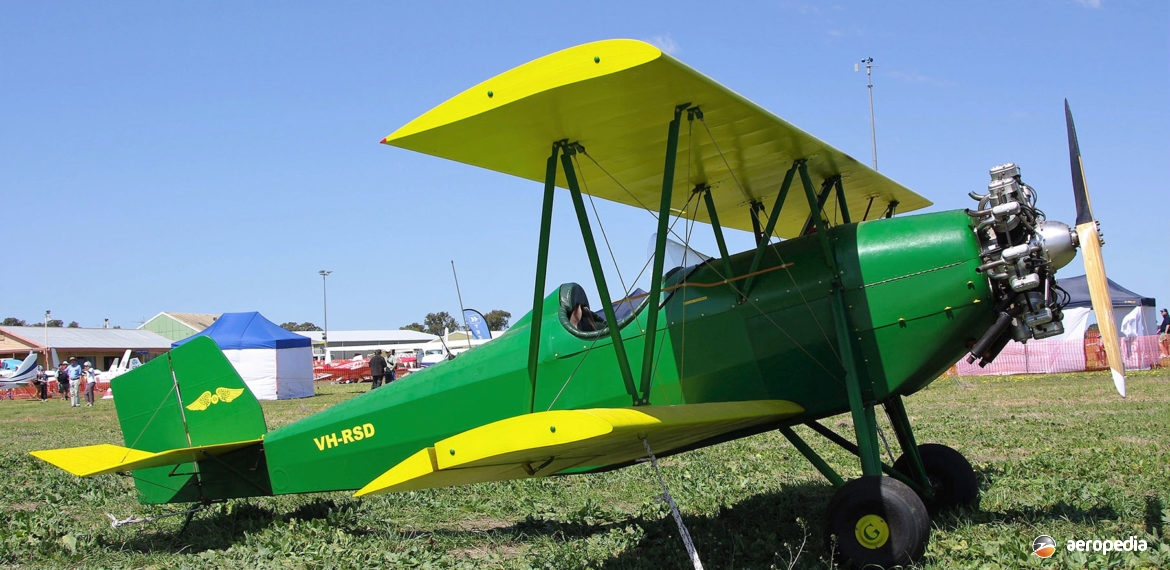
You could always try a Gere Sports Biplane

As you can see, this one was built right here in the recent past in Australia, just outside Cowra. So you can easily get advice. The plane was originally designed for a 1930's Chevrolet engine, but it will accept any modern 4-cylinder engine, or with an Australian made Rotec radial. Attached is the first few pages of the article published in the 1930's. If you want teh rest, which includes planes, PM me.
-
1
-
-
If you would like to see a very little bit of flying by a P40, watch the credits of this movie https://www.youtube.com/watch?v=_AD2KwTe8I8&t=211s and also from time 6:00 to 6:30. Don't waste your time watching anything else. The movie rates a crate of Rotten Tomatoes.
-
We've all got a can of WD-40 in the workshop. It's part of the minimalist toolbox - "If it's supposed to move and it doesn't, WD-40. If it moves and it shouldn't, duct tape."
We tend to think of WD-40 as a penetrating oil to be used to free up corroded fasteners, but although it does a fairly good job of that, it is not a job it was designed to do.
https://www.youtube.com/watch?v=aTD_SBudQfY&t=382s You only need to watch the first 5:45 minutes.
As for penetrating oil, here's what I use - 50% acetone + 50% automatic transmission fluid. It's cheap and easy to make
-
-
Thanks. I check both sites several times a day. I don't want my phone pinging its head off just for forum notifications.
-
2
-
-
Here's a list of possibilities https://en.wikipedia.org/wiki/List_of_winged_horses
I like Jabučilo the legendary winged horse of the Medieval Serb nobleman, lord Momčilo of Pirlitor.
I think that the "c" is pronounced "ch" as in chocolate.
-
How do you unsubscribe from getting emails every time someone comments on a thread?
-
1 hour ago, shajen said:
I did end up buying this aircraft
What's her name?
An air density puzzle
in Student Pilot & Further Learning
Posted
You have confused "inertia" with momentum.
Newton's First Law of Motion provides the definition of "inertia" - A body at rest ..... The amount of inertia a body possesses is solely dependent on its Mass. Mass is the total of the atoms and molecules in the body. Weight is related to mass by being the size of the force a mass can exert when accelerated by the local force of Gravity.
Since Force = Mass x Acceleration, if we put an object on a weighing scale and find that the scale reads 2.35 kilograms, then that is the Force the object is exerting on the scale mechanism. But what is the mass of the object?
Since Force = m.a, and the object at sea level is being subjected to the acceleration due to Gravity (9.81 metres/per second/per second), then
2.35 = m x 9.91
2.35/9.81 = m
m = 0.239 kgs
But for practical purposes, we equate Mass and Weight.
Momentum is the property possessed by an object in motion. Its magnitude is the product of its mass and its velocity.