


old man emu
-
Posts
5,297 -
Joined
-
Last visited
-
Days Won
78
Content Type
Profiles
Forums
Gallery
Downloads
Blogs
Events
Store
Aircraft
Resources
Tutorials
Articles
Classifieds
Movies
Books
Community Map
Quizzes
Videos Directory
Posts posted by old man emu
-
-
No doubt a lot of big bore aircraft engines used reduction gearboxes. The use of propeller reduction gearing was very common during the height of piston engine use in aviation (the 1930s through the 1940s), with essentially all of the most powerful piston engines ever built for use in aircraft being designed to make use of reduction gearing.
A propeller speed reduction unit is used to reduce the output revolutions per minute (rpm) from the higher input rpm of the powerplant. This allows the use of small displacement internal combustion engines to turn aircraft propellers within an efficient speed range. The typical maximum rpm for the propeller—2,500 to 3,000 rpm is considered optimum for an aircraft propeller due to the need to keep the propeller tip speed below the speed of sound.
What you have to do is find the compromise between power and weight. Let's say that to achieve a prop speed of 2750 rpm, for a particular prop length and pitch an engine has to produce T units of torque. From the diagram posted earlier, the torque produced by an engine is the product of the pressure (force) developed by the combustion of air/fuel and the distance the centre of the connecting rod is from the centre of the crankshaft, which is basically half the size of the bore of the cylinder.
If you have large cylinder bores, you will have to have heavier crankshafts than an engine with smaller bores. Likewise all the other bits will have to be heavier in the big bore engine. If you make the engine lighter by using narrower bores (and lighter other bits) it will not be able to make as much torque at the same rpm as the big bore engine because the amount of force developed in combustion is less.
So, how do you get a smaller engine to produce the same torque? You make it rev faster. If you make it rev to, say 5500 rpm you might get the torque to rotate the prop, but the tips might be going supersonic. So you need to fit a reduction gearing to convert engine rpm to prop rpm.
-
On 08/11/2020 at 3:59 PM, skippydiesel said:
The above is by way of illustration of my position – why do we persist with the big bore, slow revving, air cooled, unmuffled (very noisy), thirsty/polluting, aircraft donks that have served us so well but are now an anachronism???
Quite simply because what an aircraft basically needs is a stationary engine capable of producing a lot of torque within a range of low to medium revolutions. Further, by operating at low to medium revolutions, the engine can make use of air cooling better than an engine which relies on low torque and high revs to swing the same design of prop.
The thirstiness is due to the larger cylinder bore and piston stroke that these low revving engines usually have. Don't forget that the torque an engine can produce per expansion event is dictated by the distance between the centreline of the crankshaft and the centreline of the small rod end

As with everything, getting more torque out of an engine is a knife-edge dance as this video explains.
-
16 minutes ago, skippydiesel said:
My point is
Skippy PM me please.
-
There are no stupid questions. Only people too stupid to ask questions.
At least Recreational Flying allows the voices of its users to be heard on whatever topic arises.
-
 1
1
-
-
Compare site names with the names of our newspapers. Take the Sydney Morning Herald. "A herald is an official employed (historically) to make proclamations, carry official messages, and oversee tournaments. - a bit higher up the scale than a town crier. Courier Mail - the information that arrives by courier. The Telegraph - information coming by telegraph. The Advertiser - commercial notices.
Each person has a different need satisfied by a newspaper. Some are more interested in happenings; others in sport; others in finance; others in fashion, and others in the various classifications of advertisements. All of them will reach for the same newspaper and go into it where they wish.
The same applies to this site. "Recreational Flying" implies that the site is concerned with flying for recreation, but look at all the subjects it covers. Does every person visit every part of the site every day? Hardly. But the people who visit here are interested in flying as a recreation.
So count me amongst the faction with strong objections to renaming the site . The site has proved itself able to deal with the evolution of online forums and still remain true to its initial concepts.
If it ain't broke, don't fix it.
-
 1
1
-
-
Is all the flying being done from airports in the "Bush" - that is, not from Metropolitan Airports?
-
15 hours ago, shajen said:
Absolutely agree with you OME.
A woman of great intelligence.
Just remember caveat emptor
-
1 minute ago, turboplanner said:
Better to have a positive thread.
Is the negativity we are expressing a symptom of COVID-itis?
-
Oh dear!
 I have a feeling that this is not going to end well. I see someone who has a pair of rose-coloured glasses.
15 hours ago, shajen said:
I have a feeling that this is not going to end well. I see someone who has a pair of rose-coloured glasses.
15 hours ago, shajen said:that’s something else I never thought of.
I really think that we ought to create a document to be posted here dealing with the the things one should do when purchasing an aircraft and the pitfalls to avoid. It strikes me as crazy that someone would by a piece of machinery, sight unseen and take the word of the vendor that it is 100% (not implying malfeasance by this seller) AND fork out a non-refundable deposit. If a person agrees to pay a non-refundable deposit, that's the contract they entered and there's no way a Court would order the return of the deposit if the subject of the purchase turned out not to be as described, or suitable for purpose.
-
2
-
-
Why crawl around the sky in a slow, flimsy anachronism when you can sit in the "comfort" of your own darkened bed room by the glowing screen of your gaming PC and fly an ultra-modern attack aircraft, shooting and bombing,
-
2
-
-
Is it a generational thing? Are those "middle aged farts" tinkering in their sheds being replaced by "digital-age dynamos"? Remember back to your twenties when an RC plane was balsa with an IC engine and 4-channel 27 Meg radio? Then you got into ultralights which were not much further advanced in design and performance than pre-WWI "kites". What have these "digital-age dynamos" got? Fast, composite airframes with electronics that didn't exist 25 years ago except in top secret military aircraft. Cabins with all the comforts of their ANCAP rated cars. And a need for speed.
Is it a hangarage cost thing? Renting a space in a hangar, or paying for a tie-down outside is dead money. Have a look around where you live and see all the big boats, which probably cost as much as a, RAAus plane, sitting on trailers in peoples' yards. They don't pay mooring fees. If recreational aircraft could be brought home and stored in the backyard, would that increase interest?
The last thing to look at is simply the joy of flying. How many of our flights are long A to B flights where the airplane is a substitute for a car or train? (Who travels long distance by train now?) Recreational flying is for the joy of it. Getting to 1500 ft and pottering along looking at the world below is something to be promoted to the young. It's a way to divorce yourself from the worries and woes of life on the ground; to let the mind refresh itself, and to see that Life has a wider vista.
-
6
-
4
-
-
The one that is in front of me on short final.
-
2
-
1
-
-
The good Professor says he is demonstrating of Bernoulli's principle, but this is incorrect. At 9:27 in the video he is demonstrating the Magnus Effect. It is not the velocity of the air, bit its viscosity - assumed to be negligible in Bernoulli's principle - that is central to understanding the magnitude of the force.
When a body (such as a sphere or circular cylinder) is spinning in a viscous fluid, it creates a boundary layer around itself, and the boundary layer induces a more widespread circular motion of the fluid. If the body is moving through the fluid with a velocity V, the velocity of the thin layer of fluid close to the body is a little less than V on the forward-moving side and a little greater than V on the backward-moving side. This is because the induced velocity due to the boundary layer surrounding the spinning body is subtracted from V on the forward-moving side, and added to V on the backward-moving side. If the spinning body is regarded as an inefficient air pump, air will build up on the forward-moving side causing higher pressure there than on the opposite side.
This video explains it well.
By the way, the Good Professor ignited my love of Science. I remember watching his "Why is it so" program on the ABC.
https://www.abc.net.au/science/features/whyisitso/about.htm#about
-
2
-
-
2 hours ago, turboplanner said:
There are no specification limits on an aircraft, but there is Amenity, which is a part of Planning Law to protect the community, which I just pointed out in the thread above.
I agree with that. The reason I posted the law stuff was simply to point out there are no rules at present for limits on aircraft noise. So if Joe Citizen wants to complain about the passage of aircraft over his house, he would have to look elsewhere for a legal precedent.
It amazes me how many homes back onto railway tracks or freeways and the only thing that those locations do is lower the price of houses and land compared to similar houses and land located in the same suburb, but away for the transport infrastructure. People will still trade off noise for reduced price. Besides I've seen places right beside railway lines that have solved the problem with double glazing.
https://www.lifestyle.com.au/property/selling-houses-australia-series-5-railway-cottage.aspx
Double glazing doesn't seem to be common in residential housing in Australia.
-
The Air Navigation (Aircraft Noise) Regulations 2018 only apply to:
subsonic jet aircraft means an aircraft that:
(a) is propelled by one or more engines of the following kinds:
(i) turbofan engines;
(ii) turbojet engines;
(iii) unducted fan engines;
(iv) rocket engines; and
(b) is not capable of sustained level flight at a speed equal to or greater than the speed of sound.
supersonic aircraft means an aircraft that is capable of sustained level flight at a speed equal to, or greater than, the speed of sound.
There does not seem to be anything else in those regulations applying to aircraft with an MTOW less than 5700 kg.
The Airports (Environment Protection) Regulations 1997 do not apply to:
(a) pollution generated by an aircraft; or
(b) noise generated by an aircraft in flight or when landing, taking off or taxiing at an airport.
So basically, there are now laws governing how much noise an aircraft with a MTOW of less than 5700 kg can make.
No Law - No Offence.
-
The thing about aircraft engines and noise is not so much the noise itself, but the stupidity of the whingers.
For long periods of a normal flight, the engine noise is at a constant level. The changes one hears on the ground are due to the Doppler Effect (remember approaching trains?), but I won't go into that Effect. I agree that the aerobatic types are the ones who make the most noise variation whilst dancing in the sky, but not every plane is doing aerobatics.
Sensible newcomers to the vicinity of an established airport would be expected to do some investigation into the drawbacks of the location and noise is one factor. For example, if someone came to looking to buy my house in the middle of the day during the week, you'd think it was a nice quiet street. But come the peak hours, or weekends and some nights of the week, the vehicle noise can be horrendous due to cars with loud exhausts revving hard. Not to mention to clowns doing burnouts. The same goes for aircraft noise or train noise.
The people who complain about noise are most often those who haven't had the sense to make these enquiries so they whinge when they realise that they haven't got the piece of paradise they thought they paid a motza for.
-
2 hours ago, facthunter said:
A vacuum is Essentially a place devoid of matter. Hard to achieve but there's no little vacuums and bigger ones
OK. I agree that a true vacuum is a place, be it a bounded by walls, as in a light bulb, or outside the boundaries of astronomical bodies. Your definition is a little bit like being pregnant - you are, or you are not.
-
We should really be talking about Manifold-air Density.
2 hours ago, facthunter said:MP going higher for any reason will increase the torque you can get, other things remaining equal.
I agree with that. Increase MP > increase fuel/air mass > increase in pressure on the piston head from from combustion > greater torque on the crankshaft. Greater torque applied at a given rate (RPM) gives greater power.
-
1
-
-
3 hours ago, old man emu said:
Vacuum means any volume containing less gas particles, atoms and molecules (a lower particle density and gas pressure), than there are in the surrounding outside atmosphere.
32 minutes ago, facthunter said:You won't get a vacuum in the inlet manifold, unless you are in space
You'll get close to a "perfect" vacuum in Space, but we won't get a perfect vacuum in a manifold. We know from observation and experience that we will have a bit of a vacuum because the pistons are increasing the volume of the cylinder on the induction stroke. We know that "vacuum" is a relative term. It is zero when the number of gas particles at the measuring point is the same as the number is the outside atmosphere. As the number of gas particles deceases at the measuring point, the difference between outside and inside is called "vacuum", and is usually reported (shown on a recording device) as a smaller value than the outside air pressure -a negative sense. (Without getting into a discussion of "Boost", it is essentially the measure of variation above the outside air pressure - a positive sense).
How this measurement of the mass of air being drawn into the cylinder is important in engine performance is dependent on the stoichiometric ratio of air and fuel. Note that here we use the term "air" to mean all the various gases whether combustible or not. The main combustible gas under normal temperatures is Oxygen, which constitutes only 21% on average. The other 80-odd% of gases in the air mass don't help produce power.
The theoretical perfect stoichiometric ratio between the mass of air in a cylinder and the mass of fuel for petrol is 14.7 units of air to 1 unit of fuel. Any mixture greater than 14.7:1 is considered a lean mixture; any less than 14.7:1 is a rich mixture. In practice the ratio is 14.1:1.
Note that the stoichiometric ratio is calculated from the mass of air. When air is sucked into the manifold, it attains a velocity. Mass x velocity = Force. Force/Area = Pressure. Therefore, Pressure is related to air mass, which is related to the stoichiometric ratio of the fuel/air mixture, which results in the release of energy, and energy x time = power.
I still don't know Why is less manifold pressure required for a given power setting as altitude is increased? Is the question worded correctly? Should it be this? "Why does manifold pressure reduce with increase in altitude for a given engine RPM/power output?"
-
We are talking about an engine that is maintaining RPM despite moving into lower pressure air (gaining altitude). Does that imply that there is a CSU involved and that it is adjusting the pitch to maintain RPM?
Tell me. If a prop has a certain pitch to RPM configuration for cruise at sea level, does the pitch get coarser or finer for the same RPM when cruise is at higher altitudes?
Once again we are being bamboozled by words - the Humpty Dumpty Effect.
When we use the word "pressure" we imply an application of Force. We increase the air pressure in a tyre and it forces the tyre casing against the ground. The Boss piles our desk with work and we feel pressured. When it comes to the present topic, air pressure relates to the mass of air in contact with an area of material. Since this mass of air is acted upon by Gravity, it has a force proportional to the to the area - hence we use pounds per square inch, or Pascals, which is the pressure exerted by a force of magnitude one newton perpendicularly upon an area of one square metre. That's a small value, so we use Hectopascals (hPa) which is 100 Pascals.
In an engine we are trying to measure how the mass of air that the sucking pistons are removing from the intake manifold. Vacuum means any volume containing less gas particles, atoms and molecules (a lower particle density and gas pressure), than there are in the surrounding outside atmosphere. So what we are really trying to measure is a vacuum.
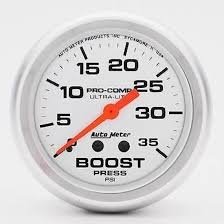
The term "Manifold Pressure" gives a mental picture of a strong Force. This picture is based on our experience of tyres, toy balloons and pressurised spray cans. In order to understand what we are actually measuring we should refer to that gauge as a Manifold Vacuum Gauge. Maybe it should also be graduated from a starting point of Zero and ending somewhere about 35 ins Hg. Picture is a Boost Gauge used to measure increased pressure due to the function of a turbo or supercharger. The principles that make it work can be reversed to allow it to read manifold vacuum. Engine manufacturers could then produce performance tables of Manifold Vacuum/RPM combinations for various power outputs.
-
2 hours ago, Thruster88 said:
the purpose of the chart is to set power in my RV6-A.
I thought so. It's a reference chart that you can pull out of your bag while flying and use it to bring the needles on the dials to the figures that will give you the power you want.
Now to answer the question. Why is less manifold pressure required for a given power setting as altitude is increased?
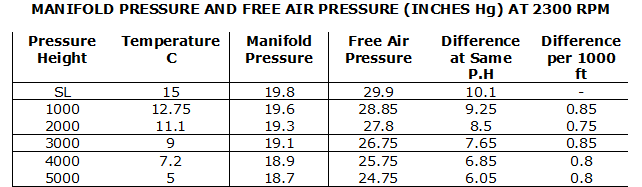
Here is a chart made from one column of data: 100 HP at 2300 RPM
At sea level, the air pressure in the International Standard Atmosphere is 29.9 inches of mercury (Hg). We know that the moving pistons reduce the pressure in the cylinders, producing a lower air pressure in the fuel intake system. If the engine is running at a steady 2300 RPM at sea level the manufacturer tells us that the manifold pressure will be 19.8 ins Hg. The difference between the pressure inside the manifold and the free air outside it is 10.1 ins Hg.
Now let's get up to circuit height in the same atmosphere. The air is less dense, so the engine at 2300 RPM can only reduce the air pressure to 19.6 ins Hg. However, at the same time the free air pressure has dropped to 28.85 ins Hg. The difference between inside the manifold and outside is 9.25 in Hg. The difference between inside and out at 1000 ft compared what that difference is at sea level is 0.85 ins hg.
As we gain altitude, both Manifold Pressure at 2300 RPM and the outside air pressure drop. HOWEVER, if you look at what happens as the aircraft goes higher, you can see that for each 1000 ft rise in altitude, the difference between Manifold Pressure and Free Air pressure from one height to the next remains at a constant 0.8 ins Hg. (Allowing for rounding errors in the published data and in the values calculated from it.) The difference is made constant by opening the throttle body more and more as the plane goes higher, until the throttle plate is in its full open position. That is one of the determinants of the service ceiling of a fixed pitch prop aircraft. The constant speed propeller lets the pilot "change gear"
Why is less manifold pressure required for a given power setting as altitude is increased? The question needs to be: "Why does manifold pressure reduce with increase in altitude for a given engine RPM/power output?"
-
2
-
-
Facthunter, I must disagree with this:
39 minutes ago, facthunter said:the throttle, by being able to restrict the flow can reduce the MP.
When the throttle is "closed" the pipe through the carby and into the manifold is closed. Air cannot move. Therefore the pressure in the manifold will approach the value of the outside air pressure. As the throttle opens, air begins to move through the tube and since pressure is inversely proportional to fluid velocity, the pressure drops. Because the pressure inside the manifold is less than the pressure of the surrounding atmosphere, air pushed in from outside and moves faster past the fuel jet, taking more fuel into the cylinder thus producing more power.
You'll notice in the table presented that at some time we reach full throttle open, so the manifold pressure cannot get lower at that particular density altitude. Also, I think that Thruster might be misunderstanding the purpose of the table. To me it is a quick reference for RPM and manifold pressure setting required to obtain a desired power and fuel burn rate at various altitudes from a CSU equipped engine/propeller combination.
-
After some more thought and research:
The maximum power that can be developed, in the cylinders of a particular piston engine, increases or decreases directly with the density of the air in the intake manifold, and air density decreases as altitude increases — or temperature increases.
Power produced is proportional to the air density at the intake manifold, the cylinder displacement and compression ratio, the number of cylinders, and the rpm. Of those items, only the air density at the intake manifold and the engine rpm alter, or can be altered, during flight. With a normally aspirated engine and a propeller whose pitch is not variable in flight, the throttle controls manifold pressure, which then determines rpm.
Density is directly proportional to pressure. As pressure decreases, with temperature constant, density decreases. Air density will decrease by about 1% for a decrease of 10 hPa in pressure.
-
The ASI

-
1
-


Nostalgia
in Aircraft General Discussion
Posted
Have a think about that recurring question we get here about buying an airplane. You can tell from the way these questions are framed that the buyers really don't know much about the engines in the airplanes they are looking to buy. They are like people who go to by a car, not really being knowledgeable about the engine and transmission, but knowing a great deal about the trim options and accessories.
So how many people buy an aircraft based on engine displacement and torque development?