


old man emu
-
Posts
5,297 -
Joined
-
Last visited
-
Days Won
78
Content Type
Profiles
Forums
Gallery
Downloads
Blogs
Events
Store
Aircraft
Resources
Tutorials
Articles
Classifieds
Movies
Books
Community Map
Quizzes
Videos Directory
Posts posted by old man emu
-
-
Just now, Chris SS said:
Very interesting. Thank you for sharing.
My pleasure. Too bad the documentary is not readily available. It was one of the better US produced ones.
A point to note: sometimes people say that the Hindenburg collided with its mooring mast. That is not correct. The error comes from the camera viewing the airship with the mast between the camera and the airship. If you watch most of the films, the airship was out in the open field when the fire started and it remained out there.
-
2 hours ago, kasper said:
your analogy falls down instantly as it’s not a question of practical management but legal jurisdiction that applies
Thruster's post giving a real example does clarify the jurisdictional issue. Basically, in the case that Thruster described, Joe Citizen could have done exactly what the RAAus did and reported straight to CASA. This shows that RAAus has no authority.
43 minutes ago, jackc said:We can’t buy printed copies of these manuals
A good case in this digital age for the manuals to be made available in pdf format so that people could have ready access to the contents. I'm always going to the State and Federal sites to access Acts and Regulations, but you do hove to know what you are looking for to find the correct bit of legislation.
-
Is it possible that once we develop ways of applying renewable energy to moving people and goods around the place, then what we use from decomposed dinosaurs for doing that job would be used for making recyclable products like the multitude of plastics and fibres. We would still be pulling oil from the reserves, but at the end of their useful life, a lot of products could be recycled. There will be losses, but the rate of loss wouldn't be as fast as it is by burning oil and coal for power.
-
 1
1
-
 2
2
-
-
An interesting submission, which seems logical - 320kg MTOW limit in 95.10 and the aircraft is out of RAAus jurisdiction. But how does that compare to this situation in the Law: Speed limit is 100 kph. You do 110 kph. Has the Law the power to punish you?
I'd like to put the argument that in the example of MTOW of aircraft, the RAAus is like a stockman working the flank of a mob of cattle. While the mob moves as a compact herd, the stockman does not have to react, but as soon as one beast moves out of the mob, it's his job to push it back.
The power of the RAAus is to ensure that the mob stays together, and to push breakaways back. That can be done in a number of ways from a warning to handing over to CASA for the full works. That leaves CASA to concentrate on other areas of licensing and maintenance, where they now only seem to be worrying about fare-paying users, both passenger and freight.
-
1 hour ago, onetrack said:
I believe CBT will have a "marketable" battery,
It will be a big win if they can do it. There's many a step between concept and completion. No doubt our Federal Government is keen to provide support if simply in the way of tax concessions, he said with a ironic grin.
-
1
-
-
The destruction of the airship Hindenburg was probably the first disaster reported by public radio broadcast and filmed as it happened. Initially there were thoughts that it was an act of sabotage, but both the USA and Germany (at that time Nazi Germany) agreed that sabotage could be ruled out. Since then a number of hypotheses have been propounded as to the cause of the ignition.
The Hindenburg the Graf Zeppelin we well-used aircraft with lots of safe hours of operation. The only real safety concern was that the lifting gas was hydrogen. The USA was the World's producer of the inert gas, helium, but would not sell it to Germany. The Zeppelin company had over 30 years' experience with handling hydrogen, so they had covered the foreseeable risks.
It is known that the Hindenburg was out of trim as it approached its destination. It was down at the rear. The obvious cause of this was that it was loosing the lift from hydrogen in the rearward gas bags

It doesn't seem that the rate of leakage was anything like a bursting balloon, more like a slow leak in a tyre for a nail. So within the body of the aircraft, there was a mixture of air and hydrogen, which is highly combustible. But for that to happen, there needs to be an ignition source.
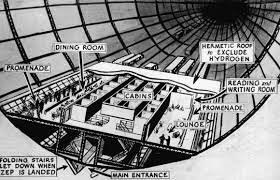
Passengers and crew were carried in an hermetically sealed area, under the gas bags. In any case, one would expect the leaked hydrogen to concentrate in the upper regions of the body. Crew members could move through the aircraft as they carried out their duties, but they would have been trained in safe work practices.
As the Hindenberg was approaching its destination, it had to go into a holding pattern because wind and rain were preventing an arrival. So, the outer covering was wet from the rain. Also, any object moving through the air, and the Hindenburg's flight had been about two and a half days, will develop a static charge on its surface.
As the aircraft approached the mooring tower, the crew dropped two ropes to the ground crew. It is the electrical behaviour of these ropes that is a factor in the creation of the ignition source.
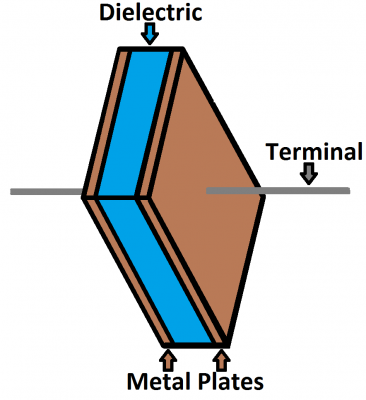
The most recent hypothesis for the creation of the ignition source is based on the properties of an electrical capacitor. A capacitor is basically two conductors separated by an insulator.
In the case of the Hindenberg, one of the conductors was the airframe, and the other was the aluminium powder contained in the dope that was applied as a final coat to the aircraft covering. The hypothesis is that when the ropes were dropped, they completed and electrical circuit between the statically charged airframe covering and the ground.
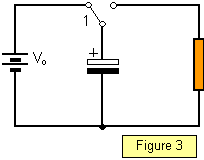
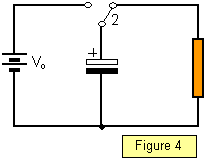
We can describe what happen this way. The voltage, Vo comes from the static electricity present on the aircraft. The "1" is a "switch". The white rectangle is the outer covering, and the black rectangle is the airframe. The orange rectangle is the ropes going to the ground crew.
While the aircraft is in the air the static electricity can't go anywhere. As soon as the switch is closed in position 1 the battery is connected across the capacitor, current flows and the potential difference across the capacitor begins to rise but, as more and more charge builds up on the capacitor plates, the current and the rate of rise of potential difference both fall. . Finally no further current will flow when the potential difference across the capacitor equals that of the supply voltage Vo. The capacitor is then fully charged.
As soon as the switch is put in position 2 a 'large' current starts to flow and the potential difference across the capacitor drops.. As charge flows from one plate to the other through the resistor the charge is neutralised and so the current falls and the rate of decrease of potential difference also falls. Eventually the charge on the plates is zero and the current and potential difference are also zero - the capacitor is fully discharged. Note that the value of the resistor does not affect the final potential difference across the capacitor – only the time that it takes to reach that value. The bigger the resistor the longer the time taken.
And therein lies to clue to what actually happened. The landing ropes were made of Manilla hemp, not highly conductive, so their initial resistance was high. As the ropes were wetted by the light rain, their resistance decreased until at some point the voltage stored in the "capacitor" was high enough to jump the air gap between the outer aluminium-containing outer covering and the metal airframe which was attached to the landing ropes.
The spark ignites the hydrogen/air mixture adjacent to the spark and the subsequent flame front moves thought the airspace around the gas bags, igniting the hydrogen/air mixture in the same way that a flame front moves across a cylinder in the combustion stroke of an internal combustion engine.
This edited film shows the lead up to the start of the destruction with the dumping of water ballast and the dropping of ropes. Unfortunately, it doesn't show the escape of the flames from the rear of the fuselage before the flame front moves forward as the front of the aircraft pitches up due to the buoyancy of the forward gas bags.
This "capacitor" hypothesis was the subject of a documentary which was broadcast in Australia on 11/4/21. As part of that documentary, after displaying that the hypothesis was sound, the scientist conducting the investigation calculated how long it would take a capacitor the size of the Hindenburg to charge up. He obtained a time of 4 minutes and a few seconds. Coincidentally, that was the time between the dropping of the ropes and the first signs of fire.
There have been other hypotheses as to why the aircraft was destroyed in just 90 seconds. That's a tale for another time.
-
3
-
 1
1
-
-
There's nothing much on the 'Net about the Cape Bouvard Investments battery. However, it does not seem that the idea is Sarich's. https://www.sciencedaily.com/releases/2021/03/210322091632.htm
Regardless of who came up with the idea, the end product is a big advancement with estimates that such a battery could reach an energy density of 75 Wh/kg and a stiffness of 75 GPa. This would make the battery about as strong as aluminium, but with a comparatively much lower weight.
-
1
-
-
3 hours ago, Thruster88 said:
So our electric cessna 210 could have a 420kg battery providing 67kwh of stored energy with current battery tech.
A cessna 210 in cruise at 65% power is producing 146kw. The battery would last 27 minutes.
What type of battery are you getting the value from? Can you give a reference for that value of stored energy?
Today you are most likely to be correct, but tomorrow?
-
There will always be problems to overcome. I doubt if anyone here is on the crest of the wave in the area of battery science. However, if we know anything from living through the past 50-60 years is that, given a problem, engineers in various fields have solved, or made great strides towards solving them. Let's leave out medicine because animals are too variable to get consistent results from all the time.
Here's a 260 kW (330 hP) electric motor for aircraft developed by Siemens that weighs 50 kgs. https://www.greencarcongress.com/2015/03/20150324-siemens.html
A Continental IO-520 (375 hp) weighs 220 kg.
A C-210 carries 330 litres of fuel (250 kg). If you replaced the IO-520 with a Siemens motor you would have a further 170 kgs for energy storage. You would also be able to dispose a a few kilograms because you would not need a liquid fuel system.
As Rachel Hunter said in the Pantene ad, "It won't happen overnight, but it will happen."
-
2
-
-
I've used overhead projectors with the image projected onto a sheet of paper on a wall. They still make these things
-
Here's an idea that might be worth following up.
We have been talking about engines that develop their power from burning petroleum distillates. Why not have a look at the possibility of replacing those types with electric motors in propeller-driven aircraft? Obviously, the the research has to go into battery technology, but that is a field that is currently (no pun) producing great leaps forward in electrical power storage.
An electric motor isn't affected by air density as the fuel burner is. Therefore you don't need all the ancillary add-ons like carby, exhaust, spark generation system and cooling(?). You could trade those weights for a bigger motor. You could look at using ducted fans instead of the usual propeller. Battery packs might be more resistant to gunfire damage.
Let's say that a big aero engine burns 80 gallons of fuel per hour. That means that the logistics of getting fuel from refineries to airfields in distant places have to be overcome. With electric powered aircraft, you only need a electricity generator mounted on a semi-trailer and a companion fuel tanker for the generator. How long would a generator run on 30,000 litres of diesel fuel?
If the aircraft were for defensive use, then range would not be such a problem. The Hurricanes and Spitfires of the Battle of Britain only had a range of about 200 nautical miles. That's plenty to defend against an invading force attacking a coast.
-
21 minutes ago, APenNameAndThatA said:
OP stated “Mr FV is not computer savvy”
-
1 hour ago, onetrack said:
You're going to have to bite the bullet and pay the $195 for the 18M roll of fade-out drafting paper
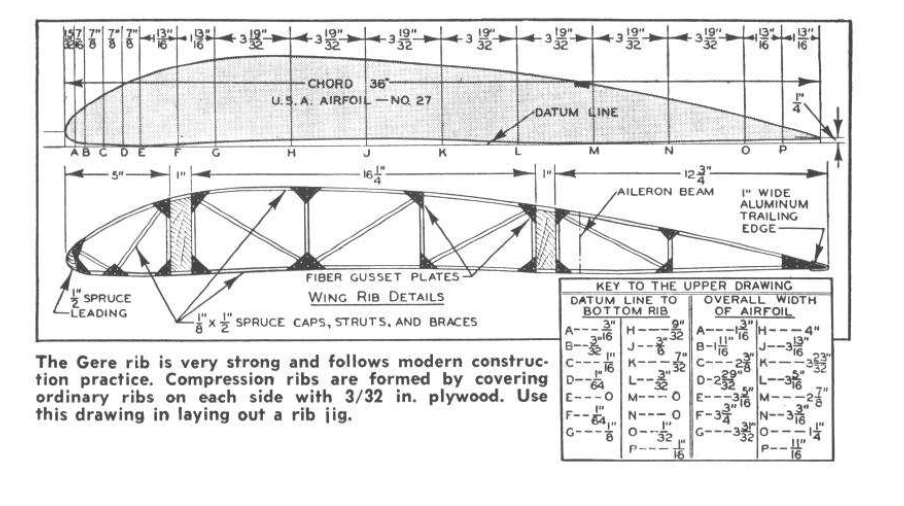
A bit OTT. The wing rib plan I posted above is only 36 inches long - and I wouldn't dare convert the measurements to metric. Sometimes when building off old plans you have to keep to cubits or things go out of design.
You could draw it out using a CAD program, then have an architect office print it up for you. That's what I did. For a few simple CAD jobs you could use one of the free CAD programs. FreeCad is supposed to be the best of these. https://freecadweb.org/
-
1
-
-
What is the length of the chord of the aerofoil? That is going to govern how long a piece of paper you want.
I plotted this rib from the co-ordinates
You don't really need graph paper. Just set a datum line and work from that.
This is what I ended up with
-
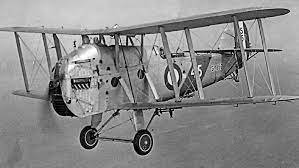
When experience gained in WWI showed that the aircraft carrier was an essential component of the 20th Century Navy, the British issued Specification 3/21 for a carrier-based fleet spotter and reconnaissance aircraft. Two companies, Blackburn and Arvo submitted entries. The aircraft were remarkably similar in appearance and could have had roles in a Christmas pantomime as the Ugly Sisters.
This is the Blackburn R1 Blackburn
and this is the Avro Bison
Here's a video about the Blackburn https://www.youtube.com/watch?v=tow1xHV_knI
-
Would this be a better place than the earlobe?
-
 2
2
-
-
We don't often get to see in detail the weaponry used for aerial gunnery in WWI. This video shows the American version of the Lewis gun and describes the features which made it functional for aerial use. Of special interest is the way in which the movement of the sights compensated for the movement of the operator's aircraft. The second video shows the gun being used on the ground. The only thing it doesn't show is the removal of the magazine, which is explained in the first video.
-
Alf Traeger was the person who created the pedal wireless, which provided the necessary communication method between those needing help and the RFDS.
Sidney Cotton, immediately prior to WWII, used his private plane to take photos of Luftwaffe airfields. In fact on one occasion he was flying around with a high ranking Luftwaffe officer who was virtually sitting on top of Cotton's hidden camera as it took photos. When the war started he established the RAAF's Photo Reconnaissance Unit. He was a bit of an Aussie rogue who would have been at home amongst some of the Corporate crims we know today.
-
1
-
-
What as the torque on those cylinder base nuts? 50 N.m or 50 lb.ft?
-
I think that the Aeronca C 3 is such a cute little plane. It reminds me of Bertie, the Aeroplane Jelly plane
http://media1.aso.gov.au/titles/ajbertae/ajbertae1_.jpg
Here's some more video of G-AEFT flying around Cornwall.
-
It's a simple thing to forget to secure your helmet's chin strap if you are thinking about other things. I caught myself in that position recently on my motorbike.
-
3
-
-
It seems the experts (physicists) can't even come up an all inclusive definition of "mass". From https://physics.stackexchange.com/questions/192564/why-is-the-definition-of-mass-and-matter-interlinked
About the proper definitions, mass actually has three, but these are not very proper too:
The inertial mass of an object is its resistance against acceleration by force.
The gravitational mass of an object is the object's tendency to be attracted by a gravitational field.
The relativistic mass is the mass of the total energy stored in a system, where mass is simply defined by the relation E=mc^2 to be a physical quantity directly proportional to energy, by a factor of c^2=89875517873681760m^2 s^-2It would appear that when "weigh" something, you are noting its gravitational mass, which is where the F = ma comes in, and your answer is in newtons. When you try to move an object, you are dealing with inertial mass, which is also F = ma, but in this case "a" is not the acceleration due to gravity, 9.81 m/s^-2. It is something less. That's clear if you want to push a car along a flat road. You only have to overcome the friction in the wheel bearings and the tyre contact patch, which is usually taken to be about 0.01 x 9.81 etc. or less in total.
The relativistic mass is related to the number of particles (atoms) you have in your lump of matter. Those atoms have the energy, so you can work out the mass if you know the energy released by its fission. Efficiently burning 2100 litres of petrol would produce the same amount of energy as fission of 1 gram of uranium, so I guess this method of determining mass is more theoretical than practical.
-
1
-
-
Our duly elected leaders have listened to the experts and committed us to paying billions for underdeveloped jet-powered military aircraft. For those billions we will get a few dozen aircraft, that any belligerent country would aim to destroy in the first few days of an attack on our land. After that, an enemy force could land under the cover of its own airforce. The professional military learns from History, and the best lesson was D-Day where complete air superiority allowed the Allies to direct their attention only at land forces.
Shouldn't Australia review the likely type of opposition we would face in the event of an invasion, and seek ways to deal with ground forces from the air? I believe that for the billions of dollars ear-marked for the purchase of a few jet aircraft we could build up a large force of simpler aircraft for anti-invasion work. As a stop-gap measure in WWII, we were able to quickly develop a fighter plane to build our numbers. We were lucky that we quickly received more suitable aircraft to deal with the air war, but those fighters we built still played an important role in the ground war as spotters and attacking ground targets.
What were those fighters? The Boomerang. What was it? A medium sized aircraft fitted with a now inefficient engine, but armed with two 20mm cannon and four 303 machine guns and able to carry a small bomb load. While the airframe design could be resurrected, a modern version would need a new type engine - realistically a turbine. Modern weaponry in the form of air-to ground missiles and cannon could be fitted. By aiming for simplicity, aircraft like these could be produced for a fraction of the cost of big, fancy, keeping-up-with-the-Joneses jets. The rigged design of landing gear would better suit these small aircraft to rough, temporary air strips that could be marked out in the event of an invasion and a need to get aircraft close to the front line.
Such aircraft have been developed since WWII. One of these is the PA-48 Enforcer. https://en.wikipedia.org/wiki/Piper_PA-48_Enforcer
-
2
-
1
-
-
I asked Ian to close the original thread.
Do you think that if a few of you asked for this thread to be closed, that he would? I think it should as it's going nowhere.



 and this is the Avro Bison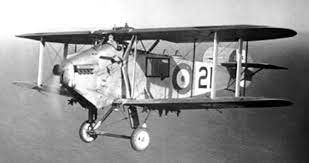
The destruction of the "Hindenberg" - a new theory.
in Aircraft Incidents and Accidents
Posted
That was one hypothesis, but during the documentary is was said that if the doped covering was the cause of the spread, then the fire would have burnt for many hours. If you watch the spread of fire you will see that the flame front moves internally from the rear to the nose. In fact, in the latter part, you can see the flame front venting out of the tip of the nose before the skin rearward is engulfed in flames.
Can you recall back in high school science generating hydrogen in a test tube, then igniting it? The hydrogen and oxygen combined as the flame front moved down the test tube. The combustion products and inert content of the air were pushed out, creating a vacuum at the bottom of the tube. As the last of the gases left the tube, air under pressure rushed in, making a popping sound that is what you hear when you pull a cork from a wine bottle. The airframe covering, being relatively tough and tear resistant, acted like the walls of the test tube, confining the flame front inside the body. That's why you see the flame front moving inside the body. The hydrogen autoignition temperature, the temperature of spontaneous ignition in air, is 500 °C (932 °F). The plasma temperature of a spark discharge is almost 5,000-6,800 C.
The dowels, were placed on the metal frame in order to keep the fabric from chaffing. Much like the way we put tapes on the top edge of wing ribs before fitting the covering. An unforeseen consequence was that the dowels created an air gap between the metalised covering (due to the aluminium powder in the final dope coating) and the metal frame. That air gap was the dielectric that allowed the whole airship to become a capacitor.
What benefits did we get from study of this disaster?
Although not recognised as a factor in the disaster until this hypothesis, we have long had a recognition of static electricity, and this has resulted in the use of anti-static wicks on the trailing edges of wings and tailplanes. Another is that we ensure that when refuelling, we attach a grounding lead to the aircraft to discharge any static electricity.
If you have a fabric covered aircraft, then it would be wise to attach anti-static wicks, and maybe even drag an anti-static wire from an undercarriage leg. Back in the day when the harbour Bridge toll was collected manually, there were earth wires sticking up from the roadway that scrapped the underside of vehicles, discharging static electricity before the toll collectors got zapped.