
Thruster88
-
Posts
3,696 -
Joined
-
Last visited
-
Days Won
83
Content Type
Profiles
Forums
Gallery
Downloads
Blogs
Events
Store
Aircraft
Resources
Tutorials
Articles
Classifieds
Movies
Books
Community Map
Quizzes
Videos Directory
Everything posted by Thruster88
-
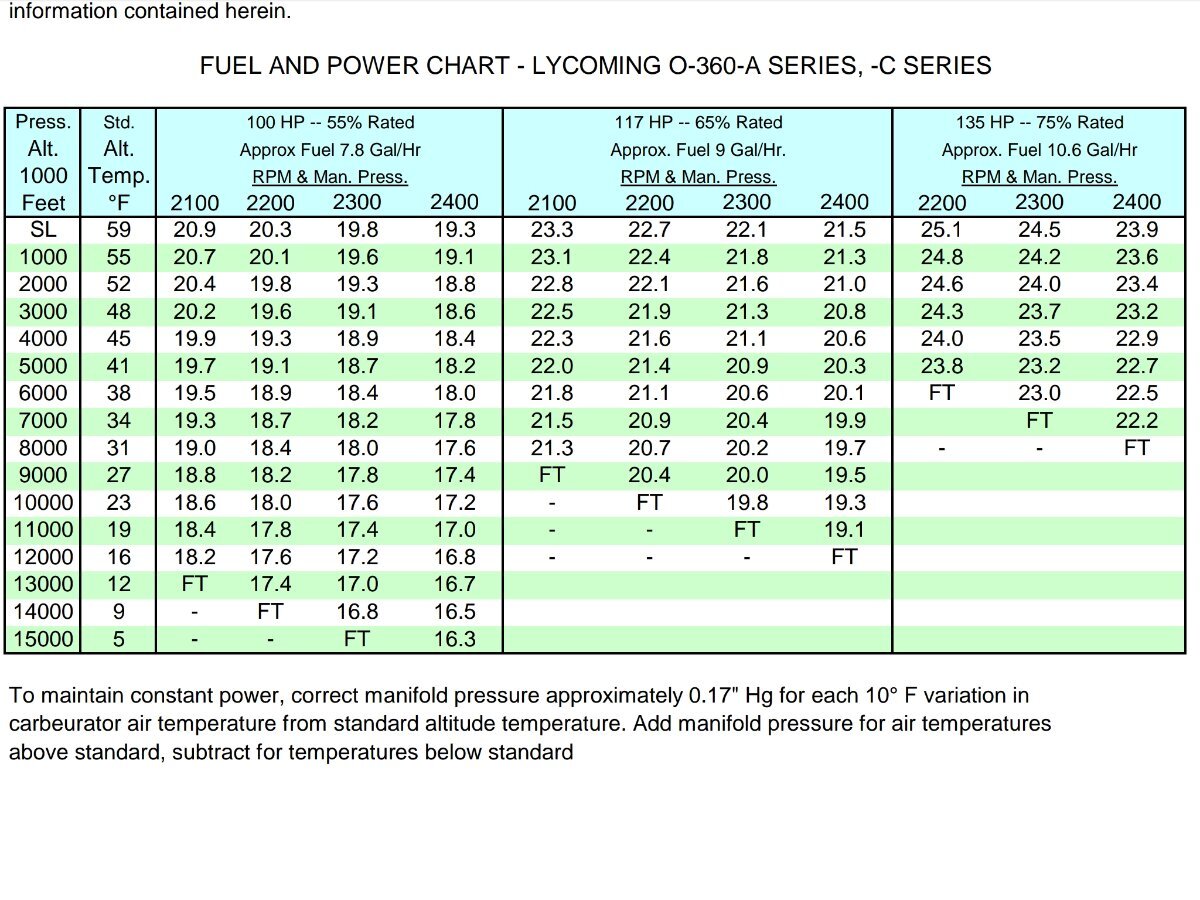
Skippy, not seeing altitude on any of the rotax charts you have put up. As you can see from this Lycoming chart there are numerous combinations of RPM (prop control), manifold pressure (throttle) and altitude to achieve a known fuel flow/performance.

-
To make use of your manifold pressure gauge you would need a power chart. Such charts for say a Lycoming O-360A1A will include altitude, rpm, manifold pressure and show fuel flow for each setting. 23-23 @3500 feet is not the same power as 23-23 @5500 feet. Rotax do not seem to publish such charts, good luck finding one.
-
There is a similar story involving a Lycoming and some dodgy oil hoses on an experimental Osprey In the hunter valley nsw. Collision with terrain involving amateur-built Osprey 2 amphibian aircraft, VH-WID, near Maitland Airport, New South Wales, on 17 May 2020 | ATSB WWW.ATSB.GOV.AU
-
The only requirement i can find for remote areas is to carry survival equipment, MOS 26.64. Remote area survival equipment (MOS 26.64) An aircraft that is flying over a remote area is required to carry appropriate survival equipment for sustaining life for the area that is being overflown.
-
Eprop now doing GA direct drive props
Thruster88 replied to Kyle Communications's topic in Engines and Props
Launch price for 3 blade to suit 180hp RV is only $7500 aud? without tax and spinner, they should sell very well. -
Security demands (further) threaten regional RPT
Thruster88 replied to Garfly's topic in AUS/NZ General Discussion
The extra screening is reqired for aircraft with more than 36 seats because terrorists will not fly on those "little" aircraft. Makes perfect sense yes. -
Twins most often go down because of a thing called Vmc roll over.
-
Sure, more weight in a 40,50:1 LD glider will make them go faster, they are powered by potential energy after all. More weight in a powered aircraft = less climb rate, less cruise speed for a given power setting so less effcient.
-
No definitive answer yet. The cruise performance chart for my muskeeter shows maximum range is achieved at the highest altitude in the chart, 10500 and the lowest power setting, 50%. 784nm in 8.6 hours. No wieght is stated so presume this is at MTOW. Higher power at lower levels reduces range by 130 nm.
-
Horizontal stabilizer has to push down more than usual so more lift on main wing required so more drag from wing and tail, more load on wing results in higher stall speed.
-
Crossover pipe of Rotax 912 Carbys
Thruster88 replied to Blueadventures's topic in Engines and Props
A little bored atm so i thought why not calculate the maximum force on the carb bowl of a Rotax 914, 6 years in development and now 29 years in production, unchanged, i would call that a succsess. So standard 912 80hp carb inlet pressure at sea level = 15psi. 115/80 x 15 = 21.5 psi approx required to make 115hp. This engine has a critical altitude of 16,000 feet. At 16,000 feet atmo pressure is 7.96psi. So 21.5 - 7.96 = 13.54 psi pressure differential. Carb bowl is approx 2.25 x 2.5 inches = 5.625 sq in x 13.54 psi = 76lb or 34.5kg. Feel free to point out anywhere i have gone wrong. I did this in imperial units for skippy's enjoyment. From above posts, the boost pressure is in both the carb throat and bowl area so flow thru the jets is not affected as one might think. -
Interesting point in the vid, "why dont manufacturers just limit the elevator travel so it can not reach stalling stick position". I believe this was done with the Ercoupe.
-
Not sure what you are trying to say here. Having done differential leak down tests with calibrated equipment on jabiru, rotax, continental, lycoming and pratt&wittney radial engines, repeatability and fault finding is excellent.
-
Lycoming have 12 year calender tbo. On condition is alowed by CASA for for private or airwork (flying trainig).
-
In Australia factory built aircraft, cessna 172 or Brumby or Tecnam cannot become experimental VH or 19-xxxx raaaus aircraft. CASA is the regulator of aircraft in Australia. A 19-xxxx can become an experiment VH or the other way if mtow is ok.
-
MARAP is what is called an Engineering Order in casa land. I am guessing people who do Engineering Orders for GA aircraft modifications have insurance in case they are sued. Most of the cost is probably legal liabilty insurance.
-
Here is an example of an automotive engine conversion with a mode of failure that should have be so obvious. No fault in the core engine, one wreaked aircraft. *** Final Report *** N15180 Titan T-51D Ashtabula, Ohio 06 JUL 2021 1 No Injury Pilot Flight Time: 8000 hours (Total, all aircraft), 4000 hours (Total, this make and model) The intent of the flight was to perform fuel flow and fuel indicator checks on the newly built airplane while taxiing on the ground; however, they were not able to obtain full engine performance on the ground and the pilot elected to take the airplane into the air. After takeoff, while climbing through 200 ft above ground level (agl), the engine lost power. The operator reported that the engine computer circuit breaker had tripped which resulted in the loss of engine power. The pilot attempted to reset the circuit breaker and restart the engine without success. The airplane landed hard on the runway and the left main landing gear collapsed. The left wing sustained substantial damage. A postaccident examination showed that the oxygen sensors used to tune the engine were left on the engine’s cylinder exhaust pipes during the flight. The sensors drew power from the engine’s control computer. During the initial climb, the increased electrical demand to run the oxygen sensors at maximum engine power exceeded the 15-ampere limit on the engine’s control computer, its circuit breaker to tripped, and the engine lost power. Probable Cause and Findings: The tripped engine control computer circuit breaker caused by an excessive electrical load on the system, which resulted in a complete loss of engine power during the initial climb.
-
Can we stick to aviation, there are other places to talk crap.
-
Flew to Tumut for their breakfast which they have on the 3rd sunday of every month. TAS165 in the RV speed machine, no time for pictures. Love the differences between the thruster and RV.
-
Six Aviation Bluetooth Headset Interface
Thruster88 replied to skippydiesel's topic in Instruments, Radios and Electronics
I have litespeed sierra, very happy. -
Four ways to get in a spin • C150 demo by Phil Unicomb
Thruster88 replied to Garfly's topic in AUS/NZ General Discussion
I liked the vid of them showing stalling stick postion and spinning the Piper t tail tomahawk, no trauma. -
I seem to remember some time back a pic of a members? fixed wing aircraft destroyed following engine failure of a 1.3 suzuki. Probably not a failure of the core engine.
-
3 more gone too soon. Near Maffra 16/11/24
Thruster88 replied to BirdDog's topic in Aircraft Incidents and Accidents
The really sad thing is that less than a month after this report was released we have another loss of control and three more gone. -
Six Aviation Bluetooth Headset Interface
Thruster88 replied to skippydiesel's topic in Instruments, Radios and Electronics
You could try listening to your favorite tunes on spotify. -
The aircraft does not appear to have adsb. FR24 data has only come from atc radar.