

turboplanner
-
Posts
24,363 -
Joined
-
Last visited
-
Days Won
159
Content Type
Profiles
Forums
Gallery
Downloads
Blogs
Events
Store
Aircraft
Resources
Tutorials
Articles
Classifieds
Movies
Books
Community Map
Quizzes
Videos Directory
Posts posted by turboplanner
-
-
A big difference; a patient who may have medical needs needs to get home; has been discharged from facility, family checked out of motel etc. Patient and family unknown to pilot, safety expectation for safety similar to Jetstar, patient may have relapse, people may be throwing up; ask a commercial pilot what it's like.So what is the difference between an "angel flight" and the friend down the road who offers to fly you to a centre for treatment. The only difference I can see is the non profit who links flyers with the need. The problem I can see with the Mount Gambier accident is that there is a commercial service available which was not utilised and a (relatively) inexperienced, community active person focused on the need to meet deadlines. It would seem that the accident potential was raised by imperative to meet deadlines which we have all experienced on the ground. Unfortunately a human response. -
Here are the links to the two ATSB reports which led to this.
Effectively they are non paid commercial flights where, because the time vs weather vs stress factors they should be flown by a CPL who is both trained for these conditions, and usually current on both VFR and IFR operations and other factors not taught for PPL.
An emotional subject where the participants have all the best intentions in the world, but the regulator has to correct the double standard.
Solution: Raise more money and use the CPL/Charter aircraft system like Royal Flying Doctor Service.
https://www.atsb.gov.au/publications/investigation_reports/2011/aair/ao-2011-100/
https://www.atsb.gov.au/publications/investigation_reports/2017/aair/ao-2017-069/
-
 1
1
-
-
Porked hes skutje.
-
Unless things have changed, the GA component covers the heavier aircraft above the RAA limit, and helicopters.Turbo you have me stuck. GA Component?We do not have a GA component, however can you show me where you are thinking we have a GA component then I can address it.
KP
-
What about dumping the GA component and just becoming a self administering RA body?Hello robinsm,I only wish work behind the scenes made a noise, however these behind the scenes activities are silent and invisible.
Notice how the politicians get on radio and TV well that is being seen and heard.
I must inform you we are working with CASA and endeavouring to get help from the politicians.
Hence we have been visiting a lot of pigeon holes and hurdles.
KP.
-
 1
1
-
-
It all works itself out quite well at a busy airport. For example, if you are in something like a C172 or PA28 and are following a C150/152 on take off, since the turn at 500' will determine how far out he got, which is not far, and the turn at 1000' will have him on a wide or cross-country downwind, with the gap when you were cleared for take off you will be well clear of him. When you turn base, he'll usually be a minute after you turning base and so far out that he's not going to catch you for the rest of the circuit. If there are a lot of aircraft in the circuit, and he still uses the old turning point references you know where he is at all times; even with visual only, a quick look to the right will tell you where to turn base so you don't interfere, so your finals in relation to a C152 will almost always be your standard uninterrupted approach. If you take off in front of a higher powered aircraft, you will be running wider than him, so he has the same chance to get past you and on to his standard final. If you add more aircraft of different performance to the circuit they will all be tracking slightly differently, and where identical aircraft are involved you adjust the spacing down, run on the leg etc. but if you don't run the turn to final on, you call going round if there's someone right in front of you and you can't fix it by slowing down on final. At country airfields that pattern is harder to learn because there will never be enough aircraft in the circuit happen at many of them. It's pretty similar to a country driver not being trained on the anticipation moves by city drivers.They are no doubt used to the way you do things, not that there's anything particularly radical about what you did. Specific POH's or Approved Company Operations Manuals will stipulate what height one should/must be stabilized by on final. Fixed gear and no flaps make the configuration issue, a non issue.. The wide variation of circuit size and circuit speeds is a flow issue that must take a bit of coping with, and I don't see any obvious solution for the cross country circuits some do.. A slow aircraft in those circumstances can hold up a lot of traffic..Nev-
1
-
-
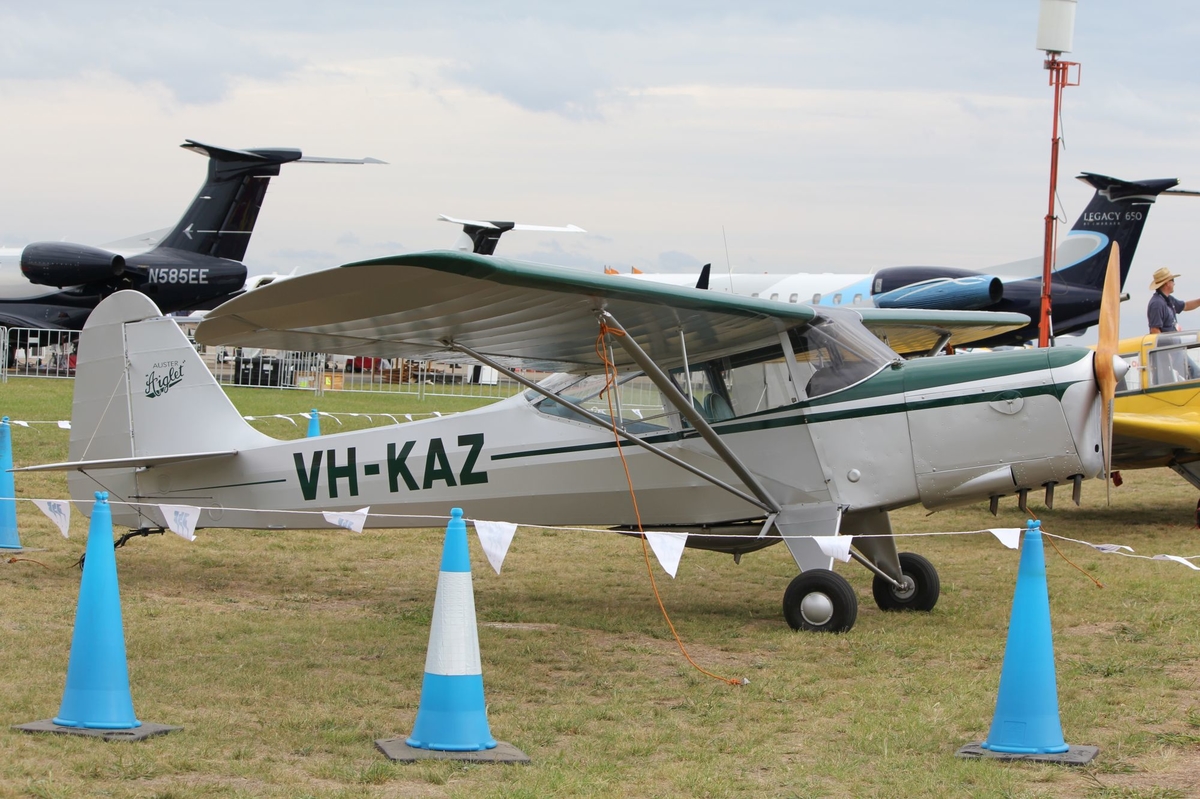
Gotcha! I wasn't sure about the Auster, but a lot of the aircraft of that era had round tubes.Round tubes...a bit savage on bare feet. Alsoheel brakes so footwear essential.kax
The industry quickly dumped the round tubes in favour of foot plates after an in depth study of aircraft accidents was done, I think in Britain.
The part which seared itself into my mind when building race cars, was a large skeletal diagramme of a human foot with the bones broken and hanging down each side of the tube. The example was not from fuselage deformations or impact with external objects, but the result of leg weight flying forward when, for example the aircraft nose hit a tree, even at relatively low speeds.
-
Are your rudder pedals flat plates or round tubes?I generally just wear sneakers and have no problem on the rudder during my landings.kaz
-
Another aspect of footwear: could it hinder your escape from a prang? I favour elastic-sided boots as they are fairly easy to slip off if caught.
Different forms of motor sport have different standards. In Speedway we’re required to wear full leather boots based on injuries from side collisions where feet can be jammed, pedals where collisions can cause deep cuts, injuries from flywheel & clutch explosions/breakages, elastic sided allows slashing of the ankle.Another aspect of footwear: could it hinder your escape from a prang? I favour elastic-sided boots as they are fairly easy to slip off if caught. -
Not necessarily; if the resultant is the hot area is then cooler but a larger area becomes hotter it’s back to the drawing board. I can remember driving along beside a test truck cab and seeing the wool tufts pointing forward rather than back.Yes Nev, that's one reason it might be better to get the cooling air to the hottest area first. -
Correct FH, I’m not sure of the emission standards, but there is plenty of video of 1959 Boeing 707s trailing black smoke compared with no smoke today.
-
OT, what you're saying sounds pretty much, according to the news reports, is what the government is thinking.
-
This is the first case I've seen of a government suing a company and driver.
A Kalari road train carrying about 50 tonnes of ammonium nitrate caught fire "in front of the windscreen" according to the driver.If this was a bonneted truck, that location would have been the rear of the engine compartment in front of the firewall. The driver's reaction was to pull off the road, and while the story doesn't say, it looks as if he rolled off the bridge which was destroyed.
The Warrego Watchman is listing the claim at $11.8 million.
This is before the Courts so we can't speculate on the details.
The driving period reported in the Brisbane Times is a prescribed law, similar to the CAR requiring a pilot to fly above 500' agl. In addition to fatigue laws, the transport industry has prescribed Chain of Responsibility laws which make not only the driver responsible for breaches, but everyone in the management chain who might have been involved in pressuring a driver to exceed driving hours. That might or might not come into this case.
This is the msds for ammonium nitrate
https://msds.orica.com/pdf/shess-en-cds-010-000032017701.pdf
-
Good question, and interesting to see the answers.Question: what is the problem with the existing arrangement?Someone mentioned steep climbs; in GA aircraft there's normally a climb out speed after achieving 500' on full throttle and the climb angle to maintain that speed will not cause the engine to overheat. RA aircraft are much less developed and much more individual, so the solution could be as simple as adopting a lower climb angle.
Power demand makes a big difference to combustion chamber temperature (as against exhaust gas temperature); have a look at the heat transfer ability of aluminium vs steel for cylinders and fins, and you will see the stunning ability of aluminium to shake off heat. Add to that a flow of cooler air through the fins and you'll increase that by a percentage depending on the stage of flight; quite a lot at cruise speed, less at descent speed, less again taxying, and less again stationary for pre-flight checks and holding. The aircraft has to be designed to keep the operating temperature within limits in all of these situations. At the extremes you need to have good high speed airflow at cruise, and you need at least 20 minutes of in-envelope temperature grade on the ground in case you need to take off from a City airfield where in some cases it may take that long from start up to clear for takeoff.
The multi-million dollar aircraft development programmes will use probe temperature check for each little change, because sometimes you gain in some areas and make others worse,
-
2
-
-
I suspect you'll find that the heating from the fins in still air would be a tiny percentage of the controlled airflow through the ducting at 100 kts cruise. I played around with it on race engines, bringing in cool air low down and extracting it from the top but it didn't make any difference to engine life compared to cooling the combustion chamber with fuel.Why are most aircraft engines cooled by forcing air down thru the fins? Warming air naturally wants to rise, so updraught cooling seems more sensible. I believe it's been used successfully in Rutan-style pusher configurations where the exhausting air can exit from the top side of the engine. My baby exits its cooling air along the midline, into the low-pressure area above the wing, so it lends itself to updraught cooling. It should work better on full-power climbs, when engines get hottest because conventional cooling is hampered by the angle of attack.Before I rip out the existing cowl ducts, does anyone see a problem?
-
1
-
-
An amazing story, amazing group of aviators and technicians who pulled off the impossible, and the incredible Barnes Wallis who only had a slide rule to come up with the method.I heard that we lost yet Another Dambuster today, I missed the news report, but I'll try and dig it out. Vic Barnett was, apparently a mate of Barnes Wallis, and their friendship extended after the war, this info came out during the funeral eulogy which we had to monitor standing outside in the freezing cold wind,. . the Crematorium is almost at the top of Redhill, the highest ground in Telford ( Discounting the Wrekin )-
2
-
1
-
-
The tower operators would probably be helping you with straight ins because of the Auster's slower circuit speed; probably telling the next pilot around the base turn to extend.Most of my arrivals at MOorabbin have been straight in because southerlies are the dominant wind direction. Don’t think I’ve ever done a full circuit there.But just in response to another post, in a high wing you lose sight of the threshold in a square turn but keep it in sight in a descending slipping turn.
Curved circuits were de rigour on Spitfires, especially at night when it was all too easy to lose sight of the glim lights and, in particular, the Chance light. Read “First Light” by Boy Wellum for an instructive commentary (one of the best RAF autobiographies I have read).
kaz
There are times there where you need maximum cruise speed to be sure the Baron you entered in front of, who was turning base when you let down doesn't catch up to you.
I was lucky enough to have a deadly first instructor who explained to me that when I pulled back the throttle on base, that was the last touch. I was to look over my shoulder and make the final turn based on the runway threshold matching some item like the wing. My accurate climb out would have set the distance from the runway so my final turn adjustment for wind component only needed to be the crosswind on base, which I would adjust along with my speed as I was getting ready to turn final. I would be making Rate 1 turns in the circuit, so the turn would put be in a direct line with the runway and I would touch down just over the threshold, and on touch down pull the throttle back. The fact that I can't ever remember pulling that off in real life, is another matter. Strangely enough, the instructor who taught me on Jabiru more or less did the same, but added an inner wing lift for a few seconds in the turns. The reference point for the base turn vs runway threshold was a certain distance up the diagonal stay, which you might be able to use, but as long as the tower operators are happy with straight ins, I'm more than happy to extend slightly.

-
I haven’t looked up the legislation but I’ve never seen a list of the airfields where this might be permitted.Turboplanner, I don't think anybody was suggesting to do a circular circuits at places like Moorabin, horses for courses -
Country flyer idea. One afternoon, I was No5 on final at Moorabbin; only three of us got in, but the last one could see the first one rolling for the runway exit.Me too Mark. Why not a neat semicircle from downwind to final? The only valid reason I've heard was that during a slow, constant turn, another aircraft might be obscured by a window post or strut; "square" turns avoids this.Try handling that in a quarter circle.
There were probably another 2 or 3 on base, the last one at least being able to see everyone in the line turning final.
Try handling that in potentially (from the above) 8 different semi circles.
However, no one had invited any novel patterns or anything other than the three legal heights above ground level.
You'll find it in the VFG.
-
1
-
-
ATIS is the terminal information as others have said, and it looks like someone has set the radio up with a short cut for 126.25
Silly thing to do because if you are moving around the ATIS for another location will usually be different. e.g. if you flew from that location to Moorabbin and broadcast on 126.25, you'd get nothing because the Moorabbin ATIS frequency is 120.9
Getting your en route information right is another reason for taking the time to do a flight plan.
-
You may be thinking of a different crash; this is the ATSB report for the one at Luskintyre. https://www.atsb.gov.au/media/24258/ASOR199401106.PDFTHAT incident has been incorrectly analysed as a stall, spin but it's caused by rudder cable attach crank failure. Rudder goes hard over one way when that happens.. No pilot could have prevented it. Tiger moths haven't been used for that demo since as the drag is "too much too high" requiring more forward elevator effect than is available to effectively control pitch. Nev -
While this broadly applies, every State has different legislation, so, for example, if you are in Victoria, The Motor Car Act 1958, Section 3 (1) Interpretation, has a definition of "highway" as "Any street, road, lane, bridge, thoroughfare, or place open to or used by the public for passage with vehicles." If you close your front gate, it's private property, but if you have a farm property where you routinely leave the front gate open its a "place" open to the public. In South Australia after rebuilding my Vincent Comet, I gave it a squirt (unregistered) an a Service Station apron, and ran a bit wide out into the street just as a cop was approaching. In the ensuing discussion he said "I know you didn't mean to go on to the street, but I still could have booked you on the Service Station apron".Motoring laws and regulations can only be enforced on property which is accepted as being, "open to the public".If you make it clear to would-be attendees/visitors to any type of "event" that you are hosting, that they are on private property, and the general public is not invited, then all bets are off, trying to enforce road regulations and traffic laws.
However, if you advertise an event and make it clear the public is welcome, then the area you have selected is regarded as being "open to the public", and the coppers can enforce road regulations and traffic laws, accordingly.
Many 4WD owners have found their insurance policy does not cover them on roads that are not gazetted or recognised as a "public thoroughfare". It pays to read the vehicle insurance PDS.
Motor vehicle fatalities on private property are not counted in the road toll. Neither are vehicle crashes on private property recorded under traffic statistics.
If someone causes a fatality on private property with a motor vehicle, they cannot be charged under road regulations and traffic laws - but they can be charged with manslaughter.
Civil liability Law comes into play against the property owner, if someone is injured or killed on private property. If the person injured or killed is a trespasser, then there is little likelihood of any successful charges or claim against the property owner.
There's definitely a precedent case, or several, against a property owner where not only trespassers, but thieves have successfully claimed for injuries. In the one I remember, a thief fell into an open excavation on a farm which didn't have a safe barrier around it. That one was i the dying days of a home being a man's castle.
-
Put whatever interpretation on it you want.You make it quite clear that despite having no authority, you barge on into a place and force them to comply to standards you admit they had no requirement to follow, assault people in the process and you can’t see a similarity?Tell the police to lie about their powers?
It’s not just that though, often your inner authoritarian peaks through when you talk of forcing compliance an weeding out the undesirable minorities.
-
Swan Hill town area is all on the Victorian side of the Murray and the track was on the NSW side so there was no local cop. Something changed which required the old cop from Moulamein, about an hour away to attend, and we usually ran on a Saturday night until 1 am Sunday. He wasn't a dickhead, and yes the locals all knew him, and he was really pissed off that he had to be there. He followed up with some roadworthy checks, and eventually the club moved the track back into a wheat paddock in Victoria and he went back to sleeping on Saturday nights. The old Swan Hill track had a great atmosphere under river redgums, and the club members were great people. I had my first win there, and at the BBQ after the races, I mentioned it would have been better if there had been trophies for the heats. The Club President disappeared for a while and came back with a sash which he ceremoniously put on me. Looked great in the firelight, but the next morning in the motel I saw that the gold lettering read "Miss Swan Hill"!Turbo,Motor sports in New South Wales have been governed by legislation since 1957. The Motor Vehicle Sports (Public Safety) Act and accompanying Regulations were just a tidying up of the existing legislation, probably to deal with a wider range of motor sports than existed in 1957.
Therefore, if the cop (and I say 'cop' with derision) did what he did, he must either have been a dickhead, or had a grudge against the speedway. What he did shows a complete lack of knowledge of the Law and discretion in applying it.
From the Regulations
24 Cessation of races or events
(1) If the senior police officer on duty at a race meeting is satisfied that any person is in imminent or undue danger if further racing or events are carried on, the officer may direct the clerk of the course or any other person in charge of the conduct of the meeting to cease immediately any racing or event and not to continue until the danger has been removed.
Everyone in Swan Hill would know that cop. I wonder how long it was before social pressures on his wife and kids made him apply for a transfer the Kings Cross Police Station where he could continue to be a dickhead, but his family would be anonymous.
-
 1
1
-
CASA set to "fix" community service flights
in Governing Bodies
Posted
The members of the general public who know the realistic risk factors in PPL and PC flying are a miniscule percentage of the population, who have an expectation that nothing goes wrong.
The first step towards giving a person a chance to avoid a risk is to provide an adequate warning.