

turboplanner
-
Posts
24,363 -
Joined
-
Last visited
-
Days Won
159
Content Type
Profiles
Forums
Gallery
Downloads
Blogs
Events
Store
Aircraft
Resources
Tutorials
Articles
Classifieds
Movies
Books
Community Map
Quizzes
Videos Directory
Posts posted by turboplanner
-
-
Yes, and that's how the industry has done it since the beginning of flight, and I can't remember anyone else doing it.Hang on..any sort of alarm or detection device just treats the symptoms (post fact)....Legs get ahead of the game and not put suspect pilots in an airplane first of all..?
There have certainly been cases in the US, and one in a corporate jet in Australia where military aircraft have been tasked to track aircraft where all occupants were unconscious due to oxygen failure and they were all fatal.
The million dollar question is whether the Port Augusta flight is the first of series where student pilots are either not being correctly trained to include attitude to the flight, or have an attitude that accidents happen to other people, or whether this is a one off incident we can all forget.
The cameras I was talking about previously are pre-fact, contacting the chain of responsiblity management and giving them vision to also communicate with and assess the driver.
-
Trains have a dead man switch which stops the train unless it is regularly activated by the driver.
In an aircraft, in the confusion when the pilot woke up he could be out of control and spiralling downward before he could take action.
Also it's more difficult to identify a sleeping pilot on autopilot because the aircraft is flying normally.
What is coming in in the transport industry is a small camera facing the driver which picks up tell tale signatures of drowsiness and eye movements and gets a driver off the road before he goes to sleep.
-
 1
1
-
-
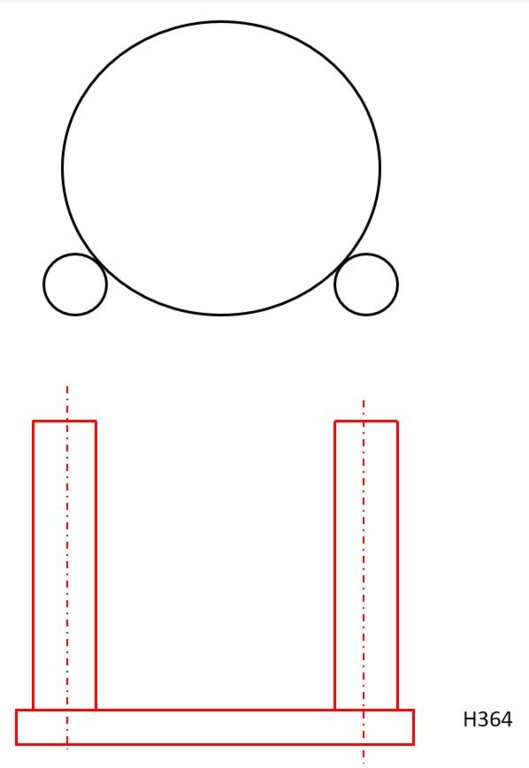
The POH for a C172 should show the Weight and Balance envelope. From this and with a tape to measure the nosewheel and Mains centrelines you can calculate the weight on each using moment equations.As I firm up the design of my lift lever, I need to know the max weight a trolley is likely to be asked to lift.If a C-172 was moved (sideways) into our hangar, what is the load on each main wheel? Hopefully my lever system can cope with it, because I don't want the expense of hydraulics...
-
1
-
-
I agree with OK that in tight spaces, pulling is not a good thing, my daughter recently proved this by pushing a camper trailer through a wall.At Gawler, most hangars for gliders use tracks, they are made of 1" angle with the vee upwards. A trolley with a low and tipping ramp is used, so you pull the glider up the ramp until it tips and locks in. Then you go to a wingtip and push the glider in sideways. Steel wheels on steel tracks give very little rolling resistance.A power plane would need 2 trolleys for the mains and something for the nose or tail wheel. It would also need some way of helping the mains up the ramps. Recently, I put a Dimona ( heavy tail dragger motor glider ) in my hangar using this method and needed a car to pull it up onto the trolleys. This is not a recommended for normal operations.
Lifting is better.
You could make the one cradle do both the mains and nosewheel.
I haven't got time to do any more on it, but a model made out of cardboard and pins is often a good way to get the scissor effect or cam effect that you need.
Levers are fine.
-
1
-
-
We don't know at this stage whether it is a medical issue where the pilot managed to set the auto pilot just in time, or whether he set the auto pilot then fell asleep.
It does show the benefit of having an auto pilot vs not having one when you are flying solo.
-
1
-
-
Two pieces of pipe, or a v shape piece of chequer plate welded on to a length of MS Flat, orientated in the same way will slide under a stationary aircraft.
You then include a jacking leverage in the frame which welds on to the MS Flat.

-
RHS rectangle with a couple of small chequerplate wedges to roll the airctaft on.Has anyone seen a good, simple dolley design we can use for moving light aircraft sideways in our hangar?Fixed pneumatic wheels or castors - Bunnings have a big range of designs. Tamworth looks the closest to you.
-
I think I made one back in the sixties.............does that help.I have made small ones like forgetting to switch the fuel pump on for takeoff, forgetting to turn the landing light for landing awareness, wondering why climb performance was poor (oh yes, the flaps!). Caused by distractions. Any of these could be part of an accident scenario, but the other holes in the cheese didnt line up. I would call these small mistakes, I hope other pilots have made them because the alternative is that i am hopeless.Turned fuel off (after last person who used the ac forgot to turn it on and I just moved the tap to the next sector.)
Forgot to retract full flap for T&G takeoff
Played with the ADF when I wasn't qualified and set it for the altitude of St George. Still made it to the airfield
-
2
-
-
I think your best bet is to try and track down the owner. If it was Wagga based that shouldn't be too hard.
From an investigation point of view it's aircraft on fire, successful forced landing, occupants OK, so I wouldn't expect a forensic examination, although it's amazing what you can still see after a completely engulfing fire; the wiring is usually all there.
-
The aircraft is in bits.
Seven News said it was flipped by a gust of wind.
Not uncommon to experience wind shear, and mechanical turbulence there.
The strip runs parallel to the coast and is shielded by Mangroves on one side and buildings on the other.
-
This should have been the top video of #12, example of radio during forced landing at Bankstown:
-
2
-
-
It would be a very good idea for you to check the history trail of PL court cases.It doesn't seem to matter what comes from RA-Aus, someone will pick holes in it and searching for them is being a bit pedantic. We are all human and make mistakes, and we are all entitled to our opinions. There are 8 opinions in the reply.Here is an alternative view.
1 The statistcs have shown our safety record has improved over the past 5 years but we can't become complacent.
2. They wouldn't have been mustering by air if the weather was poor.
3. From the media. Nothing more to say.
4. A euphamism to get the point across that there is no witch hunt (another euphamism)
5. If I didn't think it was safe to fly I wouldn't do it. By definition it is unsafe to get out of bed, to walk out the door, to drive a car.......
6. We still want it to be the safest it can be. What,s wrong with that.
7. That's what happens with all accidents. Flying, cars, motorbikes etc.
8. There is nothing wrong with using any sort of scenario as a metaphor to lead into the purpose of the subject matter.
-
Sorry, the first link ran on to another event, will try to find the original
-
At small country strips there's not too much of a problem, but at busier strips you have to get the attention of all on the radio, there may not be much time, and if the forst three words grab attention, everyone will be jerked to an alert state at least.
This one shows the congested radio of the city strips I keep talking about, and the results of drilling radio phrases allowing orderly communication between those involved.
-
2
-
 1
1
-
-
If you call a Mayday you automatically get preference over everything else.I had an oil pressure reading drop (faulty sender) while joining long downwind.Told the other aircraft that was turning base I wanted to come straight in for a downwind landing on the opposite runway as I had an engine issue.
They agreed, no problem. I think they could tell by the nervousness in my voice.
I ended up killing the engine and just gliding in to an uneventful stop and dragged it off down the taxiway....
I wasn't sure of the reason for the oil pressure drop at the time and was worried an oil line had come off or something and was worried about a fire.
-
He may not know Thruster.
-
Sorry; I should point out that my comments related to something less than a Phobia.All the reassuring talk, or efforts to ignore it, will not overcome this phobia. I know, because I suffer from it.A phobia is a medical condition, perhaps caused by a bad experience, which the person cannot overcome. Some sessions with a Pyschologist will often straighten out the conscious memory and fix it. For example, my wife worked in an office as a typist, and the typists worked in cubicles with a partition in front and behind. One day three young guys decioded to play a prank with a spider, and blocked her exit. She went over the top of the front partitition, landed on the desk in front and walked out of the company. For years, if there was a spider in the house, she would stay outside until I'd found it. One day, when she was about 7 months pregnant I had a call to say she was in a city car park distressed and wouldn't go near the car. I came in with an aerosol bomb but she wouldn't get into her car, or drive mine. I realised if one day a spider fell down from the sunvisor she would have a serious accident, so we organised a psychologist, and after one visit a week over six weeks she could tolerate a spider in the room, and eventually kill them herself.
So if anyone has a phobia about anything I'd recommend that course of action.
-
This can be a very serious problem, especially with little children and I know a few adults who've suffered burst eardrums on decent in RPT aircraft.I took my 10 year old nephew up for a local once. He'd been up before with no problems.This time he started to get upset with pain in his ears.
We were inbound on decent and I guess they were a bit blocked with the pressure building and not equalising.
I changed course and regained height, then decended at a slower rate and managed to get down ok.....
I now carry a vicks inhaler Vicks Inhaler for any future incidents with myself or passengers.
Before the high altitude era the airlines used to hand out butterscotch toffees for people to suck on and that worked, of tell you to hold your nose and blow, or swallow. Doing that can settle a child down quickly, but when it gets to the point that a child is screaming, or an adult is clearly in trouble, you might have to assess whether you can reduce the level of descent and extend the trip leg.
-
I've found that not mentioning air sickness before take off defocuses the borderline phobia cases, and if the subject comes up, as it often does from new flyers, I just reassure then the best way to avoid it is to always keep their eyes out looking at the horizon. I've had excellent success with that.
-
Better cleaning chemicals and electrical equipment. You can buy a shampoo vacuum cleaner pretty cheap on Ebay.When I was young, all light aircraft smelled of spew. Now they don’t, why?Also the high G aerobatic aircraft like the Tiger Moth and Chipmunk were replace by the aerial cars, so you don't have ex WW2 pilots and the students they trained pulling negative Gs to frighten passengers.
-
It's one of the unexpected things you get after your training, particularly on cross country flights. I've had three people throwing up around me; the stink was so bad I was dry retching, and flew for about 20 minutes with that little perspex flap you can see at 14:03 with my nose stuck in the airstream. Doesn't do much for your focus. What was worse was that while I was filling up with fuel they went into the club house and filled up with pies, so it started all over again as soon as we took off.My 10yo feels sick in an elevator but insists he wants to be the first up with me when I'm qualified. Can't end well I feel... -
Sorry about that; thought it was.
-
I don't think you're wrong and I don't think Facthunter is wrong just your English practical history vs ours where the heat and dust factors changed our attitude to service. Also you are correct on today's liquid cooled auto engines where no internal repairs are expected during ownership and most will exceed 500,000 km and many 1,000,000 km without a full rebuild, and Facthunter is correct on aircooled aircraft engines where fuel standard plays a major part.I'm with Downunder on this - Your privilege to stick with an outmoded & potentially costly concept of engine service life (is this whats called a tradition?) -
These extracts are from the book “The Killing Zone” by Paul A. Craig
Figure 4.3 is a general Load Factor Chart which complements Downunder's Foxbat Chart post #33
Note Paul Craig's disclaimer about turns other than level turns, which is complemented by BlurE's reference post $34
Once you include climbing and descending and steep, often compounding turns (i.e. turns which become sharper after entry) to follow a beast which had done a 90 degree turn, or doubled back you are well up into the top end of cropduster skills.
Low Altitude Applications
Bird spotting, powerline patrol, pollution monitoring, wildlife census…..have one thing in common: A pilot is on the job and that job requires attention to be paid to something on the ground. ……………They must be able to safely split their attention between flying the aircraft and doing the job……….that pilot must do two jobs at once very well. ……The pilots that do these jobs are usually not beginners.
Low-Altitude – Personal Flying
This category of accidents is the largest of the three maneuver accident groups. In fact 68.3% of fatal maneuvering accidents took place on what was classified as a personal flight. I would like to think that in its purest sense an “accident” is something that just happens and it is mostly beyond any person’s power to prevent. Based on that definition, the “accidents” in this category are really not accidents at all. They are deliberate acts that defy safety rules, aircraft limitations, and good old common sense. I will continue to use the word accident throughout this section but you know how I feel about them.
Figure 4.1 illustrates all the maneuvering accidents that took place from 1983 through 2000. The accidents are plotted against the flight hours of experience the pilot had when the accident took place. These are all the accidents together, so fatal – as well as those with serious injury, and even a few with no injury – are mixed in. You can see the pattern that has been present in past evaluations of flight experience data. There is a zone where most accidents occur. The span of experience from 50 to 150 hours is “off the chart”.
Avoiding low-altitude steep turns and low aerobatics all together is the safest course of action. But what is it about these maneuvers that become deadly at low altitude? Why does the airplane seem to fall out from under a pilot when in these maneuvers?
The airplane’s wings must provide life to counteract all “down” forces. Weight or gravity is the “down” force that we easily understand, but while flying other forces come into play. These additional forces can team up with gravity and reduce the effectiveness of lift.
Figure 4.2 illustrates two airplanes in flight.
The airplane on the left is flying straight and level. The lift exactly opposes weight. These lift and weight vectors are fairly simple, but things get complicated when the airplane turns.
The airplane on the right is in a medium bank turn. The first problem is that the lift vector is now leaned over, in the turn. Between the two airplane diagrams is a comparison of the “effective” lift. You can see that when the lift vector is leaned over, we lose effective lift because the lift vector no longer opposed weight. So in a turn we lose lift.
Meanwhile, the turn will produce centrifugal force, This is the swaying force you feel in your car when you take a fast turn. Centrifugal forces join forces with gravity to form a residual load. This is more commonly called the G force. The actual force of the earth’s gravity does not get stronger when you turn, but when you add gravity and centrifugal force together it places an extra load on the wings. From the wing’s point of view it is being asked to carry a greater load.
The wing is being asked to carry a greater load at the exact moment when lift is reduced and the wing is less able to carry a greater load. Something has to give. The accelerated stall takes place. Ordinarily the stall speeds are painted on the airspeed indicator. The slow end of the white arc is the stall speed with flaps down and the slow end of the green arc is the stall speed with the flaps up. But in a turn the colors of the airspeed indicator can no longer be trusted.
The airplane can and will stall even though the airspeed is well within the green arc. It stalls faster than the indicator says it should and that’s why it’s called an accelerated stall.
Figure 4.3 is a chart of the load factors. You can see that at shallow banks, the G force is not much above 1G. But when a pilot makes a 60 degree level turn, the G force jumps to 2Gs. That means a 2000 pound airplane now effectively weights 4000 pounds in the turn. More importantly the wings must support 4000 pounds. That is a great deal to ask – to get 4000 pounds of lift from the wings of a 2000 pound airplane. The wings probably will not be able to do it and lift is lost, the airplane stalls.
-
1
-
Oh dear. . .Im away from the airfield for a week and. . . .
in Aircraft Incidents and Accidents
Posted
Going crosscountry to new airfields for the first time does open your eyes to the need to do some homework before you leave; everyone else in the circuit bar you knows exactly what they are doing, and they all know where the "clubhouse" and the "haystack" are and which inviting runway is as rough as guts, along with the altitude trick and the parachute circuit trick and so on. A lot line up on taxiways also.