
red750
-
Posts
8,050 -
Joined
-
Last visited
-
Days Won
71
Content Type
Profiles
Forums
Gallery
Downloads
Blogs
Events
Store
Aircraft
Resources
Tutorials
Articles
Classifieds
Movies
Books
Community Map
Quizzes
Videos Directory
Everything posted by red750
-
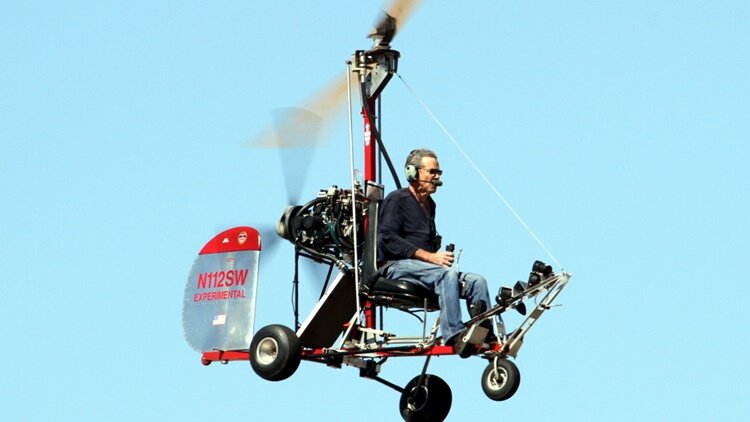 The KB-2 Freedom Machine is an autogyro designed by Ken Brock based on the designs of the Bensen B-8. Ken Brock was an early innovator in homebuilt gyrocopters starting with his first ride in 1957. Brock set to work on building and marketing a series of homebuilt gyroplanes with the KB-1 and later the KB-2. Ken Brock used his KB-2 design for years in airshow acts and completed several world records. In 1971 he completed the first coast-to-coast autogyro flight from Long Beach, California to Kitty Hawk, North Carolina. Variants KB-2 Powered variant KB-2G Variant with the same frame and rotor head as a KB-2. The "glider" is a two-seat gyroplane designed to be towed by car. The aircraft with the same frame and rotor assembly can be converted to a powered gyroplane.
 -
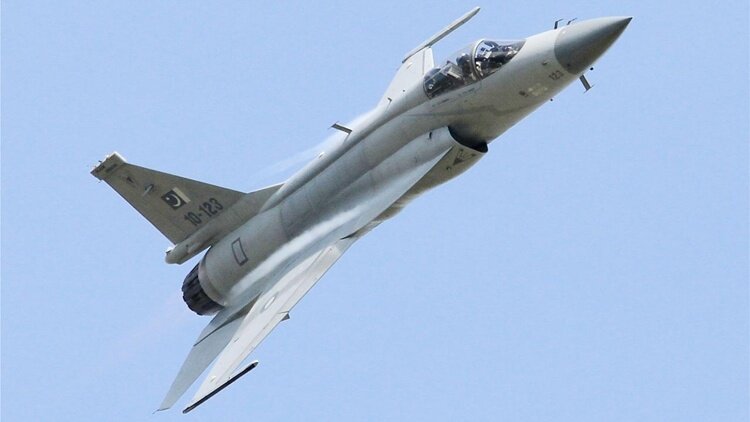 The CAC/PAC JF-17 Thunder[a] or FC-1 Xiaolong is a fourth-generation, single-engine, lightweight, multirole combat aircraft developed jointly by the Chengdu Aircraft Corporation (CAC) of China and the Pakistan Aeronautical Complex (PAC). It was designed and developed as a replacement for the third-generation A-5C, F-7P/PG, Mirage III, and Mirage 5 combat aircraft in the Pakistan Air Force (PAF). The JF-17 can be used for multiple roles, including interception, ground attack, anti-ship, and aerial reconnaissance. The Pakistani designation "JF-17" stands for "Joint Fighter-17", with the "Joint Fighter" denoting the joint Pakistani-Chinese development of the aircraft and the "-17" denoting that, in the PAF's vision, it is the successor to the F-16. The Chinese designation "FC-1" stands for "Fighter China-1". The JF-17 can deploy diverse ordnance, including air-to-air, air-to-surface, and anti-ship missiles; guided and unguided bombs; and a 23 mm GSh-23-2 twin-barrel autocannon. Powered by a Guizhou WS-13 or Klimov RD-93 afterburning turbofan, it has a top speed of Mach 1.6. The JF-17 is the backbone and workhorse of the PAF, complementing the Lockheed Martin F-16 Fighting Falcon at approximately half the cost,[5] with the Block II variant costing $25 million.[4] The JF-17 was inducted in the PAF in February 2010. Fifty-eight per cent of the JF-17 airframe, including its front fuselage, wings, and vertical stabiliser, is produced in Pakistan, whereas forty-two per cent is produced in China, with the final assembly and serial production taking place in Pakistan. In 2015, Pakistan produced 16 JF-17s.] As of 2016, PAC has the capacity to produce 20 JF-17s annually. By April 2017, PAC had manufactured 70 Block 1 aircraft and 33 Block 2 aircraft for the PAF. By 2016, PAF JF-17s had accumulated over 19,000 hours of operational flight. In 2017, PAC/CAC began developing a dual-seat variant known as the JF-17B for enhanced operational capability, conversion training, and lead-in fighter training. The JF-17B Block 2 variant went into serial production at PAC in 2018 and 26 aircraft were delivered to the PAF by December 2020. In December 2020, PAC began serial production of a more advanced Block 3 version of the aircraft with an active electronically scanned array (AESA) radar, a more powerful Russian Klimov RD-93MA engine, a larger and more advanced wide-angle Head-Up Display (HUD), electronic countermeasures, an additional hardpoint, and enhanced weapons capability. PAF JF-17s have seen military action, both air-to-air and air-to-ground, including bombing terrorist positions in North Waziristan near the Pakistan-Afghanistan border during anti-terror operations in 2014 and 2017 using both guided and unguided munitions, shooting down an intruding Iranian military drone near the Pakistan-Iran Border in Balochistan in 2017, in Operation Swift Retort during the 2019 Jammu and Kashmir airstrikes and aerial skirmish between India and Pakistan, and during Operation Marg Bar Sarmachar in 2024 in which Pakistan launched a series of air and artillery strikes inside Iran's Sistan and Baluchestan province targeting Baloch separatist groups. In March and December 2024, PAF JF-17s were used in cross-border airstrikes against Pakistani Taliban hideouts inside Afghanistan. Nigerian Air Force (NAF) JF-17s have seen military action in anti-terrorism and anti-insurgency operations in Nigeria. Myanmar Air Force has also frequently deployed its JF-17 fleet against various insurgent groups. During the May 2025 India–Pakistan conflict, the PAF deployed JF-17s in combat in both the air-to-air and air-to-ground roles. For details of design and development, operational history, users and other interest and variants, click here.
 -
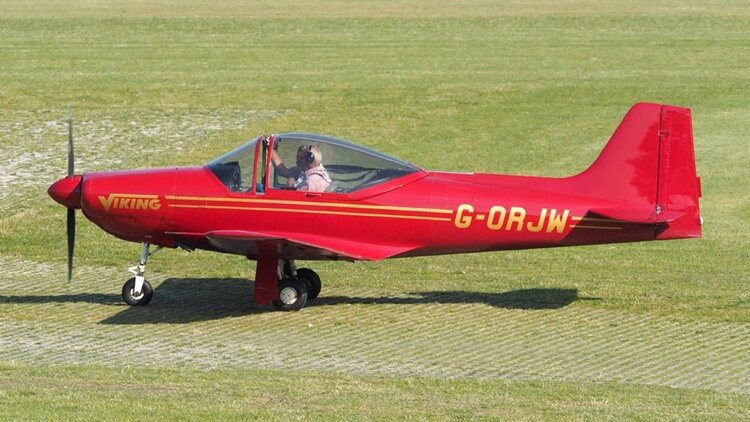 The Falco F8L is an Italian-designed lightweight 2-seater aerobatic aircraft. The aircraft was designed by the renowned Italian designer Stelio Frati in 1955, with the prototype, powered by a 90 hp (67 kW) Continental C-90 engine, flying for the first time on 15 June 1955.[4] The prototype was soon re-engined with a 135 hp (101 kW) Lycoming O-290-D2B, forming the basis for the initial production batch.[4] It was originally built in Italy by Aviamilano then Aeromere and later Laverda. The aircraft is single-engined, propeller driven and designed for private and general aviation use. The Falco was sold in kit or plans form for amateur construction by the Sequoia Aircraft Company of Richmond, Virginia from the 1980s until its closure in 2014. Laverda-built Falco IV from Denmark attending a UK air rally in 1984 The aircraft is widely considered to be one of the best handling, strongest, and most aesthetically pleasing designs ever made available to home builders. Pilots sometimes refer to the Falco as "the Ferrari of the air." Performance includes a 175 knot cruise speed and full aerobatic capability, with an inverted fuel tank an optional item. The Falco F8L is constructed of spruce and typically Finnish birch plywood. The structure is built from laminated spruce bulkheads and the birch plywood is used for the skin. The plywood is often softened with hot steam, formed over the various structures and glued in place. The aircraft is rated for 6g positive and 3g negative. Reviewers Roy Beisswenger and Marino Boric described the design in a 2015 review as "a complex all-wooden construction in spruce and plywood and is therefore time-consuming to build. But the results in terms of weight and speed are remarkable., so much so that the Falco is considered a classic, with outstanding performance and handling." Variants F.8L Series I Initial production model powered by 101 kW (135 hp) Lycoming engine. Ten built by Aviamilano starting in 1956. F.8L Series II Improved model built by Aviamilano, with 112 kW (150 hp) engine. Twenty built. F.8L Series III (Also known as F.8L America) Modified version of Series II built by Aeromere in conformance with US airworthiness requirements. 35 built by Aeromere. Super Falco Series IV (Specifications below) Similar to America, but with more powerful engine (160 hp (120 kW) Lycoming O-320-B3) and constant speed propeller. Built by Laverda.Twenty built. Sequoia Falco Similar to the production aircraft but re-designed for homebuilding from kits or plans,[5] by Alfred Scott of Sequoia Aircraft Company and David Thurston of Lake Buccaneer fame.
 -
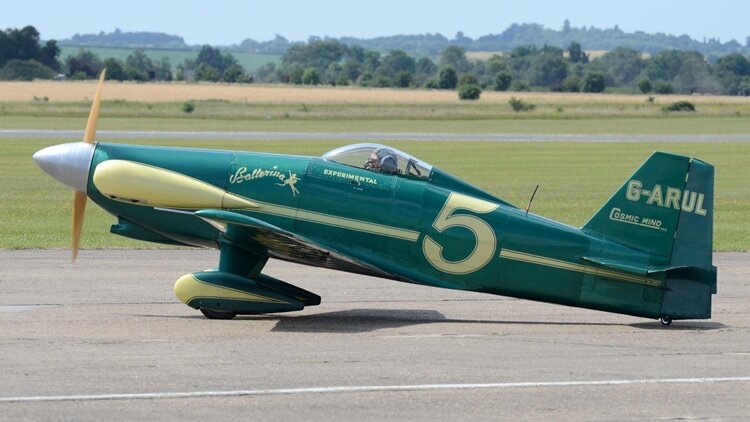 The LeVier Cosmic Wind is a small single engine, single seat racing monoplane designed and built by staff of the Lockheed Corporation in 1947. It did not race successfully in the US but one won the premier cross-country competition in the UK in 1964. It still flies today. The Cosmic Wind was designed and built by Lockheed's chief test pilot, Tony LeVier, and a group of Lockheed engineers. A very small single-seat racer, it was aimed at the Goodyear Trophy for Formula 1 class racers initiated in the US soon after World War II. It is an all-metal low-wing cantilever monoplane. Wings and tail surfaces are all straight-edged and tapered. The ailerons are full span and carry trim tabs, as does the full-fin-depth rudder. The undercarriage is fixed, with streamlined main legs and wheels in long fairings. The roller tailwheel is tucked into the rear corner of the fuselage forward of the rudder. The cockpit is enclosed with a small, single-piece, perspex canopy. The first aircraft were powered by 85 hp (63 kW) Continental C-85 horizontally opposed engines but more recently at least four[2][4][5][6] have used the 100 hp (75 kW) Continental O-200-A. The engine installation includes a large pointed spinner and long, bulbous cylinder head/exhaust fairings. Three Cosmic Winds were built at Lockheed's between 1947 and 1948 and a fourth rather later. A fifth was also built in the US by amateur constructors. The last example was built in the UK as late as 1972. The type was not particularly successful in competitions in the 1940s, coming only 3rd and 4th in the 1947 Goodyear Trophy races. One example of the first three, named Ballerina and exported to the UK as G-ARUL, won the King's Cup Race of 1964; it remains active in the UK, and is a regular participant in air displays. The UK-built Cosmic Wind remains on the civil aircraft register as G-BAER, but currently (2010-10) lacks a Permit to Fly.. In the US, the amateur-built example is now in the EAA AirVenture Museum, Oshkosh, Wisconsin.[2] Another Cosmic Wind, built or modified with a shoulder rather than low wing, is in the Planes of Fame Air Museum, Chino, California.
 -
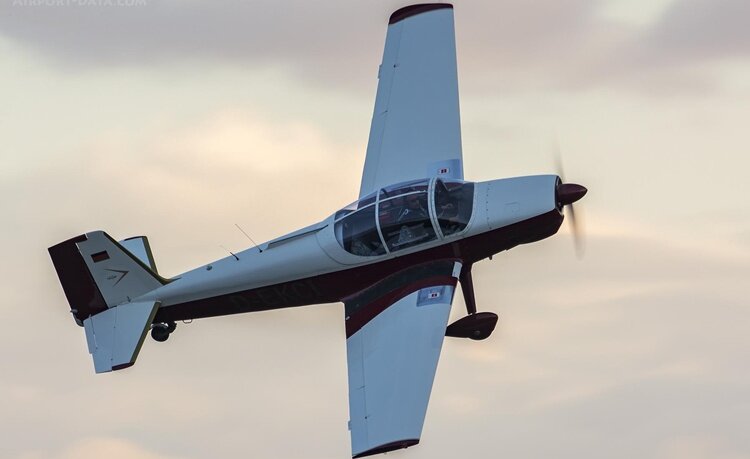 The Oberlerchner JOB 15 was an Austrian two-seat light aircraft produced by Josef Oberlerchner Holzindustrie, which had previously designed and built gliders. Using experience as sailplane designers and builders, Josef Oberlerchner Holzindustrie determined to create a powered aircraft. The result was the JOB 5,[1] a two-seat side-by-side light aircraft of wooden construction.[2] It first flew in 1958. The company decided to build a slightly larger three-seat production version, the JOB 15. The JOB 15 was a low-winged monoplane of composite construction with fixed tailwheel undercarriage, with a wooden wing and steel-tube fuselage covered in glass-reinforced plastic and fabric. The prototype first flew in 1960 with a 135 hp (101 kW) Avco Lycoming O-290-D2B engine. Three aircraft were built before the a more powerful version, the JOB 15-150, was built with a 150 hp (112 kW) Avco Lycoming O-320-A2B engine. After 11 15-150s had been built an improved version, the JOB 15-150/2, was introduced and ten were built before production ended in the late 1960s. Variants JOB 5 Prototype two-seater, 95 hp Continental C90-12F engine, one built JOB 15 Production three-seater with a 135 hp (101 kW) Avco Lycoming O-290 engine, three built. JOB 15-150 (Specifications below) Re-engined version with a 150 hp (112 kw) Avco Lycoming O-320-A2B engine, 11 built. JOB 15-150/2 Improved version, ten built.
 -
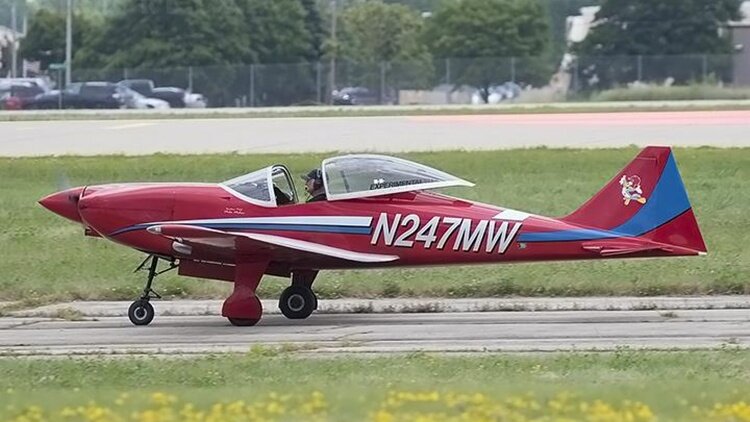 The GP-4 is an experimental aircraft designed to fly cross country with two passengers 1,100 mi (1,770 km) at 240 mph (386 km/h).[1] Aircraft Spruce & Specialty Co has the rights to distribute the kits for the aircraft, while the plans are distributed by Osprey Aircraft. The GP-4 is the fourth aircraft from designer George Pereira, It is a low wing side-by-side retractable gear aircraft of wood The aircraft's wooden construction is labor-intensive and an estimated 3000–4000 hours are required to construct it. In 1984, the GP-4 won the Grand Champion Custom Built and the Outstanding New Design awards at the Experimental Aircraft Association Airventure airshow in Oshkosh, Wisconsin.
 -
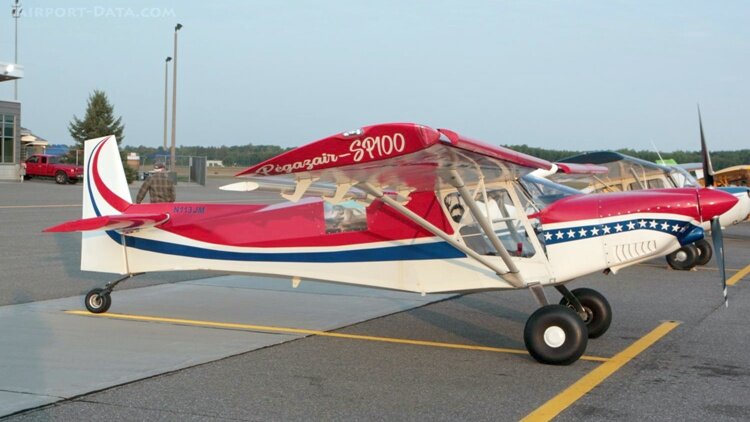 The Pegazair-100 STOL is a two-seat STOL homebuilt aircraft developed in Canada by Tapanee Aviation, Inc. of Mont-Saint-Michel, Quebec. Development of the Pegazair started in 1985 by Serg Dufour of Mont-Saint-Michel, Quebec. Originally it consisted of a new set of Pega-STOL wings with retractable leading edge slats to be installed on Zenair CH 701 STOLs to replace their wings which have fixed leading edge slots. Dufour went on to develop a new fuselage and tail to match the wings. The Pegazair is a two seats in side-by-side configuration, strut-braced, high-wing monoplane with conventional landing gear. Fuselage construction is welded steel tubing with aluminum skin. The wings employ full length flaperons and leading edge slats that deploy automatically. The tailplane is slotted for slow speed authority. The prototype was outfitted with a 65 hp (48 kW) Continental A-65 engine. The design was later developed into the four-seat Tapanee Levitation 4. Variants Pegazair P80 Powered by an 80 hp (60 kW) Rotax 912UL Pegazair P100 Powered by an 80 hp (60 kW) Continental O-200 or 115 hp (86 kW) Rotax 914
 -
 https://www.msn.com/en-au/news/other/plane-hits-car-during-emergency-landing-on-florida-freeway/ar-AA1S4o5V
 -
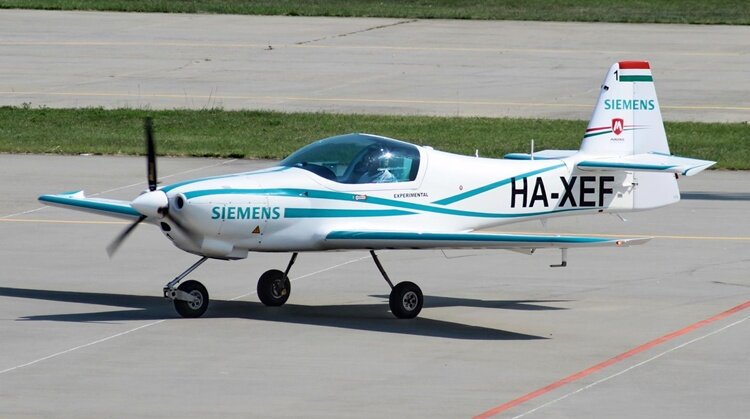 The Siemens-FlyEco Magnus eFusion is a German hybrid diesel-electric aircraft that was designed by Siemens and FlyEco, introduced at the AERO Friedrichshafen show in 2018. The aircraft is intended for series production as a ready-to-fly design. The design was first flown on 11 April 2018 in Hungary. On 31 May 2018, the prototype crashed in Hungary, while on a training flight, killing its two occupants. The accident investigation concluded that the crash was most likely due to pilot error in causing a high bank-angle stall close to the ground. The aircraft featured a cantilever low-wing, a two-seat side-by-side configuration enclosed cockpit under a bubble canopy, fixed tricycle landing gear, and a single engine in tractor configuration. The aircraft was made from composites. The power train consisted of a Siemens SP55D electric motor which was intended to be powered by batteries for take-off and landing. A FlyEco three-cylinder diesel engine, derived from a Smart Car engine, with common rail injection and electronic controls, was intended to recharge the batteries in flight for extended range. Status Production planned (2018) The approximated cost of the Magnus eFusion airplane is around US $ 200,000. Specifications below gleaned from three websites.
 -
Gyroflug SC-01 Speed Canard
red750 commented on red750's aircraft in General Aviation (single engine)
Not a distance as in travelling point A to point B, but here is a short video I shot at Avalon 2013. Otto.wmv -
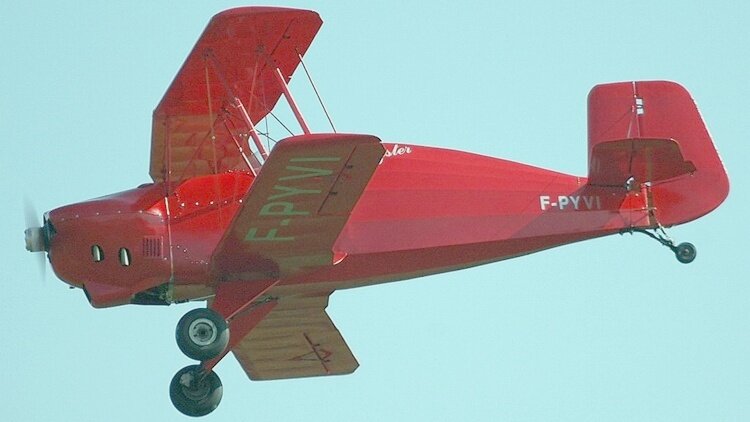 The Kaminskas Jungster I aka Papoose RK-1 Jungmeister I is a single-seat homebuilt biplane. The Jungster I is a single-engine, single-seat biplane with conventional landing gear. It was intended to be an 80 percent scale replica of the Bücker Bü 133 for homebuilt construction. The wings are swept back an additional two degrees from the Jungmeister. The fuselage uses wood trusses and the wings use spruce wood spars with fabric covering. Rights to the Jungster I were sold to Kate & Stan McLeod (K & S). The plans are distributed by Howard Allmon.
 -
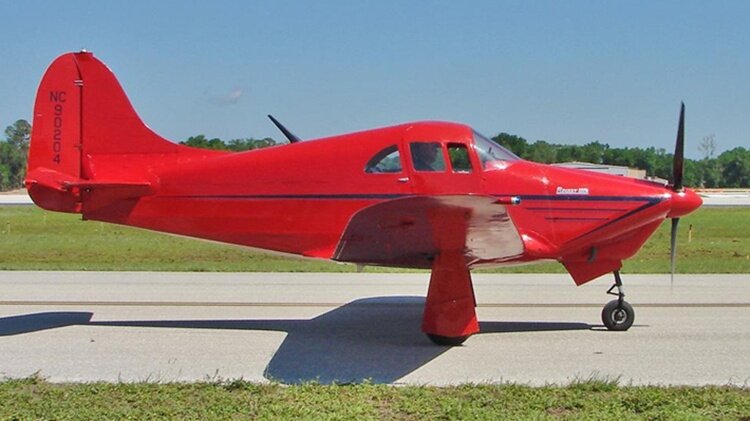 The Johnson Rocket 185 was a 1940s American two seat cabin monoplane designed by Johnson and built at Fort Worth, Texas. Johnson originally built a homebuilt Rocket 125 which first flew in 1942. The Rocket 125 was a low-wing cabin monoplane powered by a Lycoming O-290 engine. He developed the design into the Rocket 185 with a 185 hp (138 kW) Lycoming O-435-A engine and retractable landing gear. It was a high performance aircraft for the late 1940s with a top speed of 180 mph (290 km/h). In August 1945, Fred Pittera who had been an Advanced Military Pilot Training instructor on the four-engine B-24 Bomber at the nearby Fort Worth Army Air Field, joined the Johnson Rocket Aircraft as a test pilot, flying the P-39 aircraft look-alike through its various test regimens and finally in late 1945 flew the Johnson Rocket 185 with an FAA flight examiner for its first production qualification approval. A Federal Aviation Authority Type Certificate was issued on 10 September 1946 Introduced in August 1945, the Rocket 185 was pitched with the phrase "get a super-performing airplane for only $5,000 – order your 'Rocket' now!". A sales tour began in June 1946. However, because of its high performance and limited seating (two, sometimes three), the market was limited to experienced pilots and only 18 were built. A four-seat variant was produced as the Bullet 125 but all rights to the two designs were sold on in the early 1950s. The new owner of the design was the Aircraft Manufacturing Company based at Tyler, Texas. They developed a variant of the Bullet powered by a Menasco inline engine and named the Texas Bullet 205 but it was not successful.
 -
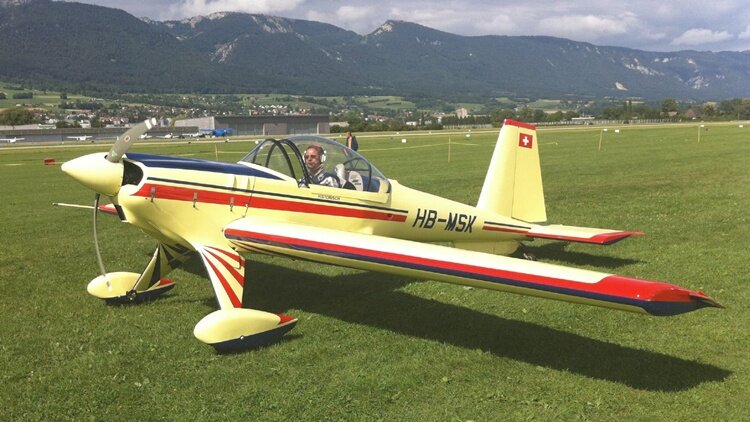 he Hirth Hi 27 Acrostar was designed by Arnold Wagner to win aerobatic competitions, in part by having handling independent of orientation, upright or inverted. A single engine, single seat low-wing monoplane, it was built in West Germany by Wolf Hirth GmbH in the early 1970s, and dominated Championships for a brief period. The Hirth Hi 27 Acrostar is a competition aerobatic aircraft designed by the Swiss aerobatic champion, Arnold Wagner. Wagner and three others, two of them German ex-champions, sponsored the construction. The Wolf Hirth team was led by Prof. Richard Eppler of the Stuttgart Technische Hochschule, starting work in the Summer of 1969. The first flight of what was known as the Acrostar Mk II was on 16 April 1970. The Acrostar is a conventionally arranged low wing single engine aircraft. The wing is straight tapered, the leading edge slightly swept and the trailing edge unswept. The aerofoil section, designed by Eppler, is quite thick with a thickness-to-chord ratio of 20%. It is a symmetric section and mounted at zero incidence. There is also zero dihedral. Full span control surfaces are fitted, flaps inboard and proportionally moving ailerons outboard. The ailerons are balanced not by the usual horn or hinge line extensions but by small surfaces which project beyond the wingtips. Unusually, both ailerons and flaps are coupled to the elevator position; this camber changing control system, together with the highly symmetric wing, produces the same control characteristics for normal and inverted manoeuvres. The basic idea in this arrangement was to keep the centerline of the fuselage horizontal in both normal and inverted horizontal flight. The result, beside this, is good controllability in low speed ballistic flight, around zero G. Another unusual control feature, allowing for independent trimming in pitch and yaw, are the independent trim tabs on the flaps. The plywood covered wing is built around a single glass fibre spar using foam reinforced ribs. Aft of the engine, the fuselage is a wooden semi-monocoque. The single seat cockpit is enclosed with a rearward sliding canopy. The fin and balanced rudder are straight tapered and square tipped, as is the rearward set horizontal tail. The prototype had elevator trim tabs but these were removed in favour of the flap trims noted above. Extra fin area is provided by a long strake on the lower fuselage, extending aft to the tailwheel. The Acrostar is powered by a 220 hp (165 kW) Franklin 6A-350-C1 six cylinder horizontally opposed piston engine. This is mounted in a steel frame which is integral with the fixed cantilever main undercarriage and its optionally streamlined, tapering legs and faired wheels. This arrangement places the main landing gear further forward than usual, providing a drag moment to oppose that of the fin in vertical flight. The tailwheel is steerable. For details of operational history, click here.
 -
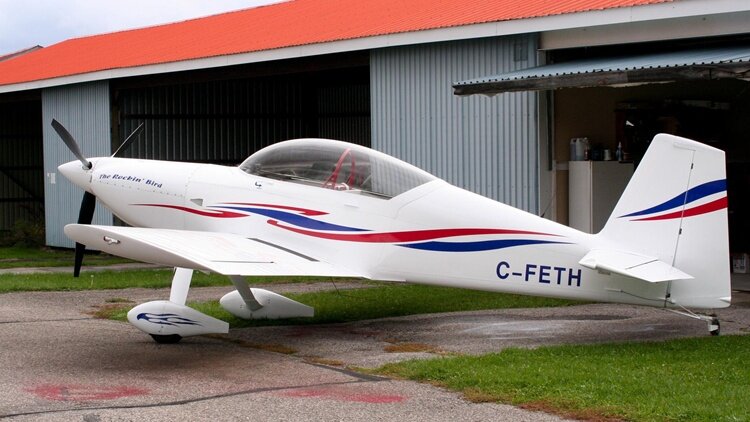 The Rocket II is a modified Van’s two place RV-4. The kit to build a Rocket II from John Harmon is an extension of RV-4 kit which is purchased from Van’s. With the intended use of bigger engines the altered fuselage is wider and the length 18 inches longer. The modified wing was tested by an independent engineering facility. A unique modification is titanium for the gear legs which provide a difference in feel when landing and also doesn’t shimmy during ground operations. The HR2 is not a quickbuild kit as many builders of the Rocket prefer to be more involved in the aircraft building process and express a preference of some minor fitting and trimming. An economy cruise speed of 215 mph at 55 is average for a Rocket II with a LYC.10-540 -C4B5/250 hp. 2575 rpm. while there is one Rocket that has a 340+ horsepower and can cruise at 275 mph.
 -
Aérospatiale (formerly Sud Aviation) Alouette III
red750 commented on red750's aircraft in Rotorcraft
The Hindustan SA-316B Chetak is an Indian-produced variant of the Aérospatiale Alouette III helicopter, manufactured under license by Hindustan Aeronautics Limited (HAL). It features a strengthened main and tail rotor, with a maximum weight of 2,200 kg (4,850 lb) and an increased rotor transmission limit on takeoff power to 440 kW (590 hp). -
The Helibrás HB-350BA Esquilo is a military utility helicopter developed under license by Helibras in Brazil, based on the French Aerospatiale AS350B design. It is also designated as the UH-12 within the Brazilian Navy.
-
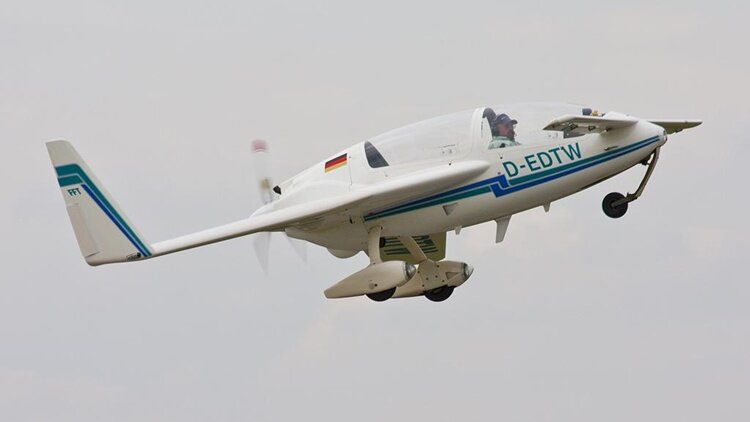 The Gyroflug SC 01 Speed Canard is an unconventional sports plane produced in Germany in the 1980s and 1990s. Inspired by the Rutan VariEze, the Speed Canard was an all-new design created without input from Rutan. Like the VariEze, the Speed Canard is a canard-configured mid-wing monoplane with wingtip fins that incorporate rudders. The two-seat tandem cockpit and canopy design were derived from Grob Twin Astir sailplane, and the nosewheel of the tricycle undercarriage is retractable. Construction throughout is of composite materials, and when the design attained German certification in 1983, it became the first composite canard design to achieve certification anywhere in the world. An interesting feature of the control system is that the twin rudders operate independently, allowing both rudders to be deflected outwards simultaneously, cancelling each other's yaw, but acting as airbrakes. In 1987, the development of a four-seat version was announced as the E 401, but was abandoned soon thereafter. In late 1988 Gyroflug partnered with Litton Industries using Gyroflug Speed Canard as for Litton's Advanced Tactical Surveillance System.
 -
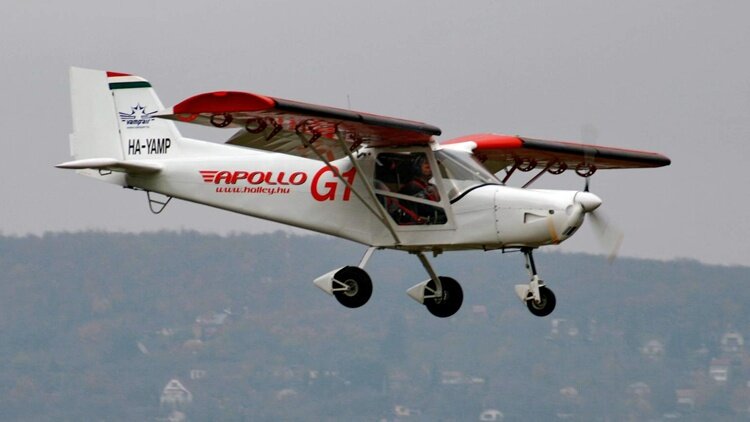 The G1 Aviation G1 SPYL is a French STOL (Short Take-Off and Landing) ultralight aircraft designed and produced by G1 Aviation of Tallard, France. It is available either as a kit for amateur construction, with approximately 80% of the aircraft pre-assembled, or as a complete ready-to-fly aircraft. The aircraft features a strut-braced high wing, a two-seats-in-side-by-side enclosed cockpit, fixed tricycle landing gear, and a single engine in a tractor configuration. The G1 SPYL is constructed primarily from anti-corrosion treated aluminium (2024T3 Alclad) for the fuselage and wings, with flaps, ailerons, and the vertical stabilizer fabric-covered on an aluminium structure or optionally made entirely of aluminium. The cabin is made from 25CD4 steel argon welded, providing a robust survival cell. The aircraft is equipped with hydraulic brakes, electric flaps and trim, and optional folding wings that allow it to be transported at a road-legal size. The G1 SPYL is marketed as a multi-purpose aircraft suitable for surveillance, agricultural use, and amphibious operations. It has been used in Africa for agricultural spraying, with about 50% of the fleet exported internationally. The aircraft is also available with a towing hook for glider towing. AI-generated description. Please verify critical facts.
 -
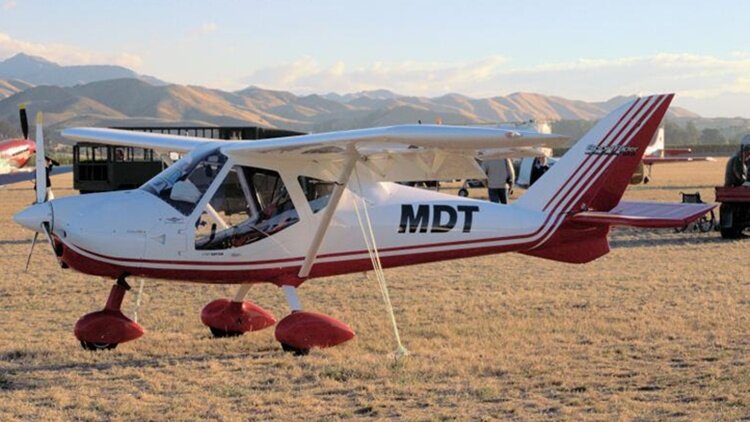 The Flyitalia MD3 Rider is an Italian ultralight and light-sport aircraft that was designed by Jaro Drostal in the Czech Republic and produced by Flyitalia of Dovera, Italy. The aircraft was supplied by Flyitalia complete and ready-to-fly. The company went out of business and production ended in 2011, but production was resumed by a new company, Next Aircraft of Rivanazzano in 2013, who supply it ready-to-fly. Finally MD3 Rider was acquired by SD Aviation Srl at the beginning of 2024, including all licensing rights. The current models, along with their unmanned versions equipped with original software, are produced by SD Aviation Srl in Mornago, VA, Italy. The aircraft was designed to comply with the Fédération Aéronautique Internationale microlight rules and US light-sport aircraft rules. It features a strut-braced high-wing, a two-seats-in-side-by-side configuration enclosed cockpit, fixed tricycle landing gear and a single engine in tractor configuration. The aircraft is made with riveted and bonded aluminum sheet semi-monocoque construction, with a welded steel cockpit cage. The engine cowling and fairings are made from composites, with the cockpit doors fashioned from carbon-fibre. Its 8.5 m (27.9 ft) span wing has an area of 9.5 m2 (102 sq ft), electrically-operated flaps, electric elevator trim and integral fuel tanks. The cockpit is 117 cm (46 in) wide. A folding wing for storage and ground transport was a factory option. The standard engines factory supplied are the 80 hp (60 kW) Rotax 912UL and the 100 hp (75 kW) Rotax 912ULS four-stroke powerplant. The MD3 has a gross weight of 472.5 kg (1,042 lb) for the European microlight class and 520 kg (1,146 lb) for the US LSA category. A float version was under consideration in 2015.
 -
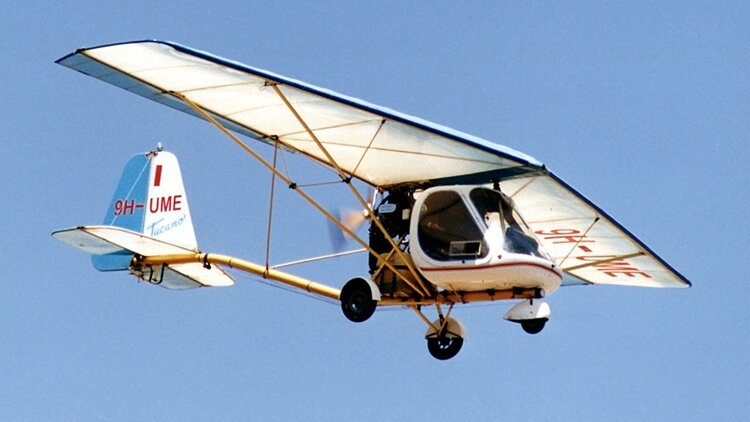 The Flylab Tucano (English: Toucan) is an Italian ultralight aircraft, produced by Flylab, of Ischitella. The aircraft is supplied as a kit for amateur construction or as a complete ready-to-fly-aircraft. The aircraft was produced in the 1990s by Ferrari ULM of Castelbaldo. The Tucano is a derivative of the Chotia Weedhopper and was designed to comply with the Fédération Aéronautique Internationale microlight rules with the design goal of being a low-cost aircraft. It features a strut-braced parasol wing, a two-seats-in-side-by-side configuration enclosed or open cockpit, fixed tricycle landing gear or floats and a single engine in pusher configuration or on some models twin engines in centreline thrust arrangement. The aircraft is made from bolted-together aluminum tubing, with its flying surfaces covered in Dacron sailcloth. Its 10.17 m (33.4 ft) span wing has an area of 17 m2 (180 sq ft) and is supported by V-struts and jury struts. There is a cabane strut that passes through the windshield and cockpit area. The aircraft is built around a central bent aluminum keel tube that runs from the cockpit to the tail. Controls are standard three-axis type. Standard engines available are the 50 hp (37 kW) Rotax 503 and 64 hp (48 kW) Rotax 582 two-stroke powerplants. The fuel tank is of plastic construction, mounted under the pusher engine. The Tucano V has a glide ratio of 11:1. Variants Tucano Base model with Rotax 582 powerplant. Tucano V (Specifications below) Improved model, with aerodynamic clean-ups and enclosed cockpit Tucano HV A Tucano V mounted on floats (hydro) Tucano Delta3 Open cockpit model powered by a Rotax 503 Tucano HD3 Float-equipped model based on the Tucano Delta3, powered by a Rotax 503 Tucano HD3A Amphibious float-equipped model based on the Tucano HD3, powered by a Rotax 503 Tucano Delta3 TW Twin-engined (TW) version with Rotax 582 engines mounted in the nose and aft of the cockpit, based on the Tucano Delta3 Tucano Delta3 VTW Twin-engined version with Rotax 582 engines mounted in the nose and aft of the cockpit, with the Tucano V aerodynamic and cockpit refinements Tucano X2 Twin-engined version with Rotax 582 engines mounted in the nose and aft of the cockpit, produced in the 1990s by Ferrari ULM.
 -
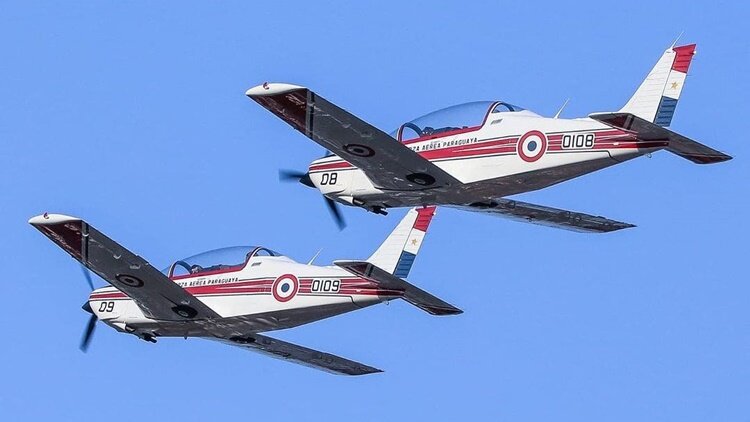 ENAER T-35 Pillán (Spanish pronunciation: [piˈʎan], Mapudungún: volcano or ancestral spirit) is a Chilean propeller-driven basic trainer aircraft. The student and the instructor sit in tandem. Production ceased in 1991 after 7 years but restarted briefly in 1998. Prior to the eighties Chile possessed a decrepit fleet of military trainers obtained under the Mutual Defense Assistance Act. However, these trainers had become exceedingly difficult to repair following passage of a US arms embargo in 1976. The PA-28R-300 Pillán was developed by Piper Aircraft in the United States as a two-seat military trainer for assembly in Chile, based on a PA-32R fuselage with a new center-section and wing stressed for aerobatics. The first prototype designated XBT first flew at Lakeland on 6 March 1981 and was followed by a second prototype, designated YBT. The second prototype first flew on 31 August 1981 and was then delivered to Chile. The prototype XBT was delivered to Chile in January 1982 but was written off on 10 March 1982. Production of kits at Vero Beach Municipal Airport commenced with three pre-production kits which were delivered for assembly in Chile in 1982, Vero Beach then produced 120 kits for assembly in Chile for the Chilean and Spanish Air Force. The first production aircraft was delivered by ENAER to the Chilean Air Force Air Academy in August 1985. The Spanish aircraft were assembled in Spain by CASA. Apart from a few turbine powered aircraft, all Pilláns were powered by a 300 hp (224 kW) Textron Lycoming AEIO-540-K1K5 six cylinder horizontally opposed piston engine. In 1985 a turboprop variant was developed by ENAER as the T-35A Aucan. In early 1986 one of the piston-engined pre-production aircraft was sent to Soloy Aviation Solutions in the United States for modification to install a 420 shp Allison 250B-17D engine. Variants Piper PA-28R-300 Pillan Two Piper built prototypes. T-35A (Specifications below) Two-seat primary training aircraft for the Chilean Air Force. 60 delivered by 1990. T-35B Two-seat instrument training aircraft for the Chilean Air Force. 20 delivered by 1990. T-35C Two-seat primary training aircraft for the Spanish Air and Space Force, known as the E.26 Tamiz. 41 delivered by 1987. T-35D Two-seat primary and instrument training aircraft for Panama and Paraguay. T-35DT Turboprop powered version, powered by a 420-ehp (313-kW) Allison 250-B17D turboprop engine. Original designation T-35XT. T-35S Single-seat aerobatic aircraft. T-35T Aucan Improved turboprop powered version. Pillan 2000 Proposed (1998) updated version of the T-35 Pillan with new wing.
 -
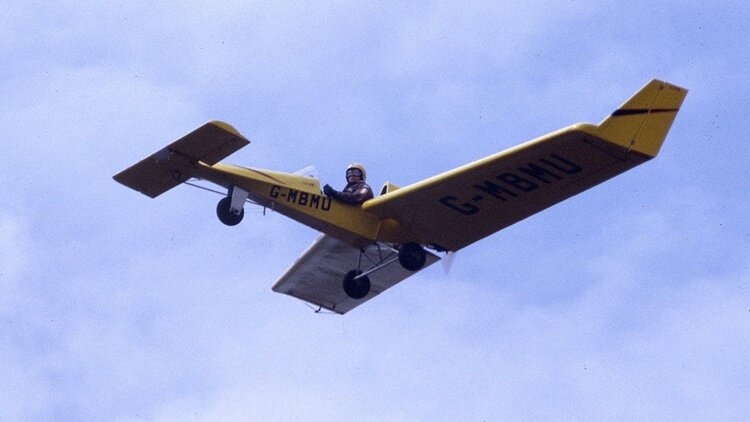 The Eurowing Goldwing is single-seat, single-engine, mid-wing monoplane with conventional three-axis control. Wing has swept back leading and trailing edges, and tapering chord; no tail, canard wing. Pitch control by elevator on canard; yaw control by tip rudders; roll control by half-span up-only ailerons and spoilers; control inputs through stick for pitch/roll and pedals for yaw. Cantilever wing; main-wing profile, modified Liebeck; canard profile, GU25; both double-surface. Undercarriage has three wheels in tricycle formation; no suspension on nosewheel and glass-fibre suspension on main wheels. Push-right go-right nosewheel steering connected to yaw control. No brakes. Aluminium-tube glassfibre fuselage, partially enclosed. Engine mounted above wing driving pusher propeller. Composite-construction wing of foam and aluminium covered with glass-fibre skin.
 -
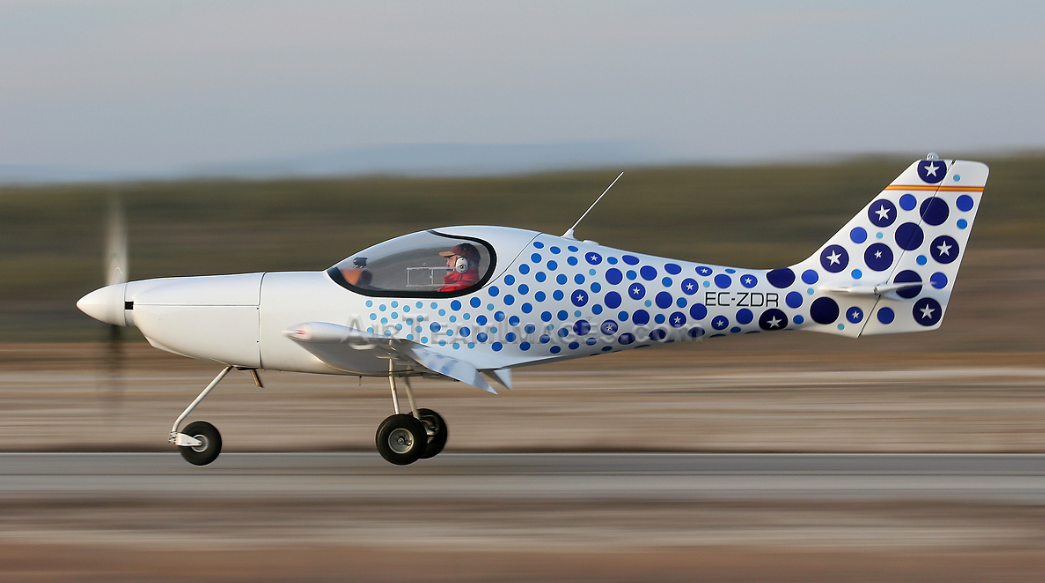 The Aerocomp VM-1 Esqual is a Swedish ultralight aircraft, produced by Arsi AB (formerly Aerocomp AB) of Alingsås. The aircraft is supplied as a kit for amateur construction or as a complete ready-to-fly-aircraft. The aircraft was originally designed in Spain by Vol Mediterrani to comply with the Fédération Aéronautique Internationale microlight rules and production was later moved to Sweden. It features a cantilever low-wing, a two-seats-in-side-by-side configuration enclosed cockpit, tricycle landing gear or conventional landing gear and a single engine in tractor configuration. Early versions used conventional landing gear but the current manufacturer is producing the nosewheel version. A retractable gear version is under development. The aircraft is made from high density PVC foam and epoxy resin composites. Standard engines available are the 100 hp (75 kW) Rotax 912S, 85 hp (63 kW) Jabiru 2200, 120 hp (89 kW) Jabiru 3300 and the 95 hp (71 kW) ULPower UL260i four-stroke powerplants. The landing gear is made from 7175-T6 aluminum alloy and employs a freely-castering nosewheel and main wheels brakes for steering. The wing features electrically actuated flaps. Manual trim is standard with electric trim optional.
 -
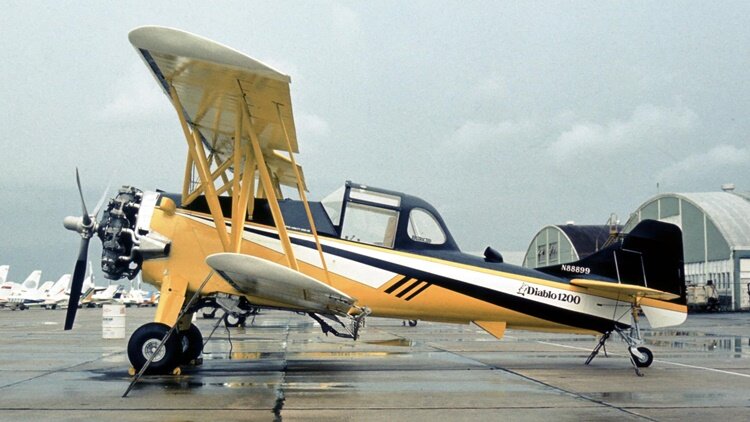 The Emair MA-1 Paymaster was a 1960s American agricultural biplane aircraft built by Emair, which was part of the Hawaiian Murray company. The prototype was constructed and flown in New Zealand, with production aircraft built in the United States at Harlingen, Texas. The prototype Murrayair MA-1 was built by Air New Zealand on behalf of Murrayair Limited of Hawaii, United States. Based on the Stearman 75 Kaydet, it had an increased wing area and modification to the forward fuselage to accommodate a pilot (in a raised cockpit for better visibility), a jump seat (used to carry an assistant or mechanic between stations), and a chemical hopper. The fixed tailwheel landing gear was strengthened and a more powerful Pratt & Whitney Wasp radial engine fitted. It first flew in New Zealand on 27 July 1969, then it was dismantled and shipped to Hawaii to obtain United States type certification; certification was awarded on 14 April 1970. Emair began production of the aircraft at Harlingen in Texas. The production aircraft were named Agronemair MA-1 Paymaster at first, then designated the Emair MA-1 Paymaster. Production ended in 1976 after 25 had been built. In 1975 Emair developed an improved version, the Emair MA-1B Diablo 1200, which was essentially an MA-1 with a more powerful Wright R-1820 radial engine. The more powerful engine did not increase the maximum takeoff weight but allowed operations at higher altitudes, and its lower output speed helped reduce propeller noise. Forty-eight MA-1s had been built by early 1980, with production being suspended by the end of the year due to poor market conditions. At the end of the 1980s the company halted production after a further 23 Diablos had been built. Variants Murrayair MA-1 New Zealand-built prototype with a 600hp (447kW) Pratt & Whitney R-1340-AN1 Wasp radial engine. Emair MA-1 Paymaster Production aircraft, 25 built. Emair MA-1B Diablo 1200 Improved version with a 900hp (671 kW) de-rated Wright R-1820 radial engine, 48 built.
 -
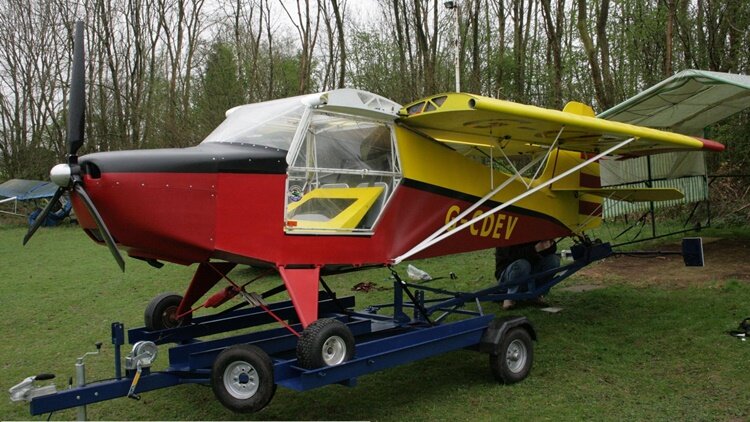 The Just Escapade is a single-engine, high-wing light aircraft, seating two in side-by-side configuration. It was jointly developed in the United States and the United Kingdom in the early 2000s and by 2010 some 145 Escapades and its "bush plane" variant, the Highlander, had been built and many more kits sold. The Escapade design can be traced back to that of the Avid Flyer, via the Denney Kitfox and Reality Easy Raider, marrying the Easy Raider's wing to a stretched Kitfox Lite fuselage. The key differences between the two types are the Escapade's side-by-side seating in a widened cabin, dual controls, and the option of a tricycle undercarriage It was developed jointly in the United States and United Kingdom by Just Aircraft and Reality Aircraft respectively, the American prototype flying in February 2003, four months before its British counterpart. These prototypes differed to fit into local classifications. The Escapade has a Chromoloy steel frame and is largely fabric covered. The wings have constant chord, ending in Hoerner-type wingtips; the trailing edges are aluminum. The ailerons and flaps have glass fiber leading edges. The wings are braced to the lower fuselage longerons with V-form struts and vertical jury struts. The fuselage is polygonal in section, sloping inwards above and below the center line, with a flat aluminum upper surface that slopes upwards from the tail to the wing trailing edge, at the rear of the cabin. The empennage is conventional, the low aspect ratio tailplane with its swept leading edge and rounded elevators located at the top of the fuselage. There is a portside flight-adjustable elevator trim tab with optional electric drive. The unbalanced rudder extends to the keel, moving in a V-shaped gap between the elevators. The seating is under the leading edge of the wing with a cabin roof window in the wing center section. Access is through side transparencies. Engine options include several Rotax or Jabiru units in the 37-89 kW (50-120 hp) range, driving two- or three-blade propellers and enclosed in a cowling manufactured from composite materials. Both undercarriage versions have the main wheels on faired-in V-form struts mounted on the lower fuselage longerons, with rubber-sprung half axles fixed to a compression frame. The conventional tailwheel is steerable but the alternative nose wheel castors freely, though a steerable version is planned. The Highlander version, intended for rough airstrips and marketed only in the United States, is designed to fly slowly and has a more robust undercarriage. Its wing has a 3 ft (910 mm) greater span, with vortex generators over the whole upper leading edge, and the fin is square cornered and 8 in (200 mm) taller. Its tail control surfaces are horn balanced and increased in area. The Highlander always has the conventional undercarriage, strengthened, with tundra tires and enhanced brakes. A 99 hp (74 kW) Rotax 912 ULS engine is fitted and allows a maximum takeoff weight of 1,320 lbs (598 kg). The Jabiru-engined United Kingdom prototype Escapade gained its permit to fly in September 2003 and the SLA prototype received British Civil Aircraft Rules section S approval from the Light Aircraft Association in April 2008. The Highlander was introduced in 2004. For details of Operational history and Variants, click here. Tailwheel variant Tricycle variant