

Admin
-
Posts
9,322 -
Joined
-
Last visited
-
Days Won
110
Content Type
Profiles
Forums
Gallery
Downloads
Blogs
Events
Store
Aircraft
Resources
Tutorials
Articles
Classifieds
Movies
Books
Community Map
Quizzes
Videos Directory
Posts posted by Admin
-
-
What next

-
A lot of folks can't understand how we came to have an oil shortage here in Australia.
Well, there's a very simple answer.
Nobody bothered to check the oil.
We just didn't know we were getting low.
The reason for that is purely geographical.
Our OIL is located in Bass Strait, East Queensland Shale Fields, Canning Basin, Perth Basin and North-West Continental Shelf
Our DIPSTICKS are located in Canberra!!!
Any Questions ? NO? I didn't Think So.
-
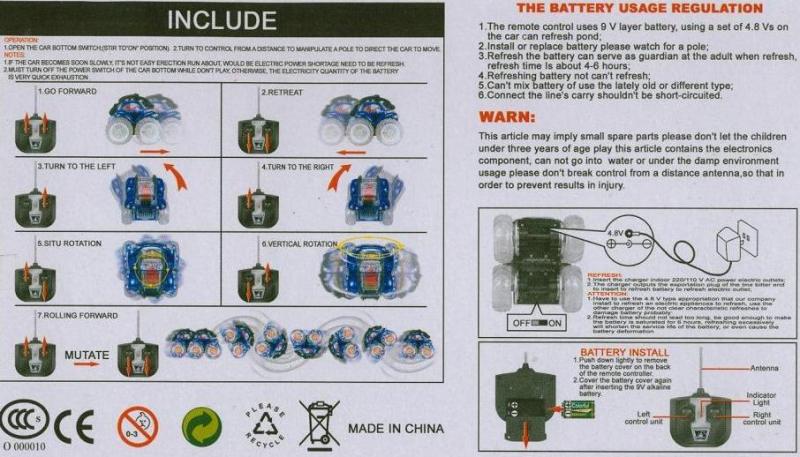
I bought my son a remote control car that was made in China - can anyone help me understand the instructions especially about the battery
-
On behalf of every forum member I would like to bid farewell with the best of luck to Chris - our RAAus Technical Manager who leaves the RAAus today (Friday 11th July 08) to take up a new role in the IT industry. Chris, you have helped our Association become far safer today and more enjoyable with your watchful eye over all the technical aspects of the aircraft that we fly and you WILL be very much missed.
However, we all do hope that you enjoy your next opportunity and that you will not forget us all - even if we don't fly gliders
- goodbye for now, good luck in the future and no doubt we will see you around at some airfield or in the air somewhere -
The latest on the Millennium Master is that I believe the production of the first batch of 5 aircraft may start in September. As soon as I get one here it will have to be certified but whilst that is happening production should commence for ordered aircraft hopefully in about October.
-
Millennium Aircraft are so busy with their production planning of the first Masters at the moment so let us wait for them to be available here first and then perhaps in a year or two.
-
Clear Prop have had the pump in stock for some time:
http://www.clearprop.com.au/index.php?target=products&product_id=30532
and it was a hit at Natfly this year - several aircraft had punctures and they came over to the Rec Flying tent and got one of them.
-
Possibly a beautiful blue Gazelle as well :big_grin:
-
I have been advised that Aircraft1 is Michael Coates. I have checked the forum settings and it seems I must have lost the ban on Coates when I upgraded the forum engine awhile back :confused:. If it is then it doesn't matter as he has been following the forum rules BUT the phone number used for registration is not connected so Aircraft1 has been banned and the message that he is showed when coming to this site is:
[You have used a phone number in your forum registration that is not connected - if you believe this is in error then contact me on 03 9444-8025]
I will wait for his phone call
-
Aircraft1 - there is a lot more then Michael Coates himself would tell you - did he also tell you that he had 3 warnings for breaking the rules before he was banned - probably not and note that he is the only person that has been "permanently" banned from here, others have had suspensions for periods of time for breaking the rules, the rules that you and everyone else agreed to when joining these forums to gain a world of helpful information, but there is absolutely no discrimination to any dealer or general person - the rules are the same for everyone so why do some people think that rules are only for other people and not them?
The RAAus forums that may be happening has been initiated as a simple means of RAAus specific information distribution and I have had discussions, private discussions which I won't elaborate on for ethical reasons with the executive, about our forums, and I can safely say that you have been either completely misinformed and probably no doubt from an aircraft salesman or you have some kind of ulterior motive. There is a lot of private information about this entire subject so please listen to someone that has integrity rather then hangar gossip. It is also worthy to note that any subject that may come up in any RAAus forum that is started will also be started here so no one will miss anything!
You know that I am standing in the current board elections and this is the 2nd time in as many weeks that you have targeted me so I do wonder if there is an ulterior motive and are sinister ploys being initiated. What I will say is that there are people out there that just take money from you and our industry yet for the last 4 years I have done nothing but give you my time and my money in the form of providing you with a great resource, a resource that is heavily moderated to maintain it's friendliness, helpfulness and above all provide you with a possibility of learning something to keep you alive - has anyone else ever done anything like this for you and for absolutely nothing in return???
Darn politics and the games that people play trying to reap any benefit they can for themselves - but me, well just look at the benefit that you have had in the last 4 years in these forums - I think it is obvious that I just simply stand for you and in helping all RAAus members and take nothing in return!
With respect!
-
Piggyback Hero
by Ralph Kenney Bennett
Tomorrow they will lay the remains of Glenn Rojohn to rest in the Peace Lutheran Cemetery in the little town of Greenock , Pa. , just southeast of Pittsburgh . He was 81, and had been in the air conditioning and plumbing business in nearby McKeesport If you had seen him on the street he would probably have looked to you like so many other graying, bespectacled old World War II veterans whose names appear so often now on obituary pages.
But like so many of them, though he seldom talked about it, he could have told you one hell of a story. He won the Air Medal, the Distinguished Flying Cross and the Purple Heart all in one fell swoop in the skies over Germany on December 31, 1944. Fell swoop indeed.
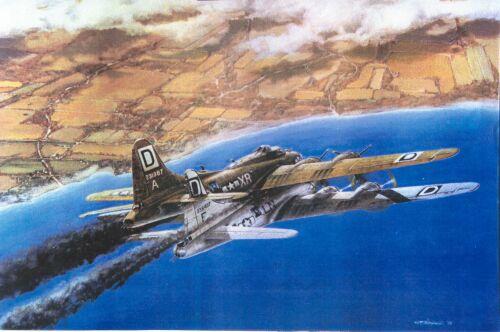
Capt. Glenn Rojohn, of the 8th Air Force's 100th Bomb Group was flying his B-17G Flying Fortress bomber on a raid over Hamburg . His formation had braved heavy flak to drop their bombs, then turned 180 degrees to head out over the North Sea . They had finally turned northwest, headed back to England , when they were jumped by German fighters at 22,000 feet. The Messerschmitt Me-109s pressed their attack so closely that Capt. Rojohn could see the faces of the German pilots. He and other pilots fought to remain in formation so they could use each other's guns to defend the group. Rojohn saw a B-17 ahead of him burst into flames and slide sickeningly toward the earth. He gunned his ship forward to fill in the gap. He felt a hug e impact. The big bomber shuddered, felt suddenly very heavy and began losing altitude. Rojohn grasped almost immediately that he had collided with another plane. A B-17 below him, piloted by Lt. William G. McNab, had slammed the top of its fuselage into the bottom of Rojohn's. The top turret gun of McNab's plane was now locked in the belly of Rojohn's plane and the ball turret in the belly of Rojohn's had smashed through the top of McNab's. The two bombers were almost perfectly aligned -- the tail of the lower plane was slightly to the left of Rojohn's tailpiece. They were stuck together, as a crewman later recalled, 'like mating dragon flies.'
Three of the engines on the bottom plane were still running, as were all four of Rojohn's. The fourth engine on the lower bomber was on fire and the flames were spreading to the rest of the aircraft. The two were losing altitude quickly. Rojohn tried several times to gun his engines and break free of the other plane. The two w ere inextricably locked together. Fearing a fire, Rojohn cut his engines and rang the bailout bell. For his crew to have any chance of parachuting, he had to keep the plane und er control somehow..
The ball turret, hanging below the belly of the B-17, was considered by many t o be a death trap -- the worst station on the bomber. In this case, both ball turrets figured in a swift and terrible drama of life and death. Staff Sgt. Edward L. Woodall, Jr., in the ball turret of the lower bomber had felt the impact of the collision above him and saw shards of metal drop past him. Worse, he realized both electrical and hydraulic power was gone.
Remembering escape drills, he grabbed the handcrank, released the clutch and cranked the turret and its guns until they were straight down, then turned and climbed out the back of the turret up into the fuselage. Once inside the plane's belly Woodall saw a chilling sight, the ball turret of the other bomber protruding through t he top of the fuselage. In that turret, hopelessly trapped, was Staff Sgt. Joseph Russo. Several crew members of Rojohn's plane tried frantically to crank Russo's turret around so he could escape, but, jammed into the fuselage of the lower plane, it would not budge. Perhaps unaware that his voice was going out over the intercom of his plane, Sgt. Russo began reciting his Hail Marys.
Up in the cockpit, Capt.. Rojohn and his co-pilot 2nd Lt. William G. Leek, Jr., had propped their feet against the instrument panel so they could pull back on their controls with all their strength, trying to prevent their plane from going into a spinning dive that would prevent the crew from jumping out. Capt. Rojohn motion left and the two managed to wheel the huge, collision-born hybrid of a plane back toward the German coast. Leek felt like he was intruding on Sgt. Russo as his prayers crackled over the radio, so he pulled off his flying helmet with its earphones.
Rojohn, immediately grasping that crew could not exit from the bottom of his plane, ordered his top turret gunner and his radio operator, Tech Sgts. Orville Elkin and Edward G. Neuhaus to make their way to the back of the fuselage and out the waist d oor on the left behind the wing. Then he got his navigator, 2nd Lt. Robert Washington, and his bombardier, Sgt. James Shirley to follow them. As Rojohn and Leek somehow held the plane steady, these four men, as well as waist gunner, Sgt. Roy Little, and tail gunner, Staff Sgt. Francis Chase, were able to bail out.
Now the plane locked below them was aflame. Fire poured over Rojohn's left wing. He could feel the heat from the plane below and hear the sound of 50 cal. machinegun ammunition 'cooking off' in the flames. Capt. Rojohn ordered Lieut. Leek to bail out. Leek knew that without him helping keep the controls back, the plane would drop in a flaming spiral and the centrifugal force would prevent Rojohn from bailing. He refused the order.
Meanwhile, German soldiers and civilians on the ground that afternoon looked up in wonder.. Some of them thought they were seeing a new Allied secret weapon -- a strange eight-engined double bomber. But anti-aircraft gunners on the North Sea coastal island of Wangerooge had seen the collision. A German battery captain wrote in his logbook at 12:47 p.m.:
'Two fortresses collided in a formation in the NE. The planes flew hooked together and flew 20 miles south. The two planes were unable to fight anymore. The crash could be awaited so I stopped the firing at these two planes.'
Suspended in his parachute in the cold December sky, Bob Washington watched with deadly fascination as the mated bombers, trailing black smoke, fell to earth about three miles away, their downward trip ending in an ugly boiling blossom of fire.
In the cockpit Rojohn and Leek held grimly to the controls trying to ride a falling rock. Leek tersely recalled, 'The ground came up faster and f aster. Praying was allowed. We gave it one last effort and slammed into the ground.' The McNab plane on the bottom exploded, vaulting the other B-17 upward and forward. It slammed back to the ground, sliding along until its left wing slammed through a wooden building and the smoldering mess of came to a stop. Rojohn and Leek were still seated in their cockpit. The nose of the plane was relatively intact, but everything from the B-17 massive wings back was destroyed. They looked at each other incredulously. Neither was badly injured.
Movies have nothing on reality. Still perhaps in shock, Leek crawled out through a huge hole behind the cockpit, felt for the familiar pack in his uniform pocket pulled out a cigarette. He placed it in his mouth and was about to light it. Then he noticed a young German soldier pointing a rifle at him. The soldier looked scared and annoyed. He grabbed the cigarette out of Leak's mouth and pointed down to the gasoline pouring out over the wing fro m a ruptured fuel tank.
Two of the six men who parachuted from Rojohn's plane did not survive the jump. But the other four and, amazingly, four men from the other bomber, including ball turret gunner Woodall, survived. All were taken prisoner. Several of them were interrogated at length by the Germans until they were satisfied that what had crashed was not a new American secret weapon.
Rojohn, typically, didn't talk much about his Distinguished Flying Cross. Of Leek, he said, 'in all fairness to my co-pilot, he's the reason I'm alive today.'
Like so many veterans, Rojohn got unsen timentally back to life after the war, marrying and raising a son and daughter. For many years, though, he tried to link back up with Leek, going through government records to try to track him down. It took him 40 years, but in 1986, he found the number of Leeks' mother, in Washington State . Yes, her son Bill was visiting from California . Would Rojohn like to speak with him ? Some things are better left unsaid. One can imagine that first conversation between the two men who had shared that wild ride in the cockpit of a B-17. A year later, the two were re-united at a reunion of the 100th Bomb Group in Long Beach , Calif. Bill Leek died the following year.
Glenn Rojohn was the last survivor of the remarkable piggyback flight. He was like thousands upon thousands of men, soda jerks and lumberjacks, teachers and dentists, students and lawyers and service station attendants and store clerks and farm boys who in the prime of their lives went to war.
He died last Saturday after a long siege of sickness. But he apparently faced that final battle with the same grim aplomb he displayed that remarkable day over Germany so long ago. Let us be thankful for such men.
-
All our thoughts are with the Brooke family and hope both pilot and passenger make a very speedy recovery
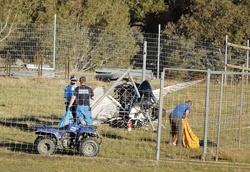
Rescue crews rushed to a Glen Oak property yesterday afternoon after two people were seriously injured in an ultralight aircraft crash. The twin-seater ultralight was taking off at 2.45pm on the Storks Road property when it clipped a fence and plummeted back to earth.
Ambulance rescue officer from Rutherford Ken Morrison told the Mercury how he and colleague Wayne Rodway found a female trapped in the wreckage when they arrived at the scene.
The officers and other rescue workers raced to get the two injured people away from the ultralight which was leaking fuel.
After brief first aid treatment, and while colleagues used fire extinguishers on the wreckage, they carried the pair to a secluded spot.
"The female was trapped under the wreckage, but the male had somehow managed to get himself out by the time we arrived," Mr Morrison said.
"We had to get them away as quickly as possible because of the leaking fuel.
"She was still lying under the wreckage when we got there.
"We used all our first aid knowledge and fire extinguishers to work as fast as we could.”
The woman was treated for injuries to her face, hip and arm and also for back pain.
She was listed in a serious to critical condition.
The man had back pain and a possible fractured shoulder as well as possible spinal injuries.
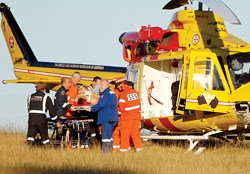
Taking part in the rescue were ambulance rescue from Rutherford, ambulance officers from Rutherford and Nelson Bay, the Rural Fire Service, police and the Westpac Rescue Helicopter.
The Westpac Rescue Helicopter airlifted both the man and the woman to John Hunter Hospital yesterday afternoon.
Police established a crime scene at the sight and said that investigations would be ongoing and would involve Recreational Aviation Australia.
Seventeen-year-old Matt Stork was on a nearby property when he heard the crash.
"It sounded like a tree snapping in half," he told the Mercury.
-
G'day Mate and welcome to the forums - "Storchy Neil" here in the forums has one and if he doesn't pick up on this thread in the next day or two then may I suggest you send him a PM
-
Personally I think that it may be better (without knowing any reasoning) if the RAAus just used the RAA domain but the problem is as stated that there are many still using the AUF domain from bookmarks and search engines. In this case I always feel it better to notify visitors of the domain change by having an index page for AUF advising of the change and to update their bookmarks/favourites plus instead of a timed redirect, to make the user click a link on it to the new RAA domain. This makes it sink in more and allows users of different reading speed the time to read the page.
Another option is to simply create an index page on the AUF domain that simply has this content:
When a user goes to the AUF domain the index page will simply redirect them to the RAA domain without them knowing
Whilst I am on the subject I would like to offer the RAAus free hosting on a fully managed Australian server located in Sydney. Recreational Flying has extensive disk space and traffic quota that is not being used that the RAAus could use without any cost. John can still manage the content, the DNS, hardware and op systems are all fully managed 24hrs a day, daily backups plus when Rec Flying get the video presentation room going the RAAus could easily link into that application to use themselves - again for free. This is just a small thing that will help to reduce the RAAus costs (our costs) yet proving a better service in uptime and technologies - just a thought!
-
The next time you are washing your hands and complain because the water temperature isn't just how you like it, think about how things used to be . Here are some facts about the 1500s:
Most people got married in June because they took their yearly bath in May, and still smelled pretty good by June. However, they were starting to smell, so brides carried a bouquet of flowers to hide the body odor. Hence the custom today of carrying a bouquet when getting married.
Now we Know
Baths consisted of a big tub filled with hot water. The man of the house had the privilege of the nice clean water, then all the other sons and men, then the women and finally the children. Last of all the babies. By then the water was so dirty you could actually lose someone in it Hence the saying, Don't throw the baby out with the Bath water..
Houses had thatched roofs-thick straw-piled high, with no wood underneath. It was the only place for animals to get warm, so all the cats and other small animals (mice, bugs) lived in the roof When it rained it became slippery and sometimes the animals would slip and fall off the roof. Hence the saying . It's raining cats and dogs.
There was nothing to stop things from falling into the house.. This posed a real problem in the bedroom where bugs and other droppings could mess up your nice clean bed. Hence, a bed with big posts and a sheet hung over the top afforded some protection. That's how canopy beds came into existence.
The floor was dirt. Only the wealthy had something other than dirt. Hence the saying, Dirt poor. The wealthy had slate floors that would get slippery in the winter when wet, so they spread thresh (straw) on floor to help keep their footing. As the winter wore on, they added more thresh until, when you opened the door, it would all start slipping outside. A piece of wood was placed in the entranceway. Hence the saying a thresh hold.
(Getting quite an education, aren't you?)
In th ose old days, they cooked in the kitchen with a big kettle that always hung over the fire. Every day they lit the fire and added things to the pot. They ate mostly vegetables and did not get much meat. They would eat the stew for dinner, leaving leftovers in the pot to get cold overnight and then start over the next day. Sometimes stew had food in it that had been there for quite a while. Hence the rhyme, Peas porridge hot, peas porridge cold, peas porridge in the pot nine days old..
Sometimes they could obtain pork, which made them feel quite special. When visitors came over, they would hang up their bacon to show off. It was a sign of wealth that a man could, bring home the bacon. They would cut off a little to share with guests and would all sit around and chew the fat..
Those with money had plates made of pewter. Food with high acid content caused some of the lead to leach onto the food, causing lead poisoning death. This happened most often with tomatoes, so for the next 400 years or so, tomatoes were considered poisonous.
Bread was divided according to status. Workers got the burnt bottom of the loaf, the family got the middle, and guests got the top, or the upper crust.
Lead cups were used to drink ale or whisky. The combination would sometimes knock the imbibers out for a couple of days. Someone walking along the road would take them for dead and prepare them for burial. They were laid out on the kitchen table for a couple of days and the family would gather around and eat and drink and wait and see if they would wake up. Hence the custom of holding a wake.
England is old and small and the local folks started running out of places to bury people. So they would dig up coffins and would take the bones to a bone-house, and reuse the grave. When reopening these coffins, 1 out of 25 coffins were found to have scratch marks on the inside and they realized they had been burying people alive. So they would tie a string on the wrist of the corpse, lead it through the coffin and up through the ground and tie it to a bell. Someone would have to sit out in the graveyard all night (the graveyard shift.) to listen for the bell; thus, someone could be, saved by the bell or was considered a ...dead ringer..
And that's the truth. Now, whoever said History was boring ! ! !
-
-
Hi Bas
Endorsement: Cross Country
Learn about: flight planning, meteorology and navigation
Minimum Hours: 5hrs training (3 hours dual instruction and 2 hours solo)
Flight Test: Navigation flight test
Written Test: Multiple choice questions on Flight Rules & Procedures
Result: The cross country endorsement will allow you to fly the recreational aircraft type that you obtained your endorsement in anywhere within Australia during daylight and reasonable weather under visual flight rules (VFR). Generally you will not be allowed to fly over 5000 feet above mean sea level and not in controlled airspace (OCTA), unless you fulfil some specific requirements of Airservices Australia (the Air Traffic Control organisation), or other prohibited or restricted areas.
Endorsement: Passenger Carrying
Learn about: The pre-flight planning of fuel requirements, passenger and baggage arrangement, assessment of runway and air density conditions, calculation of aircraft weight and balance and the physical pre-flight airworthiness checking of the aircraft is emphasised, to ensure the flight will be operated safely
Minimum Hours: 5hrs solo with a minimum of 2hrs in a 2 seat aircraft - 2hrs solo may be cross credited from the 5hr cross country endorsement
Flight Test: Passenger handling flight test
Written Test: None
Result: The passenger endorsement will allow you to take a passenger on private flights
Endorsement: Radio Operator
Learn about: The proper use of a radio and radio procedures
Minimum Hours: None
Flight Test: None
Written Test: Multiple choice questions
Result: Greater freedom, ease and safety in flight
This would mean that at:
25hrs minimum you could have your Certificate and x-country or
25hrs minimum you could have your Certificate and passenger or
27hrs minimum you could have your Certificate, x-country and passenger
Hope this helps!
-
Completely different regs here J430 - No speed limit for one
The page you were looking for is at http://www.raa.asn.au/operations/regulations.html
-
The local news says that a light aircraft got bent at Narrandera yesterday, but the pilot walked away.
Given the media accuracy out here, that probably means that a light pole got bent at Balranald,
-
I think the main advantage of something like this is that for those in the GA arena that want to get some twin time in their logbook it would be a cheap way of doing it.
-
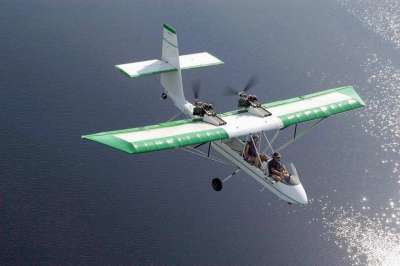
This could be what a twin engine Drifter could look like
-
Clear Prop now has stock of ERSA, WAC and VNC
-
Send me a PM with what user name you would like to change to
-
Thanks Philip - although off topic but can you tell me the best way to get these forums known over in NZ and in your opinion would anything need to be done to the forums to make them more appealing to NZ pilots? I lived in Auckland for about 8 years, married a Kiwi and my daughter was born there.




Greeting text changes
in AUS/NZ General Discussion
Posted
It's time for a change to the greeting text that is displayed with your name up on the right side of the forum page.
The times that it changes are:
02:00
04:00
05:30
07:00
12:00
13:00
17:00
18:00
18:15
22:00
23:00
24:00
and the text changes are:
Good Afternoon
Shouldn't you be going to bed soon
Still can't sleep
It's 11 o'clock, do you know where your children are
What's for dinner
Aren't you the early bird
Good Evening
Got milk
Up late, aren't we
Enjoying your lunch break
Good Morning
Having trouble sleeping
So now you have an opportunity to come up with some suggestions for the time slots - keeping it clean ;) what are your best one liners of what time??????