IBob
-
Posts
3,160 -
Joined
-
Last visited
-
Days Won
27
Content Type
Profiles
Forums
Gallery
Downloads
Blogs
Events
Store
Aircraft
Resources
Tutorials
Articles
Classifieds
Movies
Books
Community Map
Quizzes
Videos Directory
Everything posted by IBob
-
Plane hits paraglider in Germany - both survive.
IBob replied to red750's topic in Aircraft Incidents and Accidents
Yes. Following a double fatal midair here, we got a detailed look (during preparation for the proposed court case) at the limitations of 'see and avoid': Notably the closing speeds vs the considerable amount of time typically required to first spot the aircraft, then register the danger, then react to it, then for evasive action to actually take effect. Also a study carried out years ago in the US: the pilots were told it was to provide data on how they managed their various inflight workloads, but they were also instructed, in passing, to call out any other traffic they may see. Flights were then arranged, unbeknown to the pilots, with a number of traffic intercepts.....not collision stuff, but quite close enough to see. On average they missed seeing 40% of that traffic. -
Plane hits paraglider in Germany - both survive.
IBob replied to red750's topic in Aircraft Incidents and Accidents
FWIW flocking is now a thing in the skydive world: opening extremely high then flying around in a big mob formation....... -
That is a 912 UL, with a lower compression ratio. I never tried, but I'm doubtful I could pull a 912 ULS over that briskly. Still, I stand corrected!
-
Okay, that's a revelation!
-
As pointed out by others above: 1. Burping the Rotax relies on blowby to pressurise the crankcase and push the oil back. That being the case, you are no better off pulling it over briskly: you are actually better to linger in the compressed state, so maximising blowby. 2. You can't hand start a Rotax. The reason for this is that the power for the ignition comes only from little dedicated stator coils and the engine has to be turning over very briskly for these to generate sufficient power. Having said that, one still reflexively checks 'mags off' before pulling it over....
-
Marty, I recently searched the thermal conductivity of wood. In the same paragraph, AI stated that thermal conductivity is higher in denser woods (makes sense), it then stated that denser woods are preferred in building due to thermal insulation properties. It then changed it's mind yet again in the next paragraph. What this illustrates is that, while the thing is writing English (so appears logical), it is not actually in any way checking for logical consistency in what it writes.....(
-
Boots for firewall piercings?
IBob replied to Marty_d's topic in Aircraft Building and Design Discussion
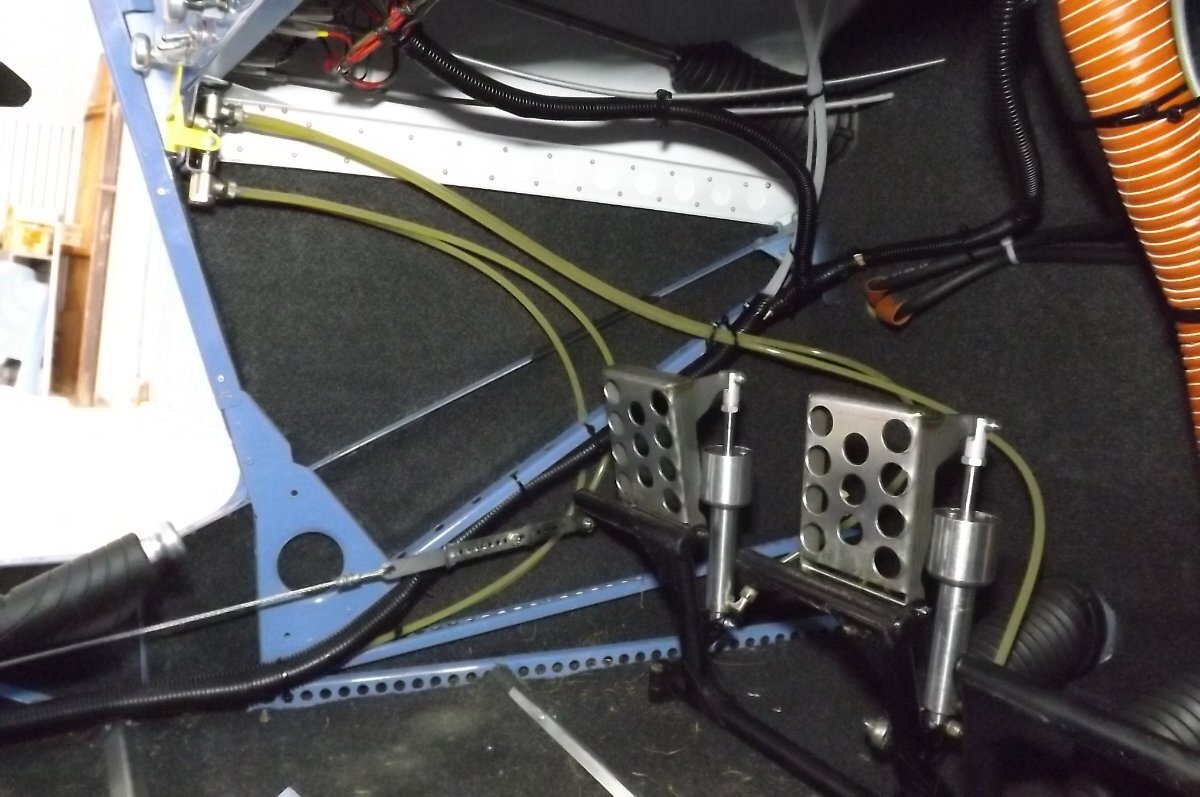
Hi Marty, my kit came from Oz, and the then dealer supplied bellows type 'rubbers' to go on steering rods and throttle rods. I don't have the details of those, but he also supplied a pattern for making a protruding collar round the rod slots, attached to the firewall, which the big end of the bellows then fitted neatly over. It looks an odd shape, but when you rivet it's ends together to make an oval, it is angled so that it attaches to the firewall in line with the rods (not perpendicular to the firewall as a single width band would). See Boot Bracket, below. Boot Bracket.pdf
-
Two EA18-G jets collide at US Airshow (Corrected)
IBob replied to red750's topic in Aircraft Incidents and Accidents
And wasn't he (the copilot) there to try and keep an eye on Hollands and his behaviours? -
Two EA18-G jets collide at US Airshow (Corrected)
IBob replied to red750's topic in Aircraft Incidents and Accidents
How fortunate were they to all get out alive??? -
Skippy, a short anecdote to support my much earlier suggestion: The Savannah puts hot air into the airbox when carb heat is selected. I had poor indicated carb heat, which I improved a bit with some attention to the ducting, but it was still very poor. So, either I had poor carb heat, or I had a faulty carb heat reading. If I could determine which, I could then greatly narrow down the problem. I bought a very cheap digital temp gauge with a 1m probe lead, tested it (iced then boiling water) and installed it in the airbox. And got the expected much higher readings. So, faulty carb heat reading. (There is a further 'gotcha' in this, but I'll put that at the end.) It seems to me you have a similar situation: is it the fuel pressure, or is it the fuel pressure sensing. In your situation I would be strongly inclined to temporarily install a steam gauge. You will then know which side of the question to be looking at, greatly reducing the number of possibilities and variables that you are currently chasing. (The gotcha: had I tested the probe supplied with the kit (iced then boiling water), I would have found nothing wrong with that. The problem wasn't the sensing, but the probe type (very short) and it's mounting (into a thick threaded bush in the airbox wall). So what that was measuring was not air temperature but airbox wall temperature. And the wall is constantly cooled by outside air. I did write to ICP about it, they thanked me politely, but I have no idea if they made any subsequent changes.)
-
You missed out the pole dancing???
-
I bought mine from Cleaveland Aircraft Tool, good quality and nice people: https://www.cleavelandtool.com/shop/kwik-loc-cleko-type-fasteners-packs-149?category=54#attribute_values=103
-
Why? Presumably it sells Red Bull by keeping the brand highly visible with dangerous/edgy/exciting/dramatic stunts.
-
There was an old (silent, I think) movie where someone climbed down a rope ladder from an aircraft onto the roof of a moving train. As I recall, they killed 2 stuntmen before the third managed it. I think part of the problem in that case was the pilot couldn't see what was going on with the man swinging on the ladder below and behind him.
-
You may want to check how the 'mag' switches are wired. Unless they are as per Rotax installation instructions, with correct shielding, they can make for radio noise.
-
There's certainly an abundance round here on occasions...................)
-
Darn, I was hoping nobody would notice... Yet another plus, Skippy?
-
Blackhawk, you may like to look at the Barber Snark. It is tandem, not side by side, but with the passenger sat high with excellent outlook. A NZ design, but I believe there is one in Australia. It has received very positive reviews: https://en.wikipedia.org/wiki/Barber_Snark
-
I've specified expansion vessels for a few closed loop boiler systems. It's been a while, but as I recall we used to budget on 4% expansion, from ambient to 100'C. I can't now recall if that was the actual expansion, or expansion plus safety margin. Water coefficient of expansion is not linear, so you can't just plug one number into the usual calculators.......
-
I recall a comment from a LAME with a lot of Rotax maintenance experience: he said that almost all the carb balancing problems he came across were due to poor installation and/or maintenance of the cables and linkages. I have only worked on one Rotax (my own) but went to some trouble to set that all up with swept cable bends etc. Some minor cable adjustments were then required in the first 50hrs, thereafter I still checked regularly but no further adjustment was required.
-
For smooth idling etc, first check the throttle stop and idle jet settings as per the manual. These are static adjustments and about 5mins 'work'. One of mine was out on a new 912 (can't now recall which one), so worth checking regardless. After that, synchronise the two throttle actions.
-
Thanks, red. I continue to enjoy seeing them. And I continue to be astonished at the sheer number there have been........
-
Nothing wrong with capitalising on your assets.........)
-
Unfortunately, birds seem to habituate to any static deterrent if there is food and/or nesting space. They are a perennial problem in vineyards. Netting of the vines has greatly improved in recent years, but prior to that vintners tried all manner of things: kites, balloons with big fierce eyes, gas guns, hawk cries. And this: An engineer in Hawkes Bay had a bright idea, persuaded a local vintner to let him try it. They erected posts with pulleys on top round a vineyard. An endless motor driven cable ran round the pulleys, and the idea was that various scare devices (balloons, kites, flashers and noise devices) could be attached to the cable and would move constantly round the vineyard. A couple of weeks after all this went in, the vintner called the engineer and said 'We have a problem, you're not going to believe this'. The birds, and there were many, had taken to sitting on the wire, and were happily riding round the vineyard, diving down occasionally whenever an especially juicy bunch of grapes hove into view...............
-
Ah, you're a week early, flymate: next week end 13/14 Dec is the monthly fly of the Vintage Aviator machines at Hood airfield, Masterton. They wheel out about 20 WW1 aircraft, crank them up and fly them.......