
Jump to content

red750

Moderators
  • Posts

    8,173
  • Joined

  • Last visited

  • Days Won

    74

Everything posted by red750

  1. red750

    Grumman F4F Wildcat

    The Grumman F4F Wildcat is an American carrier-based fighter aircraft that entered service in 1940 with the United States Navy, and the British Royal Navy where it was initially known as the Martlet. First used by the British in the North Atlantic, the Wildcat was the only effective fighter available to the United States Navy and Marine Corps in the Pacific Theater during the early part of the Second World War. The disappointing Brewster Buffalo was withdrawn in favor of the Wildcat and replaced as aircraft became available. With a top speed of 318 mph (512 km/h), the Wildcat was outperformed by the faster 331 mph (533 km/h), more maneuverable, and longer-ranged Mitsubishi A6M Zero. US Navy pilots, including John "Jimmy" Thach, a pioneer of fighter tactics to deal with the A6M Zero, were greatly dissatisfied with the Wildcat's inferior performance against the Zero in the battles of the Coral Sea and Midway. The Wildcat has a claimed air combat kill-to-loss ratio of 5.9:1 in 1942 and 6.9:1 for the war. Lessons learned from the Wildcat were later applied to the faster F6F Hellcat. While the Wildcat had better range and maneuverability at low speed, the Hellcat could rely on superior power and high speed performance to outperform the Zero. Wildcat production continued throughout the remainder of the war, with Wildcats serving on escort carriers, where the larger and much heavier Hellcat could not be used. Grumman fighter development began with the two-seat Grumman FF biplane. The FF was the first U.S. naval fighter with a retractable landing gear. The wheels retracted into the fuselage, leaving the tires visibly exposed, flush with the sides of the fuselage. Two single-seat biplane designs followed, the F2F and F3F, which established the general fuselage outlines of what would become the F4F Wildcat. In 1935, while the F3F was still undergoing flight testing, Grumman started work on its next biplane fighter, the G-16. At the time, the U.S. Navy favored a monoplane design, the Brewster F2A-1, ordering production early in 1936. However, an order was also placed for Grumman's G-16 (given the navy designation XF4F-1) as a backup in case the Brewster monoplane proved to be unsatisfactory. It was clear to Grumman that the XF4F-1 would be inferior to the Brewster monoplane, so Grumman abandoned the XF4F-1, designing instead a new monoplane fighter, the XF4F-2. The XF4F-2 would retain the same, fuselage-mounted, hand-cranked main landing gear as the F3F, with its relatively narrow track. The unusual manually-retractable main landing gear design for all of Grumman's U.S. Navy fighters up to and through the F4F, as well as for the amphibious Grumman J2F utility biplane, was originally created in the 1920s by Leroy Grumman for Grover Loening. Landing accidents caused by failure of the main gear to fully lock into place were distressingly common. Note: All photos show the RN Marlett variant. For more details on development, operational history and 15 variants, click here.
  2. red750

    Socata TB 30 Epsilon

    The Socata TB 30 Epsilon is a light military trainer aircraft produced by SOCATA (then part of Aérospatiale). It is a tandem two-seater with a metal airframe. The first prototype flew on 22 December 1979. In 1978, the French Air Force (Armée de l'Air) published a requirement for a new basic trainer aircraft to partially replace the Fouga Magister in the early parts of the syllabus for pilot training. The new aircraft was expected to have tandem seating, be powered by a 224 kW (300 hp) piston engine and have a three-hour endurance. Similar designs were proposed by the SOCATA subsidiary of Aérospatiale (based on their TB 10 Tobago light aircraft) and by GEPAL (the GEPAL Mk II). The SOCATA proposal, the TB 30B, was chosen in February 1979. The first of two prototypes flew on 22 December 1979, but testing showed that the Epsilon had poor handling and it was redesigned with a new swept back fin supplemented by a ventral strake and a larger tailplane, while the wing was fitted with elliptical tips increasing the wingspan from 7.40 m (24 ft 33⁄8 in) to 7.59 m (24 ft 113⁄4 in). The first prototype flew again with these changes on 31 October 1980, and it was soon found that the handling problems had been fixed. The Epsilon is a low winged cantilever monoplane of all metal construction. It is powered by a Lycoming O-540 flat-six piston engine driving a two-blade propeller, and is fitted with a retractable nosewheel undercarriage. The pilot and instructor are sat in tandem under a sliding Plexiglas canopy, with cockpit layout designed to aid transition to the Dassault/Dornier Alpha Jet to which French students graduate after completing the Epsilon part of their training syllabus. The first prototype was modified into a testbed for the Turbomeca TP 319 Arrius turboprop engine, flying in this form on 9 November 1985. The testbed was then modified into a dedicated turboprop trainer, the TB 31 Oméga, powered by a 360 kW (483 shp) Arrius 1A2 and fitted with ejection seats, returning to flight on 30 April 1989. While it was offered for the United States Air Force/United States Navy Joint Primary Aircraft Training System competition to replace the Beechcraft T-34 Mentor and Cessna T-37 Tweet, it was rejected, with no sales resulting. The Armée de l'Air placed an initial order for 30 Epsilons in 1981, with further contracts following with a total of 150 ordered. First deliveries started in 1983, with the first training courses based on the Epsilon starting in September 1984. Export orders were received from Togo for three armed Epsilons in 1984, delivered in 1986 (with a fourth supplied later to replace a crashed aircraft) and from Portugal in 1987 for 18 aircraft, to be assembled in Portugal by OGMA. Variants TB 30 Epsilon: Military trainer aircraft TB 31 Oméga: Proposed turboprop powered version of the TB 30 Epsilon. Only one aircraft built
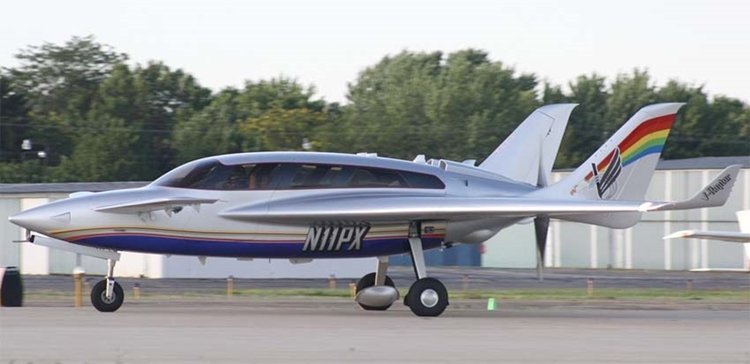
  3. red750

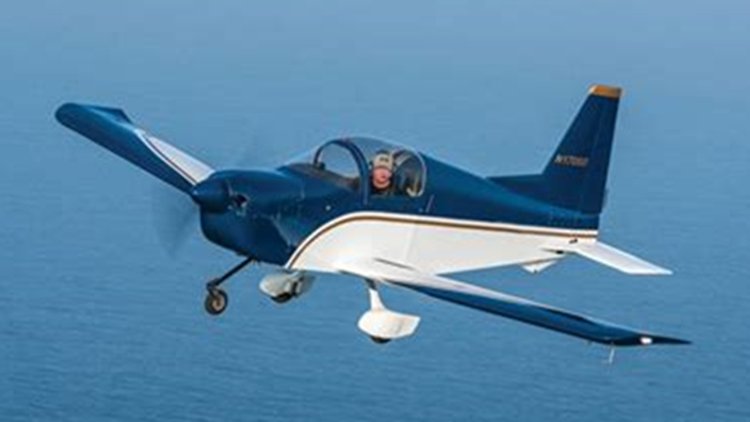
    Bréguet 280T

    The Bréguet 280T was a French biplane airliner of the late 1920s, created by the manufacturer as a means of finding a civil market for their 19 warplane, as they had once tried before with the 26T. The 280T was similar to the 26T, using the Bréguet 19's flying surfaces combined with a passenger-carrying fuselage that completely filled the interplane gap. The 280 fuselage was based on the 26T's fuselage but featured refined aerodynamics. A single prototype was evaluated in autumn 1928, followed by eight production machines ordered by Air Union. These were flown on routes between Paris and southern France, between Paris and Switzerland, and (occasionally) between Paris and London. They were joined in service by a 10th machine (converted from one of the 281T prototypes), and six 284Ts with more powerful engines (one of these converted from the other 281T). Two of this latter type were also operated by Air Orient on routes to East Asia. Some of Air Union's 280Ts and 284Ts were still in service when the airline was absorbed into Air France. Variants 280T (Specifications below) First main production version with a 370 kW (500 hp) Renault 12Jb engine, nine built. 281T Prototypes with 340 kW (450 hp) Lorraine-Dietrich 12Ed engines. Two aircraft built, one later converted to 280T, the other to 284T standard. 284T Second main production version with 450 kW (600 hp) Hispano-Suiza 12Lbrx engine, seven built.
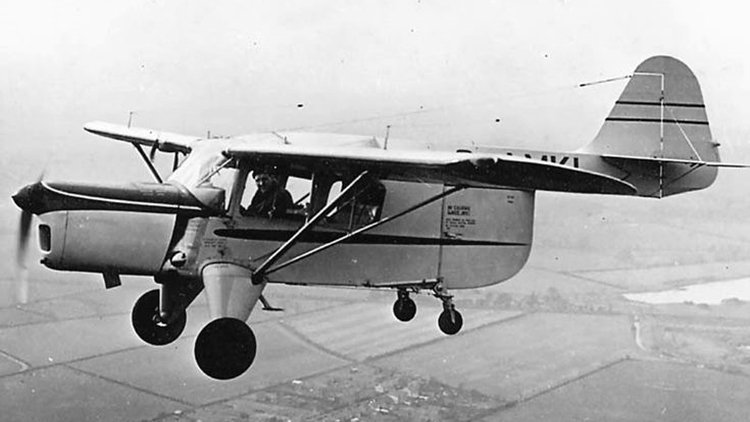
  4. The Call-Air Model A is an American two- to three-seat utility aircraft designed by the Call brothers and built by the Call Aircraft Company, later developed into a successful line of agricultural aircraft. The Model A was designed by the Call family, who were Wyoming ranchers. The aircraft was ready to be produced in 1940 but the start of World War II delayed the start of production to 1946. The family had formed the Call Aircraft Company (known as Call-Air) to produce the aircraft. The prototype Model A was powered by a Continental A-80 engine but was redesignated the Model A-1 when re-engined with an Avco Lycoming O-235-A engine. A United States type certificate was awarded in July 1944 and the production model was designated the Model A-2. The Model A-2 was a two-seat braced low-wing monoplane with fabric-covered wooden wings and fabric-covered welded steel tube. It had a fixed tailwheel landing gear. Further models were introduced with different engines. Examples of the three-seat A-4 were converted for agricultural use followed by a new-build agricultural version the A-5. In 1962 the assets of the company were acquired at auction by the Intermountain Manufacturing Company (IMCO) who developed their own version the IMCO CallAir A-9. IMCO was later taken over by the Aero Commander division of the Rockwell Standard Corporation and later became part of North American Rockwell, the design was further developed and redesignated. Variants A Continental A-80-engined prototype, one built converted to A-1 A-1 Re-engined with an Avco Lycoming O-235-a engine, four built and prototype converted. A-2 Two-seat cabin monoplane production version powered by an Avco Lycoming O-290-a engine, 16 built. (Specifications below) A-3 125 hp (93 kw) Continental C-125-2-powered version, 15 built. A-4 Two/three-seat cabin monoplane version powered by a 135 hp (101 kw) Avco Lycoming O-290-D2 engine, 65 built. A-5 Open-cockpit two-seat agricultural version of the A-4, 74 built. A-5T Texan A-5 with revised fuselage structure, nine built. A-6 Improved version of A-5 with Avco Lycoming O-360-A1A engine, 34 built. A-7 Similar to A-5 powered by West Coast Dusting-built Continental W-670-240 engine. One converted from an A-6 A-7T Proposed development of A-7 with higher gross weight
  5. The Bryan Autoplanes were a series of three experimental roadable aircraft. Leland Bryan built his roadable aircraft in the town of Milford, Michigan. As a roadable aircraft the aircraft was required to be registered by both the Civil Aeronautics Administration (CAA) and the Michigan Motor Vehicle Administration (MMVA), with road propulsion provided by propeller thrust. The Bryan Model I was built with a welded steel tube fuselage frame, wings from a Briegleb BG-6 primary glider and a Crosley automobile engine, which was later replaced by a 40 hp Continental. The Model II autoplane featured an extended Erco Ercoupe center-section, with a pusher engine at the rear of the fuselage nacelle, with twin tail booms supporting the tail section. The Ercoupe landing gear was used for the roadable operations, reaching up to 60 mph on the road. For storage and road transport the wings folded at two hinge lines. The Model I was approved for limited flight, in the experimental category. by the CAA, managing to accumulate 500 miles of road driving, and flying for the first time in 1953. The improved Model II achieved 80 hours of flight time and 4000 miles of road travel before a road accident. During repairs the Model II was rebuilt with two-seats becoming the Model III Autoplane, with a Continental A75 engine and convertible top motors, from a Chevrolet Corvair, to extend and fold the wings. After accumulating 70 hours of flight time and 1000 road miles, the Model III crashed during a flyby at the 1974 Experimental Aircraft Association (EAA) airshow, at Oshkosh, Wisconsin, when an inadequately secured wing section parted company killing the designer. At the time of his death Leland Bryan was in the process of designing the Model IV Autoplane, based on a Rutan VariViggen. Only 2 units were built.
  6. The de Havilland DH.95 Flamingo was a British twin-engined high-wing monoplane airliner first flown on 22 December 1938. During the Second World War some were used by the Royal Air Force (RAF) as a transport and general communications duties. The Flamingo was a twin-engined civil airliner developed by de Havilland, led by their newly appointed chief designer R. E. Bishop, and was the first all-metal stressed-skin aircraft built by the company; only the control surfaces were fabric covered. It was powered by two 890 hp Bristol Perseus air-cooled sleeve-valve radial engines driving three-bladed de Havilland Propellers 'Hydromatic' variable-pitch propellers. Two pilots were seated side by side with a radio operator behind them in the cockpit, with the cabin accommodating 12–17 passengers depending on the flight distance. It had a retractable undercarriage, slotted flaps, and was considered a highly promising sales prospect for the company, capable of competing with the American Douglas DC-3 and Lockheed Model 10 Electra. The first prototype flew on 22 December 1938. It had a third central fin fitted as a temporary measure; this was removed when larger fins with larger rudder area were fitted to the twin tail. Powered by 890 hp (660 kW) Bristol Perseus XIIIC engines, it had a maximum weight takeoff in 750 ft (230 m) and the ability to maintain height or climb at 120 mph (190 km/h) on a single engine. Testing was successful, with the Flamingo being granted a certificate of airworthiness on 30 June 1939, with an initial production run of twenty aircraft being laid down. The Air Ministry were interested in the Flamingo as a military transport and issued a serial T5357 for official evaluation. A single military transport variant was built to Specification 19/39 as the DH.95 Hertfordshire. It had small circular cabin windows instead of the rectangular ones, and seating for 22 soldiers. A proposed order for 30 was cancelled to leave de Havilland free to produce Tiger Moth trainers. The sole Hertfordshire (R2510) crashed on 23 October 1940 at Mill Hill killing five crew and six passengers, including Air Vice-marshal Charles Blount, the Air Officer Commanding No. 22 Group RAF travelling from Hendon to Northern Ireland, apparently due to jamming of the elevator. Following the success of the first test flights Jersey Airways ordered three 17-seat aircraft, and this was followed by orders from the Egyptian government and the Air Ministry. The Air Ministry aircraft were to be used by the Air Council and the King's Flight. The prototype, fitted with 12 passenger seats, was delivered to Jersey Airways in May 1939 for two months evaluation and became the first revenue-earning Flamingo. The first services carried mail only but in July a regular weekend passenger service was operated. In October 1939 the prototype was bought by the Air Council, being delivered to No. 24 Squadron RAF where it operated until it was lost in an accident in October 1940. The second aircraft was to be the first for Guernsey and Jersey Airlines but it was impressed into military service and delivered to 24 Squadron, the other two on order were never built due to the outbreak of the Second World War. The Flamingo was Winston Churchill's favourite short/medium range transport and he flew it to visit Reynaud and the French leadership as the Western front collapsed on May 16, 1940. The BOAC Flamingoes were not popular, and following three accidents[ – one of which was fatal – and with a lack of spares, the airline decided to withdraw the type. In 1943 the four airworthy aircraft were shipped back to the United Kingdom and stored at Croydon. They did not return to service and were scrapped at Redhill in the early 1950s.
  7. red750

    Brditschka HB-3

    The Brditschka HB-3, HB-21 and HB-23 are a family of motor gliders of unorthodox configuration developed in Austria in the early 1970s. The unusual design was based on work done by Fritz Raab in Germany in the 1960s. The pilot and passengers sit in a fuselage pod with the engine and propeller behind them. The pod also carries the fixed tricycle undercarriage and the high cantilever wing. The tail is carried on a pair of booms that emerge from the top and bottom of the fuselage pod, the upper of which passes through the propeller hub. The HB-21 has a conventional tail and has two seats in tandem accessed by a sidewards-hinged canopy, while the HB-23 has a T-tail and side-by-side seating accessed via gull-wing doors in the canopy. The Militky MB-E1 was a modified HB-3 with an 8-10 kW (11-13 hp) Bosch KM77 electric motor. It was the first full-sized, manned aircraft to be solely electrically powered. Flights of 12 minutes duration at up to an altitude of 380 m (1,247 ft) were just within the Ni-Cd battery's capacity. Its first flight was on 23 October 1973. Variants Brditschka HB-3 Single seat powered sailplane, powered by 31 kW (42 hp) Rotax 642 engine, 12.00 m (39 ft 4 in) wingspan. HB-Flugtechnik HB 21 Tandem two-seat derivative of HB-3 with longer span (16.24 m (53 ft 3 in)) wings. HB-Flugtechnik HB 21/2400 HB-Flugtechnik HB 21/2400 B HB-Flugtechnik HB 21/2400 V1 HB-Flugtechnik HB 21/2400 V2 HB-Flugtechnik HB 23/2400 HB-Flugtechnik HB 23/2400 SP HB-Flugtechnik HB 23/2400 Scanliner Observation version of HB-23 with bubble canopy and provision to carry FLIR or LLTV pods under the wings. HB-Flugtechnik HB 23/2400 V2 Militky MB-E1 electrically powered version.
  8. The Bisnovat SK-1 (Skorostnoye Krylo – high speed wing), was a research aircraft designed and built in the USSR from 1938. After working as an engineer under Tairov at the OKO in Kiev, Bisnovat was permitted to form his own OKB with the task of designing and building a high speed research aircraft, which emerged as the SK-1. This aircraft was designed to have the smallest airframe capable of flying powered by a large V-12 engine, with the smallest wings possible for safe landings on Soviet grass airfields. Construction of the SK-1 was of light-alloy stressed skin, with single plate web spar wings skinned with light-alloy sheet, smoothed to mirror finish accurate profiles using marquisette fabric, cork dust, open weave and adhesive as filler. Initially the wing was of NACA 23014.5 profile with slotted Vlasov style flaps, and fabric covered ailerons. The tail-unit also had fabric covered control surfaces, and trim tabs, with all controls 100% mass balanced. The M-105 engine was fitted in a low drag installation with a pressurised coolant system which required a radiator of only 0.17m^2 frontal area, (approx ½ that of a similar unpressurised coolant system). In the flush cockpit, the pilot sat on a hydraulically actuated seat which raised the hinged roof of the canopy to form a wind-shield for landing, allowing the fuselage to have a total frontal area of only 0.85 m^2. Hydraulically retractable main and tail undercarriages with fully closing doors reduced drag even further. Test flights began in January 1939 with the aircraft on skis, with surprisingly good handling and manoeuvrability as well as excellent performance.
  9. red750

    Myashichev M4 Bison

    The Myasishchev M-4 Molot (Russian: Молот (Hammer), USAF/DoD reporting name "Type 37", ASCC reporting name Bison) was a four-engined strategic bomber designed by Vladimir Mikhailovich Myasishchev and manufactured by the Soviet Union in the 1950s to provide a Long Range Aviation bomber capable of attacking targets in North America. The aircraft fell well short of its intended range and was not fully capable of attacking the most valuable targets in the United States. As this became clear, production was shut down. In spite of the failure to produce a capable strategic design and the resulting small numbers, the M-4 nevertheless sparked fears of a "bomber gap" when 18 of the aircraft were flown in a public demonstration on May Day in 1954. The US responded by building thousands of Boeing B-47s and B-52s to counter this perceived threat. The design was updated with more efficient engines, inflight refuelling (IFR) support and the removal of the glass nose for optical bombing and moving the radar to this location. With these changes, production restarted as the 3M. Even with these modifications the design was not truly effective in the nuclear bomber role, and only 125 aircraft, both M-4s and 3Ms, were produced before the production line was shut down for good in 1963. Only 19 of these served on nuclear alert. M-4s and 3Ms were primarily used as long-range maritime reconnaissance and strike aircraft and other supporting roles. Most were converted in the 1970s and 80s to tanker aircraft, especially as the Tupolev Tu-22M took over the maritime missions. The tanker conversions remained in service until 1994. Most surviving examples were broken up as part of post-Cold War arms limitations agreements. The M-4 was the first four-engine jet bomber deployed operationally by the Soviet Union. For more details of design and development, operational history and variants of the three types (bomber, areial refueling and cargo), click here.
  10. red750

    CASA C-201 Alcotán

    The CASA C-201 Alcotán ("Kestrel") was a 1950s transport aircraft, built by CASA for the Spanish Air Force. The C-201 was the result of an agreement between the Spanish government and manufacturer Construcciones Aeronáuticas SA (CASA), to develop a transport aircraft for the air force capable of carrying a payload of one tonne over a range of 1,000 km (620 mi). The design was a twin-engine low-wing cantilever monoplane of conventional configuration. The main units of the tailwheel undercarriage retracted into the engine nacelles. Two prototypes were constructed, and the first of those first flew on 11 February 1949. An order for twelve pre-production aircraft and one hundred series aircraft was then placed. The pre-production machines were planned to demonstrate a range of different equipment fits for the airframe, enabling it for a variety of roles including personnel transport, training for bombing and photo-reconnaissance work, and instrument flying training. A number of engines were also to be evaluated, including the Armstrong Siddeley Cheetah that had powered the prototypes, the Pratt & Whitney R-1340, and the locally produced ENMASA Sirio. The Alcotán project stalled, due to problems in the supply of powerplants and propellers. Spain's domestic engine industry was not capable of producing powerplants in sufficient quantity for the project, and Spain was unable to afford to import foreign engines. The production run had been scheduled to be completed before 1955, but the shortage of engines meant that by 1956, only eleven complete aircraft had been finished and delivered. In 1962, the project was finally cancelled, without the engine problem ever having been resolved. By then, CASA had 96 complete airframes in storage awaiting powerplants. Those were scrapped, and the Spanish government compensated the manufacturer for the debacle. Variants C-201A - personnel transport with Armstrong Siddeley Cheetah engines (Specifications below) C-201B - personnel transport with ENMASA Sirio engines C-201D - instrument flying, navigation, and radio training version with Armstrong Siddeley Cheetah engines C-201E - bombing and photo-reconnaissance training version with Armstrong Siddeley Cheetah engines C-201F - instrument flying, navigation, and radio training version with ENMASA Sirio engines C-201G - bombing and photo-reconnaissance training version with ENMASA Sirio engines
  11. The Boulton & Paul P.9 was a British single-engined two-seat biplane aircraft built by Boulton & Paul Ltd. The P.9 was an enlarged development of the P.6 single-engined biplane, with a 6 ft (1.8 m) longer fuselage and a 2 ft 6 in (0.76 m) increase in span. It used the same 90 hp (67 kW) RAF 1 V-8 engine as the P.6 but with an increased fuel capacity. The wings and fuselage were constructed of wood with fabric covering. The first order was from A.L. Long for use on a sheep station in Australia and the first aircraft was delivered to Australia where it was used on newspaper delivery flights. On 17 December 1919, it made the first flight across the Bass Strait between Tasmania and the mainland. Minor changes were then made to production aircraft, including a compartment behind the cockpit to carry two specially-built suitcases. Although the aircraft was offered at £700, with an old but still commonly available engine, it failed to compete with war-surplus military aircraft and only eight aircraft were built, including three that went to Australia.
  12. The Boulton Paul P.75 Overstrand was a twin-engine biplane medium bomber designed and produced by the British aircraft manufacturer Boulton Paul. It was the final example of a series of biplane medium bombers that had served in the Royal Air Force since the First World War, starting with the likes of the Vickers Vimy and Handley Page Type O. The Overstrand was also the first aircraft to be fitted with a fully-enclosed power-operated turret. First flown in 1933, the Overstrand was essentially an improved model of the Boulton Paul Sidestrand of the 1920s, thus early references to the type referred to it as the Sidestrand Mk IV instead. It demonstrated a higher maximum speed than its predecessor and was procured for the RAF in limited numbers. As such, the type entered service during the mid 1930s, but became increasingly overshadowed by the new generation of monoplane medium bombers, such as the Vickers Wellington and Armstrong Whitworth Whitley. Nevertheless, the Overstrand remained operational during the early years of the Second World War, albeit only being flown by training units. The few surviving aircraft were withdrawn from service during 1941, having been rendered surplus to requirements. The Overstrand was a development of the Boulton Paul Sidestrand, which had first flown in 1928 and like the Sidestrand, it was named after a village in Norfolk, home also of Boulton Paul's Norwich factory. The earlier Sidestrand had been largely similar to its predecessors of the First World War, featuring open cockpits and hand-operated defensive machine guns. Unlike its predecessors, the Sidestrand could fly at speed of up to 140 mph (230 km/h), which made operating the guns in exposed positions difficult, particularly in the nose. To address this difficulty, the Overstrand was furnished with an alternative nose turret design, which was both enclosed and powered. At the time this was a relatively novel feature, the resulting aircraft being the first in the world to feature a fully-enclosed power-operated turret. The Overstrand's innovative turret was largely developed in-house by Bolton Paul's chief armament designer H. A. Hughes.[4] In terms of its basic design, the turret was a metal-framed cylinder with a domed upper and lower area; Perspex was used as glazing, in which there was a vertical slot for the single Lewis gun, which was covered by a canvas strip with a zip fastener to facilitate movement of the gun itself. Traverse motion of the turret was driven by pneumatic motors, powered by air bottles on board that were pressurised to 200 psi (1,400,000 Pa) using an engine-driven air compressor. The turret could move through a fully 360-degree circle if the gun was raised sufficiently, helping the turret to cover the widest area of any turret system. A geared spindle at the base of the turret was supported by a series of ball bearings. Elevation was achieved manually. n addition to the turret, various other revisions and improvements were also incorporated. It was decided that the cockpit ought to also be fully enclosed within a canopy of anti-glare Perspex, complete with a sliding hood. The airframe was strengthened considerably in many areas, which facilitated an increased bomb capacity of up to 1,500 lb (680 kg), up to two 500 lb (230 kg) bombs could be carried in the aircraft's recessed bomb cell in addition to two 250 lb (110 kg) bombs on external carriers. A new levered main undercarriage, complete with larger wheels, was also fitted, while the tailskid of the Sidestrand was replaced by a tailwheel. The wing design was also revised, a noticeable sweepback was added to the outer sections in order to compensate for the aircraft's heavier nose section. For more details. including operational history, click here.
  13. AI nonsence
  14. Photos on Facebook yesterday of work on the rail link to Western Sydney Airport which is scheduled to open in 2026. However, Melbourne Airport (Tullamarine), which opened 54 years ago, is still waiting.
  15. red750

    Sud-Ouest Corse

    The Sud-Ouest Corse was a French mail and passenger transport aircraft, built by SNCASO. The Corse began as the S.O.90 Cassiopée, a nine-passenger aircraft. The S.O.93 Corse and S.O.94 Corse II prototypes were developed as the S.O.95 Corse III. The aircraft was a cantilever mid-wing monoplane, powered by two Renault 12S engines with a retractable conventional landing gear. Seating up to 13 passengers, the seats could be quickly removed in order to carry more cargo. Intended to serve Air France, it failed their aircraft requirements. 60 aircraft were built for Aeronavale, and a small number for other overseas airlines. Variants SNCASO SO.90 Cassiopée Wartime prototype for 8 passengers and powered by 325 hp Bearn 6D-07 engines. First flew 16 August 1943 with 3 built. S.O.93 Corse Prototype powered by Renault 12S engines, 1 built. S.O.94 Corse II Production 10 passenger version, 15 built. S.O.94R Radar training conversion of S.O.94. S.O.95M Corse III Production 13 passenger version with tail-wheel undercarriage, all 45 built for military use.
  16. The Avocet AV24 is the first aircraft in Avocet's clean-sheet design program created for better dynamic stability, increased control, and lower drag. Design iterations were coordinated with engineers from aerospace industry leaders, including NASA, Lockheed Martin Skunk Works and McDonnell Douglas Boeing.
  17. The Bradley BA 100 Aerobat is an American aerobatic homebuilt aircraft that was designed and produced by Bradley Aerospace of Chico, California. When it was available the aircraft was supplied as a kit for amateur construction. The BA 100 Aerobat features a cantilever low-wing, a single-seat enclosed cockpit under a bubble canopy, fixed tricycle landing gear, or optional conventional landing gear, and a single engine in tractor configuration. The all-metal aircraft is made from sheet aluminum. Its 18.40 ft (5.6 m) span wing lacks flaps and has a wing area of 63.00 sq ft (5.853 m2). The cabin width is 22 in (56 cm). The acceptable power range is 70 to 100 hp (52 to 75 kW) and the standard powerplant is the 70 hp (52 kW) Volkswagen air-cooled engine. For aerobatics the BA 100 is stressed to +/-9g. The BA 100 Aerobat has a typical empty weight of 348 lb (158 kg) and a gross weight of 620 lb (280 kg), giving a useful load of 272 lb (123 kg). With full fuel of 10 U.S. gallons (38 L; 8.3 imp gal) the payload for pilot and baggage is 212 lb (96 kg). Factory kit options included conventional landing gear and a STOL kit. The manufacturer estimated the construction time from the supplied kit as 150 hours. Production has concluded. By 1998 the company reported that 33 kits had been sold and 28 aircraft were flying. In December 2013 three examples were registered in the United States with the Federal Aviation Administration. airport-data.com lists seven registered unit in the US.
  18. The Alvarez Polliwagen is a 1970s homebuilt aircraft. The aircraft has a combination of many high performance features not typically found in a Volkswagen air-cooled engine-powered homebuilt. he Polliwagen is a low wing, side-by-side configuration, T tailed, tricycle landing gear equipped aircraft with tip tanks. The aircraft was developed and tested with a one quarter scale radio controlled model. Ailerons and flaps are full span. The fuselage is built from composites with foam cores. The aircraft's engine is configured with a turbocharger and constant speed propeller. Entrance is through a swing up canopy.
  19. The Handley Page H.P.54 Harrow was a heavy bomber designed and produced by the British aircraft manufacturer Handley Page. It was operated by the Royal Air Force (RAF) and used during the Second World War, although not as a bomber. The Harrow was developed during the 1930s as a derivative of the Handley Page H.P.51, an unsuccessful monoplane bomber-transport hybrid. It was a twin-engine, high-wing monoplane with a fixed undercarriage. In 1935, the Air Ministry wrote Specification B.29/35 around the Harrow proposal, seeking a 'stop-gap' heavy bomber to facilitate the expansion of the RAF's bomber squadrons. Handley Page updated the design with new features and along with structural changes to enable more rapid construction. Despite incorporating several modern features, including hydraulically-powered turrets, steam-based cabin heating, and variable-pitch propellers, the performance of the Harrow did not match that of contemporary bombers such as the Armstrong Whitworth Whitley. On 14 August 1936, the Air Ministry ordered one hundred Harrows for the RAF. While the Fleet Air Arm also placed a separate order for one hundred Harrows, Handley Page did not have the capacity to produce these aircraft. On 13 January 1937, the first Harrow was delivered to No. 214 Squadron; by the end of that same year, all one hundred of the RAF-bound units had been delivered. By the end of 1939, the Harrow had been rapidly displaced as a frontline bomber, it was flown as a transport aircraft instead, which included its use as an air ambulance. It participated in several major actions, including an unorthodox defensive role for The Blitz in the winter of 1940–1941 and Operation Market Garden in September 1944. Limited numbers served through to the conclusion of the conflict, the RAF withdrew the Harrow in May 1945. As a transport, the Harrow was routinely used to convey equipment and personnel between domestic military bases across Britain, as well as to continental airfields prior to the Fall of France.It also occasionally undertook risky flights between England and Gibraltar; two aircraft were recorded as having been lost on this route. Harrows also operated in support of Allied forces in their advance into north-west Europe, evacuating wounded from the Arnhem operation during September 1944. Seven Harrows were destroyed by a low level attack by Luftwaffe fighters of JG 26 and JG 54 on Evere airfield as part of Unternehmen Bodenplatte, the German attack on Allied airfields in north-west Europe, on 1 January 1945, leaving only five Harrows intact. These were retired on 25 May 1945. The Harrow also served in a novel operational role at the height of The Blitz against Britain in the winter of 1940–1941. Six Harrows equipped 420 Flight (later 93 Squadron) which used lone Harrows to tow Long Aerial Mines (LAM) into the path of German bombers. The LAM had an explosive charge on the end of a long cable and the unorthodox tactic was credited with the destruction of between four and six German bombers. The experiment was judged of poor value and the planned deployment of Douglas Havocs in the LAM role was cancelled. Seven Harrows were also used by 782 Naval Air Squadron of the Fleet Air Arm as transports from June 1941 to July 1943, being used to carry engines and spare parts as well as passengers. For more details on development and operational experience, click here. 100 Harrows were built.
  20. red750

    Boeing YB-9

    The Boeing YB-9 was the first all-metal monoplane bomber aircraft designed for the United States Army Air Corps. The YB-9 was a much enlarged twin-engine development of Boeing's single-engine Model 200 Monomail commercial transport. In May 1930, Boeing had flown its Model 200 Monomail single-engined mailplane. The Monomail was of radical design for the time, being a semi-monocoque, stressed skin cantilever monoplane with a retractable undercarriage. Air Corps bomber squadrons of the day were largely equipped with slow strut-braced biplanes built from steel-tube frames covered in doped fabric, such as the Keystone B-6, and Boeing decided to design and build a twin-engined bomber using the same techniques used in the Monomail to re-equip the Air Corps. Boeing built two prototypes of a new bomber as a private venture, which differed in the engines used, with the Model 214 powered by two liquid-cooled Curtiss V-1570-29 Conqueror engines while the Model 215 had two Pratt & Whitney R-1860 Hornet B radial engines. Both aircraft were low winged cantilever monoplanes with a slim, oval cross-section fuselage accommodating a crew of five. The pilot and co-pilot sat in separate open cockpits, with the co-pilot, who doubled as the bombardier sitting forward of the pilot. Two gunners, each armed with a single machine gun sat in nose and dorsal positions, while a radio operator sat inside the fuselage. Like the Monomail, a retractable tailwheel undercarriage was used. The first of the two prototypes to fly was the radial powered Model 215 which, carrying civil markings and the aircraft registration X-10633, made its first flight on 13 April 1931. It was leased to the Air Corps for testing under the designation XB-901, demonstrating a speed of 163 mph (262 km/h). Testing was successful, and both the XB-901 and the as-yet incomplete Model 214 were purchased as the YB-9 and Y1B-9 respectively on 13 August 1931, with an order for a further five for service testing following. The Y1B-9 (Y1 indicating funding outside normal fiscal year procurement), powered by two liquid-cooled Curtiss V-1570-29 'Conqueror' engines, first flew on 5 November 1931. The increased power from these engines, combined with improved streamlining of the engine nacelles, increased its top speed to 173 mph (278 km/h). The YB-9, meanwhile, had been re-engined with more powerful Hornet Bs, demonstrating slightly better performance than the Y1B-9, which was therefore also re-engined with Hornet Bs. The five Y1B-9A service test aircraft (Boeing Model 246) had the Pratt & Whitney R-1860-11 Hornet B engines which powered the re-engined YB-9 and Y1B-9 and a redesigned vertical stabilizer modeled on the 247D transport. While enclosed canopies were considered and designed, the B-9 was never fitted with them. Although it equaled the speed of existing American fighter aircraft, no further aircraft were built, as the Glenn L. Martin Company had flown a prototype of a more advanced bomber, the XB-907, which was ordered into production as the Martin B-10. The first of the five Y1B-9As entered service with the 20th and 49th Bombardment Squadrons, 2nd Bomb Group on 14 September 1932, with all examples built being in service by the end of March 1933. The new bomber proved impossible to intercept during air exercises in May 1932, strengthening calls for improved air defense warning systems. Two B-9s were destroyed during crashes in 1933, one of the accidents being fatal, while the remaining aircraft were gradually phased out over the next two years, with the last being withdrawn on 26 April 1935.
  21. In addition to the President, staff, and flight crew, a VC-25A can carry 102 guests in typical domestic business-class seats. The back-up VC-25 typically flies with 14 crew, two pilots, six flight crew, two cooks, and four flight attendants. When transporting the President, the primary VC-25A has three cooks and 15 flight attendants, 20 or more Secret Service agents, and some 40 members of the presidential press pool. During international state visits, another aircraft may be chartered to accommodate another 150 or more journalists and security personnel.
  22. The Mikoyan-Gurevich MiG-25 (Russian: Микоян и Гуревич МиГ-25; NATO reporting name: Foxbat) is a supersonic interceptor and reconnaissance aircraft that is among the fastest military aircraft to enter service. Designed by the Soviet Union's Mikoyan-Gurevich bureau, it is an aircraft built primarily using stainless steel. It was to be the last plane designed by Mikhail Gurevich, before his retirement. The first prototype flew in 1964 and the aircraft entered service in 1970. Although its thrust was sufficient to reach Mach 3.2+, its speed was limited to prevent engines from overheating at higher air speeds and possibly seriously damaging them, and therefore the operational top speed was limited to Mach 2.83. The MiG-25 features a powerful radar and four air-to-air missiles, and it still has the world record for reached altitude of 38 km (125,000 ft). The appearance of the MiG-25 sparked concern in the West and prompted increases in performance requirements for the McDonnell Douglas F-15 Eagle, then already under development in the late 1960s. The capabilities of the MiG-25 were better understood by the West in 1976 when Soviet pilot Viktor Belenko defected in a MiG-25 to the United States via Japan. Production of the MiG-25 series ended in 1984 after completion of 1,186 aircraft. A symbol of the Cold War, the MiG-25 flew with Soviet allies and former Soviet republics, remaining in limited service in several export customers. It is one of the highest-flying military aircraft,[6] one of the fastest serially produced interceptor aircraft, and the second-fastest serially produced aircraft after the SR-71 reconnaissance aircraft, which was built in very small numbers compared to the MiG-25.[8] As of 2018, the MiG-25 remains the fastest manned serially produced aircraft in operational use and the fastest plane that was offered for supersonic flights and edge-of-space flights to civilian customers. Because of the thermal stresses incurred in flight above Mach 2, the Mikoyan-Gurevich OKB had difficulties choosing what materials to use for the aircraft. They had to use E-2 heat-resistant Plexiglas for the canopy and high-strength stainless steel for the wings and fuselage. Using titanium rather than steel would have been ideal, but it was expensive and difficult to work with. The problem of cracks in welded titanium structures with thin walls could not be solved, so the heavier nickel steel was used instead. It cost far less than titanium and allowed for welding, along with heat-resistant seals. The MiG-25 was constructed from 80% nickel-steel alloy, 11% aluminium, and 9% titanium. The steel components were formed by a combination of spot welding, automatic machine welding, and hand arc welding methods. The MiG-25 was theoretically capable of a maximum speed exceeding Mach 3 and a ceiling of 27 km (89,000 ft). Its high speed was problematic: Although sufficient thrust was available to reach Mach 3.2, a limit of Mach 2.83 had to be imposed as the engines tended to overspeed and overheat at higher airspeeds, possibly damaging them beyond repair. For extensive details on background, development, operational history and 25 variants, click here.
  23. The Colani Cormoran CCE208 was a five-seat light aircraft under development in Germany in the late 1980s. The highly streamlined and unusual design was the work of the aeronautical engineer Walter Schulze with the collaboration of the celebrated industrial designer Luigi Colani. A particularly unorthodox feature was the pusher propeller mounted behind the top of the T-tail. Power was to be supplied by a converted Porsche automobile engine rated at 245 horsepower. The airframe was to be largely composite construction. A mockup was displayed at the Paris Air Show in 1987. No actual aircaft built. Construction of the prototype aircraft was to have been undertaken by the Composite Engineering Company in Germany, with financial backing from Tohshin of Japan.
×
×
  • Create New...