

turboplanner
-
Posts
24,367 -
Joined
-
Last visited
-
Days Won
159
Content Type
Profiles
Forums
Gallery
Downloads
Blogs
Events
Store
Aircraft
Resources
Tutorials
Articles
Classifieds
Movies
Books
Community Map
Quizzes
Videos Directory
Posts posted by turboplanner
-
-
If ELAAA had applied to set up an SAO for recreational aircraft, they'd probably have been in operation a year or tow ago.
But they didn't, they applied for something partly suitable for self-administration, but also partly for operations still under prescriptive control.
I don't know what CASA have considered, but any arms length government body would have great difficulty balancing the risk factors and possibile ramifications of that.
From the Federal Government's prespective, through its Department of Infrastructure, Regional Development and Cities, which includes air, sea and land transport, there are existing protocols.
For example, practically the manufacture and operation of motor vehicles is still prescriptive, as is General Aviation.
However you could design and build your own car from scratch, provided you carried out the design and testing required, under the signatory system, where the public liability for that design rests with the signatory, not the Government.
I don't know whether CASA have been referring this matter to DIRDC, but I would, and there would need to be a lot of discussions, and a new policy, and you could ask yourself why, when a specific exemptions had been given to allow self administering recreational aircraft, anyone would decide to draw a different boundary.
-
I'll normally hit the theory books again so I can give more attention to flying then pick an easy flight or two, and if I'm not happy go up with an instructor with instructions from him to be strict; in other words ease into it.Turbs I'm just saying that some BFR's have been far less rigorous than others.Many of us don't have the luxury of flying regularly. There have been gaps of over a year in my logbook and as a result I've applied maximum focus when returning to the air- perhaps making me safer than if regular practice had lead to complacency.
-
If an instructor uses boxes as a checklist, that is just being through; if you're saying you should have failed and he was just ticking the boxes with an eye on the flight time, that would be a worry, but also he could be ticking the boxes where you demonstrated no risk, even though it might not be up to your extremely high standard. The combination of control manipulation and management of the aircraft combined with correct radio, aircraft placement in relation to the runway, and several different emergency scenarios will be challenging to someone who doesn't fly weekly.How many pilots fail a BFR?Few of mine have been particulary demanding; more a box-ticking exercise to be gone thru as fast as possible.
-
That might or might not be the crux of it, but bypassing 10,000 members is no way to run aviation, and nor are handshake deals.Guys,This is all about the politics of Controlled Airspace Access and a higher MTOW. Did you note that RAAus are not providing information to any airport operator but only those that are members of the Australian Airports Association.
CASA has a committee from the "industry" that provide advice to it on new regulations, called the ASAP. RAAus need that committee not to stand in the way of their request for greater privileges. The AAA won't endorse a regulation change that would result in their members not being able to send invoices to aircraft owners. RAAus's change in position is a quid pro quo for not opposing the CTA and a higher MTOW.
-
 1
1
-
-
Two parts:If most votes are 4-3 then surely the answer DOES lie in electing 2 new board members each year. I don't recall much discussion of the candidates during the recent election.I am not particularly fussed by the disclosure of MY details BUT I do understand that some people are and I understand and respect that.
I have little tolerance for merely restating a problem without proposing a rational solution. If I were to become concerned about this (and I could with anger free rational argument) my first step would be to confirm whether this disclosure was legal and constitutional, if not then what are the legal remedies? If it is legal and constitutional then perhaps it is still not the direction the members want to go. Then it is about presenting the case against to fellow members.
If it is true that the usual board vote is 4-3 (I have no idea if this is correct) and if there is a good argument to be presented and if a mere 2 candidates stand on this issue then the answer does seem to be found at the ballot box.
The way to get me on side is to present a rational fact-based well-researched argument and discussion of possible solutions. I do tend to switch off when problems are merely restated over and over again or it becomes an angry rant.
Apart from legality and member sentiment has anyone who is concerned contacted RAAus and enquired about it? This surely would be the first logical step.
1. Does it breach the Privacy Act?
2. If it does not, the the better way would have been to put it to the members to either:
(a) Agree for RAA to release registration details to the airfields at the going feeds for aircraft movements, or
(b) To instruct RAA to come up with an agreement more suited to the lower cost (and income) structure of recreational aviation, where smaller aircraft arguably do negligible damage to the airfield surface, and which might included zero payments for training aircraft, which are the source of potential new customers for the airfield.
-
2
-
-
Going from past experience this has to be set up privately to avoid being met on the day by a majority of proxy votes. (Not saying the people in power would do it today, just a strategic protection. secondly it needs a bullet proof agenda, thirdly the people involved need to know the part they have to play. Fourthly the future needs to be mapped out ready to go.The only way to get ANY satisfaction from the current administration is to call a General Meeting with the potential to overthrow them aka the “freedom to fly” fiasco.-
 1
1
-
-
The Quote system isn't working as it used to; I just posted in:
RAAUS - A 'MAJOR PLAYER' WITH A POTENTIALLY MAJOR SET OF PROBLEMS. AOPA Australia member opinion
(As someone has already said, the post numbers are missing, so this is an example where they would be handy to give a precise location)
The first
split out worked, but could be improved by the shaded background it used to have to clarify it is someone else's quote it then printed an unwanted section from the downloaded quote, and also didn't seem to work for a second quote I was intending to include. -
I also think I saw another side of the matter which you may not have had access to. I don't actually don't believe the RAAus got much help and guidance and there was no intentional criminality .
The subject is about CTA, but in relation to the Audit Report, I was posting on the 187 page document which I obtained. What was going on in recreational aviation at the time is there in black and white. If you leave CASA right out of it; if that report had come to me I would have acted decisively there and then.
One of the most important things to understand is that Negligence does not necessarily involve any criminal intent. Culpable Negligence does, but the Negligence which can make you un-insurable doesn't.
So you have to act immediately.
-
I realise you have a problem with CASA, but you need to put that aside and address it from the point of view of any government department or appointed body which becomes aware of the SAO losing control. In this case there were some safety and compliance issues which needed to be addressed.Appearing to be doing something and getting the problem addressed and rectified are two different things. IF you care about an organisations future you don't pirate all their top brass at a critical time and do just do audit on Audit, without being more involved with a lot of matters that are CASA's delegated areas of responsibility. ( A contentious point at any time) A lot of the problem was that people who should know better (even GA licenced) LIED brazenly about certain facts to the RAAus.. CAA reneiged on agreed proposals for weight increase etc under it's new Management and took a very punitive approach to the organization. It's future welfare was well outside their considerations. /quote The beat up over water from memory the individual and aircraft were not even registered with RAAus so it's a straight out police matter.NevWhat I was leading to was that if an SAO wants to get involved in a new activity, then they have to budget for the cost of training, compliance and enforcement.
The beat up example I gave was hypothetical, so nothing related to your memory.
-
I don't know what caused CASA to take a closer look at its SAO, but hypothetically a W&B instigated crackup at a major flying event in front of the DAS, a beat up over water to the point where boat occupants said they were scared for their lives (making it assault) followed by a police complaint the aircraft had no ID, and some reports of non airworthy aircraft would normally cause an entity set up to manage air safety to take a detailed look.Indeed. The audit was paper audit of Raaus records against requirements of the CAO and our own docs. They were numerous, widespread and horrid admin errors but not linked to actual failure or risk.With the standard they found, it would be quite possible for failures to have occurred; I can think of one where an instructor and student died in an aircraft I wouldn't have signed off.
I didn't spend time going through the audits; maybe 15 minutes from where I started to where I stopped, but consider this:
No W&B details for the aircraft: 7 cases How can the pilot conduct pre-flight W&B calculations as he is required to do - that's a safety issue.
No Certificate of Airworthiness: 5 cases
Aircraft registered while still on the GA Register
Conformance not done
Technically forged signature
Test flight over prohibited area
Non compliant W&B
Incorrect registration
Weighed with wing detached
Unauthorised modification
Registration of grounded aircraft
No production certificate
No compliance certificate
I have no information to say that RAA didn't fix all these issues and ensure that they didn't happen again, but if an SAO has difficulties just managing the registration and specifications of aircraft, the cost is going to be much higher to manage pilot training and behaviour in CTA along with the equipment standard of new CTA approved aircraft, and ongoing performance standards for the aircraft and its equipment.
-
If you're interested in that you could contact CASA.In any event CASA may have been outside its powers for the registration audit. The CAO says that an aircraft must be registered with RAAus. The agreement of the day gave no audit powers to CASA so how was it that RAAus let them conduct the audit? Remember RAAus is a private body holding no delegations etc so where did CASA get its power to audit apart from a bureaucratic over-reach? -
That’s correct, they are self administering, not spectators, and the panic will start with the first big accident. Only two or three of us bothered to look at the Audit failures which grounded a lot of RAA aircraft a few years ago. Just lifting the standards to get the simplest aircraft up to standard will be a major task and require a lot of volunteer feet on the ground.The "Organisation" will have to have an approved process of training and verification of a standard to deal with it regardless how many schools get involved. Nev -
What is stunning to me about this report is the photo of Westall high School with no trees.
I had forgotten what the landscape looked like at that time; we started ring barking trees in Australia in the 19th Century and couldn't stop ourselves; we killed about 17 billion trees according to the late Tom Uren.
Schools and businesses planted shrubs, or small English trees, and the Westall photo is typical of what you'd see in the mid 1960s - looks like a desert to us today but that was the norm.
The General Motors dining room had a stage, with murals each side of it depicting cities of the future, oddly with roads running around the buildings and so steep that an FJ Holden could never have climbed them, but they were consistent with the era - not a single tree in the cities.
I agree with what you said about the flying saucer reports; the Westall sighting is well documented in a much calmer way elsewhere (I've forgotten the document), and was one of quite a lot of mass sightings.
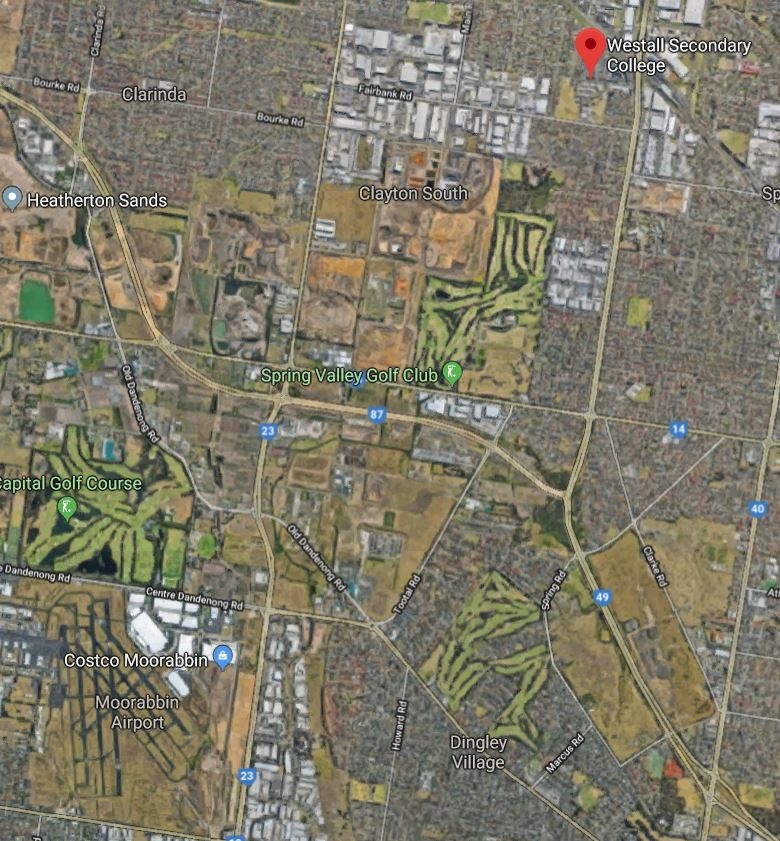
I hadn't read about the local aircraft, but the report of one aircraft watching it, then joined by more and more is quite logical to me because Westall high School is in view as you fly downwind for what was then a single Runway 17, so everyone on downwind would have heard the radio chatter and flown on a bit further for a look. The Tower Controllers couldn't have missed seeing what was going on, and would have been p!ssed off, telling them all to get back into line.
In the photo below, Moorabbin airport is in the bottom left corner and Westall High School is in the top right.
The weather balloon story was also famously used at the site of the 1947 Roswell crash with the US Airforce, with dozens of Defence vehicles and soldiers dispersed around the site. The only problem was, someone took a photo of the wreckage, and someone else compared it with a weather balloon, and there is no comparison.
Ranchers reported the cleanup of the site went on for days with a military cordon several miles diameter, and semis hauled the wreckage, under tarps out. In one book the author interviewed hundreds of people and was able to trace the truck movements to a USAF base in the east of the US.
Many people ave speculated what crashed at Roswell, some suggesting the story was a cover up of a secret military aircraft, others with the alien story with local eyewitnesses reporting the one metre tall bodies.
One book I read listed the previously unknown "inventions" which rapidly emerged from reverse engineering the spacecraft; kevlar from the skin construction, fibre optics, teflon etc.
We have a lot to condemn Orson Welles for.
[ATTACH]37654[/ATTACH]

-
Just as a matter of interest, the orange gyro shown here was not owned by a bush pilot. He posted on this site in "Tell us about your last flight", which in fact it was. He was having great fun flying down in the tidal creeks below mangrove height, but when he did the same the next time he hit a power cable and was killed.
-
It's very very simple in Australia; if you are negligent and you hurt someone you will pay the costs involved.I wish there were more guidelines and less regs. I suppose when the swat team turn up and shoot you for not conforming to a safety reg, that's ok.( different Bruce here, I'm from South Australia )
Most of what you are calling regulations are benchmarks for your defence; if you were complying you are not likely to be found negligent.
Ssssimple!
-
That's a transition, and in a very controlled airfield environment.In any case we all low fly - every time we takeoff and land - and ironically we do 90 turns next to that glass ceiling (500 feet - or is it 600 feet ?However, since you raise it, historically there are HUNDREDS of crackups featured in the RAA magazine accident reports over the years in airfield environs.
You've also given a good example of the currency problems with your uncertain heights, and I'm not picking you out for that; we probably would all fail to get a 100% pass in what we were taught, and that's because of the low annual hours.
-
1
-
-
People on this forum repeatedly complain about ever-increasing regulations; a great exaggeration of the real situation, but a very clear mandate of where not to go for administrators.We've touched on this 'recurrant training' subject before. It's a senstitive one, because while CASA talk-the-talk about continuing 'training', they baulk at recognising the need to have more training in lower level aircraft operation. This carries through into RAAus, where we cannot train a pilot in any low level operations - unless they are going to use it on their property.Now, I'd have thought that avoiding killing or injuring yourself and passengers, by having some low level skills, would be sufficient reason to have this allowed. But no, within the regulators, there is a quite irrational fear that, because a pilot has been trained in low level ops, they will immediately become a low level flying hoon. My decades of experience say that it's the very opposite.
When pilots discover that it is a whole, new, and dynamic flight world below 500ft agl, they cease doing the stupid stuff.
I'm not suggesting that we train you to fly at spraying height, or fly under powerlines, or other professional skills: I'm for training to avoid stall/spin accidents, to handle rough air, to avoid collisions, to make safe avoidance manoeuvres, and to escape from low or lost visibility situations. We can train you to make safe inspections of strips or paddock locations, how to better assess surface conditions, how to scan properly and so on.
The sooner that RAAus, (and CASA), encourage pilots to undertake post RPC/RPL training in low level operating of aircraft - the better for our industry.
The old wives tales/ urban myths about how dangerous it is, and why nobody should operate down low - need to be buried. The next obstacle will be..... 'there are no qualified training instructors.' Well, unless CASA/RAAus make some moves in this area - there will be no experienced LL instructors left in the industry. Now is the time to change things, and have the oldies train up a reasonable number of younger instructors before it's too late.
happy days,
At the present time, anyone who would like to broaden their skills, and who are prepared to travel and pay for a session can obtain training in low level flying, unusual attitude recovery, and aerobatics. You don't have to go to PPL level, you don't necessarily need an official endorsement, but you can get that experience now.
The universal 500 foot minimum flying height allows the bulk of newly trained pilots the best kind of safety you can apply, removal of risk. If you fly above 500 feet you won't hit power lines (except in mountain country), you won't hit buildings, and you won't hit the majority of Australia, as in rock and dirt, and you won't need those rarely called on skills.
We have already reached the point where there aren't enough local instructors, aren't enough local schools, and most importantly aren't enough people prepared to pay the cost of flying. Those are the barriers we have to react to.
The annual hours of pilots is pathetically low; I don't have the exact figures, but I think about 50 hours a year for GA private pilots and 20 per year for RA. While I totally agree with what Facthunter would like to teach, at this level of currency we have to worry about a pilot getting the aircraft on the ground in a crosswind, radio procedures, and all the touch and feel skills that wash off with time away from the aircraft. We have to react to that situation too.
Without a doubt we could all do with more training, and more currency which usually equals "would if it was free".
You'll note that the person asking for more training was an airline pilot whose training had been paid for by his employer; easy to do then.
Note also the photo of the upended Jab; has there been any formal information that this was caused by too little training? Or was is simply a wheel caught on a stump or unseen ditch.
-
1
-
-
I just happened to be watching “Outback Pilots” this week.
I wouldn’t give too much thought to it; R22s operating nose to ground tail vertical, then tail to ground, flown backwards chopping tree folage off, flying down twisting gullies below ground level; just natural attrition. Same with fixed wing; beat ups UNDER and around Gidget trees; it’s a different life.
-
It might be the time to go back to the OP and try to work out what the agenda is.
-
A person can attend a GA flying school and get a CTA endorsement at his/her own expense.Would it not be the case that a school wishing to offer CTA endorsement would get their instructors trained at their expense at a school able to offer this service. A pilot wanting a CTA endorsment would pay for their own training, buy the transponder and get the medical. It has been pointed out that any RAA pilot can do this now. I don't see this impacting someone who just wants to fly a Thruster around the farm.There are RAA Instructors who are dual qualified RA and GA who can train a pilot.
That process would not affect the Thruster pilot flying around the farm.
However if RAA want access to CTA on a formal basis, then there are going to be substantial self administration costs; so far the visions of Board Members (as against majority need by the members) under the old Inc. regime and the new Ltd regime have been spread across the members, so that would affect the Thruster pilot for something he/she would never want or need.
An alternative would be for RAA to adopt a User Pays policy for CTA, but it's hard to see what the benefit would be in doing that compared to a pilot just getting a PPL with CTA endorsement.
-
Having personally experienced an Ultralight coming towards me when I was flying downwind within Las Vegas controlled airspace, I wouldn't be classifying potential for collisions in US airspace as baselessIn the US holders with sport pilot licences (RAAus equivalent ie drivers licence medical) with appropriate endorsements can fly in properly equipped aircraft in Class B airspace which includes the airspace around all the major international airports like LAX (which has 5 VFR transit routes that I understand do not require ATC clearance below 10,000 feet). It may also be that US training is more rigorous. That given, the argument about collisions would seem to baseless)The link below is a good example of the complexity of the Las Vegas controlled airspace procedures today, and where its headed. Note that these procedures are now ICAO compliant, and also the importance of accurate instrumentation, and the ability to understand and use it.
https://www.faa.gov/tv/?mediaId=1536
If you search for Incursions on the ATSB website there are 19 cases, which show some of the easy ways to get caught.
I suspect, as a starter that RAA would have to retrain maybe 80% of its existing instructors to comply for CTA training, and that would be an expensive task, starting with finding and paying the RAA training staff, facilities, equipment, and compliance and enforcement. RAA members, most of whom would not be interested in flying into CTA would have to foot the bill for this. And that's apart from the aircraft specification level, and other Pilot costs.
CTA costs would be effectively a tax on country pilots.
The Office of Airspace Regulation administers the Airspace Regulations (2007) Act.
If you want to know about CTA, that's a good place to start.
-
He doesn't understand public liability, or the Department of Infrastructure, Regional Development and Cities policy of user pays.Short version?While Part 149 had a more than generous comment period, and is no gazetted, he would like to use the 10,000 RAA members to form an alliance to get rid of it; fat chance.
He does make a good point that while RAA so far has been able to finance the administration of its fleet of aircraft and operations around the fringes of cities and CTA, that cost will be exponentially increased with the need to self administer CTA operations and the complexity of having the heavier, predominantly factory and predominantly old, aircraft to manage.
-
Airfields collecting fees for use.CASA pushing an ever tighter noose around GA and RA flyingWhere does CASA fit into that?
-
1
-
-
You've pretty much encapsulated it; if you give a student a checklist, that's included in the SMS.The "nature " of the flying training "scene" is not really such that a wide divergence of safety methods need to apply really good practical principles would apply universally. people vary the method of getting the message across but he aims are the same. Safety is a mindset, an attitude that moulds the way you do things.Writing words like insist on checklists being done doesn't mean the 'ACE of the base" pilot does them, except when someone's watching. Nev
While nothing happens, nothing happens, but in an accident caused by a checklist fail, you've discharged your duty of care under the SMS, and if the pilot has been ignoring them except when you're around he's the one who pays the penalty.
Alternate organisation...deafening silence
in Governing Bodies
Posted
As a Controlling Body, part of what you have to consider are the consequences of giving people self-control. Sure the public liability of what they do passes over to them, but what do you do if they (and I'm not at all implying this about ELAAA) decide that sh!t happens and they'll wait until they have a problem with an accident. Part 149 is a lot cleaner, but I still think the issue ELAAA has compounded the problem by having a leg in each camp, which then has to be catered for.