

turboplanner
-
Posts
24,367 -
Joined
-
Last visited
-
Days Won
159
Content Type
Profiles
Forums
Gallery
Downloads
Blogs
Events
Store
Aircraft
Resources
Tutorials
Articles
Classifieds
Movies
Books
Community Map
Quizzes
Videos Directory
Posts posted by turboplanner
-
-
When QANTAS trained pilots at Avalon you would hardly know anyone was there. They kept to their own facilities and trained in series so there were only a few cars around. This is not a groundshift FT.
-
As with all statistics, the result depends on what was searched for. If records of all GA and SAO fatalities and injury producing accidents are search for the pilot's blood alcohol level, then an assessment could be made of the extent of the problem in aviation; same for drugs. I would expect the cases to be roughly the same as in road trauma.But has there been any cause for concern raised as a result of autopsies of dead GA pilots (as a result of aircraft crashes) showing that they were intoxicated? I do not believe any showed up in the data delivered in the recent( CASA's definition of "recent" not the man in the street's) medical NPRM consultation. The Governments guidelines for regulation require the need for regulation to be evidence based. I suggest that there would be nil evidence in the GA that demonstrates the need. On the other hand mandatory pre-flight testing of ATPL in RPT operations may be justifiable as is the case in many workplaces under the guise of WHS.Random audits are much less expensive than testing every single pilot before every single flight, but that's where we are heading in the car and truck industries, with interlocks, which will save an enormous amount of money compared to fielding booze buses is every state. Transitioning that to pilots is relatively easy.
-
And then a circus comes to town, you’re standing outside the bakery when around the corner comes the liw loader with the elephant on it. Old Mavis does what she always does; steps off the kerb and turns her head away from the traffic bluffing them to stop, the truck driver hits the air, and the elephant shoots across and squashes you. Random audits work very well, not the least for keeping the guilty away as they did for Natfly, but also for gauging the depth of the problem. Prior to RBT, 50% of deceased drivers had a large amount of alcohol in their blood. It would provide a foundation for flyers if the same results could be provided to them.CASA would say that’s proof their program works.A bit like my elephant attack charm around my neck. Ancient African magic charm - it wards off elephant attacks. Been wearing it here in Cairns for 20 years never been attacked by an elephant. Proof that it works!!!
-
I don’t think anyone is doing that. For ATSB to have said what they said there will be evidence. I had a ute which burnt
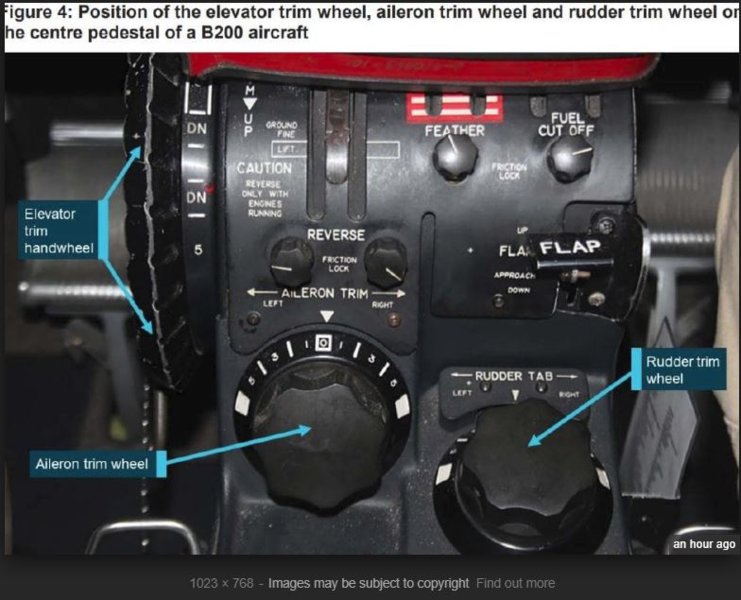
potentially fatal action. A farmer jumped in his Cessna which rolled over after take off, killing him. A bull had scratched an itch during the lunch break. You just never know whether the aircraft has been bumped, a kid has climbed in etc.I have rudder trim in my aircraft and to be honest I never check it because I am the only pilot and I know where I left it set. I check the elevator trim of course. I will try to add the rudder trim to my pre takeoff checks but it will be hard to break old habits.-
 2
2
-
-
In terms of hitting the target to prevent HF deaths the people who wrote the training hit outer spaceWho hasnt tried to start with the mixture pulled? And that is after saying the checklist out loud and even touching each control as you did it. The engine starts on primer, then stops. You sit there dumbfounded. I still don’t know what the human mind is doing when that happens.
No, just several Maydays in a row.It is hard to accept that very experienced pilot could not quickly identify problem with wrong trim and correct it in split second,Also trim could not be strong enough when adrenaline is pumping to negate rudder control ( in my opinion)But I do not know all the facts. Did he indicate over the radio the nature of the problem?
-
Yep, I don’t own a corporate jet. This thread really is about a fatality which ATSB has judged to be human factors. The consequences look as if they are going to be huge. How do we avoid missing pre-takeoff checks, removing gust locks, neutralising trim?
-
Mine is.The real question is “How good could this be?”Corporate jets aren’t recreational in any case.-
 1
1
-
-
Yet only yesterday someone wanted to lump all non-commercial aircraft in one basket - Corporate Jets to powered parachutes.I didn't mention high powered War Birds because not many of us get to fulfill our dreams.What could possibly go wrong?
-
As a rich NZ gentleman did when he stepped out of one of his Spitfires with left prop rotation to the other which had right prop rotation; wrecked it!It's not only a multi engine aircraft. with engines offset. Single engined fighters (Piston) preset a lot of trim prior to commencing the take-off roll. If you set it the wrong way you may, (probably will) crash. as you will lose directional control.. Nev -
Well in that case you might get a sociologist (strike 1) who is bad at developing Cities (strike 2)There has NEVER been a sociologist good at developing cities. Ever since the days of the "Garden City" movement which led to the "planning system" we have today, planning for our communities has been focused on the "touchy feely" rather than the development of infrastructure to reflect the future growth of our towns and cities which has left us with the infrastructure mess we have today. At least engineers with vision like Brunel provided infrastructure which is still fit for purpose today. -
Well that didn't take long; widows of US golfers to sue just announced by Melbourne Herald Sun
-
Source: Adelaide Now
-
I think you're right; "aviation" isn't even mentioned in his department's name, so it can't be like the old days where we had a Minister for Aviation.
However, that doesn't mean everything doesn't get close attention.
That letter will be given to someone with a report date set.
Where you have to have extremely careful in what you are saying to a Minister, and particularly this one, is that the person available to check out that issue may be an ex ship's captain, an Infrastructure planner, someone from Albury, of a sociologist good at developing Cities.
It's probably never as bad as that, but you can guarantee that the person who gets the job will be investigating whether the letter has any merit first, and could be told anything from anyone.
CYA will ensure the information is cross checked before the Minister gets his report, and a lot of unwanted side effects will often float to the surface.
-
The first question for RAA subscribers is whether the two Michaels did in fact say that RAAus Ltd would close its doors subject to not getting their way.
The second is whether there was any authorisation from AOPA members for what Ben said.
The conclusion of a Minister could well be; this is all too risky, we’ll adopt the safer standard.
There are some statements you make to government when you need something, but this isn’t one of them. It could lead to wiping out hundreds of flyers.
This is certainly not the measured and responsible AOPA that Facthunter talks about and that I knew.
-
Unfortunately the government probably didn't say "If we manage he high risk operations and take the liability it's going to cost us a bundle, so we're going go hand that over to you and you can take the liability" otherwise people would have pricked up their ears.I meant the self administration model not the method of incorporation. The only people at the table were CASA and some of the self administering bodies - and some of the CASA folk were GFA sycophants.I woke up to it on the way home from my meeting.
However, understanding what was done then isn't going to change the fact that we are going forward in a new era, and the organisations involved need to set up systems to adapt to it.
-
We've discussed GFA on this site previously, and I looked at the GFA Constitution; that's where the road block to a better life lies. Just needs three or four people with Association experience to fix - but not publicly.Natural justice is a concept that many have not experienced in GFA - people just give up and go away - often pissing up tens of thousands of dollars invested in aircraft against the wall.
That might be your memory, and in the very early AUF days may have been true, but the RAA, Inc Constitution reflects a totally different Association to GFA, and now it s a different animal again with Limited Company status.Remember it is the GFA model that this whole show is based upon.
Apathy is the mother of contention.No one has ever really put alternative methods of management to real examination - look at the SCC committee minutes of the day.CASA is compromised from within by employees who are closely associated with GFA -
Well I won't bring up the 40 cents per year cost of our National body in the 1980s,I would have no problem with part 149 if the organisations were "fee for service" and did not require memberships (ie the same a GA) - any delegate can revoke an authorisation in the event that the conditions of that authorisation were proven to be violated. This would permit multidiciplinary authorisations without attendant membership costs.(GFA+RAA is about $1000 per annum before you turn a wheel). Also the possibility that your flying "privileges" could be removed for a non-aviation related matter such a "bringing the organisation into disrepute" would not exist.You might have a point if Associations like Sporting Shooters Association (18,000 members) and BMX Australia (about 8,000 members), were not controlling their own destinies.
Any organisation can go under due to bad management, bad representation or the reasons you give.
Associations usually cycle between good periods where the sport grows and costs come right down, and bad periods where a clique forms, favours start to occur, and the general membership gets disgruntled and throws out the Committee, then the climb back to the good times usually starts again.
If RAA Ltd were to go belly up today, an association could be formed in the next two days, and the active flyers have enough financial power to restructure within a few weeks.
If the operations were not changed, there would be every reason for CASA to expedite the agreements necessary to resume flying.
You can fly for about the same cost, if not less, per year WITHIN the CASA system now in the aircraft fleet they supervise. Then you also have the prescription you mentioned."Surveillance" would be left in the hands of the regulator who has proper investigatory powers and who acts on reports from the public.
If you fly in GA, as I suggested, you fly within the CASA system, but if you want higher risk flying categories or performance based systems the risk will always be at your cost, and the best way to minimise your risk cost will be by joining an organisation, because all governments like to keep their day to day relationships to "Peak Bodies" rather than hordes of Type A personalities.All this can be handled by existing branches of CASA (such as the Office of Delegate Oversight) without the costs to CASA of managing relationships with a dozen or so organisations largely managed by a revolving door of volunteers who, as well meaning as they may be, will be putty in the hands of professional bureaucrats.As far as having your flying privileges removed, you've touched on an interesting point.
I view RAA as a self administering organisation which has never really gone down the path of setting itself up as a self administering organisation. A limited company almost rules it out because of the horizontal structure required to geographically cover Australia.
Even before the switch a company, the RAA Inc. Constitution was little more than more than the Model Rules provided by the ACT Department of Justice, but the clauses which would have brought it to life and made it much more active and given members much more control over their sport were never enacted.
Sorry to have gone around the subject, but it makes it easier to answer your question. With Compliance and Enforcement comes a set of self administering sanctions. With these in place it is necessary to temper the sanctions with natural justice, and that entails volunteer Appeals Tribunals, and they can extend from suspended sanctions to encourage a change in behaviour to cancellation of Certificate and membership. Given that natural justice is ensured the maximum penalties imposed are likely to be about the same as CASA imposes on its pilots, but without the financial sanctions.
With that system in place, and a low fatality/accident rate, there's a lot less need for CASA to intrude.
-
This probably explains the confusion.I too have to deal with planning law but as any practitioner will tell you it is not "black letter" law. The High Court has repeatedly found that a planning consent is an offer subject to acceptance by the proponent- a proponent can choose to accept it or effectively give up - acceptance is essentially the creation of a contract.Aviation law needs to be prescriptive in order to prevent the balancing of interests which occurs in planning law ultimately to produce inconsistent outcomes across a community.Better question is why do we need Part 149 ? - US deals with this effectively - CASA needs only to provide for the various sports aviation groups in the regs eg under 600 kg, gliders etc. and then make delegations to individuals / organisations as they do for the rest of aviation.
If a government makes its laws prescriptive, it has a duty of care to make sure they don't hurt anyone, just the same as anyone else. Government departments have been quietly moving out of prescriptive legislation for about thirty years.
DIRDC (Department of Infrastructure, Regional Development and Cities, which includes aviation and transport is a good example. In the construction of motor vehicles they have been moving away from some prescriptive Australian Design Rules, and have set up National Codes of Practice which designers can use if they wish. This is managed at the State level, not by the State Road Authorities, but by an authorised Group of "Signatories", which they audit. At the State level, the bulk of registration activity was handed over to private industry in the 1980s, so in any cheating with dimensions or specification, the liability goes to the dealer, not the State.
The States have retained the core of prescriptive road laws, and are prepared to take liability for that core; I would expect CASA to do the same with the core laws it administrates.
CASA was set up as an independent Authority in 1995, but nests under DIRDC and is responsible to the same Minister, so I would expect some similarities would filter down from departmental and Ministerial discussions along the lines of "how come you haven't caught up" and "you do realise you are exposing yourselves, and us, to unnecessary financial risk.
Ever mindful of the political fallout from dumping substantial financial responsibility from government (where an official signed a document to say you were "safe", e.g. car and truck registration, restaurant health standard, machinery safety (cranes, chain, cables, hoists), on to the users, governments have usually made the changes without giving any reasons. For example in Victoria the Department of Labour and Industry which employed hundreds of Inspectors going around factories, signing "tickets" to say the crane was OK etc. was closed down overnight and its records effectively disappeared.
DLI used to administer Speedway racing, and overnight all the race track dimensions - distance of spectators from the safety fence, safety fence specification, catch fence specification, lighting etc disappeared.
We weren't told anything, and the government, when asked suggested Police take it over;this was met by a masterpiece of obfuscation from the Police, who didn't see running sport as their business.
Our Federal Administrator in South Australia grasped the financial importance, and partnered with an insurance company to cover public liability at the race tracks, and I was deputised by the 23 Associations involved in speedway in Victoria to go and tell the government we were not happy with their idea of police being assigned to run race meetings.
I can remember sitting across the desk from the Minister for Sport and Recreation, and pouring our story; he said "Would you like to run it", I said "Yes", and we've been self administering ever since, with no involvement by the Victorian government.
There was no government announcement, no explanation.
That's why I have no problem with the current era where one of the last of the troglodytes is coming home to roost.
I would agree that the presence of an Authority between the current Federal Government and the people conducting aviation in Australia is way more complex than the situation I had to deal with, but the reasons are the same.
Therefore I look at Part 149, and say "one more step in allowing us to manage our own affairs and you look at it searching for the prescriptive element, but it's gone.
-
 1
1
-
-
Depends whether they want to make changes in the short term.
I thought Part 149 was a lot easier to understand than a lot of Planning legislation I have to deal with.
Why would they need an exposition?
-
 1
1
-
-
Firstly this is what you said: "And CASA has proven time and time again it is beyond government. No politician with an eye to the future sees any worth in bringing CASA to heel unless it impacts the major airlines. Put simply there are no votes in it."I was merely pointing out that CASA is beyond the management of government. For proof you only have to follow CASA's performance in meeting the targets set by government in response to the Forsyth report. Part 149 is only about 3 years behind schedule and by their own documentation cannot be completely introduced until Part 91 is implemented which is programmed to be in December 2019! https://www.casa.gov.au/standard-page/regulatory-progress-timelinePart 149 is dependent on Part 103 being implemented which is dependent on Part 91 being implemented.Turbs are you a senior CASA bureaucrat?
That just isn't true.
Secondly, Your proof for CASA being beyond the management of government is irrelevant
We've covered this so-called Forsyth report before; the government in November 2013 decided to conduct an Aviation Safety Regulation Review and appointed a Panel consisting David Forsyth as Chair, Don Spruston from Canada and Roger Whitfield from the UK.
They were given certain aspects to review.
A lot of the submissions ignored the basic direction, and could best be described as wish lists or complaints about organisations, procedures or even people; one tipped a bucket on RAA. Several, using identical wording told the Panel Part 149 was the best way forward, and so on. Overall it was a lot of people going off in a lot of directions.
The Panel made some recommendations, and the Minister, Warren Truss published them, and that was that. There was no obligation on the government from that panel report, and there is nothing unusual about that.
A few people on this site and another one, apparently thinking that their submissions were binding on people to do something made a lot of noise, but the truck is that governments conduct reviews all the time, panels are set up, and make reports, and the governments may decide to act on some.
If the Government issued CASA with an instruction in accordance with the appropriate powers, and CASA refused to carry out an instruction you may have a case condemning them, but that hasn't happened with Part 149. I didn't find anything in Part 149 calling up Part 103. Part 103 contains the criteria for CASA consolidating rules applying in Part 149. It doesn't say they have to change any rules right now and it doesn't prevent SAOs upgrading their own rules.
Thirdly, no I'm not a senior CASA bureaucrat.
-
CASA has guidelines it must meet. Wild accusations are not guidelines.And CASA has proven time and time again it is beyond government. No politician with an eye to the future sees any worth in bringing CASA to heel unless it impacts the major airlines. Put simply there are no votes in it. -
My first experience with an ultralight occurred in 1979, and I went to Mangalore; not sure if that is long enough for you.Turbs,I doubt you have been around aviation all that long.
You just have to look carefully at the two Constitutions to see what I was saying about the differences, and the "histories" I mentioned refer for example, to the clauses in the GFA Constitution which lock out the members, and the structure of the RAA Company, which has a different set of disadvantages for members. There's no point in lumping them together to have a general rant, because fixing each one requires a completely different strategy from a different set of people. Lumping them together doesn't solve anything.RAAus grew out of the AUF which used the GFA model of self ADMINISTRATION (note not REGULATION). Internally things are somewhat differently organised but the orgs have the same basic concept at the core.The Self Administering Organisation has the power to make its own Rules or Regulations, so it is both.
A decision was made to allow RAA aircraft to fly by a set of exemptions from GA regulations, and subject to certain conditions. It's self regulating in terms of how it goes about managing the risk it assumes. A rough parallel to that is that although there are strict regulations in the meat and restaurant industries, you can BBQ sausages outside Bunnings where you self administer the operation by requiring a Certificate III in food handling to discharge your duty of care because you are going to be sued for food poisoning, not the government.Any body that requires CASA approval of its existence and requires CASA to approve its ops manuals and has a contract with CASA can hardly be said to be self regulating.
It doesn't have to make any claims; RAA is actively managing duty of care along with you (with the few exceptions where CASA has made a mistake, or has deliberately decided it needs to control something and will take the liability for that.Nor can CASA claim it has off loaded any liability at all.
I've yet to see one which absolves owners and pilots of their duty of care. Two were quoted on this forum, as an example of the power of the little badge on the panel, but in both cases the defendant was found not to have breached his duty of care.In the sport and recreational aviation world several court cases have now established that anyone who flys a recreational aircraft is taking his or her life in their own hands and claims against instructors, supervisors, organisations etc will be very unlikely to succeed. They are recognised as dangerous activities. I don't think this is entirely fair but there it is in case law.
I think you'll find a number of RAA members have been sanctioned by CASA, some in conjunction with RAA. The minute you start the engine you are entering the CASA regulation arena.CASA actually doesn't care what we do to ourselves. They assume that recreational aviation is indulged in by "informed, consenting adults". Their concern is innocents on the ground and other airspace users.
How many years do you want? In Planning, I usually get 90 days to comment on legislation which affects several million people. What you are referring to as a 'fait accompli" is the draft. Anyone is entitled to address faults in the draft, and if the comments are found to be justified, they will be changed. Not only that, but this legislation went through Parliament so you had the benefit of going to your local Member and pointing out any defects so he/she could raise them in debate.Part 149 has NEVER been publicly and properly debated, mainly because nobody ever knew what it would look like. It was in train since 1998 and only less than a year ago was a final public form put up as a "fait accompli" by CASA.
It is operative now; people who are cleverly holding back and ranting about it just won't have the advantage of its protection.It will not be operative until organisations sign up to it and are approved as Part 149 organisations.
The way I see Part 149 is as a set of industry benchmarks, a bit like the Australian Standards; very handy if you're being sued for negligence to be able to say you met that standard and therefore discharged your duty of care. You can operate without these things, but when your passenger becomes a quadriplegic and sues you it helps to be able to point to a definition of professional conductI have it in writing from CASA that organisations will not be forced to be Part 149 organisations but if they wish to operate as present must apply to have current exemptions extended.
If someone asks them how long a piece of string is they can't help but give that answer, however some idea can be gained by the Compliance Audits, where RAA worked through some aircraft with the owners and got them back in the air, but quite a few were abandoned. In the case of RAA, members have much less control over a company than they have over an incorporated association where they can move in fund it back into compliance with a levee, or reform it into compliance. The bottom line is if you're given the luxury of flying by exemption, you make sure you don't lose that priviledge.CASA also admits it has no idea what will happen if for any reason an organisation ceases to exist or is unable to carry out its contract with CASA.
If that happens the lawyers will wait until ATSB has produced their report, and the legal process will decide all that, based on who was negligent, or the share.Now imagine what happens if a RAAus aircraft or glider collides with a Dash 8 or Saab 340 near a regional airport. 20 or more dead. CASA, RAAus(or GFA) get sued by relatives of the deceased. The first thing that will happen is that the organisation's insurance company will refuse to pay on the grounds that the law or regulations were broken, which led to the accident. The very next thing is the org will have nobody to run it as its executive decide they need to spend more time with the family or claim medical incapacity to carry on. If these people are dragged in to court they will claim that they were operating in accordance with their manuals (approved by CASA) and their agreement with CASA. CASA will then have to admit this and as CASA was charged by parliament with administering the safety of civil aviation in Australia, guess where the buck stops?BTW put in enough detail into the RAAus or GFA manuals and you will find that is used against you because it will be nearly impossible to comply in every detail.The real danger is that the Parliament will have a fit, and here will be a knee jerk reaction, something like what happened after the Port Arthur massacre. Cancellation of flying by exemption would be the biggest risk.
-
1
-
-
No, I'm referring to CASA as an entity. You may be talking about Directors and Officers liability, which is another subject related to to the actions of individuals.My point is that they have taken liability back by way of the 100million indemnity for delegates etc.
You can indeed be out of the air very quickly, as we saw in the Compliance Audits, but in a self administering organisation you're at the front of the food chain not the end, but several regimes have just sat back and done nothing about managing their own affairs. There should have been structures, such as SMS and Compliance and Enforcement built years ago.They exercise effective control by way of approval of the expositions and the inherent controls within the exposition and the regulation (CASR149). The effect on us poor sods at the end of the food chain is that if the RAA loses its certificate or goes bust or no one wants to be a director is that our investments in equipment may become worthless and we cannot fly (at least the RAA way) and for that there is no liability -
We're talking about CASA taking back legal responsibility, not individualsMight do to have a look at page 8 of CIVIL AVIATIONADVISORY PUBLICATION CAAP ADMIN-01 v2.0 which details the indemnity for delegates etc.

CASA confuses me.
in Governing Bodies
Posted