RFguy
-
Posts
3,542 -
Joined
-
Last visited
-
Days Won
49
Content Type
Profiles
Forums
Gallery
Downloads
Blogs
Events
Store
Aircraft
Resources
Tutorials
Articles
Classifieds
Movies
Books
Community Map
Quizzes
Videos Directory
Everything posted by RFguy
-
but, ATC provides separation for IFR and VFR traffic for IFR traffic , that's their job (putting aside if all the planes had been equipped, then the two planes could have alerted their pilots without ATC)
-
system works. WHAT SHOULD have been done or could have been with the ADSB integration was a method to alert the pilot to pay attention - return Mode S. IE like Sellcall function for 2 way radios. something flashes and beeps. the system supports this in Mode S. I think my Garmin GTX335 does. Wonder what sort of device R75** was using ?
-
Skyecho has a very small and fairly compromised GPS antenna. However, up in the sky there are no trees. so as long as there isnt sheet of metal or inch thick fibreglass in the way , or any carbon fibre, should be fine. However, Mark I will give some thought to your suggestion of a coupled antenna, (even if technicially inept in your description). Amplified coupled antennas need to be considered and engineered very carefully to avoid accidently jamming the GPS for miles around (feedback) mmmmm for the moment, Just get it in the clear as best you can. But I would be sure the device's compromised antenna is one of the problems I am seeing.

-
" inductive passive GPS antenna "? what ? you mean coupled to the internal antenna without galvanic connection?
-
and any repair- consider what you do NOT want sucked down the pipe into your carburettor if it came loose.
-
wow that's nice and clean. Consult your LAME , L2 or A&P for info . dont worry about it. just ensure NOTHING is rubbing on it. It's not just random tube- it is high temperature, durable, expensive sh1t
-
yeah Mark but you have a fibreglass airplane.. It can likely see OK through the skins, (not carbon fibre though) but not through the wing structure... and of your OTHER airplanes, they all are low/mid wing and have a canopy, so good ! so for a J2XX on the fore end of the passenger window would be acceptable. J170 , J160 etc would really need to be on the instrument panel . Metal planes are a different beast. I have seen my SE2 generate bogus data with greens showing.
-
Even if it shows three greens it can still have poor GPS fix and be transmitting bogus data...
-
LOL . ROFL. skin repairs, engine bulk strip, new prop. 40k-60k.
-
CASA qualifications applied to RAA
RFguy replied to old man emu's topic in Student Pilot & Further Learning
I reckon miles over the top for Cowra- there are only 'peak busy' transients... - but a different CTAF would reduce the intense pollution of the CTAFs for miles around. -
CASA qualifications applied to RAA
RFguy replied to old man emu's topic in Student Pilot & Further Learning
Turbs had an excellent point about threading yourself into traffic So there is a practical limit for an uncontrolled AD - with # aircraft in circuit- what are other intensive ADs like when it comes to maximum aircraft within 3nm ? Come to Cowra during a busy week. Up to 7 flying school aircraft circulating within 3 nm going different speeds (some cherokees, some twins, 182 etc) and continuous radio traffic due to proximity of other busy CTAF (Cowra really needs its own CTAF so it doesnt pollute the skies) ... I dont think Bankstown is any worse, except that there isnt any dead side when at Bankstown with the twin RWYs. Problem at Cowra can be no taxiway to runway threshold, which if someone wants to get out and backtrack, that bottles things up a bit as folks slow or extend downwind etc. I know the instructors actively limit traffic to 5 aircraft in circuit, which is fine when we are all flying PA28s. But we manage OK, its not often it gets really hectic where you have 2 aircraft on downwind , 1 crosswind, 1 on base,1 climbing off the runway , someone waiting to ENTER and backtrack, AND just to top it all off, someone joining midfield-crosswind threading into the downwind to make 3 on downwind...and an AG plane at 100' doing a right base...AND a GA charter coming in wanting to do a straight in ............. and perhaps a helicopter doing low level work... ("where is that aircraft ? where you want/need to call an aircraft to exactly locate it but hesitant to add even MORE radio traffic ) . That was a true story last week....Still a fantastic AD. great approaches, a 1km grass cross, no landing fees and no hills and good minimas and plenty of options for EFATO on all runways.. -
No. I moved it around the compass, in various orientations rotating in A B and C axis. No... I did remove the metal locking prong on the rear, though. (hex key) Wasnt sure at the time if it was ferrous. non ferrous.
-
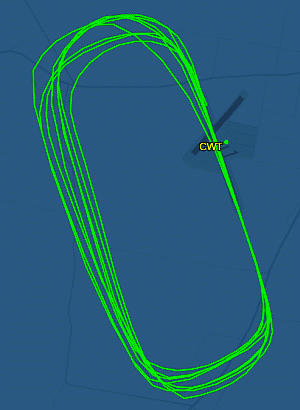
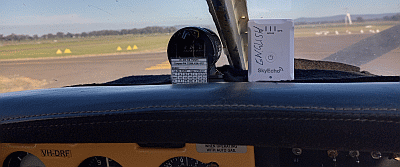
This morning's circuits. ALOT better sitting in front of the compass with a OK view of the sky... (cant see behind airplane too well) but not perfect. Had a cloth over it (like Hillary and the emails) to avoid marking the wind shield.
-
Ping device is not an EC nor a TABS device , and thus it does not contribute to visibility and not eligible.
-
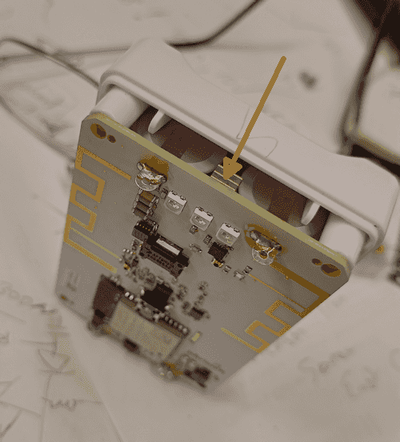
Best option is a UHF grade solder joint for the ADSB RF. But that isnt anywhere near as critical as the GPS BUT that doesnt fix the GPS ! GPS really needs external antenna OR needs to be mounted where it has a good view of the sky. (front of instrument panel under windshield etc) 'Glass or fabric planes are probably OK , but metal plane is not. I am currently doing a little PCB to turn on the skyecho when USB power is applied, and turn off the skyecho with USB power is removed. This way aircraft supplying their skyecho with ship power get auto on and off and charge... -glen
-
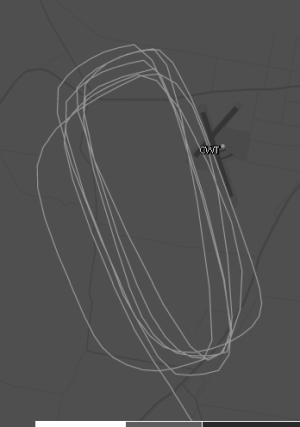
SKyecho might have a high grade GPS, but a low grade antenna AND on the window of an aircraft leads to some very large transmitted GPS errors. I see this from time to time (see below) note track errors. I have checked the received GPS stamps in the logs from the skyecho, it appears to be sending position data when the GPS fix is very poor- It should not do that, I am going to write to Uavionix. I am going to move it from a back window to just ahead of the compass on the panel, where it has a better view of the sky. So, with respect to separation - always consider that an airplane with a skyecho might be a few hundred meters out !!! And vertical performance might be even worse. There is a reason that TSO GPS ships require a GPS in an optimal spot - external along the roof line. I do not see such gross errors in aircraft flying with TSO GPS+antenna.
-
Sunday- Cowra... slightly foggy morning, 0730 local, I could see mountains OK to the west, uncertain exactly what the ceiling was , could see a few fog patches, but easterly wind. Hoping I could get a few circuits at least 1000' AGL. sun out intermittently. (low on horizon) Took off, cool so good performance.. good climb rate 1200 fpm. at 400' I look down to check Ts and Ps in the green.yep. Look up again 2 seconds later 100% IMC.... woops ! wings level, maintain runway heading, nose down, reduce power, carb heat HOT , eye on altitude . Descend out of it. 300'. bleed speed, flaps 25, low level circuit , swing onto downwind in a gentle bank, fog getting worse... make early base turn swinging down land 1/3 way down the main A 4 minute flight. (might have been 3 minutes) my shortest flight ever. Wow, soo large clumps of cloud and fog drifting through . Have done this in the simulator a few times (take off into 500' IMC) so practiced skills clicked in. But any pilot should recover from that with those same actions I think. No problem at YCWR, but if this had occurred at an AD like Young surrounded by hills, or at an unfamiliar AD, that's a little more critical. So good to think about what you might do in the above real world worked example !
-
relevant : did you read the findings of the Baron in WA ? https://www.atsb.gov.au/publications/investigation_reports/2022/aair/ao-2022-026 about half way down near "Survivability", and "Restraints" then "Survivability" Pax (in a 3 point harness) might have survived if was in a 4 point harness like the pilot was... see "the primary difference" The survivability of the accident can be broken down into the environment within the aircraft prior to and after the collision and the impact forces related to the collision. The fire generated significant heat and smoke in the aircraft’s cockpit. The reports of the pilot and the respiratory injuries to both occupants indicate that they were unable to effectively vent the smoke. With the pilot able to self-extract after the collision, the passenger continued to be exposed to the environmental conditions within the aircraft until the pilot was able to re-enter the aircraft to extract them. This likely reduced the passenger’s chances of survival. The pilot reported that they and the passenger were secured in their restraints at the time the aircraft collided with terrain. The pilot, in the left control seat was in a 4-point harness and the passenger, in the rear right seat, was in a 3-point harness. Generally, the 4-point harness improves survivability in 2 ways. Firstly, it better attenuates the impact forces, by spreading them more broadly over the body. Secondly, it secures the occupant more effectively laterally reducing flailing. This decreases the likelihood of injuries due to contact with obstructions or structure of the aircraft. The primary difference in injuries between the 2 occupants of the aircraft was the chest and other trauma present in the passenger. This trauma was consistent with the differences between the use of a 3-point and 4-point restraint. The 3-point restraint did not distribute forces as evenly across the body and allowed significant multi-directional movement (flailing) inside the aircraft. Based on advice from the manufacturer, operator and ATSB research a 4-point restraint is not available for the rear seat of B58 aircraft. However, this accident demonstrates the fitment of the 4-point harness to the crew seats, can improve survivability over the 3-point restraint that is required under the regulations.
-
Hi. My collision detector works fine. (IE predict trajectories from ADSB data ). But what to do with the data and information. Simplist is like "HAZARD TRAFFIC 3 o clock high 10 seconds" (fast) voice annunciator. As I have now started flying again regularly, I will likely push this along with extreme prejudice. especially with the zillions of other cherokees in circuit at YCWR (flight school) and the occassional guy with no radio and counter traffic-in-circuit approaches...... Ideally, I'd have a planatarium feel to it. IE airplanes are projected around you, OR a transparent sphere is in front of you, with airplanes projected onto the surface of the sphere, with one's airplane plastic model in the middle. IE Hhow to generate / communicate the 3d information
-
I dont feel I am at the age where I am likely to be incapacitated (52). well of course I wouldnt, so the only one that keeps me awake, and consider a chute, is an in circuit collision. Should be possible with a couple of 360 x 100 deg cameras to see this coming.
-
Press autoland.
-
The Cirrus has some fancy crash absorption honeycomb in the seats. One uneventful afternoon in Tony's Cirrus I got into the POH and discovered "Though shall not kneel on the seats" since the high (knee) pressure can damage the absorption matrix. I like your driving test mantra, Nev. Jack, I think an engine fire in a fibreglass aircraft like the Jabiru would be bad. The glass temperature is very low. So I guess its a matter of how much damage can ~ 40mL of fuel do in the pipes and 4 litres of oil in the system and decide from there. I'm not really familiar with the way engine oil fires burn.
-
I am trained that "The Germans are coming- less than 5 minutes to get airborne".... get checks / checklist done and go. No 20 minute ground running .
-
Skippy, - Rotax also run on ACTUAL engine running hours, where as my Lycoming is Tacho / airswitch. so run-up hours on a cold Rotax really chew into the Rotax TBO- hence fast warmup by oil thermostat (and ideally, water radiator 90% bypass thermostat) . Both of those thermostat methods dont completely kill the cooler circulation.
-
"Suction tension dominated most likely by the oil cooler." SKippy -go and read the oil cooler pressure drops at the rotax flow, and then cross reference to the manual. you will find it is thin ice and something to be adhered to and measured/verified PER THE BOOK.