RFguy
-
Posts
3,542 -
Joined
-
Last visited
-
Days Won
49
Content Type
Profiles
Forums
Gallery
Downloads
Blogs
Events
Store
Aircraft
Resources
Tutorials
Articles
Classifieds
Movies
Books
Community Map
Quizzes
Videos Directory
Everything posted by RFguy
-
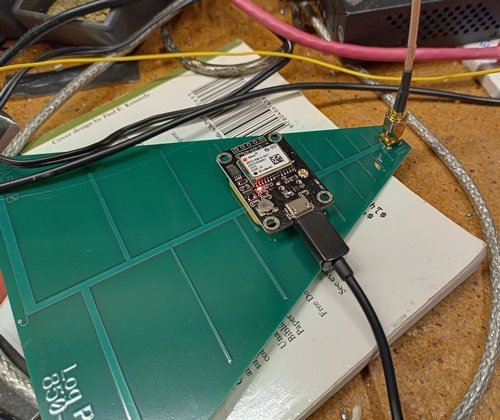
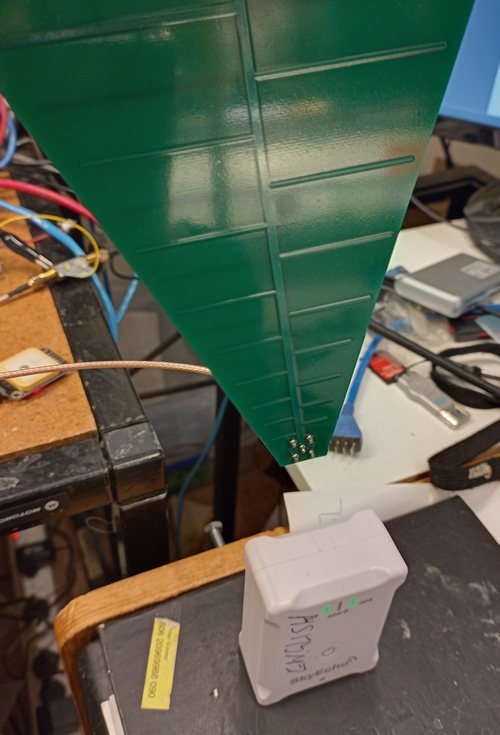
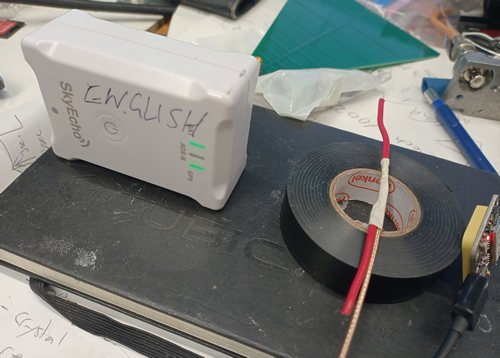
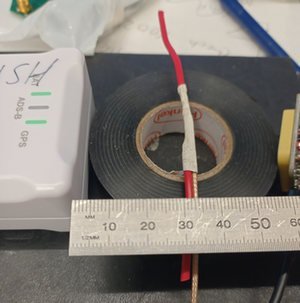
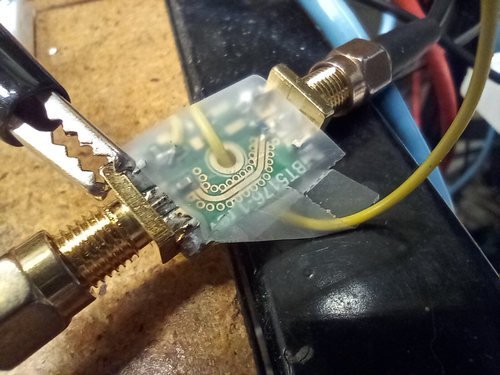
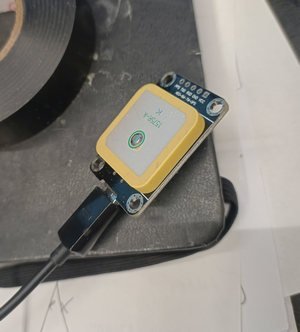
Ublox receiver sitting on log. There is a PATCH antenna on the bottom of that receiver , so it is just sitting on it, SE2 with log periodic this is good and about the best reliable distance . works up to about 65mm my GPS antenna power injector (since the roof top antennas need power on the cable) checking polarization dependence this iis cross pol (poor)

-
Today I was messing around with multiple GPS antennas on active repeaters. they're really all active because most GPS antennas have amplifiers in them to cope with the lossy long thin cable. had couple of antennas on the roof, fed with a power injector, and a few different rerad antennas. I also updated the SW in my SE2 to 2.41 Started working with some ublox receivers I have with the very fancy U-center program that tells you all the backroom GPS data. then I moved to using the SE2. It's clear why the SE2 will report some very poor position fixes. It's bar is very low. With NIC (Navigation integrity category) =0 and NACp (Navigation uncertainty category) = 6 (on the wifi GUI) the box shows GPS green. If we ignore NIC of 0 means containment radius integrity is unknown. IE NFI ! The NACp of six means better than 566 m in horizontal and worse than 45m in vertical. (95% confidence) So what I see (transmission of poor fixes) makes sense. WHen life is good, I see up to NIC=6 and NACp = 8. Now, this is much better - NACp of 8 implies better than 93m in H, but STILL > 45m in V . (95% confidence) and containment radius better than 926m. The SIL for a SE2 is 1, which means likeihood of being beyond the containment radius is < 1 in 1000. I've seen a NACp of 9, which implies better than 30m H and better then 45m in V Now, what is accepted by receivers and processors and displayed online like flight aware and flight radar might be very different to what is displayed by ATC IE ATC are unlikely to display poor NIC and NACp numbers (or shouldnt) . I wonder what SE2 pass to the EFB. NACp is transmitted in ADSB message type 31 in V2. so the nav performance is transmitted. So, of all this I think it is very practical to be able to provide a supplemental GPS antenna to a skyecho, so that the SE2 can be on some inside back window, and also have an aux GPS antenna on the window on the other wise of the aircraft. I started with a log periodic wideband antenna and then made a little dipole antenna to gauge polarization matching sensitivity, and there is that to it. The antenna in the GPS receiver should be a circularly polarized type, but its a very very simple little thing and seems to be rather random but with a preference of paralell to the board axis. Pictures to come
-
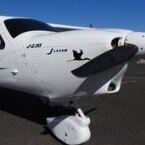 well, today or tomorrow was going to fly to Port Macquarie for a get together. However, the GAF is more than just a couple of sentences, its a couple of pages of hazards.. Instructor was right. If the GAF is more than a couple of lines stay on the ground. MOD MTW, SEV TURB and low cloud.
 -
yes, true. Best to lead by good example instead of spite.
-
No excuse now not to have ADSB TCAS. I'm muttering about doing somethhing, have been experimenting with my zero spare time on using multiple basic GPS receivers to get a good position fix with distributed antennas, since the SkyEcho GPS position fixes can be terribly poor if they dont have a good view of the sky, SKyecho can be improved- Certainly worthwhile also doing an active dual antenna >> skyecho adaptor- needs two patch antennas on each side of the aircraft that can see out the window, and uses a basic RF combiner (a $5 tv-sat one works) , and a 3d printed cosy sits over the top of the skyecho GPS antenna and couples the combined signals into the skyecho GPS antenna. That works OK. Needed to remember how to use my 3d printer... needs to be a metalized plastic because needs to shield the re-radiating antenna so the aux antennas dont feedback. but standalone ADSB-TCAS wuld be triple GPS , triple antenna , to use multiple low cost cheap looks at different areas of the sky. avoids RAaus aircraft havign to put GPS-35 antenna in the top of their aircraft skin. just take average of the fix works OK by various literature (been done many times) . Step up from that is use a couple of high performance GPS receivers and use raw data from each combined in a central CPU to produce a high performance fix from the raw data from each antenna (IE you get distance and direction for each satellite from the Nth receiver, and use the combined set to produce the fix externally. There's a few ways to generate sanity checks which is well covered in literature. Target is 10m accuracy in XY and Z. Good Z axis requires some sats overhead. X and Y need low angle sats distributed around the azimuth. anyone not having ADSB in their aircraft , which includes the flying school aircraft I will treat as persona non gratia . IE. "XYZ do you mind if we backtrack with you down to the end of 33 ?" " NO , I do mind." . what happened at YCWR the other day is BS and it's not been taken seriously.
-
that's an expensive pile up.
-
agreed if its in a fuel tank and you do NOT want blobs coming adrift and blocking inlet. good reason to have finger strainers.
-
Skip, maybe for your experimental application, just some decent automotive fuel tank/ fuel pump gasket silicone etc Repco Australia | Auto Parts Store - Aftermarket Car Parts WWW.REPCO.COM.AU Repco Australia | Auto Parts Store - Aftermarket Car Parts WWW.REPCO.COM.AU
-
although your 1 hour flight will chew up $50 of fuel and $17 of engine time ? maybe you can get a bit from the locals.
-
any any idiot can get an airplane airborne IF they manage to keep it straight on the TO roll. landing though is a different story.
-
windmilling prop RPM and water in float bowls
RFguy replied to RFguy's topic in AUS/NZ General Discussion
It would depend on how fast the air could be pushed out the float bowl (breather/equalization passages). -
redeveloped... yes that might be a good start. The transponder construction is quite solid a completely different beast. . But the radio looks like a good design start but never finished- IE looks like the person designing it left the company 75% through the design. and items never got sorted. From a modern perspective, its was built like something from the early 90s. The biggest issues I have found have been that the factory alignment method is wrong in many places, so I roll my eyes. O've seen quite a few surface mount component faults - mechanical, the chassis is a bit light for SMT components (flexure). However, when aligned corrrectly and no faults, they work well. The most rapid head shaking comes from seeing bills they gave people for alignment of $600 and they didnt get it right or find the fault..... I have reached out to them in the past with suggestions, but they dont seem to want to talk.
-
Leighton Beach WA light aircraft ditched 20.04.2023
RFguy replied to trailer's topic in Aircraft Incidents and Accidents
I wonder what the fuel pressure gauge was reading.... That might be the $64 question to whether the fuel was water, (no viable recovery method at 1800' (120 seconds) or the tank draw briefly starved (due to a manouver) or there was a fuel blockage. putting that aside, coul dhave been another fault. Carb fault ? But M-S carbs are pretty simple. Wonder how long it was since she practiced a full CFMOST full troubleshooting proceedure. (IE initial check (gauges, carb heat, pumps on, change tanks) , plan, pax brief, comprehensive check (include check is primer locked ? try different things, throttle position that works ? , bad mag ?, primer normal ? try different mixtures) . -
Microair, from my experience, I wouldnt recommend.
-
windmilling prop RPM and water in float bowls
RFguy replied to RFguy's topic in AUS/NZ General Discussion
hmm Non invasively, the only way to figure if there is fuel in the lines is to tap the line and watch the pipe vibration frequency. but if the lines post the selector are full of water, you are dead in the water. so.... it needs to be detected between the tank and the fuel selector cock. and at a velocity of about 27cm/second in 1/4" line at cruise (8 gph) , that aint long o do something about it fuel injected system will behave differently. Primer comes from elsewhere. Might keep engine alive with primer if primer has access to the fuel ? WHat's the primer pumped quantity per push in the cherokee ? something like a 2" travel in a 1/4" bore every 3 seconds... no, that's not going to keep it USEFULLY alive. you are better to fly it. -
The Funke looks good. inbuilt 2 place intercom.
-
windmilling prop RPM and water in float bowls
RFguy replied to RFguy's topic in AUS/NZ General Discussion
yeah I was wondering as what rate it would pull the water out of the float bowl . maybe reduce throttle opening is better because it creates lower pressure and might assist vapourizing the water. dunno . water VP is only 2.5 kPa. fuel is ~ 30-60.... . 20 " of Hg pressure below atm .. 67kPa below ATM so no..... Does anyone know what happens in the real world witht his question ? -
Does anyone know what the windmilling prop RPM will be for a Cherokee in best glide at WOT setting. (IE minimum intake restriction likely results in higher windmilling speed). Reason for question. In the case of water in the lines, how long does it take after changing tanks to ingest all the water through the engine, and given the low vapour pressure of water, will it even be effectively pulled into the intake system at all ? or will it just fill the float bowl and stop moving ? The 1/4 ID lines is only 31.7mL per meter. say a 1.3m worth from the fuel switch = 41mL, or at 7000mL/hour = 21 seconds.
-
Leighton Beach WA light aircraft ditched 20.04.2023
RFguy replied to trailer's topic in Aircraft Incidents and Accidents
1500' is hard. and she had to turn into the wind. room for one steep descending U turn, nothing else. Sounds like she did fine. It's one thing to practice, another thing to be severely time compressed and do all the steps. She says she didn't switch the tanks and was dirty with herself about it. But I dunno if there was enough altitude /time to switch the tanks and have the good tank deliver fuel to the carburettor....... especially if the lines were now full of water... I wonder if she looked at fuel pressure, that gauge is there also. But you might show fuel pressure if it was water, also. "fluid pressure" a filter missing off the pickup eh. a few things.... Was the aircraft perfectly level when she was draining out all the water ? I might drain them empty if there was that much water. 4 gallons in the right tank eh that's not much, that might be something to consider if you'd pulled a litre of water out of the wing.... but fine if you intend to go over to the fuller tank for landing phase. It's what I do, I have run my right tank down to 4 gallons and go onto the left tank with copius fuel . Piper floor air vents - close them for ditching ! I will remember that. The water in the fuel eh. I've never seen water in my fuel.. not ever, and the way pipe caps are done the only way water is getting in is in the source.... My guess is the engine fuel system got a bucket of water in it and that was the end of that. -
Leighton Beach WA light aircraft ditched 20.04.2023
RFguy replied to trailer's topic in Aircraft Incidents and Accidents
honest with themselves and others, and wiling always to accept and evaluate criticism are the pilots that I can fly with. Remember what Viper said, " A good pilot is compelled to critically evaluate themselves so they can improve" etc. -
yeah, there is variation across Jabs, especially early types. but in general, they have hot wires through the firewall, and no alternator disconnect from the battery. Both I am sure may lead to fires. But, in factory built LSA ' the manufacturer knows best' and there isnt any recourse to changing anything without leaning on the airspace regulator. The manufacturer of a factory built LSA having the last word is a feature of LSA. Someone help me understand WHY this is a feature ? I guess is does work for most LSA manufacturers, they respond to industry best practice more than J. appear to me to do.
-
3rd April 2023 Proserpine light aircraft crash.
RFguy replied to trailer's topic in Aircraft Incidents and Accidents
waste of a good airframe. unfortunately also took the life on an innocent. -
Great you are now PA28 familiar. I have 29 hours on type, now. They are the Commodore of the skies. easy to get parts for. not like Mooney's where there is a fight over rare 2nd hand parts ... yeah a useful beast. with one up, 2 hours of fuel, sea level, 25 flaps and a WOT before rolling, it will get off the ground very quickly. After I sell the Jab I will look for a 19- .... Savannah or Nynja/ RANS/ Zenith etc. maybe a sonex....
-
Take a look at the pressure versus flow curves for the pump you have in mind to determine suitability. Bit of pressure is useful to reducd chance of vapourization bubbles in hot weather / high altitude (high DA) ULP ops. You don't need much pressure to drive the Bings, as long as you get the flow
-
Cowra to Wagga for lunch. Wagga is another place I have not flown to myself, have been with others. Managed to figure out the taxiways. Locals very friendly. Lots of flying school activity in circuit, all had ADSB enabled so I could both hear and see what was going on on the tablet. Lodged real flight plan on the way back complete with sarwatch. Excellent Cafe at the terminal with broad operating hours. 5-17 weekdays, 5-1330 sat, 10-17 sunday. access from GA parking , get in and out via Gate 3. good coffee and OK food.