RFguy
-
Posts
3,542 -
Joined
-
Last visited
-
Days Won
49
Content Type
Profiles
Forums
Gallery
Downloads
Blogs
Events
Store
Aircraft
Resources
Tutorials
Articles
Classifieds
Movies
Books
Community Map
Quizzes
Videos Directory
Everything posted by RFguy
-

Optimum CG • discussion on 'Pilots of America' forum
RFguy replied to Garfly's topic in AUS/NZ General Discussion
What was recovery ? move all the drinks trolleys to the front of the aircraft ? -
Optimum CG • discussion on 'Pilots of America' forum
RFguy replied to Garfly's topic in AUS/NZ General Discussion
Putting aside CG location, recovery is usually about two things. Elevator authority that situation, throttle position. Certain combinations will be unrecoverable. But I think you know that , and that's not quite the question you are after. Recovery may not be possible if the CG is aft of the COL and the elevator gets locked into an aerodynamic situation where it (continues) to have no authority (IE no ability to pitch the aircraft so to reduce the AoA of the main wing below stall angle) . Take a look at some of the aircraft with specified NORMAL, UTILITY and AEROBATIC category weights and CG limits. Aero cat takes into account the higher likelihood of getting the aircraft into a more difficult to recover situation/configuration. So, its possible but unlikely to get NORMAL aircraft into difficult (recovery) situations, but highly likely with AEROBATIC. That and limits of airframe G force limits (weight). Nev (since you flew them) I was reading about 727s years ago in one of 'Jobs books where the recovery of the T tail in some attitudes was problematic, and this was new to many.... -
Optimum CG • discussion on 'Pilots of America' forum
RFguy replied to Garfly's topic in AUS/NZ General Discussion
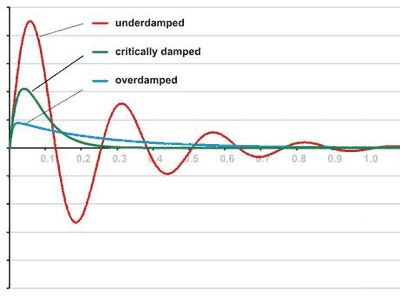
The less the tail has to do the better for efficiency. Bruce do you recall, for those gliders when set at the "design aft-limit" , in response to a impulse pitch input (up or down step), in terms of dynamic pitch stability, were they over damped (return very slowly to original attitude) or underdamped (borderline unstable probably aft CG for that airspeed/loading) IE entered an oscillatory condition like a car spring without a damper ) or somewhere in between ?
-
Optimum CG • discussion on 'Pilots of America' forum
RFguy replied to Garfly's topic in AUS/NZ General Discussion
It's interesting to examine NORMAL or UTILITY category aft (and fore) CG limits if provided. Nev you are right an inch on a sailplane is (generally) alot less (% MAC) than an inch on a short empanage powered fixedwing. Bruce, is the fastest way down in a Libelle to induce a nose down spin ? -
Leighton Beach WA light aircraft ditched 20.04.2023
RFguy replied to trailer's topic in Aircraft Incidents and Accidents
I dont think it stalled at all, looks like a perfect flare and land on the ocean, with enough energy / airspeed to get a GOOD flare (lots of tail authority) -
Anyone using automotive cable for their starter motors?
RFguy replied to danny_galaga's topic in Engines and Props
Maybe, except there are many variations on crimp connectors- many crimp lugs require to get pinned from underneath- one side is a hemisphere (sortof) and the other side a square pin push Depends if you are trying to get a swaged joint, etc - many variations. Before substituting a makeshift die, try and get a look at the real tool. -
On fuel bulk storage, getting clean fuel and so on.
RFguy replied to old man emu's topic in AUS/NZ General Discussion
do that. The twin filter Mr Funnel I have will keep up with a 20 litre jerry being poured in at max rate... Ideally, you need to fashion a collar for it to sit on- stops it falling over slightly, I use a I think 50mm long , 6" diameter bit of poly pipe with a antyi-scratch bead of edging on the bottom. . the collar becomes necessary as the things starts to slosh around when the pour rate is high -
On fuel bulk storage, getting clean fuel and so on.
RFguy replied to old man emu's topic in AUS/NZ General Discussion
Low speeds is bad and hard on the gearbox and everything, Rotax specifically recommend minimum time at low RPM. Probably depends of you have fuel that is likely to varnish up, or evap (ethanol etc) in the bowls, or not, to whether you want to starve the bowls dry on shutdown me thinks. Mr Funnel comment- buy the one with dual filters- otherwise it will not keep up with a 20 litre jerry pour. -
But not too many of them (rotax) stop. The failures of the ignition modules though was a real FU by Rotax and shows where they are good, and where they are not. Stacking two ignition modules hard on top of eachother in an area of high temperature was just asking for trouble. A 10mm gap between them would have ensured cooling. In my opinion, electronics is an area NOT to trust Rotax due to their demonstrated incompetance. However, they have demonstrated competance (to me) with the hard to get right stuff like pistons, heads, cooling, gearbox. The inlet manifold is a bit of a compromise (mixture variance front and rear at low gas velocities ) but its bearable. The dual carb is fiddly but acceptable.
-
E-Props ...who has first hand experience with these
RFguy replied to eightyknots's topic in Engines and Props
cant compare unless airspeed /efficiency is in the picture. I went four blade for rotax because of superior takeoff performance- more blades, less blade loading per blade and not as far into 'stall' if you like , IE AoA per blade lower , ---at low airspeeds much less than the screw speed. Exact performance will depend a bit at what drag you end up with and IE what RPM your end up with. Little / no penalty for 4 versus 2 blades with the Eprop at cruise speed. That's the advantage I like. AND Eprop will get you all this data... -
Anyone using automotive cable for their starter motors?
RFguy replied to danny_galaga's topic in Engines and Props
CRIMP, for sure. soldering creates a brittle, heat treated joint. Suggest as high strand count as you can get. Now, as for wire : and, may I quote AC43 : There is no need to speculate. AC43.13-1B , https://www.faa.gov/documentlibrary/media/advisory_circular/ac_43.13-1b_w-chg1.pdf CHAPTER 11 - AIRCRAFT ELECTRICAL SYSTEMS Section 6 : Aircraft Electrical Wire Selection. Section 14 : Terminal Repairs. 11-174 General 11-178 Crimp on Terminal Lugs I strongly suggest users modify and maintain their LSA airplane electrics to AC43.13. There is about 20 good pages to read between Section 6 and Section 17. That been said, I'd suggest a high strand count cable with insulation good for fire temps, and appropriate crimp lugs for that cable, and a suitable crimp tool , or fashioned die in a vice to generate the impression. -
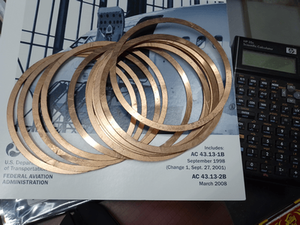
Well the #6 telltale will likely be recession., that's the hottest spot.... Do check that the rockers slide left right at TDC. exactly how much spare clearance you have depends on WHICH lengthof push rod Jabiru gave you. they vary.... most of the original Gen3 were too long and then went down a couple of mm ! (and didnt tell anyone and the manual has errors) eventually, you'll need to remove the heads , milled down say 0.9mm from the non recessed area so you get a nice flat surface again, and then drop in a 0.9mm shim. like below :
-
I mean WHICH screws out of the 6 moved ? I cant beleive that is Jabiru's advice as it is bollocks in IMO if that is so. Problem is dynamic version static friction influencing torque. Hence the reason to back them off to they are moving when you are measuring torque. Otherwise resultant tension could be out by perhaps 2:1... as you are overcoming static friction, corrosion etc etc lots of errors.
-
if you are employed as a contractor, that's the big bucks
-
were the head screws adjust backed off half a turn CCW , then CW again ? or just from where it was at ? Which head screws exactly ? with hydra lifters. the only way you will really know the 'lash' is to have them bled down. However, another the way that is useful, at TDC, you should be able to wiggle the rockers back and forth left to right on the valve head. No vertical up down (opening) movement will usually be detectable IE NO play---, but you can feel whether there is heaps of pressure or little pressure ('rest pressure') by pulling the rockers each way on the valve heads. (Mark Dunstone is credited with that one) . I used a little thread gunk to stop the cover screws unwinding... I prefer screws than clips. Leakdowns sound good.
-
Flight optimisation by altitude and vectors
RFguy replied to Ian's topic in Aircraft General Discussion
Now that's a cool idea Ian. No doubt the airlines have something like that. Years ago one would write a fancy algorithm. Now you might just compute all options (IE in 100' and 3 deg track steps) and present the user with the best three to evaluate. I assume the published GPWT charts could be obtained as a data matrix. -glen -
Sky echo 2, transponders, Hex code, AvPlan….
RFguy replied to Mike Gearon's topic in Instruments, Radios and Electronics
Suction cup seems to work fine in the Jabiru and covers a day or few. As for range measurement : Yeah, my seemingly laborious proceedure to measure Skyecho range - well, you guys know what I do for a living, I have to put my c0ck on the block , and I need to be able to stand behind my numbers... hence the methodology. One man's overkill is another man's freedom from court challenge. -
Garfly, writing time related code is easy. we all write for UTC with offsets, or number of nano seconds since 1st of January 1980, and a few other derivatives HOWEVER what is difficult is dealing with changes of time in and out of daylight saving, as skipping time might skip important scheduled events, or the other way, might run them twice.
-
Sky echo 2, transponders, Hex code, AvPlan….
RFguy replied to Mike Gearon's topic in Instruments, Radios and Electronics
@O-K - that is real world testing with reduced ambiguities.... What you first described was essentially random point testing. The result will essentially be meaningless. You need alot of testing to get data you could talk about. probably 100x the data , compared with my method which seeks to reduce the uncertainty . You cant get signal strength from the system so you'll need to move the system performance intoa region where you can measure signal strength by means of works OR does not work. That's the reason to get distance. Once you are at distance , say > 13nm, you can fly in a circle around a point on the ground without changing the range more than 10%. By flying circles you can map the directivity of your airplane / skyecho combination. Then by doing some rotation of the fixed device at the 'base' you can assess the degree of directivity by the device without the airplane around it... AFter rotating the fixed device, you might need to go further away or come closer to get on the threshold again.... Well there are other ways, but that's how I'd do it with a pair of Skyechos and nothing else. Now if I were doing it, I'd get the plane to go out into the apron, and set up my test gear , and just read the signal coming back from the airplane as it was rotated 360deg like a compass swing test..... You can do this with a $30 ebay RTL-SDR receiver and a laptop... -
Sky echo 2, transponders, Hex code, AvPlan….
RFguy replied to Mike Gearon's topic in Instruments, Radios and Electronics
experimenting with another (airborne) aircraft will simply multiply the two uncertainties from the two aircraft. You'd be better to park the 2nd aircraft , or set up the SkyEcho on a tripod, with tablet sitting on a seat underneath, and fly the 1st plane (device under test) in some direction (get some altitude to maintain line of site ) and once on station 10 to 15nm, where the pickups are becoming marginal, execute a shallow 15 deg max turn 360 deg and note the pickup variation with test aircraft heading. repeat 3 times to generate trend. Rotate test receiver 90 or 180 deg and do it again. -
Sky echo 2, transponders, Hex code, AvPlan….
RFguy replied to Mike Gearon's topic in Instruments, Radios and Electronics
not really. unless was mounted where it was heavily shielded/ obstructed- IE say, on the back of the stator. If the skyecho is mounted at least the distance behind the engine of the maximum dimension of the engine, it wont have much effect. -
Sky echo 2, transponders, Hex code, AvPlan….
RFguy replied to Mike Gearon's topic in Instruments, Radios and Electronics
they're a little directional, but up to 10nm shouldnt matter too much. not affected reliably measurably by poly screen plywood etc. and not even metal struts and thin members, since the RF tends to re radiate off those items. -
(frivolous) I want to see "NSW" cut into two states, north NSW and south NSW . IE cut NSW east-west at Hervey Bay. OME can you put a line in for that please, also on your new Australia map. I think the existing queensland border is in the wrong place.
-
I'd agree. Although, the lack of inertia I reckon could catch some GAers by surprise.....But goes the other way, RAA-GA, I think that slow response time of the aircraft could catch some out. ALthough those two aspects are an advantage for certain recovery phases I think. Compared to the Piper, the big Jabiru is like a sports car. Probably landing phase most different. My take on it - RAA aircraft speed changes are much faster (due to lower inertia) - whether that is running out of speed in a flare or pitching up the aircraft in flight..... and, while GA landing ----while speed decays more slowly, the aircraft is much slower to respond to a recovery from baulked landing due to lack of power and all that weight. Takes time to change the situation compared to the big Jab which will recover/respond to a baulked landing almost instantly. Turning airspeed into altitude in case of engine failure is more effective in the heavier plane, certainly (inertia). A plane is a plane.
-
3rd April 2023 Proserpine light aircraft crash.
RFguy replied to trailer's topic in Aircraft Incidents and Accidents
Best to do some Instrument flying training. I think that S&L and Rate 1 turns can be effectively taught in a hour of work if the right clouds are abound. I mean clouds, not under the hood. real cloud time is priceless. and a little bit of a situation/serious reality brain state goes a long way for future flying. A good simulator seems pretty good to maintain those basic , IMC back into VFR skills , recency recency recency ! flying the aircraft from the 6 pack scan needs to be inate. I am a firm beleiver this should be part of basic syllabus for the XC rating of a PC/RPL/PPL (but requires an IR aircraft) as----If that is your first 180deg turn in IMC, I'd put real money on it that you will put it into a spiral dive, and if you are lucky, you will fall out of the bottom of the cloud before Vne ensues or your run out of altitude... yeah yeah dont go near clouds ? I dont buy it. I have been flying around the western edge of the tablelands in what looks like benign weather (FEW) suddenly to be surrounded by puffy cumulus that seems to appear out of nowhere and become BKN and in cloud. The real cloud time (IE you are looked into the white) instead of under the hood drives home just how wrong your perception and brain can be in a white out !!!