

Admin
-
Posts
9,322 -
Joined
-
Last visited
-
Days Won
110
Content Type
Profiles
Forums
Gallery
Downloads
Blogs
Events
Store
Aircraft
Resources
Tutorials
Articles
Classifieds
Movies
Books
Community Map
Quizzes
Videos Directory
Posts posted by Admin
-
-
From the Director of Aviation Safety
John McCormick
CASA has set itself three clear goals for the next three years. They are: comprehensive, consistent and effective regulation to enhance aviation safety; good governance and continuous improvement of organisational efficiency; and effective and appropriate relationships with the wider aviation community. These goals, which are set out in CASA’s latest Corporate Plan, will underpin all our activities and the positive changes we are making to achieve higher levels of aviation safety. In practical terms there will be a range of activities undertaken to make sure we meet our three goals. One key area will be improvements to our surveillance processes, primarily through the introduction of a new information technology platform and an associated surveillance manual. Planned information technology changes will also improve efficiency in areas such as people and performance and financial management. We will continue to build the skills of CASA’s staff through training and support and work to improve standardisation, consistency and efficiency in all areas. Importantly, there will be a focus on the effective delivery of regulatory services to the growing aviation industry. In the area of regulatory reform we will be planning for the delivery of the new suite of operational regulations which are scheduled to be introduced in the coming years.
Our latest Corporate Plan identifies seven challenges within the Australian aviation system which CASA will respond to over the next three years. They are the growth of low fare carriers, substantial growth in air traffic, innovations in technology, growth in amateur built aircraft, ageing aircraft, a potential shortage of safety critical personnel and the implementation of new regulations. In each area CASA is developing responses to the challenges that will ensure safety standards are maintained and enhanced. Central to meeting a number of the challenges will be using CASA’s resources to conduct risk-based surveillance, particularly in the passenger carrying sectors.
Overall, I believe the Corporate Plan demonstrates CASA is firmly established as a highly competent and effective regulator, with an internal structure fully aligned with the Civil Aviation Act. I encourage everyone to read our latest Corporate Plan.
Best regards
John F McCormick
Comment now on ageing aircraft proposals
The aviation industry is being urged to comment on a series of proposals to address important safety issues arising from Australia’s ageing aircraft fleet. CASA has issued a discussion paper which recommends a number of initiatives as a proactive response to ageing aircraft issues. These are further development of a matrix tool to allow aircraft owners to more accurately establish if their aircraft may be suffering negative effects from ageing, promotion of e-learning to improve the knowledge of registered operators and encouraging aircraft type clubs to allow people to share ageing aircraft knowledge and experience. The discussion paper seeks to encourage the voluntary uptake of these initiatives by people in the aviation industry. It warns the average age of the Australian piston engine aircraft fleet is 40 years and rising, with the majority of these aircraft not envisaged to be operated for this length of time when they were manufactured. The paper goes on to say "negative safety outcomes may be anticipated if current maintenance activities are not adapted to take into account the ageing aircraft process in these aircraft".
The discussion paper provides a link and login instructions for the prototype of the ageing aircraft matrix tool. Aircraft owners are encouraged to use the tool to estimate the extent to which an individual aircraft may be susceptible to ageing issues. By inputting into the tool the operational, maintenance and storage details of individual aircraft, owners will receive an indication of how likely it is that their aircraft may be affected by the ageing process. The prototype matrix tool is intended as an educational guide only. At this stage, the prototype version can provide only generalised feedback to the user and the prototype should not be relied on to make significant maintenance decisions.
Read the ageing aircraft discussion paper and have your say before 7 November 2012.
Use the ageing aircraft matrix tool – login instructions are on page 10 of the discussion paper.
Attention pilots and operators: flight plans are changing
Important changes to flight plans come into effect on 15 November 2012. On that date there will be changes to the flight notification form and flight planning procedures. These changes will affect all pilots and operators who file flight plans, as well as Airservices Australia. The changes are being made due to Amendment 1 to the International Civil Aviation Organization PANS-ATM Doc 4444. The purpose of this amendment is to allow automated air traffic management systems to capture new aircraft technologies and capabilities associated with performance based navigation, communication and surveillance. Pilots and operators need to be aware of the new flight planning form, the changes to the descriptors used in the various equipment fields and the requirements to submit certain performance based navigation data to substantiate authorised use of indicated equipment capabilities. Major operators will need to have systems that submit flight plans in the new format, with the new identifiers and information. Smaller operators can use the flight planning capability on the Airservices Australia website, which will be updated to the correct format by 15 November. Airservices is providing detailed information through Aeronautical Information Circulars and Aeronautical Information Publication supplements, as well as updates on their web site.
Flight plans will need to be filed in the new amendment 1 format from 15 November 2012. After this date, the air traffic management system will not accept flight plans in the present format. To prepare for flight planning in the new format please read the flight notification form and flight planning guidance notes, which are in the 15 November 2012 Aeronautical Information Publication amendment.
For more information, visit the International Civil Aviation Organization flight plan 2012 section on the Airservices website or email: [email protected].
Three new aerodromes are OnTrack
Three new aerodromes have been added to the popular and valuable online pilot education tool OnTrack. Pilots can use OnTrack to learn about flying procedures at Darwin, Alice Springs and the Sunshine Coast. This means OnTrack now covers 12 aerodromes across the nation. The tool, which is accessed via CASA’s web site, provides a wealth of information on procedures and safety issues at each location. It uses maps, photographs and video to show inbound and outbound tracks at each aerodrome. There is text to explain how the tracks should be flown, with information on radio frequencies and altitudes at specific points. Moving maps allow pilots to ‘fly’ the tracks from their desktop and identify all the local operational and safety issues. Importantly, there is information on so called violations of controlled airspace hotspots, with practical tips on how to avoid violations. OnTrack also includes information on class D procedures and military procedures.
Go to OnTrack now.
Call for better helicopter safety outcomes
Australia's helicopter industry has been urged to grasp the opportunity to face current safety and operational challenges. CASA’s Director of Aviation Safety, John McCormick, told a recent helicopter forum that both unprecedented expansion of the sector and forthcoming regulatory change posed a number of challenges. Mr McCormick said the helicopter industry and CASA should cooperatively lay the foundations for the achievement of better safety outcomes. He said: "Helicopters are a key element in the development of Australia and have served our community well. If you think in broad scope, there is not a sphere of life that is not touched by this sector. At present helicopters make up 13 per cent of the approximately 14,800 aircraft on the CASA aircraft register. Helicopter numbers have almost doubled in ten years in Australia – from 1,034 in 2002 to 1,975 in mid-August 2012 – and they are likely to double again, in perhaps as early as seven years as a result of the accelerating rate of growth generated by the demands from Asia for Australia’s energy and mineral resources. Further, there is 21 per cent annual growth of the twin-engine fleet, which is nearly three times more than the annual growth rate of the single-engine fleet, which is 8 per cent."
Mr McCormick said the helicopter industry needed to be mindful that the accident rate in helicopters engaged in any type of operation is higher than that for aeroplanes performing the same type of operation. "This ranges from 1.2 times more accidents in aerial work, up to 2.5 times more in flying training. Overall, even though they account for only 13 per cent of the Australian civil fleet, helicopters were involved in about 36 per cent of all accidents in general aviation in the last ten years—and 47 per cent of all fatal accidents. The evidence shows private flying is the most risky, for both aeroplanes and helicopters, followed by flying training, aerial work and charter. It’s a fact, unfortunately, that helicopters have distinctly higher fatal accident rates in most categories."
Read the Director's helicopter speech.
Increases in mandatory insurance levels
Air operators should consider reviewing their insurance policies following the introduction of legislation which changes the insurance and liability framework. The Aviation Legislation Amendment (Liability and Insurance) Bill 2012 amends the amount of compensation payable to air accident victims on domestic flights, updating the Civil Aviation (Carriers' Liability) Act 1959 (the ‘CACL Act’) and the Damage by Aircraft Act 1999 (the ‘DBA Act’). The Bill increases the outdated carriers’ liability cap for domestic passenger carrying operations from $500,000 to $725,000 per passenger. The level of mandatory air carrier insurance is similarly increasing. Several technical changes to the way liability is determined for aircraft accidents, as well as provisions covering contributory negligence and a right of contribution, are also included in the amendments. It is expected that the new laws will become operational in early 2013. Once operational, all passenger carrying operations will need to be covered by insurance policies that reflect the increased limits.
Please contact the Trade and Aviation Market Policy section, Federal Department of Infrastructure and Transport, on 02 6274 7111 if you have any queries about these amendments.
Sydney airspace study underway
A study of the airspace within 45 nautical miles of Sydney’s Kingsford-Smith Airport has begun. This is part of routine work undertaken by CASA’s Office of Airspace Regulation, with the objective being to ensure appropriate airspace arrangements are in place. The study will look at a projected forecast period of five years to evaluate airspace arrangements within the area being reviewed. It will also include an analysis of the integration of Class D aerodromes - Bankstown and Camden - into the current airspace architecture. There will be consideration of changed aerodrome and airspace use at Richmond, including the potential introduction of civil aircraft, and turbo prop and jet passenger transport operations at Bankstown. The study will not look at airport and surrounding infrastructure which is not applicable to the objectives of the study or at discussions regarding a second airport option at Badgerys Creek and Wilton, as any development would be outside of the study’s timeframe of five years. In addition the study will not examine the Sydney airport long term operating plan and noise sharing arrangements, lifting of the movement cap and any off-airport development. The Office of Airspace Regulation will be contacting stakeholders in coming months as part of the consultation phase of the study. Stakeholders are encouraged to share their experiences and assessments of the current airspace arrangements. Should the study identify risks that can be mitigated by changes to airspace design, classification or designation then a determination will be made.
For more information or to ask questions about the Sydney airspace study please contact Matt Stein. [email protected] or phone 02 6217 1052.
Cessna 177 crack warning
Operators and maintainers of Cessna 177 series aeroplanes have been alerted to the possibility of cracking in key components in the stabilator. In an airworthiness bulletin CASA warns a failure of the components could lead to a loss of control of an aircraft. The problem is cracking in the aluminium stabilator balance weight arm brackets. CASA has received a recent defect report of cracking in four aluminium stabilator balance weight attachment brackets. The issue was identified by Cessna more than 20 years ago, with a number of service bulletins released. These service bulletins called for crack inspections after 2000 hours flight time, as well as continuing inspections every 12 months or 200 flight hours until the aluminium brackets were replaced with new steel brackets. Inspections require the stabilator to be removed from the aircraft and the balance arm to be unbolted. The right and left hand brackets are then visually inspected and if no cracks are found an eddy current inspection is required to identify any emerging cracks. Any cracked brackets must be discarded. CASA’s new airworthiness bulletin recommends these procedures be followed and that owners and operators consider replacing aluminium brackets with steel brackets.
Read the Cessna 177 stabilator airworthiness bulletin.
New processes for air operator’s certificates
Changes are being made to the CASA approval processes for air operator’s certificates. There is a new suite of air operator’s certificate manuals, revised forms and a centralised processing centre for applications. The changes are being introduced from 1 October 2012. The air operator’s certificate manual suite is made up of a process manual, handbooks and forms. In the process manual there is a national standard procedure set out for processing applications for the initial issue of air operator’s certificates, as well as variations, renewals and cancellations. It sets out clear work steps for applicants and CASA’s staff. The four handbooks provide more information on the requirements an applicant must meet when applying for an air operator’s certificate and clearly outline the criteria and methods CASA uses when assessing applications. These handbooks cover general issues, flying operations, airworthiness and specialist areas such as dangerous goods, drug and alcohol management, ground operations and cabin safety. Many of the forms needed for air operator’s certificates have been amended to align with the new handbooks. All applications for the initial issue, variations or renewals of an air operator’s certificate must now be made through CASA’s Permissions Application Centre.
Find out all the detail of changes to air operator’s certificate processes.
Finding unmanned aircraft operators is now easy
There are currently 19 aviation organisations with approval from CASA to operate unmanned aircraft systems in Australia. These organisations are now listed on CASA’s web site, along with an outline of their operations. The web site listing includes the company name, location and type of services provided. Unmanned aircraft systems are currently approved to provide services such as aerial photography, aerial surveys, power line inspections, aerial advertising and aerial spotting. Several organisations also have approval for type conversion training. The approved unmanned aerial systems operators are located in capital cities including Sydney, Melbourne, Brisbane, Adelaide and Perth, as well as a number of regional centres. All remotely piloted aircraft operated for aerial work purposes, including commercial operations, must hold an approval from CASA. Currently these operations are limited to line-of-sight in visual meteorological conditions below 400 feet above ground level over unpopulated areas. Flights cannot be conducted in controlled airspace. With improving technology it is likely aerial work operations of remotely piloted aircraft will be possible beyond visual line-of-sight in all classes of airspace by about 2017.
Find the list of approved unmanned aerial vehicle operators.
We have forums and seminars for pilots
It’s the turn of Perth pilots to get along to a special aviation information forum being run jointly by CASA, Airservices Australia, the Australian Transport Safety Bureau, the Bureau of Meteorology and the RAAF. An information forum is being held on Wednesday 3 October 2012 at the Royal Aero Club of Western Australia at Jandakot aerodrome. The forum is open to all pilots and everyone will benefit from attending. The safety education forum is a chance to access a wide range of important information across a number of topics, with a special focus on human factors issues. The all day event feature presentations from each aviation body involved and a light lunch and refreshments will be provided. There is no charge and the event is open to everyone involved in aviation.
Please book your place for the Perth forum now.
During October 2012 there will also be ten AvSafety seminars for pilots. These seminars are being held in NSW, Queensland and Victoria. Topics to be covered at each location include human factors in aviation and aviation resources on the internet. CASA wants all pilots to attend an AvSafety seminar in their area as it is a great chance to learn, discuss safety with colleagues and talk with CASA's aviation safety advisers. The seminars are free but everyone is asked to book online at the CASA web site.
Find an AvSafety seminar in your area and book now.
-
Hi All
Blogs are returning...that's right, a feature that will allow you to create and manage your own Blog where you can create entries on what ever you would like and other members can comment on them.
You can create a Blog recording each step you take through your training, a brain dump on your thoughts about aviation, building your aircraft, your personal experiences in aviation and flying...just about anything that you want.
The development of Stage 1 is complete and here are some screen shots:

All that is left for me to do is copy across all the blogs and entries from the old software that we use to use. That is on the agenda for tomorrow and then copy it all across to this "Live" site for you to start using.
Stage 2 will come in a couple of months time which will include extra enhancements to make it a full featured blogging platform for you.
So look out for the Recreational Flying User Blogs, coming very soon!
(Paid for by Recreational Flying First Class Members)
-
I haven't looked up the differences and only going by what I had heard...all the promotion was on a medical like a car license so I am obviously not up with the finer detail of it...sorry
-
Personally I think all this CASA fear is built up into something that it is not...perhaps from the "regulated" GA style of flying. The only difference I see between the two is with RAA you have less training due to non-controlled airspace, no medical at all and you can do your own maintenance. If CASA was to take over:
- the medical is nothing with just a local doc sign off...you should be seeing your loc doc at least once a year for a check up anyway
- the uproar would be so great that CASA would have to keep the 10hr min training (for non-controlled airspace) and the owner maintenance
That is all, that I can think of, is the difference, so really there wouldn't be that much "real" difference and you have no registration and licensing fees, still have the option if you want to go further, of CTA with PPL...BUT, if CASA didn't continue the min hrs and maintenance then that would be a different story as these are the only 2 "real" benefits of RAA but you pay for it in cash
-
 2
2
-
-
I have last Friday made an offer to RAAus that once Runciman, Tizzard, Middleton and Reid are no longer on the board, representative(s) of this web site are willing to sit down with the RAAus board and see how we can work together for the betterment of the recreational aviation industry. Failing this, it is possible that we may be able to look at ways in working with other more professionally run governing bodies. I believe there could be 3 entities out there looking at providing the same services as RAAus and more.
-
2
-
-
It was a Trike...hope they bounce back very quickly
http://www.recreationalflying.com/threads/two-hurt-in-ultra-light-crash-mackay-daily-mercury.47726/
-
Many of them have not been on the site for some time plus there are some great usernames that new or existing members may wish to use.
-
I believe the same people have today been returned to the same positions in the Executive:
Runciman (President)
Middleton (Secretary)
Reid (Treasurer)
-
Hi All
A recent ping (check) of user's email addresses has shown a couple of hundred users have incorrect email addresses in their settings.
This causes great grief in that when the system tries to email you for example an update to a thread or an email notification that someone wants to have a conversation with you, the emails bounce back and end up in my inbox.
So can I ask that you check your email address in your site settings that it is your correct and current one for you. I will then start to go through the system and clean out the user registrations with incorrect email addresses which will also free up some more, and maybe in demand, user names for users to have.
Thanks!
PS, the system has also reported several users with more then 1 registration (username) on the site...those that have can you please advise me by Private Conversation of which one you prefer to keep so it will save any problems as I will only delete one of them (and not both) and keep the one you do want...thanks
-
Hi All
As you know we have an account Upgrade from a standard user to a "First Class Member". This account Upgrade provides those that wish to, have extra features plus a Gold User Name to indicate to others that they are supporting this site and what it offers everyone. This First Class Member Upgrade is given for a 12 month period to anyone that supports the site by donating $50 (or more) towards the site costs and upkeep and to which we are so very grateful for.
One problem we have had with the First Class Member Upgrade is that unlike the old software that we use to use, this software doesn't send out any type of reminder that the First Class Membership is coming to a close. An "addon" has now been added to the site for an email to be sent out 3 days prior to the expiry of the First Class Membership status.
So to the current First Class Members, to whom we owe so much to by their assistance towards keeping this site "alive", please note this change and again I say thanks for your support.
-
And look what happened to poor old Capt who got "attacked" (only word I can think of) in front of hundreds of people at the meeting at NatFly by the then President Eugene Reid, who I believe was set up by Steve Tizzard, in being told he wasn't an RAAus member and was not allowed at the meeting...Cap't then had to prove by displaying his membership card that he was in fact a memberThere was definitely no checking to see if only financial members were present or voting. -
I can also report that I believe Steve Runciman has also now lied to the Members on at least one of his answers to the questions that were put to him which will come out in discovery of further legal action against him and RAAus...it seems to be just getting worst and worst...what makes them think that they are the absolute best and greatest people on this earth that are the only people capable of being on the RAAus board, so much so that they can't put the betterment of RAAus above everything else and resign given that there is so much outcry over everything they are doing...how can these people be so blind to what has been presented to them not only yesterday at the AGM but the long running dissidence of the members which is getting stronger and stronger, and all those that are coming out against them...this in itself is a true indicator that they are not fit to hold such a position in my opinion, nor do they have the decency to listen and say "OK, I am hearing you, I will put RAAus first and foremost, above all else, above my own personal agendas of seeking greatness and glory, so let's work at getting some better people in to replace me to get RAAus to the greatest it can possibly be".
-
Hi All
I have just heard that ALL of the Constitutional Changes put forward at the 2012 RAAus AGM have been accepted and passed.
-
6
-
-
Besides, wouldn't it be illegal for your "mate" to let you touch the controls unless your "mate" is an instructor?
-
I like the rocky take off...hope the aircraft have strong undercarriage:
-
That will always be the problem with such a small sample number. It is also one of the things that I dislike about polls on here, with so many registered users logging in each day, and only registered users can vote in a poll, that so little do bother to vote...it is simply a click of a button, there is nothing strenuous about it yet it makes for some great topics of conversation and the intent was for some great indicators...I have had to do a lot in the behind the scenes aspects of the site and its code to allow for polls so perhaps it may be better to make the site cleaner in its default code and remove the polls feature, if the interest isn't going to be there...besides I rattle my brain every Monday morning trying to come up with some kind of an interesting poll each week whilst I could be doing other things...so, perhaps we have a poll asking if polls are worth it and if we don't get at least 350 votes (5% of registered users) for either choice then we remove them, and save the effort as nothing can be gained from them..
-
Tubz, the figure you quoted of 0.15% is not on the whole membership as to get that figure you have not extrapolated the percentage figure of a "sample" up to the "total". Again the 0.8% has not been achieved by extrapolating both sides of the figure (both the denominator and the numerator) up to obtain a figure...so sorry Tubz, but I have to completely disagree with you on your figures
-
-
The issue, which would need to be confirmed, is that only members are allowed at an AGM and a recording can not be guaranteed that only members would later have access to it (as I said, would need to be confirmed)
-
I believe congratulations are also in order for you Wayne???
-
Cap't, not sure if David is currently available due to his daughter's wedding but "off the record" I have heard that Runciman has been drafting answers to the questions...but not sure what we will hear first, from David or the results of the AGM.
-
The results of this Poll are very interesting because to me, I see it it as a "health" measure of our industry.
It seems:
Overall 2/3rds prefer a single body compared to 1/3 for 2 bodies
3 Axis only, the split is 2 to 1...this means that 2 out of every 3 people prefer to have one body yet 1 out of every 3 people prefer to have 2 bodies
My interpretation of this is more people are upset with RAAus then other components of the recreational aviation industry and with it being at 2 to 1, it is at a very dangerous satisfaction level of RAAus. To me it seems the RAAus MUST fix the current issues that are currently effecting them, including a complete restructure, management style and outlook or else the door will be widely open for another competing 3 Axis body to "come out"...it could be an existing body like HGFA or SAAA, or perhaps a whole new start up governing body venture bringing a fresh new outlook of recreational flying for the members and the industry.
The next 12 months is certainly going to be an interesting time and I can't help but wonder why, how and who has caused this situation that has, in my opinion, evolved over the last 2 years.
-
We have seen many many many grounding of aircraft this year due to failures by the CEO (Tizzard)/President (Runciman) regime to competently manage the operations of RAAus, it is a sorry and very frequent state of affairs and now the Ibis has been grounded.
I really feel for the owners of these aircraft in being prevented from flying due to these management failures however, at least it will just be time that they are grounded and eventually they will be allowed to fly again once everything is sorted.
I must follow up on all the groundings of other aircraft that were also grounded this year e.g. Super Petrel, to see if they are all back in the air again...anyone have any news on all the others
-
It use to be 150kb but I increased the limit to 256kb about a year ago. A resizing function has been added to the site plus a better image processing library used then the default.
Here is a screen shot of the Attachment settings:
BUT, please remember to always try and use thumbnails where possible so it doesn't drain yours and other users resources especially if they keep coming back to the same thread to see extra posts that have been made after the ones that have attachments included in them...not to mention the havoc that non-thumbnail images cause when clicking on a thread and the software tries to take you to the first unread post
(oops, looking at the screen shot it seems I have missed the xlsx, ppt and pptx extensions...will add now)
.jpg.dc8596641a1cdea057857b684419334d.jpg)
.jpg.676854129a5ad300ebbb8c494bd234cf.jpg)
.jpg.7d39cc67bd20644119b519223ee13c1b.jpg)
.jpg.5f0b9a4d3eb082b984728e063cdcd1b2.jpg)
.jpg.cec91b4115dcf63d3fafe5dd1be8c67a.jpg)
 Well done guys.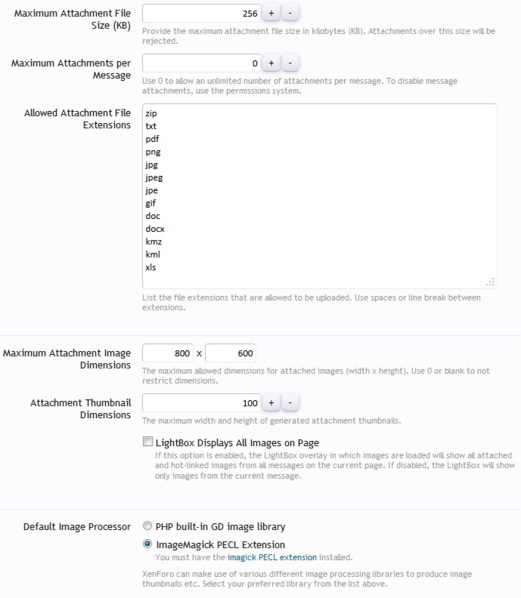
CAAP 50A/B-1(0) – Aircraft Log Books and Alternate to Aircraft Log Books
in Governing Bodies
Posted
CASA wishes to advise that Civil Aviation Advisory Publication – CAAP 50A/B-1(0) – Aircraft Log Books and Alternate to Aircraft Log Books has been published.
A full list of Final Civil Aviation Advisory Publications can be found on the CASA website: http://casa.gov.au/scripts/nc.dll?WCMS:STANDARD::pc=PC_91054