

Dafydd Llewellyn
-
Posts
1,513 -
Joined
-
Last visited
-
Days Won
43
Content Type
Profiles
Forums
Gallery
Downloads
Blogs
Events
Store
Aircraft
Resources
Tutorials
Articles
Classifieds
Movies
Books
Community Map
Quizzes
Videos Directory
Posts posted by Dafydd Llewellyn
-
-
there's a distribution block between the carbs that also has a restricted outlet for a fuel return to the tanks, it seems to be a later 912 thing as I don't think the early installs had itMatty
OK, I deduce from that that the fuel supply from the tank passes via the electric pump and the gascolator, to the engine-driven pump, and thence to the distributor block, from whence a supply line goes to each carburettor plus a restricted outlet for the return line? If that's the case, it is a form of vapour-purge system to prevent vapour-lock - and I would think that it should return to the fuel tank. GA aircraft using injected Continental engines have a similar system; on things like Beech 23s, it goes to one main tank, so you must remember to use that tank first, or fuel will be pumped overboard. On more expensive aircraft, there is a second stage in the main fuel tank selector that routes the return fuel to whichever tank is in use. If you return it to the gascolator, you risk total vapour lock.The proper Rotax item is a 4 way block with one input and three outputs. Two of the outputs go to the carbs and the third output has a restricter nozzle in it and it is plumbed back to the fuel tank. On my airplane, I did this by having two T units. The first T has the restricter (a carby jet) threaded into the base leg and the fuel from the pump goes into one side of the top of the T. The other side of the top of the T is the outlet to the next T that splits the fuel flow to the carbys.The restricter outlet should be at or as near as possible to the highest point in the fuel delivery lines so that any bubbles will rise to that point and be routed back to the fuel tank. In my system, I didn't bother firesleeving the return line. I also put standoffs between the lines that go to the carbys and the intake manifolds. When the engine is shut down after a run, the manifolds get hot enough to burn your hand on and easily hot enough to vapourise petrol.-
 1
1
-
-
Please pardon my curiosity; you seem to be talking about something I'm quite unfamiliar with. Precisely where on the engine does the return line start? What is it returning fuel from?I've run the return line back to the collector tank in my aircraft, so far works okay , I do know a lot of older installations don't have a return line. The early Skyfox didn't have them , not sure about the gazelles.Matty -
Sometimes used, loosely. You have to evaluate it against the context, in that case.Thanks for the feedback... however I need to deal with the wording of AUW as this is the term used in the piece I'm working on. Additionally the AIP does makes mention of AUW a couple of times which, to some extent, locks it into aviation terminology, albeit without a definition.RegardsVev
-
Indeed it does - provided you have sufficient power. Don't try it in a PA 28-140 on a hot day at full load, though.My theory studies became very practical one day when I faced a row of pine trees at low level and the nose wouldn't come up any higher than about half way (100 kt cruise at zero flaps). Fortunately in the BAK course a few of us did together the instructor made it very simple - "Full flap = greatest climb angle at slowest forward speed"Through that I was able to climb over the pines.
One stage of flap on takeoff gives you a higher departure angle on takeoff than no flap, and one day will come in handy and allow you to say SH$T!!! as a powerline slips underneath you just off the runway end.
-
 1
1
-
1
-
-
Oh well, in for a penny...OK, thanks FH, so what you're saying is that since climb (any climb at all - rate or angle doesn't matter) is purely a factor of power in excess of that required to maintain height, then the total power available reduces as DA increases, and so the excess power available also reduces as DA increases. Therefore, as DA increases, we run out of of excess power available at some stage? If that's Ok so far, then since the plane requires a bit more power to maintain height (or rather, fly straight and level) with any flap at all, than it does without any flap (because there is a bit more drag with any flap extension), it would run out of excess power sooner (i.e. at a lower DA) with some flap, than without any flap.OK, I can see that but we haven't factored in the wing performance issues and the 'cleanness' of the airframe. A little flap gives a relatively large increase in lift compared with the small amount of induced drag increase, and that allows the plane to fly slower than it would without the flap. So whilst the induced drag might be marginally higher, the parasitic drag at that lower speed is likely to be lower by more than the increase in induced drag because parasitic drag is a square function of speed and induced drag is linear with lift increase.This is why I don't think the recommendations for jet aircraft operations should be applied to our kind of aircraft. Jet aircraft are so clean that their parasitic drag is very small compared with their induced drag whereas our aircraft have exactly the opposite drag characteristics, parasitic being the main consideration.
From a practical point of view in our Lightwing for example, if we were taking off at a DA where we were so close to not having any power margin available for climb we probably shouldn't be attempting to fly, but if we assessed the conditions, strip length and all that, and considered that we could make it, but only just, would you use 10 degrees of flap or none?
There are three fundamental aerodynamic considerations: Firstly, when the aeroplane is at fast cruise, it needs a small angle of attack, so the fuselage attitude tends to be nose-down. Unless the designer wants it to look like a shovel-nose shark hunting mud-crabs, he mounts the wings on the fuselage at an angle such that the nose-down attitude at cruise is minimised. That usually means that it needs a very tall undercarriage to allow the maximum angle of attack at takeoff. Flaps can be (often are) used to allow the wing to achieve its maximum lift at takeoff without needing to be excessively nose-down at cruise. In other words, extending the flaps has (to a degree) the same effect as changing the wing rigged incidence. Handily, this also increases the maximum lift available - Yay! Two birds with one stone!
However, there's no free lunch; flaps increase the drag as well as increasing the lift. So in order to take full advantage of flaps, the aircraft requires some excess power. So at higher density altitudes, when the power available is reduced, the benefit of flaps tends to be cancelled by the reduction in available power to climb.
The manufacturers of small aeroplanes generally do not go to the trouble of producing elaborate performance data that describes where the cross-over points occur - though they will sometimes (especially in the older Cessnas - if they had Flight Manuals at all) - provide take-off and climb data for both take-off flap setting and flaps retracted. Nowadays they mostly don't bother, because the average pilot never reads the FM anyway.
I hope this goes a little way to explaining why . . .
-
 1
1
-
-
I think you will find that the term "all-up weight" is not used in normal aviation practice; it's not given, for example in FAR Part 1 (definitions). The term "take-off weight" is used (self-explanatory) and MTOW (maximum take-off weight) which is a design limitation of the aircraft, and "certificated MTOW" which is the MTOW that the thing ended-up with after completing Type certification (may be less than the design MTOW).Can someone point me to a credible reference (not wiki) to define AUW (All Up Weight)?My understanding of AUW refers to the actual weight of an aircraft at a point in time (takeoff, landing, cruise etc) and will weight anywhere between its empty weight and it max structural weight i.e. MTOW or Max Taxi Weight.I need a credible reference of this definition such as the AIS, ICOA or high profile published reference.
Can anyone help?
Cheers
Vev
The certificated MTOW is the least of:
(i) The maximum weight for which the structure was proven;
(ii) The maximum weight for which the aircraft met its handling and stability requirements;
(iii) The maximum weight for which the aircraft met its performance requirements.
The empty weight is the weight with all required flight equipment, plus full engine oil, and undrainable fuel. If you want the weight at a given moment in time during a flight, it's normally referred to as "aircraft weight" in my experience.
-
CAO 100.7 para 6 covers this:WRT weight and balance. I also believe that there are clauses that state that weight changes that are less that a specified portion of the aircraft's weight are not considered "significant" and don't require a new weight and balance. An example that I can think of might be something like adding a new placard in the cockpit. The clauses I read (can't remember the reference now) were a bit more generous than just allowing things like placards.Also, the return line to the tank is from the vapour bypass valve which is reccommended to prevent vapour locking in the fuel lines. If your engine doesn't have this bypass valve and its attendant return to the tank, there is a possibility in your system of having engine troubles from vapour locking. Regardless of whether it's legal or not, if you don't have this valve, you could have an engine stoppage.I had a trike that didn't have one of these valves and the manufacturer ran the unshielded fuel line UNDER the intake manifold. On warm days my trike would vapour lock if I did some circuits, then shutdown the engine for a few minutes and then restart and do a takeoff.
6 Record of weight alterations
6.1 A complete, current and continuous record of changes in empty weight and empty
weight centre of gravity position and, where appropriate, operating weight and
operating weight centre of gravity position, shall be maintained for each aeroplane and
rotorcraft and this record shall contain details of all alterations affecting the weight
and balance of the aircraft.
6.1A If changes to an aircraft’s empty weight or operating weight occur due to changes in
the aircraft’s equipment, the aircraft’s equipment list must be amended in accordance
with the equipment changes.
6.2 A new record of weight alterations shall be raised after each weighing.
6.3 Unless otherwise agreed to by CASA, the load data sheet for an aeroplane or
rotorcraft shall be renewed before further flight whenever, as the result of a
modification or as otherwise shown in the record of weight alterations, changes
exceeding the following have occurred:
(a) for aeroplanes:
(i) the empty weight has changed by more than 0.5% of the max. T.O.W. or
10 kg, whichever is the greater; or
(ii) the empty weight centre of gravity position has changed by more than 2% of
the maximum permissible centre of gravity range or 5 mm, whichever is the
greater;
So whilst ALL changes must be recorded, the Load data Sheet does not have to be renewed unless the changes exceed those limits.
-
 1
1
-
-
I suggest you check this; aircraft weight & Balance is controlled by CAO 100.7, which is enabled by CAR 235 - and as far as I am aware, RAA does NOT have an exemption to that regulation. There is normally a page close to the front of the aircraft log book for the purpose of recording changes to the aircraft empty weight and CG. See below for a typical samplehow hard is it to follow an installation manualrotax installation manual for 912 aircraft engine states that return line to tank is required page 14 -3 date mod 1998 09 01does your plane have this
if you don't is your plane legal
weight and balance you have your aircraft repaired or a new gadget put in do you have to do a new weight and balance
storch s manual maintenance page 17 30 10 07 every variation needs a new weight and balance
as a pilot can you do a weight and balance on a 24 reg aircraft neil
Log book W&B page pro-forma.doc
Log book W&B page pro-forma.doc
-
The the top speed and stall speed differences were applied to the Australian LSA rules as a result of representation at the time by (amongst others) Bill Whitney and myself; the reasons are: (1) The top speed in level flight (Vh) is essentially controlled by the stall speed; very few aeroplanes manage better than four times the stall speed - so there is no practical necessity to limit both the stall speed and Vh; limiting either one will suffice. (2) Putting the limit on the VSO stall speed rather than the flaps-retracted stall speed, allows a higher wing loading, which helps to reduce the gust loads. Australia has a more severe environment in regard to turbulent air than is commonly indicated elsewhere. Neither change prevents foreign LSA types from being accepted here, but Australian designed ones are likely to be safer in typical Australian summer conditions, and generally more practical aircraft. We thought this to be no bad thing.I don't think you have missed the point. To add to the confusion, LSA standards and rules are not the same worldwide. For example:1. In the US, the top speed at sea level for an LSA is limited to 120 kts, but there is no such limit in Australia. We are also happy to allow higher stall speeds than the US.2. If you build a kit ELSA in the US, the kit manufacturer (not you) is officially the builder of your aircraft. Not so in Australia, where CASA's view (quite reasonable I think) is that if you built it, you are the builder and it's your name on the registration plate, not the kit manufacturer's.
3. In the US and here, to register your plane as an ELSA, it has to be an exact copy of the manufacturer's original SLSA prototype. However in the US, they have a bizarre rule that once you have passed the inspection for your ELSA certificate, you can make whatever changes you like to your aircraft as long as those changes don't violate the LSA performance parameters. Where does that leave the aircraft manufacturer, whose is still the registered `builder' of your now modified aircraft?
4. Under the RAA rules, I think (may be wrong) that the builder can sign of the annuals for an ELSA, however you can't do that with a VH registered ELSA.
The whole thing's a bit of a mess. However if you do decide to build or buy an LSA, it would at least be advisable to get one from a reputable manufacturer.
rgmwa
-
5
-
1
-
-
Sure - your choice, pal, but make it with full knowledge.Anyone priced a new GA aircraft lately? Caveat emptor, definitely, but you can't have it both ways.-
 1
1
-
-
No, you got it dead right.I don’t usually comment on this type of thread, as they can get a little pointed with “discussion” about the application of the rules etc., and my own knowledge would fit on a postage stamp – however posts like this from knowledgeable experienced people like Dafydd always make me think of the human behaviours at play when people are assessing an aircraft purchase - seems to be a whole different set of criteria than when making a purchase for other forms of transport or recreational vehicle.Not many would even consider a new car with a $100k or so price tag that wasn’t well engineered and didn't have a 5 star safety rating, or a new boat that wasn’t from a reputable designer/manufacturer that had proven the design with robust testing.This a completely separate issue from ultra light aircraft strength limitations due to weight limits etc. and very much “caveat emptor” . Apparently with very little in the way of consumer protection that we are used to in Aus, but conversely still with all the other usual liability risks attached to the operator.
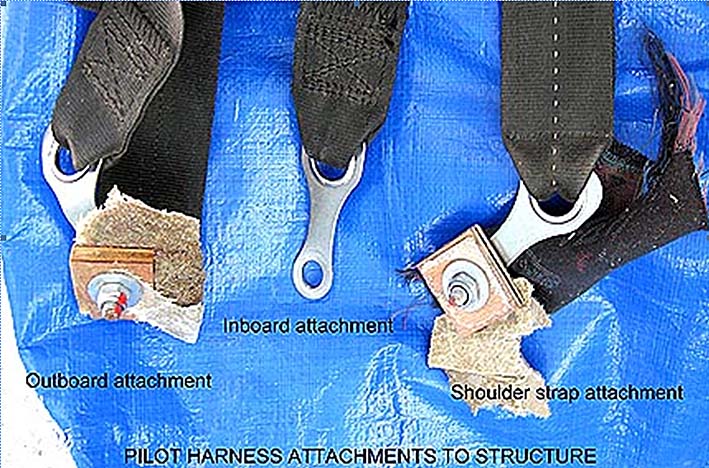
Seems to me the LSA rules may have been in part an effort to reduce the cost of certification and release the potential of the free market from excessive Government control, but the pendulum has gone too far out from the centre and the regulators are not happy with some of the consequences - perhaps the pendulum will get pulled back a bit. Looking at the photo of the harness anchorage it needs to.
Or maybe I missed the point completely
-
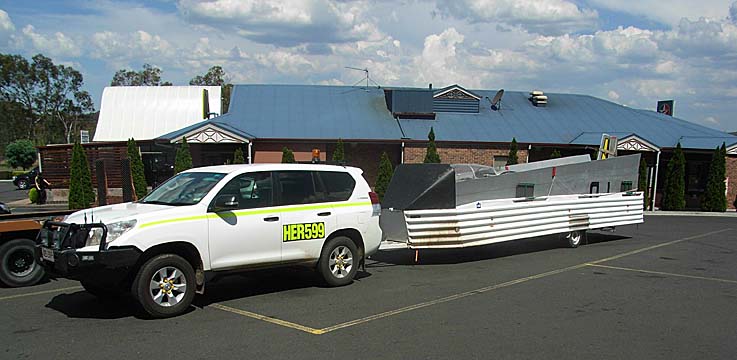
Exactly. If you're talking about recreational aircraft in general, and not merely the LSA sub-group, there are quite a few types that are designed to be folded or de-rigged for road transport; all gliders, for a start. The glider whose image I posted on this thread earlier has 16.2 metres wingspan, and a fuselage length of 8.4 metres, and weighs a little over 300 Kg empty. That photo was taken on a tow from Mangelore to Toowoomba. It needs a really well-designed trailer; but it's quite possible to do this without damaging the aircraft. Skyfoxes and the like are designed to fold mainly for stowage in a hangar; if they are to be trailered, they really need additional support for the wings; and such supports must not overload the wing attachments when the fuselage moves about on its undercarriage, or when the trailer flexes - this can present a difficult design challenge. Being fabric and tube makes it difficult to support them without risking abrasion or local damage. The major constraint is usually the tailplane span, which must not exceed the permissible maximum load width - unless the tail is also designed to fold or be de-rigged. Insurance costs are generally higher if the aircraft is to be road-towed.My family travelled thousands of kilometres towing sailplanes ... including plenty of dirt ...It can be done ... the Sailplane fraternity has been doing it for years...As previously pointed out ...the correct equipment makes all the difference.
-
CAVEAT EMPTOR
This article does not apply to those hardy individuals who design their own scratch-built aircraft; however if you’re contemplating the purchase of a factory-built aircraft, and you wish to survive the experience, here is some important information:
Many people assume that a factory-built aircraft has the automatic assurance of meeting Government-mandated standards for airworthiness, safety etc. and that therefore one does not need to look beyond the fact that it IS a factory-built aircraft to have such confidence. Having rather taken that for granted, they then turn to the published information - particularly claimed performance (which is not necessarily the same as actual performance in real-life) to make their purchase decisions because they believe that safety etc. is effectively guaranteed. Is this realistic and safe?
Sadly, NO. Definitely NOT. In the area of recreational aircraft; you need to know what you are looking at.
Firstly, the benefit of direct government overview of the design and manufacture process is confined to aircraft that have a Type Certificate (or a Type Acceptance Certificate) and a Certificate of Airworthiness. Only a National Airworthiness Authority can issue a Type Certificate or a Type Acceptance certificate – and they do not do so lightly, at least if they are ICAO signatories and want to stay that way.
If you are offered a product for which a Type Certificate is claimed, ask to see a copy. You should also be able to download the corresponding Type Certificate Data Sheet from the relevant Authority’s web site; see, for example, the U.S. Federal Aviation Administration site:
http://www.airweb.faa.gov/Regulatory_and_Guidance_Library/rgMakeModel.nsf/MainFrame?OpenFrameSet
RULE 1: If it has not got a TCDS, it is NOT certificated.
Is that all there is to it? Unfortunately, NO. Question 2 is, against what design standard is the TC issued? To discover this, look in the back part of the TCDS, where it says “Data applicable to all models”, and find the “Certification Basis”.
A Type Certificate is a certificate issued by the responsible national airworthiness authority, attesting that the product was investigated and found to meet a specific product safety standard (design standard). TCs are issued for aircraft, engines, and propellers only. The certification basis is that product safety standard. It’s written in shorthand form in the TCDS; here’s a short guide to translation:
Ground Floor:
CAR 3: Means U.S. Civil Air Regulations, Part 3. Almost all the older single-engine Cessnas, Pipers and Beech aircraft were certificated to this standard. It was superseded in about 1965 by US Federal Aviation Regulations, Part 23 (which came into being partly as a response to the efforts of Ralph Nader, who stated that government should legislate for the results, not the methods needed to achieve them). It was used under “grandfather clauses” until quite recently, where a manufacturer was raising a new model of an existing aeroplane.
FAR 23: Means U.S. Federal Aviation Regulations, Part 23. The later versions of most light aeroplanes are certificated against this standard; however it’s not that simple, either, because we’re currently up to amendment 58 of FAR 23, and it’s often necessary to delve into the actual amendment status that was used. FAR 23 stays up to date, so any aeroplane certificated against it, was pretty much up to current standards as they were at that time. FAR 23 has word-for-word equivalence with the European standard, CS 23 (used to be JAR 23). It is the practical international standard for light aircraft.
JAR-VLA (now CS-VLA). This is a sub-set of FAR 23, for two-place aeroplanes up to 750 Kg., whose Vso stall speed does not exceed 45 Kts CAS. It has international acceptance. It does not allow aerobatics or instrument or night flying. JAR stands for the European Joint Airworthiness Requirements; however the Euro Joint Airworthiness Authority has now been taken over by the European Aviation Safety Authority, (EASA), and the old JAR standards are now called CS standards.
These standards (and a few now superseded national standards) allow an aircraft to be given a “standard” certificate of airworthiness. This means, a Certificate of Airworthiness that is recognised under ICAO Annex 8, which allows one to operate the aeroplane in the airspace of any ICAO-signatory country.
OK, that’s the ground floor, as far as small personal aeroplanes goes. Now we come to the next level down, which is where modern recreational aeroplanes begin.
Basement 1:
The next level, is where the design standard is a “watered-down” standard, but the certification is still done by the National Airworthiness Authority.
Standards of this sort include Australian Civil Aviation Order 101.55, and British Civil Airworthiness Regulations, Part S (BCAR S). Primary category sort of fits in here, too, though it’s not, strictly speaking, a design standard.
You can download Type Certificate Data Sheets for this class of aircraft; see, for example,
http://www.casa.gov.au/scripts/nc.dll?WCMS:STANDARD::pc=PC_93274
For this class of aircraft, the design standard has been somewhat simplified, leaving out aspects that were not, at the time, considered necessary for recreational aeroplanes; the requirement to demonstrate an adequate safe fatigue life, for instance, or to declare a limiting speed in rough air, or to prove it can recover from a spin, or its safety in the event of an overturn, and such trivia. (more recent standards have, so some extent, recitified such omissions – but not always very effectively). In some standards (e.g. CAO 101.55), the actual clauses were negotiable. CAO 101.55 is a “shell” standard, within which the applicant was allowed to elect to use any of a variety of recognised standards – but not to “cherry pick” the easy bits.
However, within the limitations of the watered-down standard, the Government was still in there, protecting the consumer. These aircraft are eligible for a Special Airworthiness Certificate (if they are VH-registered); “Special” means the certificate is recognised only in the country of issue.
Basement 2: Mezzanine
Now we come to a level where the Government does NOT guarantee that the product complies with a recognised standard.
This is the level of factory-built Light Sports Aircraft (LSA). The standard was NOT put into place by the Government; it was raised by a private body, the American Society for the Testing of Materials (ASTM). It’s not actually a bad standard, if it’s properly applied, however there are some notable weak spots in it, for example in regard to the means of demonstrating freedom from flutter. However, the important bit is that the manufacturer does NOT have to prove to the steely-eyed agents of the National Airworthiness Authority that every clause has been properly met; under certain conditions, he is allowed to make a unilateral declaration to that effect, with no third-party overview whatever.
This would be all right, if the manufacturer is both knowledgable and responsible. Many of them are. However, it has aspects of putting the fox in charge of the hen-house, just the same, because the method of enforcement is by charging the manufacturer with fraud if it turns out he made a false declaration. This means, it’s a recipe for “regulation by litigation” - improvements are made when it becomes too expensive through litigation for the manufacturer to risk no t making them. There is increasing evidence that some manufacturers who really do not have sufficient knowledge are making declarations that shouldn’t ought to be made. See http://search.alot.com/web?q=light-sport+aircraft+manufacturers+assessment
For these aircraft, you cannot download a TCDS, because there isn’t one. These aircraft are NOT certificated by any national airworthiness authority. You can’t examine the certification basis (you can assume it’s the ASTM consensus standard, but it may not be). If the manufacturer turns out to have made a false declaration, your dependents can sue the manufacturer for fraud. (Good luck).
In this area, one finds some very emotive advertising – long on “sex appeal” but short on hard fact. Factory-built LSA aeroplanes are eligible for a Special Airworthiness certificate in Australia – but you need to read the fine print on the certificate. Best bet here is to choose a manufacturer who has a long reputation – but even that is not a guarantee. Oh, and watch the insurance hull rate, on this class of aircraft -- those with bad accident records and high cost of repair will inevitably attract higher premiums than those with a good accident history and lower repair costs.
“Bargain” basement:
Here we have the various aircraft types that were “accepted” by various non-government bodies in their country of origin. This is often the case for aircraft from Eastern European countries. These aircraft may not comply with any particular design standard – or if they do, it will often be a homespun thing, full of holes – and there will be no authoritative third-party overview. You will not be able to find a TCDS or even what the design standard actually said; just lots of hype about what a marvellous device it is. These may be “accepted” under CAO 95.55.1.6(a)(i)(B). This means the RAA has no discretion about accepting these aircraft and the idea that the RAA, as a delegated authority under CASA, can protect you, the buyer, from being offered a substandard product is entirely false. Yes, CASA is supposed to overview acceptance but it rarely intervenes unless there is a demonstrated history of problem/s with a particular aircraft that basically forces CASA's hand. As a prospective owner of an aircraft you almost certainly do not want to become part of that 'demonstrated history'.
The importer is, in principle, liable under the Trade Practices Act as though he were the manufacturer. However, if you buy through an importing company and you ultimately need to litigate against that company for defects in the aircraft, you may find yourself without adequate redress if the company does not have the resources / insurance to meet a judgement.
This sort of aircraft has produced the sort of lethal thing shown below. The manufacturer’s website states that it has four-point harness. So it does; they didn’t say it was attached so as to provide any useful protection. (It had a single layer of light glass either side of the ply). They didn’t say it met any safety standard at all. People don’t ask those questions, evidently.
Perhaps they should - and as in the case of the aircraft in which those harnesses were installed, while they are still alive to do so..

-
1
-
5
-
-
The above categories are all - rather roughly - recreational aircraft. The distinctions within that overall description arise because of the different ways that the design quality and build quality are handled.
Prior to the advent of LSA category, aircraft that were commercially manufactured had to have their design certificated by a National Airworthiness Authority (e.g. CASA, EASA, FAA, etc) as complying with an acceptable design standard (e.g. FAR 23, JAR-VLA, CS-VLA, BCAR-E etc) AND they had to be built under a Production Certificate (or equivalent) issued by a National Airworthiness Authority. The analogy is a motor vehicle that has an ADR compliance plate. This is consumer protection before the event.
This is the situation for aircraft that have a Type Certificate. How do you find this? Go look for a Type Certificate Data Sheet (TCDS) on the relevant NAA website. (See attached example). RULE 1: If if ain't got a TCDS, it aint Type certificated.
LSA category aircraft are commercially-manufactured products whose design and manufacture is NOT under the steely-eyed scrutiny of a NAA; instead the manufacturer must make a declaration that each aircraft he builds complies with design and manufacture standards specified by a separate body, the US Association for Testing of Materials (ASTM). If the declaration turns out to be incorrect, the manufacturer may be charged with fraud. This is of scant comfort if you happen to be the injured party. LSA aircraft do NOT have a Type Certificate. What they have is a piece of paper from the fox, stating that the hen-house is perfectly safe.
I forgot to add: See http://www.casa.gov.au/scripts/nc.dll?WCMS:STANDARD::pc=PC_93274
-
The above categories are all - rather roughly - recreational aircraft.I've extracted the posts above from the 'Trailer a Drifter' thread. They were Off Topic there but I think they raise a point that needs some consideration as confusion is likely to be propagated well into the future.What's below is what I think is the case but I may well be wrong about some of it.Since the powers-that-be saw fit to lump all the powered fixed-wing recreational aircraft together into one category we need some new names for the different kinds of aircraft we have but which are in most cases being referred to as 'LSAs'.
Has everyone noticed that we have lost the two seat 95.25 450kg category that Drifters and Thrusters and Lightwings used to occupy ..? It's gone, finito! Now those aircraft are in 95.55 but, as some people have discovered with other marques, without the weight increase to 600kg that the CAO allows, because some of the aircraft are not Certificated to 600kg by the manufacturer.
So - for example, a Foxbat is an LSA if it's built in the factory. And if the factory decided to sell approved kits they would not be LSAs, they would be experimental LSAs ie ELSAs. ELSA kits do not have to comply with the 51% amateur built rule.
LSAs can be used for training but ELSAs cannot be used for general training in a school, only for the training of its owner(s).
See the description of what LSAs and ELSAs are in AC 21-41 here.
Note that LSAs can be any of the following -
5.2 The types of aircraft that may satisfy these criteria are:
(1) Fixed wing aircraft;
(2) Powered parachutes;
(3) Weight shift aircraft;
(4) Gliders;
(5) Balloons;
(6) Airships; and
(7) Gyroplanes.
If we refer to the CAO 95.55 under which some (i.e. those in sub-section (1)) of these types of LSAs operate in Australia we find that the LSAs are but are small part of the 95.55 aircraft we operate between us, the LSAs fit into Section 1.2 (g) and (h) but many of us are flying recreational aircraft that are now within 95.55 but are not LSAs because they fit somewhere into Section 1.2 (a) to (e).
(a) is 101.28 aircraft that also happen to fit the requirements of 95.55
(b) and © are 101.55 aircraft but only if they fit parts 1.1 or 1.2 of 101.55
(d) planes that fit the old 95.25 category (there's no link to them because 95.25 is gone) - that's the two seat Drifters, Thrusters, Lightwings etc
(e) this is the new place for the (non-GA) amateur built category which does require compliance with the 51% rule.
So what are these planes that fit (a) to (e) called? The GA version of the Amateur Built Experimentals are called ABEs in the USA so I can imagine that those in (e) above might be Amateur Built Light Experimentals (ABLEs) but other than that if you fly a Lightwing and someone asks what category of plane you fly ... hmmm at this stage you can really only answer that it's a '95.55' but that doesn't do much to answer the question for the general public. And neither does "Well, it's a 'sort of' LSA".
The distinctions within that overall description arise because of the different ways that the design quality and build quality are handled.
Prior to the advent of LSA category, aircraft that were commercially manufactured had to have their design certificated by a National Airworthiness Authority (e.g. CASA, EASA, FAA, etc) as complying with an acceptable design standard (e.g. FAR 23, JAR-VLA, CS-VLA, BCAR-E etc) AND they had to be built under a Production Certificate (or equivalent) issued by a National Airworthiness Authority. The analogy is a motor vehicle that has an ADR compliance plate. This is consumer protection before the event.
This is the situation for aircraft that have a Type Certificate. How do you find this? Go look for a Type Certificate Data Sheet (TCDS) on the relevant NAA website. (See attached example). RULE 1: If if ain't got a TCDS, it aint Type certificated.
LSA category aircraft are commercially-manufactured products whose design and manufacture is NOT under the steely-eyed scrutiny of a NAA; instead the manufacturer must make a declaration that each aircraft he builds complies with design and manufacture standards specified by a separate body, the US Association for Testing of Materials (ASTM). If the declaration turns out to be incorrect, the manufacturer may be charged with fraud. This is of scant comfort if you happen to be the injured party. LSA aircraft do NOT have a Type Certificate. What they have is a piece of paper from the fox, stating that the hen-house is perfectly safe.
-
1
-
-
Well, thread drift or not, between the two ACs you have a reasonable summary of what an LSA aircraft actually is. The essential point is that an LSA aircraft is a commercially-manufactured product whose quality is NOT ensured by the steely-eyed scrutiny of a national airworthiness authority, but in respect of which the manufacturer has made a declaration that it complies with a specific design standard. The physical description above gives the limits to the physical characteristics of an aircraft that may be certified that way. Note, in AC 21-42(1), what happens if the manufacturer (who is the only one who can approve a modification or repair to such an aircraft) goes belly-up.Thread drift here, but according to AC 21-41(0), an LSA is ...5. WHAT IS A LIGHT SPORT AIRCRAFT?5.1 A light sport aircraft (LSA) is a small, simple to operate, low performance aircraft.
With regard to the requirements of the CASRs, a light-sport aircraft is an aircraft, other than
a helicopter that complies with the following criteria:
(1) A maximum takeoff weight of not more than 600 kilograms or 650 kilograms for an
aircraft intended for operation on water or 560 kilograms for a lighter-than-air
aircraft.
(2) A maximum stalling speed in the landing configuration (VS0) of not more than 45
knots CAS at the aircraft’s maximum certificated takeoff weight and most critical
center of gravity.
(3) A maximum seating capacity of no more than two persons, including the pilot.
(4) If powered, a single, non-turbine engine fitted with a propeller.
(5) A non-pressurised cabin:
(i) For an aircraft operating over land, a fixed landing gear;
(ii) For an aircraft intended for operation on water, a fixed or repositionable
landing gear; and
(iii) For a glider a fixed or retractable landing gear.
(6) If the aircraft is a glider a maximum never exceed speed Vne of 135 knots CAS.
6. CERTIFICATE OF AIRWORTHINESS FOR LSA
6.1 Types of Certificate of Airworthiness for LSA
6.1.1 There are 2 types of Certificates of Airworthiness for LSA, a Special Certificate of
Airworthiness for Light Sport Aircraft (LSA), and an Experimental Certificate for Light
Sport Aircraft.
ie. SLSA (factory built) and ELSA (kit-built, typically)
rgmwa
-
Not correct. See http://www.casa.gov.au/wcmswr/_assets/main/rules/1998casr/021/021c42.pdfLSA is performance category, not a registration classification like ELSA, SLSA, AB(E) etc.rgmwa -
Maybe. I think there's more to it than that. See http://diki.heliohost.org/parkinsonselection.htmNo Job should be unifillable. If it is, I would suggest it's because either the money does'nt match the skills required or the support and processes to enable them to do the job are not there, or both. That's what we should be fixing.-
1
-
-
All pigs will take-off at 0800 . . . . Why would anybody in his right mind WANT to do the RAA Tech Manager's job? Anybody who CASA would approve could almost certainly find a more attractive career opportunity - I would suggest that almost all such people are gainfully employed elsewhere, and would not be interested in such a dead-end position.If there is an identifiable bottleneck, then max effort should be used to overcome it. There is a shortage of people that CASA approve to do the job. Whose job is it to address THAT? Could I suggest CASA? Why don't they? Nothing in it for them. (as they see it). NevTry writing a set of criteria for a suitable employee, and advertise for applicants, and see how you get on. Then maybe the memberas will be in a position to know what they can realistically demand.
-
Unless you cant get, or cant afford hanger space, or absolutely need to trailer it, think again. Think about trailer rash, trailer damage from road bumps, vibration etc , the pain in the but about setup and preflight checks and then x that by 2 to be real..... We looked into it and it seems perfect until you investigate it and find out the reality.By all means if you need it then go for it, but please research it to death first.
Those tiny little bolts and those big wings are not really designed for Australian roads and they are more designed to fit more aircraft in sheds or hangers.
-
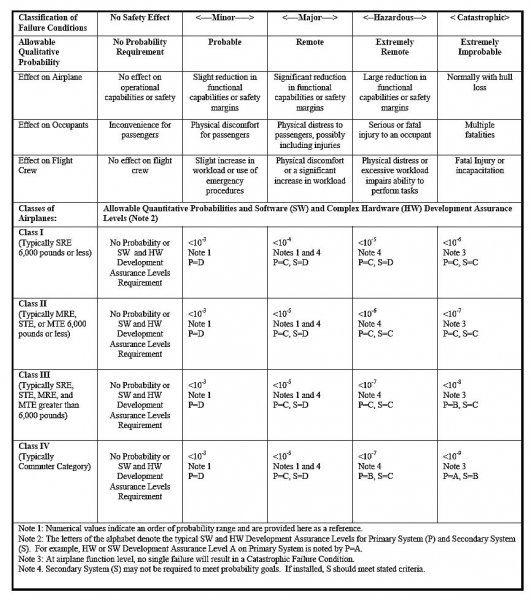
I say again - Go look at FAA AC 23.1309 Fig 2 (attached) . AC 1309 strictly applies to an aircraft system, not to structure - but the basic principle remains: Consider, by way of example, the main wing spar in a typical single-engine aircraft (class 1 in the second part of the table). These aircraft are normally single-load-path structures, so failure of the spar is classed as "catastrophic". As you can see, the table requires the probability of failure to be less than one in a million, per flying hour.The thread starter "Is accident prevention guaranteed?" doesn't fit . Guaranteed to "WHAT". and Prevention as far as accidents is concerned is impossible to be guaranteed unless the activity is highly modified or stopped entirely if there is some real risk in it. Aircraft have plenty of potential to be dangerous. In many instances there were more pilots killed in training than in actual combat. The actual figures are revealing. They relate to military style situations where the fighters were single seat and the bigger stuff was multi engine where practicing engine out procedures was extremely likely to result in accidents.If I am correct the most safe part of the RAAus activity is the training segment, particularly the "dual". Interesting? Nev..So, the answer to the thread question is (watch my lips): NO, accident prevention is NOT guaranteed. ICAO sets specified statistical probability levels.
-
Nev, it's true that gliding has gone in the direction of high cost - it was not always so; when I started gliding (1968) the emphasis was definitely on affordability. It started to drift away from that in the mid 1980s, and I dropped out of it due to career pressure. The high cost is a conscious choice of gliding people who treat high-performance gliders as "white goods". Not my preference, I assure you.I'm talking of the aims and differentiating them from the RAAus. I recall McCormick specifically saying low cost and aviation don't mix. and clearly seemed to reject the concept of it. You, Dafydd may find it challenging I would suggest. We all become captive to our background experiences and attitudes to some extent.I would suggest also you are lucky where you glide to be able to do five launches for that figure. but I'm no expert. I have had friends who glide and saving money has nothing to do with it.Strange how airlines spend heaps on being the cheapest and never mention safety in their advertising or comparisons, because most customers buy on price . Cheapness and cost saving is inherent in commercial aviation to why can't it be part of the philosophy of peoples hobby. It all depends on what you have been used to. You could build a safe aeroplane with most of the stuff from Bunnings if you set out methodically to do it. Nev
The RAA is at present, very much in the same phase of evolution as the gliding movement was around 1995. That's another lesson that can be learned from GFA;
I use Bunnings stuff when I can, but materials cost is really not the major issue. I suppose this really merits a new thread, but aircraft-grade fasteners and materials are actually good value for money, if the designer uses them where they are needed. The big difference between aircraft grade material and commercial grade material is that aircraft quality material is graded so that 99.5% of it will pass or exceed its specification - whereas commercial grade material is usually graded by its average properties - i.e. 50% of it will pass or exceed its specification. If you apply the necessary downgrading factors to achieve aviation reliability standards for, say, a commercial Grade 8 bolt, AN bolts start to look a lot more attractive - and you can buy them in a large number of shank lengths, so you do not get bearing on the threads. The added cost of this is really not significant considering the small total weight of material actually used in an aircraft. Things like fire-resistant cabin lining & upholstery are generally not available from outlets such as Bunnings, and neither is high-strength steel etc.
If you build an aircraft using the normal commercially-available aluminium, the structure weight will need to be a considerably larger proportion of the MTOW - or the structural reliability will be something not very nice. That generalisation can be extended to just about all generally-available commercial materials.
Where the real cost lies, is the labour - and in processes such as heat-treatment and de-embrittled electroplating. These are inordinately costly in small quantities. The problem is fundamentally one of small volume production; a special bolt that might cost $3.50 for a car, where it's made by the tens of thousand, can cost as much as
$ 600 if you have to make one of them.
The reason there are no $15,000 aeroplanes is that the manufacturer has to make a profit in order to survive - and as Dr. Zoos points out, in an environment of high product liability. I say again, the ONLY way to get cheap aeroplanes, is to build ones that are still viable when they get to their third owner. NOT by building them from rubbish. You do not need to gold-plate them to achieve this - but it does require less constrictive weight limits.
I would not recommend anybody to use any Bunnings timber products in an aircraft - and neither would Bunnings, I am sure.
-
Waal - I had to renew my GFA pilot qualifications last month - did five launches, general flying, spins, cable breaks etc. Total just on one hour. Most of it with an instructor. Total cost $103.00While it might be seen by some as a good thing. GFA appear to make no effort to be affordable to the ordinary person. RAAus has a specific aim to be low cost or at least attempt to limit it. This is an aim that I feel some don't GET. Nev-
1
-
-
We've all come across that sort of thing; it's a given, in any amateur-run organisation, tho I think somebody was pulling your leg. Even your drongo instructor would be able to teach spin recovery. However, the GFA maintenance system has a specified annual inspection checklist which GFA issues on request (and payment) for every glider, together with a list of airworthiness directives applicable to that glider. All that has to be signed-off by the glider inspector and returned tp GFA, where it goes on the aircraft file. Then the GI must issue the maintenance release, which makes him legally responsible; and a maintenance test flight has to be completed. So one finds rather more information in the log book, nowadays, than "annual check OK - squiggle" which seems to be par for the course for RAA aircraft. So GFA is in a position to produce the maintenance records if it is ever needed; and the people concerned take it seriously.If I thought a bunch officious goons were going to impound my plane if I went anywhere I would drive instead. As for the GFA being some sort of great example I don't think so, with my personal experience I have come across an instructor who thinks it is best to tack like a yacht with a head wind, a pilot who reckons you can't lay off drift with a cross wind as normal because there is no motor on the front to pull the nose around, numerous cases of bad airmanship including lack of look out and radio use. If they can't get these sort of things right why would other issues be any better?I'm not here to sell the GFA; but I can say from personal experience that they handle maintenance an order of magnitude more professionally that does RAA. Yes, they've had their own radio frequencies for ages, and sloppy radio techniques because of that, and individual clubs tend to be parochial - but they are having to come into line with GA nowadays. Everybody shares the same atmosphere, and we can't carve off bits of it for specialist group use any more, unless we're the RAAF. . .
RAA can learn a few useful things from GFA. (And vice versa, I suppose, though I can't think of any, offhand)
-
1
-
opinion sought
in Aircraft General Discussion
Posted