

Dafydd Llewellyn
-
Posts
1,513 -
Joined
-
Last visited
-
Days Won
43
Content Type
Profiles
Forums
Gallery
Downloads
Blogs
Events
Store
Aircraft
Resources
Tutorials
Articles
Classifieds
Movies
Books
Community Map
Quizzes
Videos Directory
Posts posted by Dafydd Llewellyn
-
-
Thanks - that's a useful piece of clarification.Sorry for the thread revival.I emailed CASA about the original question by the OP.Here is the response by Miles Harris
Brad
I draw your attention to CAR 1988, Part 1, Para 2 Interpretation, para 7 as follows:

I agree that you are able to carry tools of your trade on board a CASA GA acft for the purposes of conducting a job at your destination. The reward you are receiving is for your professional services required only at the other end of the trip, not for the use of the acft to get yourself there.
Sections (v) and (viii) highlighted is, in my opinion, a hybrid of where you are at wrt your case scenario below and is deemed to be a private operation.
Concerning RA-Aus acft, you would have to approach them, and get there technical advice on this matter. If you wish to present this email to them, I don’t have any issues with this.
Rgds
-
Yes; however what is the proportion who simply decide that aviation is a mug's game and give it away completely, versus those who move away from RAA to another form of aviation? I consider this a most important statistic, because it is the determinant of whether the GA industry as a whole (i.e. including all the recreational facets) goes ahead or not. The more people involved overall, the less costly it will be for the individual, and therefore there is a "snowball" effect, to a degree. Firstly, it annoys me intensely to see people driven away from aviation simply due to bad management (and I do not mean solely the bad management within RAA - I see bad management almost everywhere; and it's all totally unnecessary). Secondly, I see that RAA will in future have to sell itself in a competetive marketplace. I don't think it has that much to offer, if one looks at it dispassionately. On the whole, the pros and cons of RAA versus other options are very much a matter of one's personal situation and experience; there's no overwhelming advantage to any of them. If you are interested in a census, count me as one who has gone from RAA to another area of aviation, and who is not coming back.I think things are quiet because the industry has been hurt, hurt very badly over the last 2 years under a poorly performing RAAus Management and more specifically over the last 9 months. We see an unprecedented amount of aircraft up for sale, we see anger at its peak and much more, so over time it simply wears people out, wears them out to a point where people just say "I've had enough" and move on.Apart from a possibility that the uptake of boating or motorcycles may increase from the spill, I believe it will take at least 1 to 2 years before some degree of confidence, and enjoyment, returns to our industry and a possible return of those that have recently left in disgust, plus with a newly found confidence and return of vigour in "recreational flying is fun" again, we will start to see this radiate out to the general public which can only support the promotion of our industry and growth with the influx of new members.Those board reps, and a CEO, that have recently left along with a few that still remain have a lot to answer for in the complete destruction that they have caused in a whole industry...that will always be known as their legacy
-
 1
1
-
-
The gnus have sore feet, maybe?So the logic is now, if you don't hear anything that means things must be good? -
Yes, that's pretty correct in my experience; you cannot be working to a deadline if you use a personal aircraft for travel under VFR. Nevertheless, with some flexibility in planning, one can get quite a lot of use under these conditions; but you need to understand the weather in the area you wish to operate, in some detail. I've done quite a bit of this sort of flying, and it's most useful for an out-and-return of a couple of hundred miles, within no more than a couple of days, so you can complete the exercise before the next patch of bad weather moves in. I don't know how much training RAA pilots get in meteorology these days, but it's a most necessary area of knowledge if you want to do much more than local flying.I recently chatted to a person who has never been in anything smaller than an A320 about the idea of getting his RAA cert/Plane. As I ran through all the possibilities of what he could use the proposed plane and licence for when he would get them, it swiftly merged into just one remaining purpose. To fly around for fun or (with no pressing deadlines) he could kind of travel around packing light and go from airport to airport, getting a taxi if he wanted to go into town and have a look.For anything else he is still better off in his car or going the whole hog and getting CPL/CIR. $$$-
 1
1
-
-
Not if it's a glider or motorglider operated under GFA. You have to have the appropriate GFA qualifications.As I understand it, you can only maintain a VH Experimental aircraft if you built it and you've done the SAAA MPC course. If you bought it (as opposed to building it), it's the same as any other VH aircraft - you can't maintain it unles you're a LAME with the appropriate authorisations. Given the majority of RAAus members are buyers rather than builders, the pros of the RPL would be offset by the cons around maintenance. -
Yeah, AD/rad/47 has to be done every two years. Rad 36 has been cancelled - I don't see any requirement for recurrent checking of modern VHF-COMs - and I don't particularly want to go into CTR, but occasionally it may be necessary . . . I don't need to do a maintenance course, I already have what i need in that area.I wasn't actually comparing the two, you don't have to be in the SAAA to use an exp VH aircraft, you don't even have to join to do the MPC ,it's cheaper if you join ,but you don't have to.If you go RPL then there's no class 1or 2 medical, not sure what a drivers licence medical will cost, and so for me my insurance covers flight and hull risk as well as a public liability component , for $1800 a year( it includes my RV6 for ground risk) so I doubt it would be cheaper if it was RAA reg ,and I can do the maintenance myself.Rego was $135 for ,,,ever,,,, I have a couple of things that need to be done regularly rad 36 and 47 ( I think that's the numbers) but if you want to go into CTR then you need to have them in your RAA reg aircraft too, other than that I'm kinda thankful I got screwed around by RAA and went VH with mine, it's not an option for everyone,,, ,,,,,,,hang on soon it will be !
-
OK, what transactions are involved in operating under CASA, and how do they differ from operating under RAAus?Every transaction you do with CASA costs. There is no equivalent of the insurance that comes with pilot membership of RAAus and no equivalent of the magazine either, nor do you have any say about what they do to you. Not apples with apples, CASA -RAAus. CASA is the Authority. That is all it is. ALL RAAus has to do is get running and restore confidence that it will be working sometime soon. This uncertainty has been going for years now. I don't entirely blame RAAus Just MOSTLY.. NevThere's registration - which is a one-time thing. My aircraft is already VH-registered, so I don't have to pay anything more on that score. There's a class 2 aviation medical - which cost around $200 for the DAME and $ 75 for CASA to issue the medical certificate. There's a biennial flight review. There's Oz runways. There's insurance. There's no membership or pilot certificate renewal cost. There's no difference in the maintenance cost in my case. So what else is there?
-
Are you applying logic? What possible justification is there to do anything of the sort?I would read the exemption to part 5 as allowing you to fly without the qualifications required by part 5 (PPl/CPL etc.), and therefore allowing you to fly with a RAA issued pilot certificate.It still seems that RAA is considered to be providing flying training, as CAO 95.55. 3.1(f) specifically allows advertising of flying training without an AOC. To me, 95.55. 3.1(f) suggests that there should be a matching exemption allowing the actual flying training to occur without an AOC.Perhaps there is an Instrument somewhere allowing it - oh dear, CAO 95.55 is already an Instrument, Instruments on Instruments perhaps. If you get the impression that I think the regulations are a mess, and that a pilot can't be expected to interpret them or use them to work out what is and is not allowed, you would be about right.
-
 2
2
-
-
I suspect, this follows from the exemption to Part 5 of the CARs (CAO 95.55. 3.1(a)). This is a rather curious exemption; it means RAA is NOT conducting flying training under the CARs, but under its Operations Manual. I suspect this will prevent RAA training organisations from being able to issue RPLs - if it does not, the gymnastics involved on CASA's part are something I await with bated breath . . .I agree. So, do RAA training facilities require an AOC, and if not, why not? (CAR 206 defines which operations require an AOC.)-
 1
1
-
-
If an exemption to CAR 206 is not in CAO 95.55 (and there isn't one that I can see) then CAR 206 applies to RAA aircraft, just as it does to all other Australian aircraft.I'm not trying to argue for commercial operations in RAA, I'm just trying to read and understand the regulations. A court ruling is one way to gain understanding I suppose, but not a terribly efficient one.If I flew away for a weekend and was pinged for taking my laptop and mobile phone (tools of trade) and maybe even responding to an email or (horror) processing a sale while I was at my destination, I probably would challenge it in court.CAR 206 is confusing regarding RAA. Can you provide a reference as to why it applies/does not apply to RAA aircraft? And if it does apply, why are RAA allowed to perform flying trainig without an AOC? I found a reference in CAO 95.55 exempting RAA from CAR 210 requiring an AOC to advertise commercial operations, but not section 27 of the Act, requiring an AOC for the actual flying operations.
The more I explore the regulations, the less they make sense, and the more convinced I am that aviation works on the basis that what everyone else does is allowed (until CASA decide something isn't!), anything else is forbidden.
-
Yes, indeed. No argument. However, it seems to me that a clear statement by RAAus as to exactly what one can and cannot do UNDER THE EXISTING REGULATIONS in regard to operations that are on the fringe between private and aerial work, would hardly be viewed as an attempt to expand - it is, rather, another aspect of tidying-up the current mess. Expansion would entail pursuing an amendment to CAR 206(i)(viii) - and that's a political agenda that, obviously, RAA should not be embarking on until it has been seen for some time to have its house in order. However, there is no reason for people not to consider it as an option for the future.RAAus is already more than knee deep in digested grass with CASA. After all the organisations' demonstrated failures to successfully conduct the activities that it contracted with CASA - it's hardly the time to be seeking to expand. RAAus hasn't delivered on its' contract. Clearly, the RAAus Board needs to look to its' own housekeeping before all else.We need to be more focussed on what we are able to do - and that's flying training,( and remember that in GA, training is an aerial work activity and requires an AOC). RAAus needs to ensure that it fits into the system as the 'ab initio' provider of training - feeding seamlessly into the new RPL.If we don't grasp this opportunity - then SAAA will! One major plank of the SAAA's earlier proposals was to provide ab initio training up to what was then to be called the LAPL, (now the RPL). Nothing currently mentioned, but now that they are an RAAO, they meet the criteria as described in the Part 61 most recent docs. Nothing then to stop them becoming direct 'competition' for RAAus FTF's.
happy days,
Yes, this is looking ahead; however an organisation such as RAAus needs to not only do its current task properly - which I believe has never been the case - but once that ground-floor has been reached, an organisation of this sort either progresses or dies. It cannot stand still and survive, in the long run.
-
2
-
-
I think you are correct. There's a difference in the wording between CAR 206(i)(viii) and the later definition given in the reference in Oscar's initial post, which suggests they have softened their interpretation to allow tools of trade - but that may be yet to be tested in court.I'm not convinced that CAR 206 defines private operations at all.CAR 206 defines Commercial Purposes "For the purposes of subsection 27(9) of the Act". Subsection 27(9) deals with the purposes for which an AOC is required - not the requirement for a commercial license.CAR 5.78 defines what a Private Pilot License allows you to do "to fly an aeroplane as pilot in command, or as co-pilot, while the aeroplane is engaged in a private operation" with the note:
"Paragraph (d) of subregulation 2(7) sets out the operations that are classed as private operations."
It appears to me that paragraph (d) of CAR subregulation 2(7) defines private operations, not CAR 206.
The assumption that private operations are operations that are not commercial seems incorrect. CAR 206 lists:
(ii) aerial spotting;
(iii) agricultural operations;
(iv) aerial photography;
as commercial operations.
Subregulation 2(7) paragraph (d) lists
(ii) aerial spotting where no remuneration is received by the pilot or the owner of the aircraft or by any person or organisation on whose behalf the spotting is conducted;
(iii) agricultural operations on land owned and occupied by the owner of the aircraft;
(iv) aerial photography where no remuneration is received by the pilot or the owner of the aircraft or by any person or organisation on whose behalf the photography is conducted;
as private operations.
This seems to say that e.g. agricultural operations on land owned and occupied by the owner of the aircraft are commercial operations that require an AOC, but can be performed with a private pilots license. It seems clear that an operation can be both commercial and private.
Subregulation 2(7) paragraph (d) also lists
(i) the personal transportation of the owner of the aircraft;
as a private operation, which seems to mean that transportation of the owner of the aircraft is definitely a private operation. There doesn't seem to be any restriction on what the owner does at the destination, except that CAR 206 says that carriage of goods property of the pilot, the owner or the hirer of the aircraft for the purposes of trade requires an AOC.
I don't know the definition of "goods for the purposes of trade", but it seems that it must be goods for sale, not just tools of trade. If CAR 206 includes tools of trade it would seem, for example, that a commercial pilot was forbidden from carrying a pilot's tools of trade without an AOC. Or if you assume a pilot is somehow exempt, what about a salesman carrying a mobile phone on a flying holiday? How far do you extend tools of trade? Do I need an AOC to check work email at my destination, if I carried my smartphone with me?
Whether this is how CASA interprets these regulations I don't know, but that is how I read them. Ultimately, it is CASA's interpretation that matters, until you are prepared to pay a lawyer to go to court and challenge them.
-
No, CAR 206 defines what constitutes commercial operations. Therefore, if it isn't in CAR 206, it ain't a commercial operation. I used my Cherokee 140, on a PPL, to regularly fly between Sydney and Tamworth, for the purpose of oversighting the work East-West airlines were doing on the CSIRO F-27, VH-CAT, for which I was responsible. That usage is plainly for "going to the job" but it was not a defined commercial purpose. My employer did not pay for my usage of my own aircraft, so I was not earning money from the use of the aircraft per se. Yes, I claimed that flying against my tax - and never had a query. I don't think either CAR 206 or that aspect of the Tax laws has changed noticably since those days.From what I understand - and I don't claim to be any sort of guru here - if you use your RAA-reg. aircraft just to GO to a job, even if you don't carry so much as a Swiss Army knife - you have used it for a 'commercial purpose'. Presumably, coming home isn't a 'commercial purpose' - unless, perhaps, you return to your home airfield and then also do a paying job before actually going home.This is where it all gets silly, I feel. I want to be able, in the future when it's back in the air, to be able to do trips in my wee, simple, cheap but capable Jab. that have, in some small way, a 'commercial purpose'. I don't want to be a commercial gun for hire, and despite CASA's apparent interpretation that because there is a 'commercial purpose' for my flight I might be inclined to become a task-driven homicidal/suicidal maniac, I'm not going to breach any condition of the operational limits to do any such flights.I also don't want to suddenly find out that my insurance cover is void because I have used the aircraft for a purpose other than 'recreational' aviation, as defined and limited.
So - the upshot of all of that is: if I want to be able to do the odd 'commercial' flight, such as delivering a part I have manufactured to a customer and installing it in her/his aircraft, even if it's just a damn cup-holder weighing 50 grammes that needs to be screwed to the door and signed off by an L2, I may have to consider putting the old girl back in VH-reg and taking out at the least an RPL I'm damned if I can see what qualitative difference there will be to my, or the general public's, safety resulting from that change - but I'd have to amortise the extra costs of operating a VH-reg aircraft vs. a self-maintained RAA-reg aircraft on the cost of that cup-holder. And the cup-holder will be almost certainly be screwed into an RAA aircraft identical in almost every respect to my own but with a different set of letters/numbers on it.
Al Capone was jailed for tax evasion. A prostitute can claim 'expenses' as long as she/he is determined to have properly declared all income and properly have claimed allowable 'expenses'. What the ATO decides is allowable has NO reflection on the legality of the source of the income / expenses - as long as they're justified by the ATO rules. An ATO decision on your income/outgo bottom-line position has NO relevance on a CASA decision on a breach/non breach of the safety regulations for which they are responsible. You can fly Jack the Ripper to and fro - as long as you do it within the rules.
-
1
-
-
Well, that's clear enough. But how is carrying a toolbox or a lap-top, endangering other people's lives? And yes, you can use a Boeing 747 as a toy, if you can afford it.I agree completely that the way in which authorities in this country are compelled to enforce the letter of the law rather than the spirit in which it was made, is utterly ridiculous. I have no issue with using your aircraft to do what you want with, but, unfortunately (or fortunately perhaps), when you start to use it to earn some money and are risking other peoples lives and/or property (and I think this should be the key criteria) in doing so, there will be more boxes to tick and certifications to apply. I struggle to afford the lower end of aviation along with many others, but I am very happy with what I have. The Jab 230 could certainly be used as a tool, as many Drifters are, but that doesn't mean it can't be used as a toy.In short, yes I think the regs are stupid, and should be rewritten appropriately, in a manner that cannot be misconstrued, but recreational aviation is just that, and was never meant to earn a living. -
Would you be carrying it for the purpose of trade - i.e. to sell it or to assist you in earning your living? As I understand it, if you use it to visit your auntie or whatever, that's OK, but if you use it to get you to a client's premises, it's not. CASA is the Civil Aviation Safety Authority - it's mandate is aviation safety. How is carrying something safe if it's not used for a trade purpose, but not if it is?So if i'm reading this right , this means I carnt load my motor scooter in the back of the avocet and have ground transport upon arrival ??Or as far as " goods "are concerned it would seem that nothing at all can be carried in a rec aircraft , not even an Ersa or mobile phone?I'm a bit confused !
Cheers
-
Yes, it's insane; yes, it's being flouted every day; yes there will be FOIs out there trying to get runs on the board in the form of prosecutions. AOPA have been pursuing this issue of CAR 206 for decades; it was also a major issue raised in the Review of Regulations 1996 (which is still ongoing, after a fashion). Yes, it's contrary to Parliamentary policy as defined by Anderson's 2nd reading speech in 1998. No, it's not being fixed.
Why?
Oscar asks, do people want to be able to change the community perception of "recreational aircraft" from being "toys of those Rich Bastards", to being an asset to the community.
It's a good question; there are parts of the country where I would not want to tie a shiny two-seat aeroplane down overnight. Airfields are being closed because the community attitude is anti private aviation. The community no longer regards flying ultralights as "Those magnificent men in their flying machines"; i.e. it's not seen as a few harmless idiots allowing themselves to float around on what amounts to a powered clothes-hoist - people regard that sort of thing with mild amusement, not jealous resentment.
However, recreational aircraft nowadays look to the the man-in-the-street more like expensive sports cars, and in a society where there the owning of such a thing is way beyond the average means, that sort of toy gets scratches in its paintwork, or worse. Back in 1984, my 17 year old (and hardly shiny) Cherokee 140 - which I used as a business tool - missed getting burned at Hoxton Park by some disgruntled youths from the Green Valley ghetto (outside Liverpool, Sydney) only because the conflagration of the aircraft tied down alongside it attracted attention that chased them off (I got off with a stove-in door).
The answer is, I think, that a bunch of affordable little aeroplanes at the local airfield could and would perform various small services to the community - for example, letting the local volunteer fire brigade chief get a rapid look at that fire starting in the hills, or helping the local Bank manager to assess a property for a loan, as well as any number of emergency uses - but for the fact that those activities are classified as "commercial" by CAR 206(i). The whole Australian attitude to private aircraft has been soured by this regulation; and we complain at the average Australian being about as air-minded as an earthworm - but the reason is, to a large degree, CAR 206(i).
Also, it does not help that the name of both the organisation and the aircraft category starts with the word "recreational". The homebuilt ones may justify that term; but a Jab 230 is not a toy; it's a tool, and should be seen as such. The whole philosophy is asking for trouble from the broader community, in the long term. The head-in-the-sand attitude in the preceding post may be realistic in view of the current chaos within RAA, but it's something we cannot afford in the longer term.
-
It sounds to me like a question to be answered from legal precedent. To my understanding, there is at least one successful prosecution under CAR 206 (i)(viii) against an electrical contractor who carried his toolbox. I consider the regulation needs to be challenged.Time to ask CASA. Firstly, you may find that the govt uses this definition. Secondly, it may not be only the trading of those goods. A purpose of trade can be the services provided such as Vet or professional engineering. i.e. the goods are carried for the purpose of a trade. I wonder if this interpretation came from CPL ground theory - I haven't had this come up myself recently but I get questions like this when I do a flight review.-
1
-
-
Man, read the regulation. Look at its heading. Doing any of those things is, ipso facto, a commercial operation, whether you get paid for the flight or not. That's one of the things that is so objectionable about it. If you happen to be a plumber, check your pockets before yo fly in case there's a roll of thread tape there. . . .If there was no charge made it wouldn't be commercial. That is how I see it. The law would not be particularly interested in the circumstances. The sentence might be ameliorated. ( How do you like that word? but the breach or otherwise of the law would be unaffected... Nev-
1
-
-
I seriously suspect it is not the profit but the purpose of the trip that CASA has decided is the determinant. CASA doesn't care (and legislatively, can't) whether there is commercial profit in using the aircraft, but they can make a determination that the purpose of the flight was 'commercial' by its determination of that term.I suspect that it's (probably) possible that, keeping to the strict legal definition, travel from your home field to the nearby field of a client and then taking a taxi to their place, means the flight you took wasn't, strictly ' commercial'
However, that's not really the point of this thread. The point is: if RAA-class aircraft flown by RAA-certificated pilots (as they have to be, thanks to the division of jurisdictions) can provide some services to local communities, then just perhaps local communities will increase their interest in having RAA-class activities in their area. If RAA-class aircraft and an RAA Pilots Certificate can assist a service provider to make her/his living, then that is an attractive option vs. having to meet all the costs of GA. People who might want such opportunities will progress up the RAA path instead of going to GA.
That gives RAA activities a 'career path' - for want of a better term - that is not a required path that has to be followed, for either your Certificate or your aircraft, but an option. If a single-seat Thruster is all you want to own and fly, then it's no imposition that there is more possible - you can stop at the level that you want. Same as a driver's licence: you do not HAVE to get a B-double licence if all you want to do is drive your Camry to the shops and back.
Yes, CASA's predecessors drew a very long bow in defining commercial purposes. It's very debatable whether S9 of the Civil Aviation Act gives them the authority to do so. It is arguable that CAR 206(i) is so restrictive that it considerably inhibits the benefits of aviation from being achieved to the best interests of the community at large.
-
No, 206 was NOT changed in 1996. As I read 206(i)(viii) you can travel to work in your own plane, but you can't carry your tools of trade, or goods for sale. So, as a professional engineer, I could not carry my calculator; and the Vet cannot carry his stethoscope or whatever.Does this mean that 206 was changed in 1996 to exclude travelling to work in your own plane? I can't see where the Regs do exclude it though. It seems you can't deliver your own goods but that's another (ridiculous) matter.Good point Andy, but then the Regs have never been in plain English. I think it was when I was studying for my CPL that I started to learn to read between the lines ...
In fact Aerial Spotting has a definition too so you don't actually have to go spotting before you muster, you just have to find the herds if you follow me. Spotting is another form of AW, might be spotting damage to fences, or loitering high above a multi-aircraft muster spotting the sneaky bastard mickeys that try and hide in the thickets or the bullocks that have ideas of their own which don't involve the yards. Or spotting mobs bogged in blacksoil after rains, or spotting individuals missed on a TB cull perhaps. Spotting doesn't necessarily require a LL endorse, and mustering endorse can't be completed until LL has been gained.
I agree, and can't find anything in the new or old Regs saying you can't use your plane for travel, to work or otherwise. But they've been amended so many times that it was hard enough to keep up with it when I was in comm ops, these days I can't be bothered, just 'phone a friend' (ask the forum) instead.
-
People have been trying to get CAR 206 amended to allow tradesmen and professionals to use personal aircraft to travel in the course of their trade or profession, since 1996. It is LONG overdue for revision; and it is contrary to the second reading speech by Anderson, in 1998 (see below). RAAus is not the only organisation that does not obey its masters.I believe, though I do not have personal knowledge of it, that a CASA ramp inspector has pinged someone in SQ, presumably under 206 (1) (viii) for carrying his plumbing tools intending to do work in his RAA-reg aircraft. Personally, I think this is as stupid as it would be to require a Plumber to have some sort of 'commercial operator' licence (maybe something of the taxi licence type), and the vehicles to have some sort of goods-carrying certification to take his tools to a job in his ute.I believe that CASA's position is, roughly, that if you are going to use your aircraft to provide a service, then you might be inclined to break safety rules in order to provide the service. Again, speaking personally, I think this position has as much validity as banning the sale of rope on the basis that you might be inclined to hang yourself, therefore you should not be allowed to buy rope.The idea that the owner/pilot of an RAA-registered aircraft cannot be able to offer to provide any services to the community utilising her/his aircraft, is fairly much the nub of my argument. Provided that one does not break any safety requirements nor exceed the limitations of the aircraft (sort of implicit really from the first statement..) - why could a pilot with sufficient competence flying an aircraft with sufficient capability, not be allowed to undertake operations with a commercial return? For example, we see small vehicles carrying pathological samples to laboratories for analysis everywhere in the community; for a remote community, that could be as readily done by someone in say a Jab. 160 or 230, as someone in a C172. However, as things stand, the Jab. owner could not offer to provide the service and would be subject to penalties if he/she did so.
I am not advocating that recreational pilots/owners should be forced into conforming to standards appropriate to (limited) forms of 'commercial' operations. What I am advocating is that there should be room within the ambit of 'recreational aircraft' for the use of their qualifications and aircraft, if eligible and maintained to a prescribed standard, to engage in certain types of commercial operation without having to make the large jump to GA level - where this can be demonstrated to be reasonable on safety etc, grounds.
The benefit to RAA-class operation is, I believe, a shift in the appreciation by the general community that RAA-class operations has potential benefit to their community, thus generating a supportive community attitude towards us. The flow-on from that would be community support of facilities for RAA operations. Hell, it could even assist in the fuel companies continuing to supply suitable fuel rather than backing away from any aviation use of other than Avtur.
-
Interesting points.You don't need a CPL to do aerial work, a PPL is sufficient unless you're getting paid to do the flying. For example unless things have changed I think you can be paid as a boreman on a cattle station and use your, or the the station's, plane to get around to fix the bores and windmills, carrying all the tools of your trade. In that example the purpose of the flying is for transport and you're not getting paid for flying, you're being paid for the work you do on the ground, so I don't think your use of the plane to get to the bore is classed as aerial work. Or you can tow gliders free, or throw sky-divers out free - to build hours for example.
If you were paid as a stockman and spent your working time spotting or mustering cattle in your plane or the station's plane you couldn't claim that the flying was incidental to your work, in that example the work you are doing relies on your being in the air and so it is aerial work. If you are hired as a stockman and doing that aerial work then I believe you can do it with a PPL, but if you are hired as a pilot then you need a CPL. If you have a CPL and an aircraft, and hire yourself and it out for mustering then you need a CPL and an Air Service Licence/Air Operator's Certificate (hence you must then also have, or be, a CASA appointed Chief Pilot) because you would then be selling the services of a Commercial operation.
What I find intriguing here is that I always thought you could use your LSA for personal transport. If that's the case then in your vet example I would have thought it was permitted for you to fly yourself to a station with your vets bag. It might be worth getting a determination on this because I can't see how doing so would constitute 'aerial work' under the definition shown in the link you posted.
See http://www.comlaw.gov.au/Details/F2013C00371/Html/Volume_3#_Toc358291563
-
Somebody pointed out that RAA is part of GA. It is; it's a particular subset of GA. GA with some of the complicated bits left out, if you will. Recreational aircraft fly in the same atmosphere as all other classes of aircraft; and they are subject to the same rules (with a few complicated bits left out). This means, the RAA board needs to comprehend where RAaus fits in relation to the rest of aviation; it needs to know which rules it is NOT exempted from, as well as the conditions under which the exemptions in CAO 95.55 apply. RAA cannot shut itself in a box and ignore the rest of the World. There is, in fact, a continuous spectrum from 95.10 to A380s; the divisions we currently recognise are actually unnecessary. Yes, some organisations supply specialist training for particular parts of the spectrum, but there is no need for "turf wars". If you want an agricultural rating, you go to the AAAA. Gliding, to the GFA, and so on.
How can this be reconciled with the attitudes of the KISS people, who want it all to go back to the days before HORSCOTS? Well, I think you will find that it does not really conflict, if you understand the big picture; it only appears to, to people who do not have that perspective.
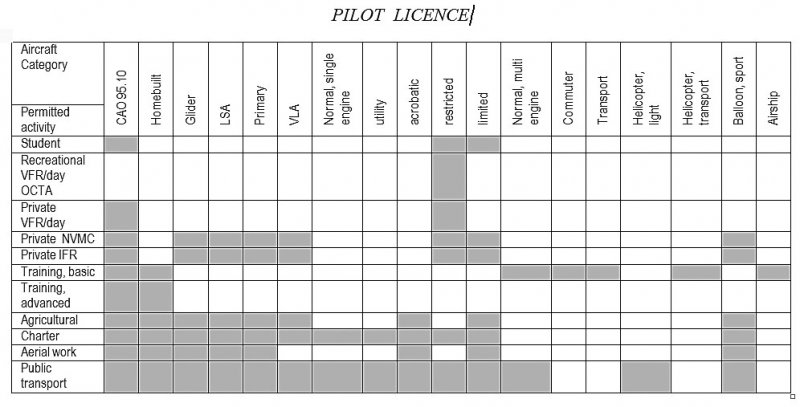
Here's the germ of an idea of a better understanding of how recreational aviation really fits in the big picture:
Let us imagine that all the present forms of pilot licence were combined into a general pilot licence - for an idea of what that might look like, see the attachment (it's far from complete, but you can see the idea):
One would start as a student in the aircraft class of one's choice - somewhere in the top left corner of the matrix. As one gains a qualification, so you get a stamp in another box in the matrix. You can progress or not as you wish. If you want to be a career pilot, you could progress towards the lower right corner of the matrix.
Notice that there are no artificial boundaries. If you want to qualify for another box in the matrix, you get training from an organisation that can supply it, and when you are qualified, you get a stamp in that box. The licence is universal - it would be recognised by all aviation organisations in Australia. Parts of it would be recognised overseas as soon as it was introduced, some may require negotiation.
The KISS people can stay in the CAO95.10/Recreational VRF/day box, if that's what they want to do. We're all pilots. What you can fly, and what purpose you can fly it for, depends on which boxes are stamped on your licence.
Note that whilst LSA, Primary, and homebuilt aircraft are precluded by definition from being used for aerial work applications such as Oscar suggests, VLA aircraft are not. That follows from CASR Part 23; VLA is a sub-set of FAR Part 23, for aircraft under 750 Kg MTOW. Some RAAus aircraft are certificated under that standard.
So the notion of being able to demonstrate that aeroplanes at the top end of RAA can be useful to the community and not just "Boy's Toys" is not impractical.
-
2
-
-
HMMM. Somebody pointed out that RAA is part of GA. It is; it's a particular subset of GA. GA with some of the complicated bits left out, if you will. Recreational aircraft fly in the same atmosphere as all other classes of aircraft; and they are subject to the same rules (with a few complicated bits left out). This means, the RAA board needs to comprehend where RAaus fits in relation to the rest of aviation; it needs to know which rules it is NOT exempted from, as well as the conditions under which the exemptions in CAO 95.55 apply. RAA cannot shut itself in a box and ignore the rest of the World.
How can this be reconciled with the attitudes of the KISS people? Well, I think you will find that it does not really conflict, if you understand the big picture; it only appears to, to people who do not have that perspective.
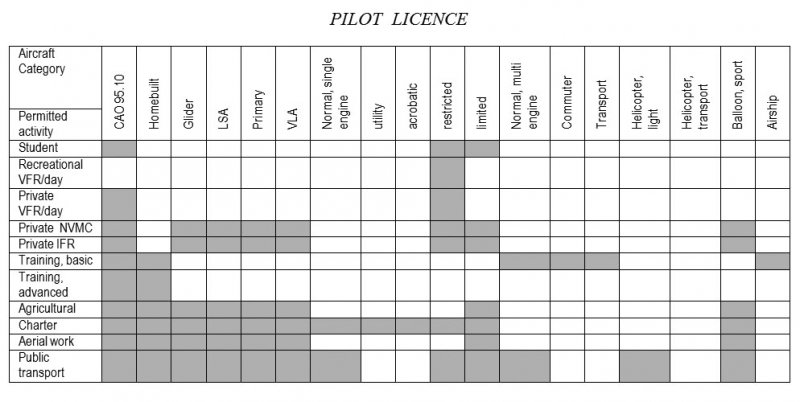
Here's the germ of an idea of how a better understanding of how recreational aviation really fits:
Let us imagine that all the present forms of pilot licence were combined into a general pilot licence - for an idea of what that might look like, see the attachment (it's far from complete, but you can see the idea:
One would start as a student in the aircraft class of one's choice - somewhere in the top left corner of the matrix. As one gains a qualification, so you get a stamp in another box in the matrix. You can progress or not as you wish. If you want to be a career pilot, you could progress towards the lower right corner of the matrix.
Notice that there are no artificial boundaries. If you want to qualify for another box in the matrix, you get training from an organisation that can supply it, and when you are qualified, you get a stamp in that box. The licence is universal - it is recognised by all aviation organisations in Australia. Maybe overseas also, in time.
The KISS people can stay in the CAO95.10/Recreational VRF/day box, if that's what they want to do. We're all pilots. What you can fly, and what purpose you can fly it for, depends on which boxes are stamped on your licence.

Aerial Work
in Governing Bodies
Posted