

Dafydd Llewellyn
-
Posts
1,513 -
Joined
-
Last visited
-
Days Won
43
Content Type
Profiles
Forums
Gallery
Downloads
Blogs
Events
Store
Aircraft
Resources
Tutorials
Articles
Classifieds
Movies
Books
Community Map
Quizzes
Videos Directory
Posts posted by Dafydd Llewellyn
-
-
Thank goodness for some technical nous at last. Bruce is right; conduction from the metal surface to the passing air is about 25 times as effective as radiation - and the shape of a cowled engine is hardly suitable for efficient radiation. The rough rule of thumb, is 26 square inches of fin surface area per horsepower - but that assumes unobstructed flow through the fins, whereas there are things like cylinder head bolts (on, for example, VW derivatives) that muck up the airflow. Also, the air may be cool when it first hits the fins, but it heats up on its way through, so on the downstream side of the cylinder, not only is the airflow difficult to direct to stay in the fin slots, but the air is a lot hotter - so you get uneven cooling around the cylinder periphery. Good baffling is essential. The conduction of heat from metal to air is very complex, it depends on the boundary layer, the conductivity of the metal surface (oxide on the surface doesn't help), and it's driven by the temperature difference between the metal and the air - and overall, it's a difficult design issue. Water cooling isn't without its problems; the radiator (wrongly named - it hardly loses any heat by radiation) is also a metal surface trying to get rid of its heat into the air - but at about half the temperature difference of an air-cooled cylinder head. In a liquid-cooled engine, there are three fluid/metal interfaces - the first between the water and the cylinder head metal, the second between the water and the inside of the radiator tubes, and the third, between the outside of the tubes and the air. Essentially, a liquid-cooling system exports its problems from the engine to the radiator; however testing back in the 1930s showed there was almost no difference between the exhaust valve head temperature of a liquid-cooled engine and that of an air-cooled engine. It's the temperature of the exhaust valve head and the tips of the spark plug electrodes that usually trigger pre-ignition and hence detonation, so this is a fundamental barrier to better engine efficiency.Yes you would be better off with everything matt black, but not by that much. And you could do more harm than good if the paint acted even slightly as an insulation layer.In a Jabiru engine at 170 degrees C, if you were to paint it black, there would be a gain in radiated energy from about 200 watts (at emissivity = 0.2) to about 1000 watts (at emissivity = 1) . Now at 12kg/hour avgas usage, there is 147,000 watts of energy input. Some of this energy goes out as work and some out the exhaust pipe as hot gas, but a lot goes into heating the engine, which is mainly cooled by transfer of heat from the metal surface to the flowing air at the junction between the air and the cooling fins. The cooling gain from the black paint would only be 1 or 2 percent of this airflow cooling effect, so if you want to improve your cooling, the airflow past the fins is the place to look at.I wrote an article about this for the magazine last year asking the editor how it could be improved for publication, but didn't get a reply. It was obviously too technical and therefore boring. You get better technical stuff here anyway.
regards, Bruce
-
 2
2
-
 1
1
-
-
Are you being logical AGAIN? I'm sure I spoke to you about that . . .This plane, like what I'm told is in the same boat as others caught in this mess, has only had one prop. Uno. Une. Eins.Built by evektor Jan 2007 with Woodcomp prop fitted by Evektor. Shipped Australia, regsitered with CASA, and swapped to RAA 24- when distributor had no GA buyers.The plane has never been modified, other than oil filter changes, brake pads, and a set of fluffy dice.
Both Evektor and Woodcomp are Czech so I'm sure it's a common combination.
-
Stir the pot by all means; it's an interminable debate. However I recall that the insurance issue arose originally in relation to tail draggers used in flying schools. If you look at a Beech Skipper when it has its access panels removed for a major inspection, you will realise that it is in reality an extra heavy-duty undercarriage with the bare minimum of wings, seats and engine to allow it to fly. Rod Stiff once commented that every time he increased the strength of the nose undercarriage, a new breed of idiot arose to break it. It ended up about 2.5 times the strength required by FAR Part 23, and now people break the fuselage instead. The fact is that the advent of things like the Skipper allowed a broadening of the range of people that could be taught to fly; and those people need (bloody strong) tricycle undercarriages. But the majority of agricultural aircraft and "bush" aircraft are still tail-draggers, and for good reason.interesting post from vans siteI prefer to look at the tail-dragger/nose-dragger debate as a matter of evolution.Many years ago pre-man was pretty hairy and was designed to be a "knuckle dragger" that we know today as the ape. Over time man evolved into the elegant and well-adapted being that we all know today. There's an analogy in aircraft history. The tail-dragger came first but over time a design evolved that was better suited to getting into and out of the air without ground-looping because of a misplaced center of gravity. :D As some have noted, insurance companies recognize the superior design when they give tricycle gear planes better rates.
Now some folks will argue that real "pilots" (not real men) fly tail-draggers implying they somehow posess superior flying skills. In reality, the skill needed with a tail-dragger has nothing to do with flying and everything to do with ground control (aka "driving"). I'd love to hear a LOGICAL argument that explains why the group of pilots with the supposedly superior skills (tail-dragger pilots) have to pay higher insurance than those inferior nose-wheel pilots. If there was actually any data to support the difference in skill levels argument that would be even better. :D
Its my opinion, supported by no more data than you'll find in this note, that tricycle gear pilots have demonstrated the ability to exercise the most crucial of flying skills - good judgement. They selected the safer aircraft to fly rather than the better looking airplane (yeah, even I gotta admit that tail-dragger planes are better looking).
Don RV-9AAAAAAAAAAA (fuselage)
No flames please....this was sent tongue in cheek....mostly.
The directional control of a tailwheel aircraft on the ground is not difficult, provided it has: (i) Good tailwheel steering and (ii) Good differential brakes. The heavier ones (e.g. Ayres Bull Thrush) also benefit from a tailwheel lock. But you do have to learn to use your feet.
-
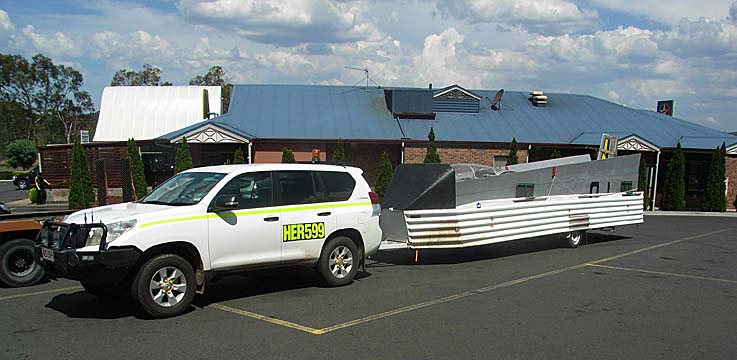
Rotax 582 DCDI model 99; single-blade folding pusher (experimental). It's intended to be a cruising motorglider; target is 80 KTAS at 50% power. My trailer has no problem with the engine pylon . . .A motor blanik - what sort of engine/motor and prop combination is envisaged? It would be interesting to know how much hp is required, and will it be purely to get to altitude and avoid outlandings or be enough for some motor touring? (need a big bump in the trailer for the motor pylon!)
-
 2
2
-
-
The short answer to that is, I don't know. However it seems gliding clubs find it much easier to get finance for a new aircraft, than for a major rebuild of their Blanik.I guess at $5 per hour it sounds better...I was just thinking that $35k is a lot of money for a Blanik... Again if you spread that cost over 7000 hours and factor in the price of a new club trainer it maybe makes sense...What do clubs buy these days of they want a NEW trainer? -
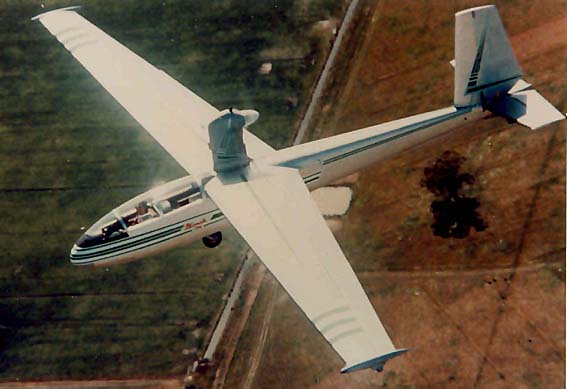
That one was done at Tocumwal, around 1982, by Bill Riley and Bert Perssons. It flew a total of about 250 hours, then was converted back to standard glider configuration. I'm planning to do something similar, with CH-GIW. Its MTOW was 575 Kg and it had a best L/D around 24:1 with the prop. feathered. Felt very much the same as a standard Blanik, with the prop feathered; the added weight gave improved penetration so you could hardly tell the difference. I had a double ignition failure (Rotax 505) test flying it, so I simply thermalled my way back to Tocumwal.Was that the only one in Australia? -
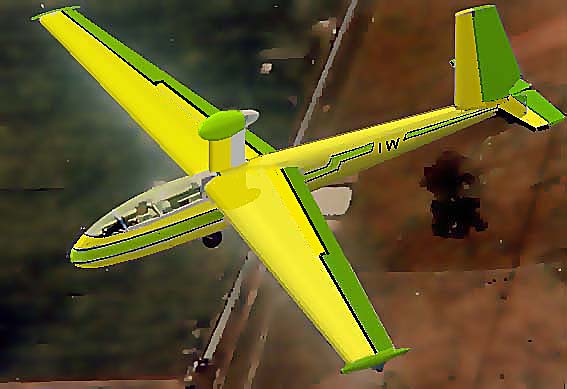
Thanks for that. Here's what our one will look like (I'm still rib-stitching ailerons; the main life-extension work is complete). You're correct, the mod makes no measurable difference to the performance; we checked it way back by flying one with one modified wing and one unmodified wing; it showed no turning tendency whatever. I renewed my gliding currency a couple of weeks ago, on the Bundaberg one, VH-XQO; it still flies just as nicely as I remembered.
-
1
-
-
Yes; that's about what it typically costs, provided the basic aircraft is in reasonably good condition. That gets it to 12,000 hours total life (if mainly aero-towed). The machined, heat-treated and proof-tested parts kit costs around $12,000; there are about 240 man-hours in installing it; and roughly $3000 cost for the fasteners. It replaces more than double the critical metal in the root area out to rib#7 in the wing, and supplies added reinforcement out to about 40% of the wing span, plus at selected spots further out; it replaces the steel wing root fitting and the lower fuselage carry-through member and the main wing pin. It also replaces the tailplane root fittings and reinforces the tailplane carry-through structure; and it reinforces the fin attachment. In other words, it's a major structural re-build, not a band-aid. The wing has to be opened and the mod pretty much deals with "ageing aircraft" issues, at least so far as the main structure goes. Look at it on a cost per hour basis; if you start with a Blanik that has already done 5000 hours, you get another 7000 hours life, so the cost works out at about $5 per hour. The job covers most of the "heavy engineering" aspects of the 40 year inspection.DafyddAre you saying it would cost $35k to upgrade an L13?!???What did you expect? A can of fly-spray labelled "Crack begone?" maybe?
-
(1) Better performance (no nosewheel in the propeller slipstream).What are the main real world benefits of a tail dragger do you think? Apart from style and class!(2) Better (yes, better) crosswind capability. A nosewheel aircraft is limited by "wheelbarrowing"; whereas (provided you have sufficient runway) you can fly a tailwheel aircraft onto the ground, using the "one wing low" technique, at its cruise speed. If the crosswind is strong enough, you'll round-up into wind at the end of the landing roll, whereas a wheelbarrow accident due to the nosewheel touching down before the main wheels, is likely to end up with the aircraft cartwheeling. However, if the wind is that strong, you can generally land across the runway (yes, I have done this on occasion).
(3) Usually, more effective water drainage from the fuel system (if the fuel system is properly designed).
(4) Much better propeller clearance whilst taxiing.
-
2
-
2
-
-
Well, yes; that was pretty much my point. However, the thread was not up to date even back then. I have the jigs; anybody interested can deal directly with the suppliers.That is because all posts before yours were made between late 2010 and late 2012.Logical I guess. -
Please correct me if I have this wrongly - but my understanding is that the aircraft manufacturer of an LSA must declare that the aircraft as a whole - i.e. including the engine and propeller - complies with the ASTM standard (or whatever standard applies in the particular case). For that to include an IFA propeller, firstly the standard against which the manufacturer is declaring compliance must not exclude such a propeller; and secondly, there must be a declaration of compliance by the manufacturer of the propeller. So if you have an LSA that had a fixed-pitch propeller on it when the manufacturer made his original declaration, then fitting an IFA propeller (or in fact ANY different propeller) subsequently constitutes a modification, which ONLY the original aircraft manufacturere can approve.If the RTA did something similar to car registrations there'ld be riots.Did the CASA public servant consider- Grace period vs grounding the entire fleet.Changing the goal posts several years later, reinterpreting or re-administering the rules - is there an admission somewhere that someone, somewhere, stuffed up several years ago?
Any lawyer types out there? Class action anyone?
Perhaps the more letters to the minister, the better.
I can't see how a bit of paper miraculously improves safety, on a plane whose flying characteristics are now second nature.
How would swapping to a fixed prop improve my safety in this plane?
If you are talking about a type certificated aircraft, then a propeller change can be approved by a third party, which would normally be CASA because such a change is a major modification and would nowadays normally require an STC (can be a one-off STC). IFA propellers are normally subject to vibratory stress survey requirements for each engine type, whereas FP wood propellers do not require this.
-
1
-
1
-
-
Try this (experimental Blanik motor conversion, circa 1982
). It needs the fatigue mod first, though. -
This thread is ridiculously out of date. Look up STC SVA 542 on the CASA website. All the servicable L13A1s were returned to service; in addition, VH-XQO (Bundaberg gliding club) has been added to the list. VH-GIW will shortly join them. This mod. can be applied to L-13s that were servicable when the grounding occurred and which have proper log book records up to that time. Anybody interested should contact CAMIT Pty Ltd (Bundaberg) for the cost of a parts kit, and Seabird Australia Pty Ltd for the labour cost to put it together, and add approximately $3000.00 for the package of fasteners. Total cost is likely to be in the vicinity of $ 35,000.00
-
1
-
-
Well, by the sounds of it, nothing much has fundamentally changed since I learned to fly in 1963. There are less aircraft on the local frequency at any given time nowadays, but some of them are travelling quite a bit faster. What HAS changed, is the advent of Mode S transponders (if you have a Mode C one, that will be OK for a few more years, I understand) and an altitude encoder; but the consequences for everybody of a collision between a recreational aircraft and a "heavy" are so serious that it is simply irresponsible to not have, and use, a transponder if your aircraft electrical system can drive one - and even a Rotax 582 can.Good way to make regionals look out around small airfields is to make plenty of calls. Anything id with "Jabiru, skyfox, Sportstar, Glider " etc at the start makes them pucker. When requested tell them you dont have a transponder and they will get very concerned even holding for long periods whilst you land. BUT this is ones who are on the right freq.Some have company policies to change to CTAF of destination RPT airport long in advance and as a result arent listening to area freq as they fly over many smaller airfields enroute.I agree with Military guys using non std calls and localities, especially overseas based ones. Had US crewed C130 flying below 2000ft straight across central NSW, he appeared not to have much idea what was around him including small airfields with gliders up. He seemed very surprised when I told him I thought I was just ahead and above him.
NOTAMS are essential reading but seems military block out huge areas and levels for extended times.
Good radio procedures certainly help, but there's only one channel and voice is a very slow and imprecise way to convey position information; so we will not be relieved of this hazard until we have automatic transmission of GPS position (ADSB OUT) and display of threatening traffic on a moving map (ADSB IN). Things like OzRunways are moving towards this capability now; the snag at present is the high cost of the required GPS receiver. The gliding movement is moving to a system called FLARM, which is based on low-cost commercial GPS, but like any of these systems, it's only useful if every aircraft has one and it's turned on.
This stuff is not mandatory as yet for recreational aircraft - tho it likely will be within a decade, and GFA insist on FLARM for gliders in competitions, but you CAN get protection right now, from being run-down by a civil-registered "heavy" by having a suitable transponder, and using it. ADSB out will require a Mode S transponder, as far as I can discover, so if you are purchasing one, nothing else makes sense.
-
The simple fact is that the pilot's field of view in most transport-category aircraft is rather limited (also in things like Cessna 210 Centurions; it's a bit like sitting in a letterbox, looking out through the slot). Also, the crews are pretty busy; they have a lot of challenge:response checklists to get through, plus radio procedures, and they are generally covering the ground at 3 to 4 miles a minute. In a recreational aircraft, one usually has a much better field of view (though not if you are sitting in the shade under a wing - always remember to lift the wingtip when you look to the side) - and the real danger is being run down by a descending "heavy" that can't see you because it's flying nose-up, at what it a slow speed for it, tho about twice your cruise speed.
-
1
-
-
Whose fault? Look up the San Diego Cessna 172 / 727 collision; it will be that all over again. Get yourself a Mode S transponder.Ross,. . . . good article bloke,. . . . .Our militaries use UHF radio only unfortunately, so we can't talk to them directly,. . . . shame that ! ! ! dunno whether your khaki warriors do the same, you didn't say. The RAF don't usually carry VHF, Except in the case of the Red Arrows display team, who have to deal with lots of Civvy airspace whilst transiting mostly at low level between gigs in the airshow season, but tornados and Eurofighters,. . . ? forget it.As for Civvy jet jobs, well, they drop out of controlled airspace into the open F.I.R. regularly around our airfield, where the lowest protected airspace is FL 45. . . . this is, well, as far as I am concerned, so dangerous as to rate as bloody stupid, especially in the summer months when they have been known to pass over our very busy airfield as low as 2500 ft,. .. with microlight aircraft operating in the area higher than this. . . . it is normally to speed up ops into Birmingham I realise, but I wonder what the passengers would think if they knew that his was going on on a regular basis.
I personally witnessed a 737 going beneath me last year, I was at 2800 feet on local qnh, not unreasonable when the base of the protected airway was another 1,700 feet above me,. . . . Yes yes yes, I KNOW. . . . an airliner is ALLOWED to descend outside controlled airspace without special permission if it helps with a visual approach,. . . I'm just whingeing about the lack of commonsense inherent in this activity, when the sky is full of guys like me in toy aeroplanes, operating without any parental guidance from big brother. . .
OK end of rant.
In the event of a collision,. . . . who's fault will it be I wonder. . . . . .
Hmmmm
Phil
-
Indeed; and utter disregard for quite a few other things, it seems, in some cases . . .Why on earth did you guys all bother with that going through CASA stuff? Isn't the whole point of RA-Aus to be able to fly an aircraft with an utter disregard to whether you're fit and able? Crikey there's hundreds of guys in those situations who took the easy route and went and got their RA ticket... -
Not quite correct, I believe; my past history of Prostate cancer required (at least, for five years) that my class 2 medical must be issued by AVMED - presumably so they could observe for themselves whether there is a rise in my PSA level that would indicate a secondary cancer starting up. However, whilst there continues to be no such indication, I can continue as PIC.If you have conditions that require special attention or considerations then flying as pilot in charge of anything is most likely not for you!-
1
-
-
Well, yes, I had prostate cancer diagnosed in 2005, and surgery. I still have a PPL and a class 2 medical on 2 yearly renewal. I have to produce a record of my PSA level to the medical examiner, that's all. This is all bogey-man stuff; if you're basically fit to fly, you're fit to fly and whilst you might have to answer a few more questions at medical time, it isn't ridiculous. If you're not fit to fly, bad luck, but what are you complaining about that CASA won't let you?Yes you're right there are quite a few, the first 3/4 of the page are conditions that fail you from Austroads viewpoint, the last 10 are CASA imposed -RPL Medical Disqualifying ConditionsThis is a very useful page for checking RPL restrictions of a Medical and Operational nature
The Explanatory Statement is helpful in understanding CASA's ethos in the introduction of the DLM and makes mention in the first page of the 10,000 member RAAus 'self-declaration medical procedures' as well as insurance considerations and info gathered from overseas where they have been using similar medical arrangements.
Since we're going through the exercise here's the page with all the information and forms on how to Register for the Driver Licence Medical (Aviation) click the links on this page and all the answers are there. Basically it means that if you are fit to pass the Driver Licence Medical (AustRoads) then you need to also be free of the CASA imposed extra restrictions that I've copy/pasted below. If you are affected by the items below you can still go for the Class 2 medical from a CASA approved Avmed practitioner.
CASA imposed restrictions - below that are the Austroads imposed restrictions that would disqualify you from driving a car let alone a plane - makes me feel distinctly queasy just reading the list. I think my neighbour has half of all these things and still drives a car.
Cancerthe person has had Cancer within last 5 years (except BCCs)CASA
ECG changes the person has had Any ECG changes CASA
Heart failurethe person has a history of past or current heart failure (see guidance material for qualifications)CASA
Hearingthe person is unable to hear a conversational voice from a distance of 2 metresCASA
Physical limitationsthe person has any physical limitations or disabilitiesCASA
TIAthe person has a history of transient ischaemic attacksCASA
Multiple Sclerosis, Cerebral Palsy, Parkinson’s Diseasethe persons has any of these conditionsCASA
Head Injurythe person has a history of head injury that is more than trivial (see guidance material for details)CASA
Renal calculus diseasethe person has any history of renal calculi or renal colic CASA
Vestibular disordersthe person has active vertigo, or a history of benign paroxysmal positional vertigoCASA
Blackoutsthe person has experienced blackouts that cannot be diagnosed as syncope, seizure or another condition.Austroads
Acute Myocardial Infarctionthe person has had an Acute Myocardial Infarction.Austroads
Anginathe person is subject to angina pectoris at rest or on minimal exertion despite medical therapy, or has unstable angina.Austroads
Coronary Artery Bypass Graftingthe person requires or has had Coronary Artery Bypass Grafting.Austroads
Percutaneous coronary intervention (PCI) e.g. angioplastythe person requires or has had a Percutaneous coronary intervention.Austroads
Atrial Fibrillationthe person has an episode of fibrillation resulting in syncope or incapacitating symptoms.Austroads
Paroxysmal arrythmias (e.g. SVT atrial flutter, idiopathic ventricular tachycardia)the person has near or definite collapse.Austroads
Cardiac arrestthe person has suffered a cardiac arrest.Austroads
Cardiac Pacemakerthe person requires a cardiac pacemaker or has been implanted or replaced.Austroads
Implantable cardioverter defibrillator (ICD)the person requires or has had an Implantable cardioverter defibrillator implanted for ventricular arrhythmiasAustroads
ECG Changes: Strain patterns, bundle branch blocks, heart block, etc.the person's conduction defect is causing symptoms.Austroads
Aneurysms – abdominal and thoracicthe person has an unrepaired aortic aneurysm, thoracic or abdominal.Austroads
Valvular heart diseasethe person has symptoms on moderate exertion.Austroads
Dilated Cardiomyopathythe person has a dilated cardiomyopathy.Austroads
Hypertrophic Cardiomyopathythe person has Hypertrophic Cardiomyopathy.Austroads
Congenital Disordersthe person has a complicated congenital heart disorder.Austroads
Heart Failurethe person experiences symptoms in moderate exertion.Austroads
Heart Transplantthe person requires or has had a heart or heart/lung transplant.Austroads
Hypertensionthe person has blood pressure consistently greater than 200 systolic or greater than 110 diastolic (treated or untreated).Austroads
Syncopethe person has severe enough condition to cause episodes of loss of consciousness without warning.Austroads
Diabetes treated by glucose lowering agents other than insulinthe person has end-organ complications that may affect driving, as per this publication, or the person has had a recent ‘severe hypoglycaemic event’.Austroads
Insulin-treated diabetesthe person has insulin-treated diabetes.Austroads
Musculoskeletal Disordersthe driver’s ability to perform the required driving activities is inadequate.Austroads
Dementiathe person has a diagnosis of dementia.Austroads
Seizures and Epilepsythe person has experienced a seizure.Austroads
Benign paroxysmal positional vertigo (BPPV)the person experiences recurrent sudden and severe episodes of vertigo in the upright posture.Austroads
Ménière’s diseasethe person has Ménière’s disease producing vertigo within the preceding two years.Austroads
Aneurysms (unruptured intracranial aneurysms) and other vascular malformations of the brainthe person has an unruptured intracranial aneurysm or other vascular malformation at high risk of major symptomatic haemorrhage.Austroads
Cerebral Palsythe person has cerebral palsy producing significant impairment of any of the following: visuospatial perception, insight, judgement, attention, reaction time, sensation, muscle power, coordination, vision (including visual fields).Austroads
Head Injurythe person has had head injury producing significant impairment of any of the following: visuospatial perception, insight,judgement, attention, reaction time, memory, sensation, muscle power, coordination, vision (including visual fields).Austroads
Multiple Sclerosisthe person has multiple sclerosis and significant impairment of any of the following: visuospatial perception, insight, judgement, attention, reaction time, memory, sensation, muscle power, coordination, vision (including visual fields).Austroads
Neuromuscular conditionsthe person has peripheral neuropathy, muscular dystrophy or any other neuromuscular disorder that significantly impairs muscle power, sensation or coordination.Austroads
Parkinson’s diseasethe person has Parkinson’s disease with significant impairment of movement or reaction time or the onset of dementia.Austroads
Strokethe person has had a stroke producing significant impairment of any of the following: visuospatial perception, insight, judgement, attention, reaction time, memory,sensation, muscle power, coordination, vision (including visual fields).Austroads
Space-occupying lesions (including brain tumours)the person has had a space-occupying lesion that results in significant impairment of any of the following: visuospatial perception, insight, judgement, attention, reaction time, memory, sensation, muscle power, coordination and vision (including visual fields).Austroads
Subarachnoid haemorrhagethe person has had a subarachnoid haemorrhage.Austroads
Other neurological conditionsthe person has a neurological disorder that significantly impairs any of the following: visuospatial perception, insight, judgement, attention, reaction time, memory, sensation, muscle power, coordination and vision (including visual fields).Austroads
Psychiatric conditionsthe person has a chronic psychiatric condition of such severity that it is likely to impair insight, behaviour, cognitive ability or perception required for safe driving.Austroads
Sleep apnoeathe person has established sleep apnoea syndrome (sleep apnoea on a diagnostic sleep study and moderate to severe excessive daytime sleepiness), or if the person has frequent self-reported episodes of sleepiness or drowsiness while driving, or if the person has had motor vehicle crash/es caused by inattention or sleepiness, or if the person, in opinion of the treating doctor, represents a significant driving risk as a result of a sleep disorder.Austroads
Narcolepsythe person's narcolepsy is confirmed.Austroads
Substance use disorderthe person has alcohol or other substance use disorder, such as substance dependence or heavy frequent alcohol or other substance use that is likely to impair safe driving.Austroads
Visual Acuitythe person’s uncorrected visual acuity in the better eye or with both eyes together is worse than 6/12.Austroads
Visual Fieldsthe person's binocular visual field does not have a horizontal extent of at least 110 degrees within 10 degrees above and below the horizontal midline, or if there is any significant visual field loss (scotoma) within a central radius of 20 degrees of the foveal fixation or other scotoma likely to impede driving performance.Austroads
Monocular visionthe person is monocular.Austroads
Diplopiathe person experiences any diplopia (other than physiological diplopia) when fixating objects within the central 20 degrees of the primary direction of gaze.Austroads
-
Is it, now? The requirements for registering an aircraft on the VH register are clearly set out in CASA AC 47-1. Registration on the VH register does not involve airworthiness aspects. The form you have to fill out is tedious, but straightforward. I suspect the "difficult" bit will be that the aircraft has to be issued with a C of A - but that it all covered under CASR 21.174 thru 21.186 and associated ACs, so anybody who is interested in finding out, only needs to look those things up, instead of guessing.HITC,My understanding, which means just that ... is that it is not that easy, if not so onerous as to be not really viable, to transfer an aircarft from RA Aus rego to GA 'VH' Exp. The reverse of course is a simple process if you are within the weight limits.Whilst many RA Aus pilots may be able to get the CASA version of the Drivers Medical, many will not. Those that can get a CASA Drivers license medical are also highly likely to be able to get a CASA Class 2 medical ... so where is the advantage other than being able to get a CASA Drivers license medical from any GP.?
-
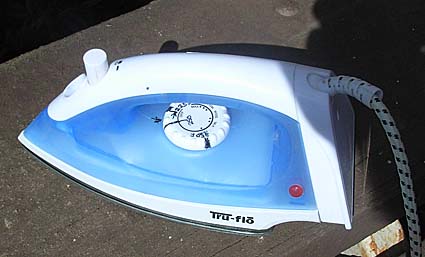
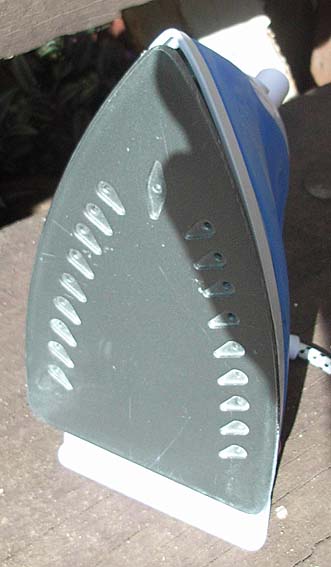
If it helps - the little iron I got from Hervey Norman is a Chinese generic basic steam irom, branded "Tru-Flo" (See photos). I don't think it's anything special, but I'm getting satisfactory results on Ceconite 102 with it.Wow!!!! and here was me thinking I would just get the make & model of a few irons that have been successfully used by others. Dafydd seems to have come closest in this regard.My thanks Dafydd.Just to expand on my situation a little further: I am using the Stewart System - the manual is very comprehensive and goes into some detail regarding iron specifications.I have three irons (in the house) - so far non meet the specs. In the main, the hot plate fails to heat evenly with large variation from side to side & front to back
My research to date would suggest:
So called "dry irons" seem to be below the 1100 watt minimum requirement.
All modern irons have "auto shut off"
Regarding "auto shut off" - while I see the benefit in having an iron that is on when you expect it to be so ie continually on (no auto off) I think that an iron with auto off could be managed, it would just require that it be checked for temperature each time you pick it up. Tedious to be sure, but "do able" - I have several thermometers including a cheapy infra red (instant readout) from Super Cheap to assist in temperature monitoring.
Pinking Shears ??? - Not sure how we "drifted" on to this - I bought my rotary pinkers through Stewarts
Heat gun promoters - I like to flatter myself I think "outside the square" however I feel that this is a step too far - check out the Stewart manual and their very precise temperature requirements for progressive shrinking of fabric and their warning regarding overheating.
Anyone like to recommend an iron ie make/model
I suspect the iron itself is not as critical as how you calibrate it. I used a mercury-in-glass laboratory-style thermometer, with a dab of heat-sink compound as sold by Jaycar - tho I suspect any of the electronic supply companies would have this, and I spent most of an afternoone calibrating it, with the iron sitting on the bulb of the thermometer on some scrap dry rag (i.e. pretty much insulated from the outside air); I used the procedure outlined by the Poly-Fiber catalog. I would suggest from this experience that you need to find the temperature that the iron cuts out on the rise, and the temperature that is cuts back in, on the fall, and do that several times, for each required temperature setting. Then try to adjust the control until it cuts out at the upper limit for the temperature range you are after (Poly-Fiber gives a nominal 225 deg F, 250 deg F and 350 deg F, with some indication of the tolerance); and in general, get the "feel" of how the temperature control actually works.
I rather doubt that any iron with an aluminium sole-plate will exhibit much of a temperature range across the sole-plate under the conditions for shrinking fabric, which drag heat out of the iron a lot more slowly than it is designed for when it is operating in steam mode.
In any case, the Poly-Fiber instructions are to go right over the surface three times at each temperature, to get the shrinkage even. I did it by the book, and it worked for me.
-
1
-
-
CAO 95.25 no longer exists. Are you looking at a kit, for -19 registration; or are you looking at a complete aeroplane? If it's the latter, then you need to start with the design standard and the category limitations, and design from there. Do NOT make the mistake of building the aeroplane first, and then trying to fit it into a certification category; if your product needs a TC, you have to design compliance into it.Whether you'd need a twin endorsement or not isn't really the issue. A 95:10 aircraft isn't limited in the number of engines and can be flown with an RAAus certificate so it could have 20 engines (or motors if electric for example) placed anywhere you like and you don't need a multi-engine endorsement. But - 95:10 aircraft are limited to one seat.And - 95:25 specifically states one engine and one propellor, so you can't have more than one engine or one engine driving two propellors or one engine and no propellor (i.e. a jet). 95:25 aircraft can have one or two seats.If you built a push-pull twin engined two seater then it would have to be in GA experimental category which means you need a PPL with DL(aviation) medical at the very least and would have to have a multi-engine endorsement. Actually I'm not even sure you could fly it with the reduced medical requirement if it's a twin, you might have to have the Class 2 medical.
The quick single handed folding method is sorted, less than 2 minutes with ease, no controls to disconnect, just rip a metre of velcro, pull out two pip pins, unclip one rigging cable connection, fold two different items, replace two pip pins in different locations to secure everything for trailering or compact storage (dimensions 5.8m long, 2.2m wide, 2.1m high). Any guesses?
-
'Scuze me - the Gazelle is a type-certificated aircraft, n'est-ce pas? In that case it is required to use a type certificated engine and a type-certificated propeller. If you want to use a different type-certificated propeller, it is quite possible to get that approved by a CASA design signatory (used to be a CAR 35 engineer - now under CASR Part 21 subpart M) provided it meets the certification requirements. You would also have to prove that the aircraft, so fitted, meets the performance requirements of its certification basis. This is standard stuff in GA. What you can't do is slap on any old propeller that you happen to like.I suppose that in responding positively to pettifogging behaviour we may ignore far more serious issues such as Gazelles being left inefficient and under performing by the requirement to only use the original specified propeller. This undoubtedly helps keep the fleet and those who fly in them safe! Why are we required to affix in a prominent positition a label stating that the aircraft does not conform to airworthiness standards when we are, in fact, over regulated by dolts? Don -
You need an iron with NO "auto off", around 1200 watts. I got mine from Harvey Norman as a discontinued line, for $11 (yes, eleven dollars). It has a teflon-faced sole plate, and works quite well with Ceconite 102. However, I suspect it does not use a thermostat that measures the actual sole-plate temperature, but a simmerstat (like most electric stoves) that regulates the current according to a small heating element inside itself. As a result, its calibration is fairly loose at 225 degrees F but it is fairly closely regulated at 350 degrees F. You need to use a mercury-in-glass thermometer to calibrate it; read the Poly-Fiber manual.Anyone got any recommendations on best iron (available in Australia) or what worked for you??It would be nice to get an iron that had a real thermostat in it, but I doubt these come without "auto-off"; most modern irons seem to be festooned with bells and whistles one simply does not need for fabric work.

RAAus Future
in Governing Bodies
Posted