

Dafydd Llewellyn
-
Posts
1,513 -
Joined
-
Last visited
-
Days Won
43
Content Type
Profiles
Forums
Gallery
Downloads
Blogs
Events
Store
Aircraft
Resources
Tutorials
Articles
Classifieds
Movies
Books
Community Map
Quizzes
Videos Directory
Posts posted by Dafydd Llewellyn
-
-
Do you know how to check if the fuel contains alchohol? (add a small amount of water to the fuel test sample. If you get a much larger amount of water as a result, it had alchohol that had absorbed some water, but not quite enough to make it separate from the petrol). Alchohol in the fuel is always in danger of separating, if it has time to absorb sufficient moisture from the air - so it's not a good risk in a flying machine. If the alchohol separates, your engine will be running lean, because straight alchohol needs a larger main jet to give the correct mixture.
Also, an in-line filter of the common styles normally seen, is asking for fuel starvation due to filter blockage - an accident going somewhere to happen, in fact. A gascolator (fuel sediment bowl with a simple brass screen at the top) is vastly less susceptible to clogging; and it tends to self-clean whilst the aircraft is not in use - the garbage falls to the bottom of the bowl, and gets removed when you do the morning fuel drain check, along with any water that has made it to the sediment bowl. Get one that has a drain valve fitted to the sediment bowl, and drain a bit from it after every refuelling and at the daily inspection.
-
No, I think you missed my point. I was definitely NOT talking about fully-developed spins. Those normal category aircraft (and some ultralight types, whose manufacturers were sufficiently conscientious to do so, which were tested for one-turn spins, the term means exactly what it says - here's the requirement, as written in FAR Part 23 (most design standards are similar). There was no requirement in the design standard for the Skyfox or the original Jabiru, but we did it anyway.You missed the point I was attempting to make. I am NOT advocating spins in Ultralight aircraft. I asked the question whether or not Normal category and LSA ultralight aircraft were tested to a one turn spin recovery at all (as normal category GA aircraft are) as part of their certification /approval process. The question was in relation to whether or not you could/should legally teach "INCIPIENT" stall /spin recognition and recovery, NOT FULLY DEVELOPED SPINS in RAA training aircraft (it would seem perhaps safe in Jabirus). If it is properly taught by an instructor, exceeding VNE should not even be a risk. Hell if you are a dick head you can exceed VNE in any aircraft, you don't have to be doing stall/spin training.On another note Drifters have been spin tested, just probably not an approved testing regime, the first Austflight Drifters were stated as unspinnable, and I "was told ..." rigging was altered to improve performance and they "became" spinnable. Wayne Fisher developed an experimental VH registered aerobatic Drifter VH-VSI (hopefully with a beefed up structure). Also I believe there was an aerobatic version of the Winton Sapphire (hopefully you would know whether that is true or not). In any case my question was related to testing to at least one turn and recovery as normal category GA aircraft are.Dafydd all I am trying to establish is whether or not we actually should or do teach true incipient stall/spin recognition and recovery as stated in the RAA syllabus, because I don't believe we do teach what the syllabus says.
§ 23.221 Spinning.
(a) Normal category airplanes. A single-engine, normal category airplane must be able to recover from a one-turn spin or a three-second spin, whichever takes longer, in not more than one additional turn after initiation of the first control action for recovery, or demonstrate compliance with the optional spin resistant requirements of this section.
(1) The following apply to one turn or three second spins:
(i) For both the flaps-retracted and flaps-extended conditions, the applicable airspeed limit and positive limit maneuvering load factor must not be exceeded;
(ii) No control forces or characteristic encountered during the spin or recovery may adversely affect prompt recovery;
(iii) It must be impossible to obtain unrecoverable spins with any use of the flight or engine power controls either at the entry into or during the spin; and
(iv) For the flaps-extended condition, the flaps may be retracted during the recovery but not before rotation has ceased.
This has to be done at the maximum weight and the most aft CG position - one normally tests with the CG at around 1% of the mean aerodynamic chord further aft than the eventual POH aft limit; and it's quite common to weigh the aircraft before and after the sortie, with the pilot aboard, to ensure the test loading was within tolerance. One has to test with ailerons neutral, aileron into the spin, aileron against the spin, power on, power off, and for all flap positions (if the aircraft has flaps).
I did the certification spin testing for the CA22 Skyfox and the original Jabiru; and after 360 degrees of rotation, which took about 2 seconds, I had the utmost difficulty in staying within the aircraft speed limits during the recovery. Could not stay in the spin for 3 seconds, the wings would have come off, I suspect. I usually hit about 140 kts IAS in the Jabiru, which is too damn fast in an aircraft without control mass-balance, and about 115 kts IAS in the Skyfox, which is also too damn fast for those wings. So, if one is going to do incipient spin training on such an aircraft, you are going to be within about 2/3 of a second of being a test pilot - and you won't be wearing a parachute, as I was. Therefore, my view is that the safety margin for incipient spin training is too small, in these aircraft.
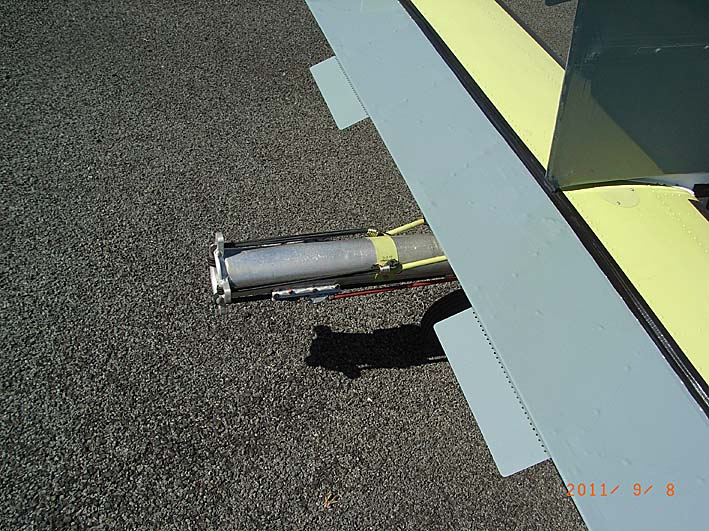
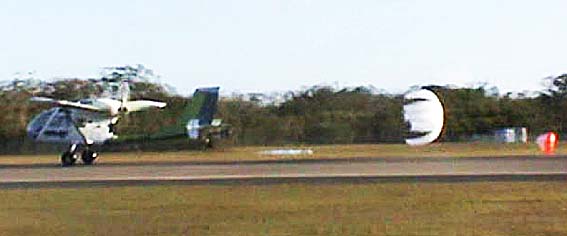
Also, those tests were done with a spin-recovery parachute system installed - there's quite a bit of knowledge involved in making a satisfactory one of those (see photo)

-
 1
1
-
 1
1
-
-
Try the gliding club at Jondaryan, or at Kingaroy, or at Massie field at Warwick, or at Caboolture, or at Boonah. They charge a lot less than $400 per hour.For those that are interested I dropped into talk to an instructor in Toowoomba about doing some upset attitude and spin training. He dose it in a ct 4 and the cost is around 400 an hour in this aircraft and recommends 3 to 4 hours should give you the idea of what's fun what scares you and what will kill you. can anyone recomend any where else in the SEQ area that can offer this sort of training ?Marc
-
No - the Drifter was NOT tested. See my earlier posts on this thread. The Jabiru and the Skyfox were. However, it's dangerous to use these aircraft for any form of aggravated stall training because they pick up speed very rapidly, and the danger is that you will exceed to flight envelope (and lose a wing from flutter or divergance - a real possibility in a Skyfox). How many times do I need to say it? DON'T DO THAT SORT OF THING IN AN ULTRALIGHT AIRCRAFT.Thanks for that David, it would surprise me too, I guess you will show me one day.Are the typical RAA trainers and LSA all spin tested to at least one turn? I know the Jabiru and Drifter were.-
 1
1
-
-
I'd agree; the un-blanketted rudder area below the tailplane is most important. The Jodel is well-endowed in this regard. I suggest you download NASA TN-D-6575; however quite a few French aeroplanes of that era needed anti-spin strakes as well, so I suggest you study the matter carefully before trying it. When one is test flying an aircraft for spin recovery, no sane test pilot will fly without a spin recovery parachute installation; see the Flight Test Society of Australia Symposium papers for 12 March 2009 (I do not know whether this is available from the internet).I'll stick my neck out and say it is a lot better than most. The part below the elevators is large enough to be effective and the small fin before the rudder energises the flow around the rudder above. Don't use my statement to encourage you to try it, but I'm fairly confident of most French designs of that period. Nev -
Seems a bit off topic, tho I agree - I've moved to an oldish Subaru, after a turbodiesel Pug 405. The Subie is simply better put together, passion or no. Surprised me, actually. Wish it had a diesel in it, but the EJ22 is fine if you use the right oil.Ha ha Daffyd .. but if there was no "Chevrolet Passion" on behalf of the customers, the metal would not sell well. Chevrolet has a cult following and if that is not brand passion, I don't know what is. I don't share that passion, I was raised by a Ford mechanic, but even I have lost my Ford passion these days and drive 'Rice Crackers' that have hair driers fitted to them and have CI (Diesel) engines. LOLGetting back to spinnable aeroplanes, there is no excuse nowadays for designers getting the empennage as totally wrong as, for example, the Lancair Legacy (tho in fairness, they made the vertical tail pretty large). If you want to see how an empennage should be designed for a spinnable aeroplane, look at the Pilatus PC 9. Or even the Blanik. These aircraft put the fin leading edge well ahead of the tailplane leading edge, and they do NOT use a swept-back vertical tail - both of which have the result that the vertical tail is largely unshielded by the stalled horizontal tail. T-tails achieve that too, of course, but they are nasty from a flutter point of view, and expensive to certificate for that reason. Yes, putting the vertical tail largely ahead of the horizontal tail means it has a shorter lever arm about the CG, so it has to be bigger. No, I said BIGGER. Pretty? Well, to me, form follows function - and I shudder every time I see an empennage having a smallish sharply-swept fin whose leading edge is at the same fuselage station as the tailplane. If it has ejection seats, or stick-pushers, OK it may be necessary for high Mach drag - but for aircraft that operate below about 0.6 Mach, it's a sign of excessive concern over "style" on the part of the designer, in my books.
The Lancair was designed by a hair stylist - and it shows. In the case of the 162, I can only surmise that the sales dept. dictated the style, and engineering had no say in it. Damn fool way to go about it, in my view.
-
1
-
-
"Chevrolet does not exist to build cars. It exists to add value to metal" . . .Yeah I've seen Guys running outfits and suggesting that knowing nothing about the game will bring a fresh view into the business. If you believe that you believe anything. If you are ONLY a pilot, and can't see past that, that wouldn't help to be a CEO. Enthusiasm for small planes is what got Cessna going. Lawyers killed off the three in the USA. If you are designing and building PLANES It wouldn't hurt to be a pilot and know what pilots WANT. After all, PILOTS are the ones who buy small planes. Nev -
I suspect that you are entirely correct; RAA knows neither what to do nor how to do it. It has collectively a set of ideas, but it does not know how to decide on priorities or method.I have to agree. While I'm all for proportional representation it's difficult to see how this helps RAAus. Do the needs of a RAAus pilot in NthQld really differ from those in Victoria? If a clique of well qualified Caboolture (Qld) people were elected to the board I fail to see how this would harm the interests of myself in Sth NSW (apart from Natfly being held at Caboolture airport ). RAAus and it's members are bound by the regulations in its Ops and Tech manuals, which in turn are controlled by aviation law. The main problem we seem to have at the moment is actually complying with our own regs and the laws that constrain them.Let's get the outfit fixed and running properly. If that takes cutting back the board to a manageable size where important decisions can be made in a timely manner then so be it.I'm rather surprised that Jim has said that the newly accepted model is one where the board is "to set policy and strategy for the organisation". Jim also says this model is used widely in the "outside world". Is this really how the culture within the RAAus thinks? Are they that insular from the "outside world"? Have they really only just now realised that perhaps a governance model that most organisations in the world use might just be something that RAAus could also use??
If true, therein lies much of the problem with RAAus.
George Markey, Bill Dinsmore and I had a very well-formed set of ideas as to what needed to be achieved and what the overall aims were, when we were setting it up in the first place. Those ideas were not airy-fairy things; they were very specific, tangible objectives. It seems to me that neither the membership nor the elected management nowadays have anything like such well-defined objectives; most of the ideas I see in forums (like getting more airfields - as if that were a realistic objective for the RAA controlling body!) are not at all well thought out.
Also, we had a good overall knowledge of the regulations. That is clearly lacking throughout RAA in general, though there are individuals who do have a fair knowledge.
Times have changed, and the original objectives may not be very relevant now; but the method of getting to them is still valid:
Firstly, ask yourselves (set up a referendum, or something of the sort) what are the ten most important issues facing RAA. Then sort out the top four of those.
Second, ask yourselves just exactly how each of those objectives can be achieved - and I mean, in detail, step by step, not just arm-waving. This needs expertise in the regulations; although it's largely spelled out in the existing documentation, RAA needs to comprehend the background behind that documentation; CASA is constrained by the regulations just as much as RAA is - and if you understand that, you will see that the CASA requirements for RAA are somebody's interpretation of how RAA needs to behave in order that CASA's obligations under the regulations can be met. With that kind of understanding, progress is possible; otherwise, RAA is simply a squirrel on a wheel.
Third, figure out what you need by way of resources to implement the objectives - out of that will come the prescription of the capabilities needed in the key personnel, and a list of specific tasks (like, getting a filing system that works).
Cut this down so it has no more that three main objectives, and select the best three people you can find, each to pursue one of these objectives, and then get behind them and give them the resources to do the job.
I think you will find that the three principal objectives are fairly easy to determine. Once the tasks that come out of this process are accomplished, then and only then, go after the next three objectives.
In other words, stop floundering and get down to tin tacks.
-
 1
1
-
 1
1
-
-
Quite correct. All the Auster series use the same airfoil as the Bonanza, Baron, and just about every high-performance piston aircraft subsequent to the Spitfire that didn't succumb to the lure of "laminar-flow" airfoils - i.e. NACA 23012. (Still in use on quite a few modern aircraft, also - I think Cessna used it on the Citation 1). And yes, Gipsy Major engines require an additional oil scavenge pump and an "inverted" carburettor, to run inverted - some Chipmunks were fitted for it.My recollection is they were clipped wing and a separate endorsement. ( Such a demanding aircraft.) tee hee Mr Llewellyn would be able to fill you in better than me there as to wing section. As an opinion I would be surprised if it was symmetrical as the engines never ran inverted. They lose oil pressure fairly quickly and you should wait till the pressure is regular before applying power after you have been mucking around. Do it in a Tiger instead. There's plenty of them around and find out how you feel with nothing above you and you go inverted..Nev. -
I am, I think, able to supply a drawing; however you will need an Engineering Order to fit it, and I retired from CAR 35 work in 2011, so I cannot provide that. Whatever you do, do NOT put an American "gate latch" release (as sold by Aircraft Spruce etc) on it. Best choice is a Tost aerotow release; you may be able to purchase one from GFA.Thanks Dafydd,Mine is a J1B, the manufactuer's hand book says spins approved, the CAA approved POH says spins not approved. Got me bluffed ...BTW Dafydd, this may interest you. Mine (VH-KBY) was operated by the Wagga gliding club back in the 70s and was pranged and totaled on an EFATO towing a glider. It was subsequently fully restored in 1998, but without the tow hook (damn it).
She is currently undergoing maintenance and I am looking for a tow hook, because the LAME at Luskintyre has acquried a 1938 single seat timber German Glider that has a max towing speed of 47 knots, which the J1B can manage. So in the not too distant future I will be looking for a tow endorsement and may be towing an antique glider out of Luskintyre. Perhaps you may know where I can get an Auster glider tow hook assembly?
I have never spun a J1B, tho I have about 600 hours of glider towing in them (and am pretty deaf as a result); I always thought they were spinnable, but never tried it. Best glider-towing propeller is the Bishton one (I do not recall the part number - probably BB 8150)
-
1
-
-
No, the J5G was the Cirrus Autocar; the aerobatic one is the J5F. The J5B is the Autocar with a Gipsy Major. The J5G is a 2400 lb MTOW aeroplane with 1000 lb disposable load, so they were actually quite capable. Still maintenance-intensive, of course.Isn't the J5G the aerobatic one. There is also a good restored aerobatic model at Kempsey. -
I'd assume it would have an operations manager and a technical manager, just as it does now - except they'd be directors of the company (and not the sole directors) so they would have a stake in getting it right, as well as getting it done. Training comes from the CFIs of the training schools, not from RAA; RAA's function is to set the required standard. The directors would be doing their damndest to get "the best deal". However, they'd bring some real relevant expertise to the management of the organisation. I don't see that that has any effect on the social side of it. Advertising for the TM as though you were advertising for an up-market office boy, won't cut it.If they only have one job to do and that is to follow CASA's rules, nothing more. . I can't see that you have followed this through. what No training No education. No trying to get the best deal. No social side No member input on rules and structure.. I think we would be looking at BIG changes there. Could we have achieved what has been so far under you proposal?. I can't see how. Just accept what is dished out.? Give me another hobby. Nev -
A propos of that, for what it may be worth, George Markey made a remark, not too long before he died, that the way to run it would be to set it up as a limited-liability company, and give the technical people and the managers directorships, and make the members shareholders. I've not thought this through, but somebody might like to.Realistically, the laws of physics and the other rules we must abide by do not change no matter where you are in this country. They have one job to do, that being to make sure we all safely follow CASA's rules, nothing more. You could probably effectively outsource it to somewhere in India and get as good or better result as we currently have. -
Because I was involved in the original set-up of the AUF; and I hate to see so much potential go down the tube due to stupidity. I was a member for about 20 years; and its first tech manager. I'll spit orange pips if I want to.It is interesting to note how many people who don't have enough interest to even be a member, and thereby vote,[and support the costs involved] have so much to say about how an organisation they don't belong to should be run. Why bother?-
2
-
1
-
-
If you are landing at an aerodrome that has a tower, the crosswind component will be being recorded. Some aerodromes have no tower but are BOM reporting points; there's usually a record of wind strength and direction. So don't bet that the insurer cannot prove you were exceeding some crosswind value.
-
I have to say that this thread exemplifies the reasons why I am no longer a member of RAA.
What I see here, is a conflict between capability and proportional representation. What I cannot see, is what the importance is of representation based on geography. RAA contains a number of identifiable interest groups, based on the kinds of aircraft they choose to fly; these are all set out in CAO 95.55 and CAO 95.10. If proportional representation were of any consequence at all, I could understand its being based on the representation from each of these groups; 95.10 people tend to have the same needs, wherever they are based, so do the operators of LSA, homebuilt, etcetera. Each group has its particular desiderata, and the numbers in the group should perhaps bear some relationship to its representation on the Board.
However, I rather doubt that RAA needs proportional representation at this point in time; I suspect it needs "12 wise men" - and you don't get that by proportional representation. RAA has major problems that need competence, rather than loyalty. After those are sorted out, if the organisation still exists, maybe there will be an opportunity to do it the old way - tho I doubt it.
FFS, stop playing sand castles and fix the dyke instead, before you all and your sand castles are washed away. I've seen kindergarten kids with more sense . . .
-
2
-
2
-
-
Not that I'm aware of (not that that proves anything). There was a J5G conversion on floats that was done by Aerosmith in the early 1970's, but I think that had an 0-360 in it, too.Was there one done with a Cont 0--300.? I recall a Yellow and black? one at Bankstown. in the 60's. Autocar I think The six cylinder would be nice and smooth. Nev -
Yes, I know that one - nice aircraft. However the J5G is a bit heavier and it goes rather well with the 0-360.Mine has an 0-320 160 hp up front. Was originally built with an 0-290, converted to Gypsy at Sydney by Kingsford Smith then rebuilt and its current engine fitted at a total rebuild a few years back.Kaz -
My STC is for a Lyc 0-360-A (180 HP); there are about half a dozen of them on the register.A 150-160 HP Lycoming would be a nice move. Should save a lot of weight. You might just have to extend the nose a bit for balance. If you go bigger it will exceed Vne in cruise .The Mk V had a "flat' motor. Nev -
And if anybody has a J5G or J5B and wants to put a Lycoming in it, I have the drawings and the STC
-
Erhmm - the Auster airspeed system has about 13 knots of position error at the stall - i.e. it reads about 13 knots low. That error reduces as the speed increases. A knot or two fast makes a big difference - and so does the smallest amount of water in the plumbing.Actually I'm a great believer in spoilers. Maybe one day they will be more universally used in the more efficient types. Differential ones make turning easier. Ailerons are 1/2 way to wing warping. though of course they ( the spoilers) don't work well upside down. Bugger!..PS Hot bitumen IS an excuse with an Auster. Nothing should fly that slow anyhow The slightest gust doubles the lift in that situation. Nev -
Not clear to me what you mean. The Dromader is based on the Ayres Thrush - probably pretty close to the Bull Thrush (R1820) and I've seen quite a bit of that spar design. It's a non-tapered cantilever wing, and the spar caps are steel - but the web stress at the wing root is a major problem in that wing. I've done plenty of fatigue life calculations using the cumulative damage hypothesis - it's standard practice, see FAA AC 23.13B - and a small increase in the 1-G stress makes a big difference to the fatigue life. The cumulative damage sums go out the window when the MTOW is arbitrary. The agricultural operators have been in denial about fatigue for decades. So, it would not surprise me if that accident was a fatigue failure; but we are hypothesizing ahead of the evidence.Actually not. The formula for fatigue is miners rule... check the other axis of the curve... -
Yes, well, agricultural aircraft can operate at whatever weight the pilot considers he can get off the ground. Add this to a cantilever wing, and you have a formula for wing fatigue failure. See http://www.ruudleeuw.com/tanker130.htm
-
There's a new EASA AD, # 2013-0252, which mandates a LET Service Bulletin #L13/116a, that calls for conductivity check on the spar caps of Blanik wings. It's arguably irrelevant to L13A1s and L-13s modified under STC SVA-542; and I am requesting an exclusion from it for Australian-registered Blaniks that incorporate either of those modifications. Watch this space.
-
 2
2
-
 ). RAAus and it's members are bound by the regulations in its Ops and Tech manuals, which in turn are controlled by aviation law. The main problem we seem to have at the moment is actually complying with our own regs and the laws that constrain them.Let's get the outfit fixed and running properly. If that takes cutting back the board to a manageable size where important decisions can be made in a timely manner then so be it.
Spin practice
in AUS/NZ General Discussion
Posted
In answer to your third question: Yes, all "normal" category aircraft must meet this requirement. However they usually have somewhat higher stall speeds than are permitted for recreational aircraft. Since the way the flight envelope limiting speeds are determined is based on the flaps-up stall speed (in a roundabout sort of way), the design diving speed (normally 111% of Vne) for recreational aeroplanes is usually fairly low; however gravitational acceleration is not similarly scaled down for them. As a consequence, when you have one of these pointed vertically downwards, it will very quickly exceed its maximum design velocity - whereas a higher stall speed GA aeroplane takes a bit longer. So whilst it was perhaps not too unreasonable to allow incipient spin training in normal category GA aeroplanes, mindlessly carrying that over to recreational aeroplanes is considerably less reasonable, from my experience. Also, do bear in mind that most of the common 4-seat GA trainers had either dual certification - normal category at MTOW, and utility category at a reduced weight corresponding to two occupants - or, in the case of the C150/152, were utility category at all weights - so they had higher limiting airspeeds than a minimum "normal category" aircraft.
Therefore, in answer to your second question: I think you are correct; in most RAA aircraft it is unwise to go beyond a stall with wing drop - which as somebody pointed out, usually involves only about 90 degrees of rotation. And yes, this constitutes a deficiency in these aircraft as trainers, in my view.
I did my basic training on Chipmunks, which were of course fully aerobatic aircraft, with "classic" spin characteristics. Full spinning was part of the PPL syllabus, back then (1963). I've taught many students spinning, as a gliding instructor. My personal view is that it is important to expose students to the full spin experience sufficiently to allow them to cease to be disoriented by it and start to react automatically; about three or four spins of maybe two full turns will usually achieve this. Gliders are good for getting over the disorientation, because they spin a trifle more slowly than short-span ultralights. The fastest-spinning aircraft of my experience was the Ultrabat (22 ft wingspan), which rotated at about 360 degrees per second; I was able to recover by rote, but the world did several barrel rolls afterwards (I simply followed it, and eventually it all stopped - but one does NOT want to expose a student to that sort of thing.)
I also think that normal training procedure has a serious defect, in that it does not train people to recover from any stall situation by "unloading the wing"; the training patter talks about lowering the nose & regaining speed, which imparts very little if any understanding of the actual aerodynamic process involved in regaining attached airflow over the wing. One "unstalls" the wing by reducing the angle of attack; and since there is normally some hysteresis in the process, one often needs to reduce the angle of attack significantly. If you "punch" the stick forward sufficiently to rapidly reduce the angle of attack by five degrees or so, you will unstall the wing with almost no loss of height. The conventional patter achieves this, but in slow motion, and requires a much larger departure from the flight path accordingly. That's OK for the initial exposure to stall recovery, but the training should not stop there, in MHO.