

Dafydd Llewellyn
-
Posts
1,513 -
Joined
-
Last visited
-
Days Won
43
Content Type
Profiles
Forums
Gallery
Downloads
Blogs
Events
Store
Aircraft
Resources
Tutorials
Articles
Classifieds
Movies
Books
Community Map
Quizzes
Videos Directory
Posts posted by Dafydd Llewellyn
-
-
Couple of points: What is being described here is not "flutter" in the normal sense of the word; it is extremely rare to come across a true flutter mode that is not almost explosively destructive; flutter is by its normal definition, a coupling between two separate motions (e.g., but not limited to, wing bending and aileron motion about its hinges) that can interact in such a way as to extract energy from the airflow to build up the ampliude of the motion. This is resisted by whatever inherent structural damping may be present. Generally, if the energy is extracted from the airflow faster than it can be dissipated by the structural damping, the motion "runs away" - and when this happens, what the pilot experiences is not "flutter" but FLUT! and a shower of pieces of aeroplane. DJP is almost certainly correct in ascribing it to a Von Karman vortex street; and the Jabiru fix tends to confirms that.
It's therefore a nuisance-value vibration - but if allowed to persist, it could - at least potentially, in the long term - reduce the fatigue life of the lift strut.
However most jabs up to & including the 160 do not have mass-balanced ailerons; nor for that matter does the Blanik, and I venture to guess, quite a few recreational aircraft types. For such aircraft, the stiffness of the control linkages and freedom from slop anywhere in the system is important; and the speed limits should be rigorously observed. Any aircraft with non-mass-balanced control surfaces will flutter if you fly it fast enough, and when it does, the effect would be like a bomb going off. The friction of the Jabiru control cables is probably a major part of the damping that stops the system from fluttering.
-
 1
1
-
 1
1
-
-
Yeah, well I'm about half-deaf - and it's not entirely a disadvantage. But Oscar is dead right.
-
Hmmm. The usual council run-around, then. The B50 had IGSO-480 Lycomings, not Continentals, I thought. With ejector exhausts, which act as megaphones. The really annoying noises are the ones that keep happening all day; the occasional Tiger or whatever puttering overhead is only a nuisance if it keeps doing it; if it goes past on its way to somewhere else, it's not really an issue. So any operation that is repetive at the same site is likely to provoke a response if it continues long enough.When Ramblers were using it was a short term deal while owners, council and developers fought it out. Always going to rezoned and built on.-
1
-
-
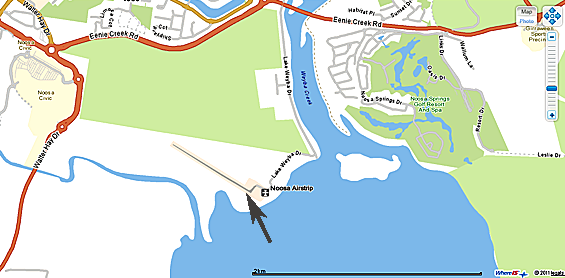
This is the strip I mean; I enquired several times about it, because I was looking for a site that I could use occasionally as a base for a day or two for aircraft cooling and climb performance testing over the water, along the beach just north of Noosa. That sort of testing needs smooth air with no temoerature inversion, and those conditions occur just offshore in gentle sea-breeze conditions. It's on private property; each time the answer was as I described. I've no idea what's there now. I suppose it could have been the B50; a Queen Air is just a B50 on steroids. Whatever, it did nobody a service by getting the place closed.Never seen a Queen Air on the jump scene> But I suspect you are referring to Ramblers 'Twin Bonanza'. Two thumping geared supercharged Continentals.. I'm sure Macca would be pleased being called an idiot. Sure it was a direct result of the noise the T Bone made? What is there now?
-
The ICAO standard is required by the aircraft noise regulations, 1984, which are regulations made under the Air Navigation Act, 1920. I'm no legal expert, but I think that came under the heading of a Disallowable Instrument in the Australian Federal Parliament, and that makes it Federal Law. So to my limited knowledge, a legal challenge to that standard would seem unlikely.In my very quick scan of the regulation, I was stunned to read that the microphone results in the ICAO standard appear to be required to be doctored at the upper and lower ends of the spectrum - the upper end in particular being the area which grates on us when we hear it. (Mid range is rather like an air conditioner - hardly noticed.)I hope I'm wrong with this, because that could cause legal issues where there was a noise dispute. -
Here are the relevant requirements from FAR Part 23:I really think each tank should have it's own tap/valve. Pilots have more important things to think about than flying out of balance (on purpose) and watching for crossfilling.§ 23.951 General.
(a) Each fuel system must be constructed and arranged to ensure fuel flow at a rate and pressure established for proper engine and auxiliary power unit functioning under each likely operating condition, including any maneuver for which certification is requested and during which the engine or auxiliary power unit is permitted to be in operation.
(b) Each fuel system must be arranged so that—
(1) No fuel pump can draw fuel from more than one tank at a time; or
(2) There are means to prevent introducing air into the system.
§ 23.957 Flow between interconnected tanks.
(a) It must be impossible, in a gravity feed system with interconnected tank outlets, for enough fuel to flow between the tanks to cause an overflow of fuel from any tank vent under the conditions in §23.959, except that full tanks must be used.
(b) If fuel can be pumped from one tank to another in flight, the fuel tank vents and the fuel transfer system must be designed so that no structural damage to any airplane component can occur because of overfilling of any tank.
§ 23.777 Cockpit controls.
(a) Each cockpit control must be located and (except where its function is obvious) identified to provide convenient operation and to prevent confusion and inadvertent operation.
(b) The controls must be located and arranged so that the pilot, when seated, has full and unrestricted movement of each control without interference from either his clothing or the cockpit structure.
© Powerplant controls must be located—
(2) For single and tandem seated single-engine airplanes, on the left side console or instrument panel;
(3) For other single-engine airplanes at or near the center of the cockpit, on the pedestal, instrument panel, or overhead;
(d) The control location order from left to right must be power (thrust) lever, propeller (rpm control), and mixture control (condition lever and fuel cutoff for turbine-powered airplanes). Power (thrust) levers must be at least one inch higher or longer to make them more prominent than propeller (rpm control) or mixture controls. Carburetor heat or alternate air control must be to the left of the throttle or at least eight inches from the mixture control when located other than on a pedestal. Carburetor heat or alternate air control, when located on a pedestal must be aft or below the power (thrust) lever. Supercharger controls must be located below or aft of the propeller controls. Airplanes with tandem seating or single-place airplanes may utilize control locations on the left side of the cabin compartment; however, location order from left to right must be power (thrust) lever, propeller (rpm control) and mixture control.
(h) Each fuel feed selector control must comply with §23.995 and be located and arranged so that the pilot can see and reach it without moving any seat or primary flight control when his seat is at any position in which it can be placed.
(1) For a mechanical fuel selector:
(i) The indication of the selected fuel valve position must be by means of a pointer and must provide positive identification and feel (detent, etc.) of the selected position.
(ii) The position indicator pointer must be located at the part of the handle that is the maximum dimension of the handle measured from the center of rotation.
(2) For electrical or electronic fuel selector:
(i) Digital controls or electrical switches must be properly labelled.
(ii) Means must be provided to indicate to the flight crew the tank or function selected. Selector switch position is not acceptable as a means of indication. The “off” or “closed” position must be indicated in red.
(3) If the fuel valve selector handle or electrical or digital selection is also a fuel shut-off selector, the off position marking must be colored red. If a separate emergency shut-off means is provided, it also must be colored red.
-
Anything with a Continental IO-520 and a constant-speed propeller does that; TCM put the red-line RPM at 2850, so they could boast another 15 horsepower or so over the competing Lycoming (2700 RPM) at the time. The added RPM do not increase the aircraft's performance one iota; I recall some performance tests that showed you got the same climb performance at full throttle, at 2700 RPM - and it was a whole lot quieter. However, you'll never convince the pilots - they know it's producing more power at 2850, they can hear it . . .Wonder if he is running it hard due to the float drag. He just flew over the entire town then heading back into the area to land with full prop noise like he was in a red bull air race. Doesnt worry me but i bet its annoying someone.There's a strip at Noosaville that was permanently closed as a result of an idiot who ran a meat-bomber operation there for several years, using a Beech Queen Air - which must be one of the noisiest light twins ever built. Take you seaplane pal out behind the hangar and have a quiet word to him, would be my advice.
-
2
-
-
Taylorcraft Aeroplanes, Leistershire, actually. I've always wondered why they didn't get around to making some part of it from leather. It started out as an emergency measure to provide artillery-spotting aeroplanes for the British Army, but the ship carrying the Lycomings was torpedoed, so they had to stick Gipsy Majors in them.IF it was British you wouldn't fit in the cockpit or be able to work on it. Dafydd's just a perfectionist when design comes into it. Nev -
I asked you to look it up, because (a) I've used my monthly broadband quota, and (b) my recollection of the details is not perfect. Your reading of it accords with my recollection. Aircraft certificated prior to 1984 are exempt, I think, and those will be most of the wide open exhaust ones. However, the greatest source of noise by far is always the propeller.I did look it up and I don't need to wade through definitions of "aircraft" and other irrelevant thanks, you could have been a lot more helpful to everyone.What I did find after half an hour or so's searching was, and take this as very general because it could be subject to a few hundred other clauses of crap:Measurement is 2500 metres past brake release, so the faster you climb the better the result
Maximum noise is 70 dB(A) up to 570 kg increasing to 85 dB(A) at 1500 kg
To give you some comparison, ADR83/00 requirement for a Heavy Truck over 320 kW power is 83 dB(A) measured at 7.5 metres from the vehicle.
At your altitude attained by 2500 metres, you will be much further away than 7.5 metres, and the noise reading will diminish with distance, so that's not a severe standard, and I wouldn't be surprised if some engines could achieve it without mufflers.
I have always used ADR83/00 or it's predecessor ADR 28/01 in Planning arguments, because that is the acceptable, and legal community noise level 7.5 metres from the edge of a road, and the noise level residents are being subjected to in a built up environment. That comparison has been very successful in settling noise disputes,
-
If you are talking about the noise regulations, I posted the link earlier in this thread. Go look it up. The basic requirement for GA aircraft in Australia is ICAO Annex 16, chapter 10. Much too large to post here."How about posting the offending regulation so we can see what the problem is."Interesting how no one seems keen to spell out what exactly is the problem. -
Let's just set the record straight on that point. I've owned two Austers, and learned more than I really want to know about them as a result of that plus operating them as glider tugs. I also own an STC for putting Lycoming 0-360 engines into J5G Autocars, and I've written lots of EOs for them as a CAR 35 engineer. Yes, one can keep them going almost indefinitely, by the "George Washington's axe" approach. They are not all that economical to operate in the long term. However their weaknesses are largely a known quantity:For sure, and all these years later, they're still flying. Must have got some things somewhere near right.To be specific:
Airframe:
1. There is a weakness in the leading edge ribs, which are made from something like oversize umbrella frame material, on the upper surface, just ahead of the main spar. There have been several fatal accidents to glider tugs in the U.K. and one quite remarkable escape in Australia, due to this. The rib fails by upward buckling of its upper truss, under the very high suction load at that point, if the aircraft is exposed to a strong upward gust when flying at speeds above about 100 knots, and the failure propagates instantly to all the ribs in the wing. The cure is to replace all the wing leading edge ribs with pressed sheet metal ribs made from 0.050 inch material. This was done to the port wing of VH-WED, if my memory serves me correctly, after the owner managed to get it back on the ground with the entire leading edge of the wing buckled upwards. MORAL: Do NOT fly an Auster at more than about 95 knots, regardless of what its Vne may be - it is not designed for those speeds.
2. The ailerons have to be rigged about 3/4 inch down at their trailing edges, to prevent overbalance causing aileron "snatch" (abrupt hard-over) at the upper end of the speed range; this is caused by stretch in the aileron balance cable circuit, mainly due to extremely poor design of the aileron pulley brackets.
3. The flaps are barn doors, certainly - but if you are so foolish as to exceed the maximum flaps-extended speed, they will peel the rear spar out of the wing. The fix for this is to install steel-tube "A" frames, one at each flap bracket, running between the rear spar and the main spar, picking up on the flap bracket bolts, so the twisting load is not applied to the wooden spar.
4. Some aircraft have cast magnesium flap brackets, which are prone to rot away.
5. The control system pulleys are all too small in diameter for the cables, and they lack ball-bearings. They can be replaced with more modern pulleys, but the diameter problem remains. This shortens the life of the cables, and also causes considerable control circuit friction.
6. The main undercarriage pivot bolts bend in service and in doing so, crack the welded brackets on the longerons, because the design of the pivot lacked a spacer tube.
7. The main wheels are sized to use tyres made for Hurricane tail wheels, which are now unobtainable. The main wheel brakes are designed to fade completely after taxiing about 100 yards if there is any cross-wind, and the fairlead tubes from the heel pedals to the top of the undercarriage legs acquire a wear groove in them that completely locks up when the brake cables are replaced with new cables, so the brakes become completely useless. The cure is to modify the axles to accept Cleveland 600 x 6 wheels & tyres, and fit hydraulic toe brakes; there are several approved schemes for this.
8. The original tail wheel needs to be replaced with a properly-designed fully-castering one with a shimmy damper - a Scott 3200 is best. The tailwheel spring front bolt breaks regularly, in glider-towing it needs to be replaced at every 100 hourly inspection.
9. The early-type teilplane stubs had reinforcing tubes silver-soldered into them. The silver solder causes the stubs to crack, in the fullness of time, due to copper diffusion into tjhe grain boundaries of the steel. There is an AD on this; it really needs to be fixed by replacent the tailplane stubs completely.
10. The original fuel tanks are soft-soldered Terne plate, and they have an unfixable chronic leakage problem. The only cure is to replace them with made-to-fit welded aluminium tanks.
The pitot-static system has enormous errors, especially at low speed. It causes the ASI to under-read by 13 knots at the stall. This is the reason why many people find them difficult to land because they float. The do NOT actually land at 26 knots; when the ASI shows that, the real speed is 39 knots.
Engine:
1. The original magnetos are dreadful in too many ways to cover here; the worst is that the mechanical advance-retard linkage coupled to the throttle, wears the outside of the contact-breaker cam ring, and it only takes about 0.004 inches of wear here to prevent the points from opening at all. Lesser amounts of wear affect the ignition timing. The cure is to replace them with Slicks.
2. The engine anti-vibration rubber mounts - don't.
3. You need to wear ANR headsets, if you want to keep your hearing. They were invented too late, for me.
Apart from all that, they are quite fun to fly; but do respect their speed limits.
-
Really? When was the last time you had a loose baffle in a muffler?I think even Henry Ford was still in overalls in the factory when those issues were virtually permanently solved FH. -
If your fuel system has wing tanks and any way they can be both on at once, fuel cross-flow will be a problem, unless:
(1) The tank vents are crossed over - i.e. the left tank vent is on the right wing, outboard of (higher than) the outboard end of the right tank, and vice-versa; AND
(2) There is a tank ullage space vent line that goes from the high outboard corner of one tank to the high outboard corner of the opposite tank, and the bore of that line is larger than the bore of the vent lines. This ullage space interconnection line has been mandatory in FAR 23.975a(4) since about1975, but I suspect it is one of the things that has been left out of the "simplified" standards for recreational aircraft. It was introduced after a number of accidents where a loose fuel cap on a Cessna allowed all the fuel to be sucked out of the system; it's especially bad when the aircraft has rubber-bag tanks.
The problem with this sort of system is that there is a low point in each of the vent lines where it runs through the fuselage - so it is necessary to have a drainage provision for each vent line, separately. The fuel system gets complicated. It is also desirable to have a collector tank; you can prevent the collector tank from emptying itself to the wing tank in a sideslip by crossing over the feed lines to the collector tank. You do not normally find this level of detail design in recreational aircraft, unfortunately.
The problem of people taking off with the fuel turned off can be largely overcome by an arrangement whereby the fuel must be "on" before you can access the starter. There's at least one type that has this feature.
These problems have been around for about a century; there is really no excuse for lousy designs in fuel systems - but one sees it all the time.
-
Good point; CAO 100.7 is empowered by CAR 235 (which is what CAO 95.55 does NOT include in its list of exclusions) - so you could reasonably argue that that makes compliance with what's in the Drifter manual mandatory.I have my AC 43.13, none of my aircraft (Drifter and 95.10), have what I would call a maintenance manual, with the exception of the engine. If there is something specific about CAO100.7 that applies could you perhaps point it out? While we're not exempt, I can't see anything that might apply. It pretty much starts with stating all aircraft must be weighed prior to issue of an airworthiness certificate. I thought most of us didn't have airworthiness certificates, being the reason we have to have "fly at your own risk" placards. I am open to correction.Note: my Drifter manual does have a weight and balance procedure listed, along with a page for weights to be annotated. -
Yep - the first three were standard J1B.Yep...pretty much.And then when they were shipped out here many of them had quite significant alterations again. Mine had a new and bigger tail, different glass, a transverse seat for two in the back and a different engine.Many years later, a total rebuild and an 0-320 gave it a new lease of life.
Kaz
-
I have the type records for several marks of Auster; and the NSW Regional office of DCA had a paper on Auster types and how to identify them. Personally, I suspect they had a great heap of wings, fuselages, etc from subcontractors or whatever, and they simply took parts from the top of the heap & assembled them into an aircraft - and if it happened to be a combination of bits they had not previously come up with, they gave it a new model number, and just kept going . . .
-
Blimey you people go on with a lot of crap. See http://www.airservicesaustralia.com/services/aircraft-noise-certification/
If you own a factory-built aircraft it will normally have been put through noise certification by its manufacturer; I don't know what the paperwork process is, but the hard part of it is already done. If it's a homebuilt, you will need to apply for an exemption. They may not give you one if it has a pulsejet engine.
This is administered by Air Services Australia, it has nothing whatever to do with CASA. It's been the law for damn near 25 years.
-
2
-
 1
1
-
-
How many of you have (and use) (i) FAA AC 43.13-1; (ii) The maintenance manual for your aircraft (assuming it's not a homebuilt); (iii) An aircraft weight & balance authority (See CAO 100.7 - no, RAA is NOT exempt from it). The information is (mostly) available if you know where to look.So who teaches the teachers?-
1
-
-
The video says it's a J1NSome of you may have seen this before...if not here is 8mm footage of an Auster(anyone know what model?)towing a Kooka and Mucha many moons ago at The Isa...-
1
-
-
The Auster J1B makes quite a useful tug, for gliders up to 500 Kg MTOW, provided it has a Gipsy 10-1 in it . But ONLY if you fit the correct propeller; a Bishton 8150 (81 inches diameter, 50 inches pitch) or second best, an Adams A49. There's no third best. It does need an oil cooler - The standard J1B cowl had a scoop for one. They were made by Delaney-Galley and they are as rare as rocking-horse manure. Without these, you will simply flog the engine to death. The one we had at Bathurst, set up this way, was VH-KCJ. You need to remove every non-essential item of weight. If yours has a Gipsy 1 in it (bronze cylinder heads) forget glider towing. The aluminium-head ones can handle it, but you have to be VERY careful not to shock-cool them. You will also need a glider-towing flight manual supplement - LOL.Yes Nev, I was thinking of the potential overheat. Dafydd suggested the correct prop which I am certain would be a lot finer than mine. I cant get anymore than about 1900RPM on take off (max power is at 2100), mind you the Tacho is a little sticky on mine, so it is hard to read accurately. She cruises at 91 knots at 1900 RPM, so it would definitely be a cruise prop I would think.Austers has a tendency to overheat in Oz without some proper cowl clearances, I was going to fit CHT and EGT gauges on mine, just out of curiosity.-
 1
1
-
-
Yes - though I must say, sitting at the holding point and watching a 737 or whatever, pointing straight at one just before the pilot kicked it straight, is an enlivening experience . . .Both.Weekend fun - out of balance, into wind wing down, nose straight, touch down on into wind wheel.Day job - in balance, crabbed, offset upwind from centreline, kick it straight (holding wings level) during the flare. Otherwise a) you could be risking a pod scrape, and b) the passengers all think they're going to die!
-
1
-
-
I did the original flight testing of the lightwing when it was fitted with the Jabiru 2200. Next question?I' d like to throw Daffy the duck in my Lightwing and just see how well he would do, with a bunch of video cameras set up. Well maybe not my Lightwing, maybe someone else's ............Talks cheap, but it takes money to buy Whisky !...............-
1
-
-
I should probably also add that carrying one wing low all the way to touchdown, works best on aircraft - like the Auster, and most ultralights - that have a relatively small wheel track relative to their wingspan; they have sufficient aileron authority to let the pilot lower the other wheel in a controlled manner. However, an aircraft like the Victa Airtourer, which has widely-spaced main wheels and a small wingspan, comes down hard on the second wheel and may oscillate from side to side a bit - so the technique is not good on that sort of aircraft. From an engineering point of view, there's an optimum wheel track for which the impact of the second wheel will be no greater than for the first wheel. If your aircraft has a smaller track than this, flying it in on one wheel will work OK. The change-over point seems to be (very roughly) a main wheel track of about 1/4 of the wingspan. The final word is: RTFM
-
People are dead right about consulting the Flight Manual. Don't crack the canopy in flight unless you have hard data that says it's OK. Once you're past that hurdle, on most sliding canopy aircraft, the canopy develops considerable lift, which tends to suck it to the fully forward position. The lift also tends to lift the canopy to the top of its tracks, and thus tends to lift any canopy seal off its seat. This causes a reduced pressure in the cockpit, which will drag in air through any leak, and with it, any CO that happens to be mixed in that air. So sliding canopy aircraft are often bad for CO; the T 18 is noted for this. Cracking the canopy an inch may actually drag even more CO inside, if it's coming in from an exhaust that is underneath the fuselage, via pop rivets or any other leakage points. You might be better off using your hand to scoop air onto you face via the clear-vision window. It's no bad idea to have a form of cabin ventilator that can be turned to act as a scoop, and positioned so it blows on the pilot's face.
-
1
-
1
-
1
-


Major weaknesses addressed
in AUS/NZ General Discussion
Posted