


Dafydd Llewellyn
-
Posts
1,513 -
Joined
-
Last visited
-
Days Won
43
Content Type
Profiles
Forums
Gallery
Downloads
Blogs
Events
Store
Aircraft
Resources
Tutorials
Articles
Classifieds
Movies
Books
Community Map
Quizzes
Videos Directory
Posts posted by Dafydd Llewellyn
-
-
Right on the button - except I understand CAMIT also have a kit to convert hydraulic lifter engines back to solid lifters.Some of the issues being discussed are OLD, cracking coolers was a problem nearly 10 years ago, using automotive oil coolers and everyone yelled they werent up to the job, investigation showed oil pressure pulses not seen in guages were fatiguing some, They were changed to positech in the J230 ~ 2005??There are hundreds still running old cooler or NO cooler overseas. Also was a oil pump modification too. All detailed in SB's. New cooler and scoop available as a kit.What about flywheel bolt problems..... Sb's and manatory upgrades and the problem is gone yet you still see examples flying with original setup and tears when something goes wrong.
The through bolt issues.... surely this has been discussed to death? Agree or not on theory and success, Jabiru have put a lot of effort into this, issueing free parts, free install, SB's and pretty open discussion. I believe the issue is probably related to timing or pre ignition. Didnt exist in Solid lifter engines as far as I know.
Cooling and head limits, multiple upgrades, information and setup documents available.
Still seeing through bolts fail where SB and other directives have not been implemented.
Burnt valves... still posters here just last week saying they are running 21 lph down to 16 lph in 3300 - fer fugs sake the correct lph is in the POH so is EGT and CHT limits but few can tell you what they were before a failure occurred.
Whole SB and update there about jetting and carbs - then another on fuel types and problems.
Now this agrees with Oscar, David and others which says the magazine incident report (from a recently pissed off owner) when their engine flames out is NOT the best place to get a assessment of problem. They are unlikely to say, "engine failed on take off.....after I left a bit sooner before oil warmed up, or ....after I watched EGT go over 750 and I kept it @ WOT.... through bolts not replaced cause I read on ??? website that bolt update from Jabiru was dodgy idea so I hadnt done it"
Next is the story they have had to tell insurers or Jabiru re warranty - being no fault of the pilot/maintainer of course.
These reports state something happened thats it. Extroplate what you like but it aint evidence or proof of problem or real cause. Doesnt mean they are worthless just need to be taken in context.
Now in regards to Camits work, what I can deduce from photo on website and here is they have :-
Importantly only working with old solid lifter models - these had very few issues historically and now have huge hours on them as a design.
New design through bolts and install system.
Oil control improvements - could be better regulation or maybe thermostat
Oil catch can and drain system
New cylinder design
Some sort of inhibiting setup
Redesigned heads to control guide wear and valve failure
Combined with monitoring of EGT and CHT would see big improvements - apparantly what Ross and others are calling for,
Why arent they supportive and throwing RAA support behind this?
Give them credit for looking at the data and known problems and are reading like having "adressed" many of the problems.
Im sure some wont give credit until it is certified for military applications (and priced accordingly). like never.
-
 1
1
-
-
It may be worth clarifying a few things at this stage:
Firstly, CASR Part 21 (and likewise FAR Part 21) define what things can be type-certificated: These are called "Class 1 aeronautical products" and are Aircraft, aircraft engines, and aircraft propellers. (See CASR 21.011). So a TC for an engine usually has nothing to do with the aircraft or the propeller. Legally, they are quite separate entities - even though they may be supplied by the one manufacturer. There can be some variation to this, in cases like CAO 101.55, where the engine could be certificated as part of the aircraft package - that was done, as I recall, for the Jabiru 1600 - but that's a rarity; the Jab 2200 has its own TC, as you can find on the CASA website. A manufacturer who want to sell engines as a separate product, will need to certificate the engine separately, before it can be used in any Type certificated aircraft.
1. The various design standards are normally written to cover aircraft, engines and propellers separately. For instance, FAR 23 covers aircraft up to 19000 lbs MTOW; FAR 33 covers engines, and FAR 35 covers propellers. The same distinction is made in CASR Parts 23 thru 35. The reason for this is that engines and propellers are commonly manufactured quite independently of the aircraft on which they are used.
2. The aircraft design standards specify the requirements for things like fuel systems, lubrication systems, cooling systems, induction systems, exhaust systems, electrical systems, etc, all of which impinge on the powerplant, but are not generally supplied by the engine manufacturer. These things are NOT, in general, part of the engine package, tho some engine manufacturers may elect to supply some such parts.
3. To discover in any particular case, what items are part of the engine, and what are part of the aeroplane, look up the respective parts catalogues. You will find, for example, that the inter-cylinder baffles on Lycomings and Continentals are mandatory engine parts; however the rest of the baffling is left up to the airframe manufacturer.
Since this thread was about the engines supplied by CAMit under their own name, raising issues about Jabiru airframe components is not really relevantto this thread.
-
Ozzie, I agree with you that the oil cooler is highly important. However, from a legal standpoint, it is NOT included in the engine type certificate, so it is NOT part of the engine. It's not part of the CAMit engine either, so far as I am aware. So it's a separate issue to the subject matter of this thread.considering the piddling amount of oil a jab engine carries I'd consider the oil cooler a pretty important part of the engine package especially how hot they run. Maybe one that is a little larger and tougher than the Repco auto trans ones I saw fitted would help to keep temps down a bit on a long climb.Hats off to Camit to take this on. Jab can only benefit as there are no doubt that prople would like to buy a jab but are hesitant with the current power plant issues No doubt says will rise considerably with increased reliability and ability ro achieve TBO without having to adjust things every 50 hrs.Edit: great thread by the way. has brought the xmas spirit out in everyone participating.
Re oil temp, the optimum oil inlet temp is usually taken as between 80 and 85 degrees C. Lycomings etc usually have thermostatically controlled oil cooler bypasses in order to keep the oil temp UP. "Optimum" is probably the wrong word - "least worse" might be more appropriate. The oil needs to be sufficiently hot as it comes out of the engine to boil-off water and whatever acids have formed as by-products of partial combustion. 80C at the inlet is about the lowest temperature that will achieve that to any useful degree. If the oil inlet temp gets much above 85C, the oil degrades at an accelerated rate due to oxidation. Many car engines do not have this feature, and neither does the Jabiru engine, so far as I am aware. Adding it means another failure mode to consider, so it's not automatically desirable. Jabiru try to keep things simple, in the interests of reliability; this may be the reason their oil coolers seem a bit on the small side.
-
We're talking about ENGINES, right?Regardless of whether the oil cooler is an airframe part or not I seem to remember the one I saw fail was supplied by jab. -
Do the statistics on engine failure identify the cause of the engine failure? I've been trying for years to get authoritative data on any aero engines that breaks down the causes in sufficient detail to allow one to identify design priorities. However, the term "engine failure" includes fuel starvation, fuel mismanagement, misuse of mixture controls (tho not on Jabirus, obviously), carbie icing, failure of accessories such as magnetors, fuel pumps etc. Hell, one of the things Zoos mentioned was a leaky oil cooler. The oil cooler is an AIRFRAME part, you goose, not an engine part - except on those Continentals that build it into the engine. So how the blazes can anybody pin anything down onto the engine design, given such sloppy handling of the data? All right, there's an issue with Jabiru through bolts. Can you identify exactly what is the cause of that issue? I bet you cannot; and don't just tell me "it's because they are not strong enough" - if that were the case, the cylinders would fly off the first time the throttle was opened. It's much more subtle than that, and likely has a number of contributing factors. So, there have been some valve failures. Where's the metallurgical analysis to show why they failed? Without that, the only conclusion one could reach is that we'd be better off with 2-strokes that do not have valves. These data are simply too superficial to be useful. So people like Maj can rant, but it cuts no ice at all. First, fix the data base so it provides some fundamental engineering data - and mind you make sure it's correct.This is more than a personal opinion; I've databased about 35 Jabiru forced landings due to engine failure from May 07 to March 12 from about half the available figures from an official RAA publication.One day I'll database the other half, but if we assume the numbers are the same, that would be about 70 forced landings in the five year period which were reported.With numbers like that, RAA have a duty of care issue which could hit members hard, so if anything was going to get untidy, expensive even, and all the facts came out officially Major is probably on very firm ground.
I'm more than ever reminded of the dog that chases cars, but wouldn't know what to do with one if he caught it. Pray tell me, exactly what could RAA do, that would be really useful, with your data base, if they had it? Duty of care my foot; they do not have the technical know-how.
-
2
-
 1
1
-
-
These are bare incident reports; they contain no analysis whatever as to the cause. Without proper incident investigation and analysis (and I would challenge the competence of RAA to make a valid engineering appraisal of the actual CAUSE of an engine mechanical issue) they have no useful content. There's a big step from such an incident report to a valid defect report. I suggest you look at the defect reports on the CASA website. There's an even bigger step between a defect report and a valid engineering identification of the cause.http://www.atsb.gov.au/aviation/weekly-summaries.aspxThey only need to get someone to sift thru these and they will have a fair picture.Simply right click in each pdf and search the word jabiru. You will find them regualrly eg
These are just from searching about 12 weeks. So there is plenty of data there.
Thats an engine problem causing a reportable indecent on average 2 in every 3 weeks. If thats not reason to look into it then why do we report incidents??
06/11/2013 201310905 Incident No
Thangool
Aerodrome,
SW M 26Km
QLD Jabiru Aircraft J160 Sports Aviation Unknown G OCTA
During cruise, the pilot declared a PAN due to the
engine running roughly. The pilot subseqeuntly
reported that the engine performance had improved
and continued on to Thangool.
27/10/2013 201310722 Incident No
Launceston
Aerodrome,
330° M 55Km
TAS JABIRU J-LSA Sports Aviation Unknown G CTAF
During cruise, the engine began to run rough, and
the pilot conducted a precautionary landing in a
field. The nose wheel collapsed resulting in minor
damage.
12/10/2013 201309997 Serious
Incident No
Shepparton
Aerodrome,
006° M 35Km
VIC Jabiru Aircraft Pty
Ltd LSA 55/3J Sports Aviation Other G OCTA
During cruise, the engine failed and the pilot
conducted a forced landing into a paddock.
05/10/2013 201309076 Accident No
The Oaks
(ALA) NSW Jabiru Aircraft LSA 55/2J Private Pleasure / Travel G CTAF
During initial climb, the engine did not develop full
power and subseqeuntly failed during the circuit.
The pilot attempted to land back on the runway but
collided with trees resulting in substantial damage.
The pilot recieved minor injuries and the passenger
was seriously injured.
20/08/2013 201308044 Serious
Incident
No
Archerfield
Aerodrome,
110° M 30Km
(Near Mt
Cotton)
QLD Jabiru Aircraft J170-D Flying Training Training Dual G OCTA
During the flight, the engine failed and the pilot
conducted a forced landing in a paddock resulting in
minor damage
17/07/2013 201306928 Incident No Moorabbin
Aerodrome
VIC Jabiru Aircraft J160-D Private Unknown D CTR
While in the circuit, the engine started to run
roughly. The pilot conducted a precautionary
landing.
18/07/2013 201307022 Incident No Clifton (ALA) QLD Jabiru Aircraft J160 Private Unknown G CTAF
During circuit operations, the pilot detected smoke
in the cockpit. An engineering inspection revealed a
leak in the oil cooler.
01/08/2013 201307085 Serious
Incident
No Bundaberg
Aerodrome
QLD Jabiru Aircraft LSA Flying Training Training Dual G CTAF
During the initial climb, the aircraft's engine failed.
The crew conducted a forced landing on the
remaining runway available.
21/07/2013 201307009 Incident No
overhead
Moorabbin
Aerodrome
VIC Jabiru Unknown Sports Aviation Unknown D CTR
During the approach, the pilot reported a rough
running engine.
Your question is, however, quite valid - what useful purpose does it serve to send incident reports to RAA, since RAA is obviously incapable of dealing with such reports in a meaningful way?
-
 2
2
-
2
-
-
Maj, you sound like a prosecuting counsel, pursuing a reticent witness. Firstly this is a FORUM, not a law court. Secondly, nobody here is bound by the rules of evidence or an oath. Thirdly, most of us have only hearsay on these matters anyway. I suggest you re-read the title of the thread; it pre-supposes that Jabiru engines have or have had known major weaknesses; the whole discussion is about CAMit's current efforts to put out a product that addresses them. CAMit cannot force Jabiru to accept its engines in -24 registered aircraft; and Jabiru are unlikely to do so for the reasons OSCAR states. It's early days yet for CAMit's product to be approved formally as a substitute for a Jabiru engine in any aircraft that requires formal approval; however no doubt CAMit will be working towards that. For a -19 registered aircraft, it's up to the builder; he can use whatever powerplant he chooses - and accept whatever operating limitations flow from that choice. I, for one, am very tired of hearing that a Jabiru 2200 is not as good a 912 as a Rotax 912 is. That's not the point of this thread. Nor is the question of "what is Jabiru doing about it?" If you want to bang that drum, start another thread. FFS, get off your soap-box, man; we all know where you stand on this subject.I'm a having trouble following you a little Camel. Are you trying to say that the majority of the problems with Jab engines are the result of Quote : "poor judgement, misuse, mismanagement and poor maintenance" as suggested above ?... Yes I agree all of these symptoms beset all aircraft engines at various times.But can you please explain your lack of mention of :....unplanned low time mechanical failure, or, general lack of robustness of certain critical components leading to sudden, and unexpected engine failure ....IE: valve heads separating from valve stems, critical engine case through bolt failures, and flywheel/ ign rotors separating from crankshafts without warning ?........if I am missing something here please enlighten me................Maj....
-
4
-
-
No it does NOT require time with no oil. Look up FAR Part 33 on the FAA website, www.faa.govThat 230 deg is nowhwere near the combustion temperature, but it is the average heat of the cylinder head. there are several reasons why the head is lower in temp than combustion, such as the fact that combustion only lasts less than a quarter of the cycle and also incoming air and fuel are acting as coolant as well as the cooling airflow over the fins.From memory to get an aero engine certified such as a Lycoming it has a test regime to follow, which includes some run time with no oil. I can't remember the exact requirements, but they are probably on the FAA web site.-
 1
1
-
-
Yairrsss . . .that would be nice, IF one had the money.Well if you can manage to run it for 5-6 hours in a work day 5 days a week its going to be a lot of months before you have some good reliability numbers. Basically 100 hours per month or so. So what numbers are you wanting to see before you buy and on how many engines do you want to see it done on? Personally i would want to see 500 plus hours on several engines to establish some good credibility. And perhaps 1000+ on one engine. And if i was running the show and had the cash, i would want to do that before i sold any. Its easier to fix things in house then once they are all over the place or after you injure someone.Let's see, now: CS-VLA calls for an endurance run of 50 hours, in 25 2-hour segments. Each of those segments has one hour of cold start, idle, full power, etc, and one hour at full throttle at maximum temperatures of CHT, oil, etc. This is quite separate from the various tests that must be performed for detonation, vibration, crankshaft torsional resonance, backfire testing, etc. All this has to be done with a "representative propeller" - you can't simply shove it on a Dyno. For certification, CASA has to be present for all of this.
For a 128 HP engine, that's going to consume around about 1000 litres of fuel, plus about 150 man-hours, plus 500 around KwH of mains power to run cooling fans, etc. - say $20,000 in direct costs, taking into accound transporting the fuel, etc. Then there's the cost of the test engine, which has to be fully "conformed" prior to the test run. It also has to be fitted up with thermocouples in all sorts of places. There's another $25K or so.
Then there's the cost of the test cell itself. Care to estimate what that costs? Workplace health & safety? Noise? And the engine has to be put through a power rating run before and after, because one of the aims is to show that 50 hours of torture at maximum everything, has merely run the engine in a bit - it should be producing more power at the end of the run than at the start of it. That means the test cell must be capable of running the engine at standard sea-level conditions
Once the final rating check is completed, the engine has to be stripped and inspected, also under CASA's surveillance. CASA charges around $180/hour currently.
You're looking at at least $ 100K to do just this much, and that's only if it all works perfectly the first time. You are asking for a procedure which - apart from the endurance run being increased to 150 hours - is appropriate for an engine to be used for carrying paying passengers in scheduled airline use. You want ten times this? AND you want an affordable engine?
BTW, test-cell running does not normally expose the crankshaft to propeller gyroscopic couples, or inclined airflow. The best way to include those effects is to put it in an aeroplane and fly it.
-
1
-
-
That's exactly what happens in the required endurance run for engine certification. What would you consider to be a "short time"?Test cell running and monitoring of engine performance parameters is the basic engine testing regime . Usually the biggest problem here is the constant noise produced, over a long period, plus keeping fuel, and cooling air up to the engine. The latter usually resolved with the use of large fans. A lot can be learn in a short time this way if conducted correctly.I would expect this to be the very minimum level of testing for someone wishing to manufacture and supply a reliable aero engine, certified or not..................Maj........... -
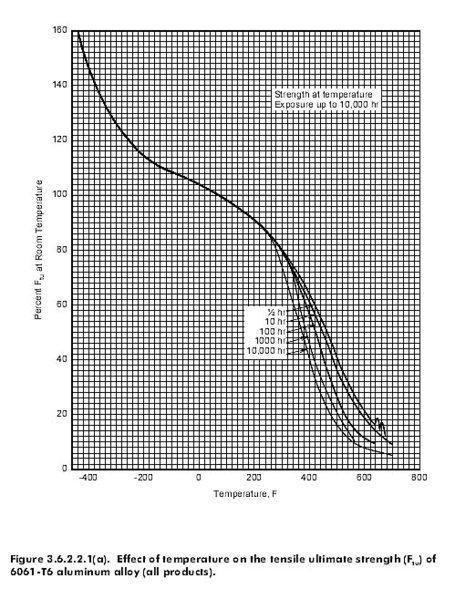
Well, as you say, they are working from a known base, and looking for an improvement. It takes time to evaluate how big the effect of an improvement will be on the longevity of the engine; but it takes a lot less time to quantify that there IS an improvement. Elevated temperature testing is likely to be pretty relevant in the case of the cylinder head; see the attached - it shows how the effect of time at elevated temperature affects the strength of a typical aluminium alloy; you can see how much faster it loses strength at the higher temperatures. So better cooling can be evaluated with some knowledge - or a change in the alloy. If one can measure the temperature of the exhaust valve guide and thereby modify the design to make it run cooler, you can be pretty sure of an improvement in durability. Some users can get quite acceptable lives from their Jabiru engines; some do not. The biggest single factor is the user; and that's not something the manufacturer can measure readily. All he can really do is try to provide a bigger safety margin.In fairness though they are in a pretty advanced position due to experience with this engine....But i agree .... Testing is a long way short of convincing punters to be to fly with onePeople buy based on six main emotions. But in this case it will be greed , fear or pride.
The only way camit will steal a decent volume of sales will be to convince people they will be safer, save money or look smarter by having one.
Ultimately thats going to require a track record of reliability or a significant incentive to buy one. And not being able to shove it in club planes that might rack up the hours fast , they are going to either take a very long time to establish that reliability or they are going to have to fast track some engine lives.
I get the feeling after my source they will fast track it, but they are not ready for that yet.
Just as Mr Stiff probably wishes he did more testing early up these guys are actually trying to test it enought to get it to the stage they can do some longevity work...
Sounds to me like its very very very early days in terms of testing.
-
2
-
-
Are you referring to the contact face where the rocker bears on the valve stem, being finished to the same radius as the radius of the contact point from the rocker-arm pivot? If this geometry is correct, the rocker arm "rolls" on the valve stem, without sliding and thus dragging the valve sideways, even if the arm does not have a physical roller. I suspect some of the the proponents of roller-rockers may not appreciate this point; in fact a physical roller there adds an additional variability to the valve clearance, in that the roller can wear out-of-round. Also, to have a comparable bearing surface radius to a correctly-faced rocker arm, the roller would need to have the same radius as the arm itself - which is of course completely impractical.The rocker ends move through an arc of a circle and the valves operate straight up and down. There is an ideal geometry but that does nor avoid all the load, it just minimises it, but it should be correct. Roller equipped rocker ends are sometimes used, but not universal. All engine fits have wear limits as well as minimum running clearances, You can check the wear in situ but it's not simple for the average person who hasn't been shown.Things can't really wear out suddenly unless there is foreign matter ie abrasive (Dust etc) , a failure of the oil film or incorrect fit, finish and/or incompatible materials used together. This can cause "galling" where a very rough finish forms and wear is rapid. Local heating due to distortion or overloading can destroy the surfaces, but these are not "normal" wear. NevSecondly, a small amount of sliding friction is not necessarily a bad thing, because it is the main means of inducing the valve to rotate in the guide, which is a major means of maintaining the seating surfaces in good condition. There are a number of subtleties in the design of rockers which are simply not addressed by switching to rollor-rockers.
Exhaust-valve guide wear appears to be one ot the first indicators that the engine has been operating beyond its cooling limitations; one sees it in turbocharged Lycomings & Continentals; the point at which this occurs seems to be quite sharply defined. If the guide temperature gets too hot, guide wear is rapid & catastrophic. I doubt it really has all that much to do with the side loads from the rockers.
-
1
-
2
-
-
If you look at the early posts on this thread, the cost of a CAMit engine was said to be comparable to that of a Jabiru factory-rebuilt engine. Why don't you simply ask CAMit? Obviously, nobody knows the practical in-service life as yet - they haven't been around long enough; but since they are a concerted attempt to tackle the known issues in the original, one would logically expect the useful life to be increased, n'est-ce pas?OZ manufacturing plants like Camit and Jab need to be nutured, accepted and improved ....... to compete and employits been mentioned but not answered - someone must have enquired .......................... no point getting to carried away if the Camit is 'X' times the costWhats the cost for a 4 cylinder Camit vs Jab and engine life difference ?
Whats the cost for a 6 cylinder Camit vs Jab and engine life difference ?
-
1
-
-
Interesting. It may be rare in first-life cases; but most owners of Lycomings & Continentals would like to get three overhaul lives out of their crankcases - and nowadays there are a lot of third-life cases out there. We developed, in the '90s, in conjunction with Rudi's Aero Engines, a new welding process for cast Lycoming and Continental crankcases. It took a lot of effort on Rudi's part, with specimens from all the cracked crankcases he had laying around. I'd suggest, based on this experience, that very few Lycoming or Continental cases get to the end of their third life without a weld repair. It's a function of the long-term effects of heat, which causes all heat-treated aluminium materials to gradually lose strength, plus the migration of the copper in the cast crankcase alloy to the grain boundaries. I don't know where the Jabiru case fits in that, but I'd expect it to be very little different, except that it's not a copper-base aluminium alloy. Being forged billet material, it's inherently vastly better than any cast material in regard to porosity.Yes you do get the occasional crack in cast crankcases, but considering the numbers out there, it's really rare in the big picture. On the other hand , many do their TBOS and return for another go. The radial 985 crankcases for instances just keep going on, and on. Some of the total time hours on those is very impressive, and they are still flying daily in Beavers etc....Let me know when any Jab engine comes even close to that..................Maj......-
 1
1
-
-
Good question. I think the answer is yes. Bear in mind that CAMit (not GAMIT) know exactly what goes into a standard Jabiru engine, unlike any other would-be clone producer. They know why it is the way it is. But they have to do it Jabiru's way, because they are working under Jabiru's Production Certificate, whether they agree with what that requires or not. The Jabiru engine was an enormous step forward from what preceded it; and it has undergone a lot of development; and that road has not been an easy one. Do not make the mistake of undervaluing that achievement. But people are correct, the effect of certification of the design and manufacture do inhibit further development. Also, people's goals change; the Jabiru 2200 was originally developed to be a better option than a Rotax 2-stroke. To do that it had to be built down to a weight.Yets cut to the chase, are GAMIT , after being frustrated. Trying to build their version of the Jab motor that they believe is the best clone of it ? I mean it couldn't be that hard to improve the product with the engines history.I would also like to see fuel injection to combat detonation .Nowadays, the relevance of that goal seems less significant; it would perhaps (amongst a dozen other considerations) be preferable to allow some additional weight, judiciously applied, in order to achieve greater durability. And whilst we're about it, the ability to run on lower-grade fuels. And be able to run leaner, and cost less, and . . . Everybody has a wish list, but not the slightest idea of what that might mean for the design compromises that must be chosen. If Rod Stiff had listened to all those things, he'd never have built anything. He had to shut his ears and make a start somewhere. It was a damn good start. There are still, and always will be, incremental improvements to be made; even Lycoming are still doing that, and their engines have been around for fifty years. You may like the idea of liquid-cooled heads, or EFI, or Nicasil barrels, or whatever, we all have our pet ideas. But you have no knowledge of what those things involve in regard to certification, product liability, production on a small scale, or any of a score of issues that must be weighed & balanced by the designer. Everybody is a hangar expert. The result is such a clamor that it's white noise to a designer.
Therefore, each engine designer has his own style, and generally sticks pretty much to it. Rotax produce mainly engine with built-up crankshafts and liquid cooled heads, that run at high RPM and use reduction gearboxes. That's their style of choice. You either like that style or you do not. Personally, I do not - but for some applications it has its uses. Rod Stiff has his style, and Ian Bent has yet another style. There's no such thing as one correct style. Therefore, a greater freedom of choice can only be a good thing.
However, making changes to a certificated product is a time-consuming, costly, and frustrating business. Jabiru as a company needs to keep going; and every Jabiru owner had better be aware of what would happen if it stopped. This sets their priorities - which may or may not be the priorities you or I might hanker for; but bleating about it serves no useful purpose.
Looking further, we see GM and Ford and General Electric pulling out of Australia, which dumps thousands of workers in the little support industries that supplied components, down the plug hole, with no compunction whatever. We NEED little businesses like Jabiru and CAMit who are in a sector of the marketplace that is too small for the giants to be bothered stomping on them. I'm all for these enterprises; they are all that will stop us from becoming a banana republic when the mineral boom runs down. So stop knocking, it doesn't help anybody.
CAMit are in a prime position to pursue further development of the Jabiru engine (and I understand they have a sufficient ownership share in its IP), and indeed they need to move this way because Jabiru are moving to Chinese and other sources of supply. It's time for the tree to branch, and CAMit will follow a different branch to what Jabiru are pursuing. The market place will vote with its cheque book. I hope they both make a go of it, because nothing can stay still and survive; one either grows or dies.
So stop asking damn fool questions that cannot be answered in this Forum; if you have a need to know, get on your bicycle and go visit CAMit. You won't be disappointed.
-
2
-
7
-
2
-
-
I think that may have hastened the process; however there's been a genuine desire to produce a better product, for a long time - together with a thorough understanding that the way to do so requires a great depth of understanding of the causes of problems. Also, a need to sift through the perceived issues and try to make sense of them, in order to get to the root causes - which are often far from obvious. Most importantly, CAMit's principal, Ian Bent, is au fond an aviation enthusiast, with a strong blend of perfectionist as well. It's a rare combination, particularly when you add painstaking deep research. Factors such as the obtaining of a CASA Production Certificate also take time; CAMIT produced - and as far as I am aware, still produce - Jabiru engines under Jabiru's PC, and therefore totally under Jabiru's control; however, now they have their own PC, so they have the QA system in place, BEFORE they started building their own engines. Ian personally flies all his engine developments on his J230, until he's satisfied with them. The CAMit engine has been brewing for quite a while.So is Camit's motivation for building these engines primarily because Jabiru has started using Chinese parts?-
2
-
1
-
2
-
1
-
-
Your last comment is not quite correct, at least in the version of FAR Part 33 that I have ; the vibration test requirement actually says:I'm told the heads on Camit engines are not the same as the Chinese made engines which Jabiru has now switched to: rather they are more similar to the earlier thick finned heads. UL power make a similar engine - wait - thats a clone of the Jab too....The certification aspect has always interested me. Before I bought my 2200 I checked what cert. it held compared to others. Their Type certificate has been updated only once in 2008 to include the change to hydraulic lifters. Ironically it should have been cancelled as a result of the introduction of them, if reliability has anything to do with the validity of a Type Certificate. I've had a fairly good run with my 2003 engine, but would not want to replace it with the later designs.The Camit option seems more sensible, and I dont need any certification for my application, fortunately.
Jabiru engines were Certified to JAR 22-H (now called EASA CS-22 subpart H) standards for JAR-VLA category aircraft.
This test requires an engine to complete a 50 hour endurance test with 25 hrs being at max continuous power. It doesnt seem much needs to be done once the initial paperwork is filed. The ASTM F2339-04 is even simpler to achieve.
Most other engines are Certified to JAR-E or FAR-33, which require 150 hrs running - not a lot really - but FAR 33 includes vibration tests with propeller at worst vibration case with the worst cylinder not firing for 10 million reversals.
(a) Each engine must undergo a vibration survey to establish the torsional and bending vibration characteristics of the crankshaft and the propeller shaft or other output shaft, over the range of crankshaft speed and engine power, under steady state and transient conditions, from idling speed to either 110 percent of the desired maximum continuous speed rating or 103 percent of the maximum desired takeoff speed rating, whichever is higher. The survey must be conducted using, for airplane engines, the same configuration of the propeller type which is used for the endurance test, and using, for other engines, the same configuration of the loading device type which is used for the endurance test.
(b) The torsional and bending vibration stresses of the crankshaft and the propeller shaft or other output shaft may not exceed the endurance limit stress of the material from which the shaft is made. If the maximum stress in the shaft cannot be shown to be below the endurance limit by measurement, the vibration frequency and amplitude must be measured. The peak amplitude must be shown to produce a stress below the endurance limit; if not, the engine must be run at the condition producing the peak amplitude until, for steel shafts, 10 million stress reversals have been sustained without fatigue failure and, for other shafts, until it is shown that fatigue will not occur within the endurance limit stress of the material.
© Each accessory drive and mounting attachment must be loaded, with the loads imposed by each accessory used only for an aircraft service being the limit load specified by the applicant for the drive or attachment point.
(d) The vibration survey described in paragraph (a) of this section must be repeated with that cylinder not firing which has the most adverse vibration effect, in order to establish the conditions under which the engine can be operated safely in that abnormal state. However, for this vibration survey, the engine speed range need only extend from idle to the maximum desired takeoff speed, and compliance with paragraph (b) of this section need not be shown.
[Amdt. 33–6, 39 FR 35465, Oct. 1, 1974, as amended by Amdt. 33–10, 49 FR 6851, Feb. 23, 1984]
The bit you missed (unless it has been deleted in later amentments) is in para (d). Also, when certificating an engine, the maximum allowable temperatures are based on the temperature that was maintained for at least half of the endurance test running. That aspect has so far been the most difficult part of the engine certification exercises of my knowledge to-date.
-
On the subject of gap seals, what's the objection to brush seals? Why does everybody persist with tape seals?I believe older jabirus, with shorter wing etc didnt show the problem. New long narrow wing has different struts maybe and different vibration isuesI used some mylar strips on the gaps on the elevator-mainly trying to tidy things up as original fabric tape fell to bits.At high cruise speed it howled loudly and flung itself to bits, went back to outdoor tape and no problems. If i couldnt see it, it would have been concerning and caused landing.
-
I have no idea what the agreement/arrangement is between Camit and Jabiru .
Bob
Well, that's their business, isn't it? I am sure CAMit would not be putting out their version of a Jabiru engine if there were a legal impediment. Superior Air Parts in the USA built a clone of the Lycoming 0-360, based on their own PMA parts; and in due course, certificated it. If you want to study the regulatory side of this, look up the APMA system in the CASRs, or the PMA system in the FARs. At this stage, CAMit are not claiming APMA status for their engine; they are simply saying they are building a non-certificated engine that is very similar to a Jabiru engine. Jabiru's commercial protection is its Type Certificate.
-
Well, watt's the output of the alternator on a 912? Or a standard jab 2200? They all seem to be able to operate radios and transponders. The answer, of course, is that the transmitter isn't transmitting all the time; but the alternator is there to charge the battery all the time. Go look at http://www.casa.gov.au/wcmswr/_assets/main/rules/1998casr/021/021c38.pdf Anyway, it's a 40 amp alternator, not a 40 watt alternator.good to see everybody playing nice and friendly..Question for Oscar, who seems to know about these engines... you said 40Watt alternator in an earlier post? Isn't that a trifle on the small side? A transmitting radio is going to draw something on the order of 41Watts. Once you start adding up the fancy electronic flight instruments, the blinking lights (strobe, nav, landing), any electronic gyros, flap motors, well, a 40 Watt alternator isn't going to cut it... -
Wot patents? You think there's anything still patentable about a four-stroke, poppet-valve, spark ignition engine?Wonder who owns the patents....could get interesting... If apple sued samsung for round corners .......You would think with all the costs so far Jab would have this well patented.-
2
-
-
That's at least five very good questions. We'll just have to wait & see, won't we? - unless of course you have a -19 registered aircraft . . .Oscar, everything you write is valid, appreciated and informative. If one could replace a Jab enginewith a Camit engine And keep the plane in the factory built LSA catorgoryI'm sure most would buy the more reliable engine. Will Jabiru allow it ?
Does any engine need to be certified to be in a LSA ? My belief is it just has to meet the ASTM standard.
If certified, will Jabiru allow it to be installed in a Jab LSA. ?
Jabiru have upgraded parts before, why are they not participating ?
An oil manufacturer has done tests on Jabiru engines and found a suitable oil not recommended by
Jabiru, why don't they participate ?
Is Camit aware of oil tests and I wonder what they recommend ? Did they recommend oil to you ?
I also believe what you say Oscar about overheating Jab engine which is the start of the rot. And if every mod that others
have produced ie water cooled heads, fuel injection, ignition systems plus Camit mods and none of Jabs mods, what kind
of engine would we have ? Reliable or not ?
My point is I think Jabiru are not participating in research and development of their own product and ignoring the demands of the customers who want their product, but want reliability. I am one of those people and I believe the J230 would be the best seller worldwide if they listened to the customers, lots have tried to tell them but it appears no one will listen. The problems are obvious to those in the know and would stick with it if they knew that the product would improve, as you say you have a Camit rebuild with mods, the legality in a factory build without jabiru approval is a problem, or is it ?
Thankyou again Oscar for taking the time to share.
-
Yes, VG strips may well have that effect. The vortex street mechanism is essentially (to my understanding) a consequence of having separated airflow over the back portion of the strut - and the vortex street causes it to re-attach momentarily one one side, then the other side etc which sets up a minute cyclic twisting of the strut, which perpetuates the cycle. If the flow were fully attached - which is, after all, the purpose of vortex strips - this cycle cannot begin.
-
Both.Who designed these engines? They look like Jab engines and I believe Camit build the engines for Jabiru.Are they a Camit design or an improved version of the jab engine?


 top
top
Major weaknesses addressed
in AUS/NZ General Discussion
Posted