

Dafydd Llewellyn
-
Posts
1,513 -
Joined
-
Last visited
-
Days Won
43
Content Type
Profiles
Forums
Gallery
Downloads
Blogs
Events
Store
Aircraft
Resources
Tutorials
Articles
Classifieds
Movies
Books
Community Map
Quizzes
Videos Directory
Posts posted by Dafydd Llewellyn
-
-
Remember that it all started with the Skycraft Scout. The people who wrote the original design standards for ultralight aircraft tried to "simplify" the certification process - which was seen as the major cost factor - by omitting things from the standard. In effect, they started with the obsolete standard, CAR 3, which already lacked any requirement to calculate the safe fatigue life, or otherwise make the structure damage-tolerant, and also largely ignored any requirement to produce a maintenance manual; and took a machete to it and cut out a lot of other things - gust loads, for one. The concept was that, firstly, the things were butterflies and not likely to fly more than 100 hours per year; and secondly, that if (when) problems arose, they would be dealt with by issuing ADs; and anyway, they flew so slowly that it was not really necessary to bother calculating the gust loads. Also, those were the days when everybody did his own car maintenance. A Drifter looks like the sort of thing any handyman could build using a Wolf Cub electric drill and a hacksaw, starting with a Hills Hoist, and people felt that building aircraft had at last come into everybody's backyard capability. Fatigue life? What's that?I'm not arguing for eliminating maintenance. Some maintenance is obviously necessary. What I am suggesting is that if you design so less maintenance is required, safety and reliability are improved. Part of that is because whenever maintenance occurs, errors are possible. Most people who have been involved in aircraft maintenance could give examples of problems that occurred after maintenance - but to repeat, I am not arguing that that means the maintenance should not have occurred.Concepts such as designing for minimum maintenance were not even dreamed about; the attitude to even CAR 3 aircraft (such as most of the Cessnas and Pipers from the 1950s thru 1980s) was epitomised by a Piper sales rep, who gave a spruik at the NSW Royal Aero Club, on the latest version of the PA-28. When somebody pointed out that the original PA-28s the club had purchased were already showing signs of corrosion, he reply was "Gawdam, man, those airplanes are five yars ole!".
What has in fact been happening, ever since it progressed past the Skycraft Scout, is the re-invention of the aeroplane. The evolution from open frame, externally-braced aircraft such as the Drifter and the Thruster, to enclosed bone & rag things like the Lightwing & the Skyfox, to stressed-skin devices like the Jabiru and Tecnam, is almost an exact replica of the progression from the Wright Flier No 8 to the Cessna 172 - the differences have mainly been due to modern materials. We even had a few biplanes along the way. though they hardly made a dent in the progress.
Now we're starting to see the necessity of re-inventing FAR 23 - or even going a bit further, to include low-maintenance design. This is, I suppose, a natural consequence of the fact that, far from the fix-it-yourself attitude of the 1960s, we are now in the "throw-away white goods" era where people have lost the basic skills to do maintenance, and anyway can't be bothered with it.
The whole idea started out with the belief that "there has to be a simpler way". If you study history, this is a recurring theme; the first manifestation of it was the "Flying Flea" of Henri Mignet; the second one was Bensen's Gyrocopter; the third was the rogallo-wing hang-glider; and the fourth was the ultra-light aeroplane. They all go through much the same phases. They all have small groups of fanatics who persist with the original idea after the mainstream has moved on. They all have fundamental shortcomings; and by the time people have identified the shortcomings and addressed them, somebody else says "Hell, this is too complicated - there HAS to be a simpler way!" - and the cycle starts again, in a new guise. Overall, it does not seem particularly sensible, to me. I wonder at the overall sanity of the human race, actually.
The way to break out of this endless loop, if anybody actually wants to, is to do some reading; Stinton's book "The Design of the Aeroplane" is not a bad starting point. The statement "those who fail to study history are doomed to repeat it" is observably correct. How about we look at all this experience, and make our minds up what we really think personal aircraft should be (and obviously that will need to be divided into several categories), and in effect present the manufacturers with a realistic design specification?
Or am I being altogether too logical?
-
 3
3
-
 1
1
-
-
Agree. CASA is only interested in reducing its liability under S8.2© of the Civil Aviation Act 1988. **** covering, in other words.What makes you think any of these rule changes are designed to stop people killing themselves? Ft, if that's what you think Casa are concerned with, then you don't know Casa.-
1
-
-
You said it yourself - knowledge of the flight envelope. The basic comprehension of what it means should be in whatever theory exam people have to do ( I assume, the equivalent of BAK - but it's 50 years since I looked at that sort of course material); the actual numbers that apply to the particular aeroplane are in the flight manual (and, hopefully, the speeds are colour-coded on the ASI - but not always).Knowledge of what though?This covers factory-built aircraft. How does specific type endorsement deal with home-designed aircraft? The whole concept of type endorsements comes apart on that point alone.
-
I couldn't agree more. The issue is better knowledge. Not medical, not type endorsement per se - it's basically a case of RTFM.The problem with the type training solution is that it won't stop people killing themselves, there is no evidence to suggest that pilots kill themselves due to lack of knowledge of the flight envelope of RAA/LSA type aircraft. -
Sorry, but I do not see the logic that takes you from your first sentence to your second one. Given the precedents that I've cited, an individual's medical standard is his own concern and not anybody else's, provided he's not carrying a passenger, and not over a built-up area - essentially the same risk as flying the initial hours off, in an experimental homebuilt. However, if he's medically fit to carry a passenger in a car, I also don't see that there is any credible reason why flying in VMC by day, is any more demanding on one's fitness. I suppose you could argue that the agony of a kidney stone can be dealt with by stopping beside the road, in a car; whereas you have to stay in control of an aircraft long enough to get it down safely - but how is that prevented by a Class 2 medical? (I have one, BTW).The law now recognises that flying is a dangerous activity and most deaths are self inflicted. The RAA has to bite the bullet and introduce a medical standard that reflects the new legal reality.-
2
-
-
No; the issue is not "learning" - it's simply the act of getting into either an RAA aircraft or a glider. Anybody who does this in NSW is now deemed to be "engaging in an inherently dangerous recreational activity" whose inherent danger is obvious - and by doing so, they have lost their ability to sue anybody for negligence in regard to the exercise, no matter what its intent is. Is that not "diminishing the RAA - or for that matter, the GFA - of negligent liability"?Dafydd you are confusing the legal implications of learning to fly with flying, the type endorsement is for people that have certificates.The RAA really needs to bite the bullet and introduce the GA style medical examinations to thin the pack of the weaker and sicker pilots who are more likely to kill themselves flying.Its the only way to diminish the RAA of the negligent liability
If it's necessary to introduce type endorsements for pilots with certificates, that means the training is inadequate. Since the training syllabus is pretty much verbatim the old CAA syllabus for a restricted pilot licence, with a cross-country add-on, it should be no more inadequate than was the old RPL.
-
-
Simple design IS possible; the Jabiru airframe is a prime example. The Drifter LOOKS simple - but it ain't. What is much more difficult, is for a manufacturer to survive with a grass-roots aircraft product. Again, Jabiru is the case you should study; they've done better that anybody else at this, by miles. Recognise it for what it is.
-
No, what it does is make flying training an "inherently dangerous recreational activity" - which means the trainee does it at his/her own risk and cannot sue anybody for negligence. That has no effect whatever on the validity or otherwise of the current rules - but it does protect CASA, RAA, and the FTF from litigation for negligence, at least in NSW. That NSW Act was introduced in 2002 because it had become impossible to obtain liability insurance for things like bungee-jumping, para-skiing etc. So if those sorts of occupations are commercially available in your State, it's likely that some such Act exists in your State. This precedent has now been established in NSW for both flying in an RAA aircraft and for gliding; I do not know whether a NSW precedent can be applied for another State; we may have to wait until such precedants have been established in other States.the stupid thing is you can't put an instructor into a #19 rego aircraft, so how does this create consistent safety environment? Does this mean the end of #19 in the RAA?These precedents were what caused the Carol Smith case to go to settlement; but for this, Carol had a strong case against both GFA and CASA for negligence. The law moves slowly, but this principle seems likely to change the whole picture radically. I do not propose to debate it on this thread; work it out for yourselves.
-
The second precedent is Echin vs STGC (also NSW) - I'm having trouble finding a link to it
-
See http://www.mondaq.com/australia/x/242022/Personal+Injury/Civil+liability+for+personal+harm+dangerous+recreational+activity+and+obvious+risk It explains the subject clearly and gives references. At present this comes under the NSW Civil Liabilities Act 2002; I haven't researched the situation is in other States at the present time.Can you give some details Dafydd?-
 1
1
-
-
The legal precedent set by NSW DC 11 - Noel Campbell V Rodney Victor Hay and also Etchel V Southern Tablelands Gliding Club covers those risks, at least in NSW. Whether the "Inherently dangerous recreational activity" Act applies in other States, I do not know - but if it does, than nobody can sue anybody for negligence in this area. This precedent changed the whole ball game; it must be taken into account.
-
The Cessna 208 uses jet A1 (Kerosene).I think you are all missing something!,the price of petrol would make them a big profit on the blackmarket, (and not a drop on the turf) Lots of litres so how many cans would it take to carry it off ? ; 20shsssss. I got a 200lt drum of premium at a dollar a litre,
spacesailor
Back in about 1983, my PA28 was broken into at Hoxton Park. The aircraft next to it on the tie-down line was set on fire; mine would have been next, but the police turned up. The consequence for me was a replacement door (did you know Piper built the aircraft first and cut out the door afterwards? Gets a nice, accurate door fit, but makes fitting a replacement quite a problem). It was a couple of under-18 kids from green Valley; the first thing the one the police caught said was "I'm under 18."
So presumably they were let off instead of being gaoled for 2 years as under S24 of the Civil Aviation Act. I think they'd be best converted into fertilizer for public parks, personally.
I'm disturbed that this has occurred at Tyagarah; that's one of the places I would like to feel safe at. There are presumably places where vandalism is more frequent; a data base on them would be very useful.
-
When you go to hire an aircraft, no operator will simply hand you the keys unless he's satisfied you are competent to fly it. So if you go the hire a Jabiru, with a background of only Tecnam experience, or vice-versa, you are going to get put through the hoops anyway. Formalising this by way of an endorsement that has to be processed by RAA is simply useless make-work. Sure, you can go buy one, but the dealer will normally provide some conversion experience; he has an insurance premium to consider, too.
It's a bloody fool idea.
-
5
-
-
Well, that surely indicates that introducing individual type endorsements into RAA training is about on a par with buttering the edges of a slice of bread.A very grey area; please ignore the spruik in the tail of the attached doc, and look at what the stats do (and don't) indicate...-
1
-
-
“Crinkle, crinkle, little spar –
Stressed beyond the yield-point far;
Up above the World so high,
Bits and pieces in the sky . . .”
Would the dreamers on this thread please look up CASR Part 21 subparts G and B, plus 21.186, and learn what is actually involved in bringing an aircraft to market?
The parts cost for a Drifter-type aircraft are only a small part of it. Firstly, there is the business of getting a Type certificate. That requires full drawing coverage of the aircraft to acceptable aeronautical standards, plus building a structural test specimen and a flight test srticle, and proving that they meet the structural and flight requirements. There are also a slather of other design requirements, dealing with things like fire resistance, crashworthiness, and a thousand other matters.
Once a manufacturer has done that, he can apply for a Production Certificate. To get that, he has to have the necessary tooling (and means of verifying that it is servicable), a means of purchasing the correct materials and keeping them segregated, so only the correct parts & materials get used, plus a quality assurance system. Once he has that, he can start to produce aircraft that are capable of being issued with a C of A. Only then are they saleable products.
This process involves a large, high-risk investment, both in time and cost. Part of that may be borrowed money.
So by the time the would-be manufacturer gets his product to market, he has a mountain of debt of one sort or another.
What is the incentive for him to build a product that has a very limited market, and sell it for peanuts? Come into the real world - nobody in his right mind is going to do that.
Bill Whitney gave a figure for the actual cost to manufacture a light aircraft - he quoted $5.50 for every dimension on a drawing. That was from his experience with the Boomerang. Do you people have any idea of how many dimensions there are on drawings to build a Drifter? AsI have previously stated, it has nine times the parts count of a Jabiru - and whilst a lot of those are standard parts, a lot of them have to be made.
The manufacturer has to pay off his initial investment, and then continue to stay in business so there will be spare parts for his product. Remember, the spares have also to be manufactured under his Production Certificate - or somebody else has to go through a similar process to get an after-market spare approved.
There is only one way around this, and that is DIY. So what you can do, is set up a shop in your backyard and get on with it. This whole thread is a piece of cargo-cult wishful thinking, and really a complete WOFTAM. The answer - such as it is - is literally in your own hands. Learn to use them. That's why you have opposable thumbs.
-
4
-
1
-
 2
2
-
-
"By the ring around his eyeball, you can tell the bombardier;Firstly: We are the only ICAO signatory in the world, whose National Airworthiness Authority DOES NOT have immunity from prosecution in the course of their normal affairs - thank you the Balmain pig PM, Paul Keating. As a result, CASA has had a degree of ****-covering since 1988. Secondly, the several attempts to introduce "and foster" into the Act have all failed, thanks to luddite fools in parliament or the senate. This is a matter of record. Thirdly, Dick Smith did (and still, I suspect, does not) understand the link between "airworthiness" and engineering judgement; so Keating - via Brereton - used him to gut CASA of most of its engineering heritage. Since then, with the exception of Byron, Ministers have been appointing fighter pilots to direct CASA. In parallel, since Anderson's era, our NAA has abused its discretionary authority, flouted the constitution, and exhibited a culture of arrogance that began to lose the credibility of supporting expertise in the late 1970s.Currently, CASA officers are trained in their responsibilities under the Administrative Decisions Judicial Review Act 1988, but completely ignore their KNOWN responsibility towards natural justice, when directed by the head fighter pilot. There is no system of internal checks and balances, because CASA has neither the economic resources nor, it would appear, the moral resources* to successfully implement systemic change to the culture. It must be made clear that, at any point in time, CASA has (and has had) a significant number of highly motivated, well educated, and highly capable people, of high personal probity and good intent, who find themselves virtually paralysed in any attempt to reform or improve, due to the pervasive nature of the post-Anderson culture. CASA firmly believes that it has a near-divine responsibility to tell people what they can't do in the interests of safety, and that appointment to a position in CASA automatically imbues the appointee with moral authority, irrespective of the actual expertise. Within this culture, the few persons I have experienced who are persuing personal agendas have virtually no limits on their ability to negate the positive efforts of the most of CASA, most of the time.*The structure and methodologies of CASA do not allow the officers any discretion to speak of, in allowing their personal probity to inform them in matters of regulatory judgement; I have a letter stating that CASA has a team of lawers to guide officers in making each regulatory judgement. it's not a lawer's bloody job to make engineering judgements, but this is the outcome of Paul Keating's all-embracing comprehension of the economics of management of hardware.
Now, CASA is - pointlessly, because Australia is very much not the US, OR the EEC - trying to emulate those NAAs, but at the same time do not have the corporate guts to recognise that the bulk of aeronautical expertise in Australia is in private industry, and can be used as a resourse to fulfil our ICAO obligations. because, as a member of CASA Engineering Services said to me (in personal conversation), "you can't trust pilots". John McCormack said to me, personally, face to face, in a room full of the operators of Approved Aircraft Maintenance organisations (LAMEs to a person), "what do these guys know about airworthiness? Nothing!". He was a fighter pilot (Mirages), so he knows.
We have a few career politicians, who have been exposed to CASA for so long, that they realise that the furphy of CASA's untouchable expertise is a Furphy; and we have a few relatively young, generally independent MPs, who are sufficiently iconoclastic to consider that CASA may, indeed, be somewhat less than perfect. Well, if they fix the frigging laws, so that CASA people can do their bloody jobs without looking over their shoulders all the time; admit that Australia deserves an aviation industry, and include "foster" as a prime directive in the CAAct; allow the reformers in CASA to work, under a director who (like Byron) was never a fighter pilot; and outsource airworthiness as the FAA so successfully has to DERs (who are members of the FAA when DERing, even if not employed by the FAA - make THAT work in Australia!)... then, in about3-5 years, our industry might start to recover.
Otherwise, we need to really work the trans-tasman bilateral, and move our industry to New Zealand.
you can tell a bomber pilot by the flatness of his rear;
you can tell a navigator by his sextant, charts and such;
you can tell a fighter pilot - but you cannot tell him much."
-
2
-
-
I think this is a very serious issue; and I'd like some real answers. I didn't find the HF course all that much practical use on this. I regularly drive around 500 Km - in an automatic car, with cruise control - and on occasion I've had to stop and have a snooze. Mostly on the way home, after an intensive week at a client's premises; not on the way out, when I'm fresh - you can't beat a good night's sleep. Definitely a cumulative fatigue thing, and I've learned to spot the early signs - but it took a few frights with microsleeps to teach me that. Unfortunately, you can't pull over & have a snooze in an aircraft; but you can plan a stop every couple of hours, and have a nap if you need one; but if you do, it's probably a sign you've done enough flying for one day.
I've never had this problem when flying - I've never had the luxury of an autopilot that actually worked; and there's enough to do to keep one alert, I find. If you're chasing "lift" in a glider, or following a speed-to-fly ring, you've plenty to do to keep you awake, if watching out for traffic & staying out of controlled airspace etc isn't sufficient. But the time for which one can maintain concentration is finite, and if you push it too far, you'll be in trouble. I make it a rule to always have water available; and when they are in season, grapes. A Mars Bar is revolting, but it's good in my experience for about 30 minutes - but you had better be on the ground by then, because you aren't going to be fit to fly again that day.
It does seem to be age-related.
-
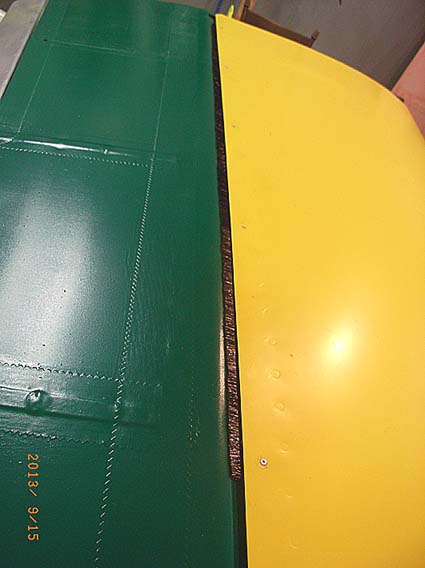
No, it's a case of horses for courses; but where brush seals can be used, you don't need to disassemble them to remove & refit the control surface - and I've not yet seen a cloth tape seal that doesn't start to peel after a year or two.Thanks for the info on gap seals Dafydd. Looks good, but probably not suited to my wooden contruction. I have spent a lot of time searching for mylar-type sheet suitable for my aircraft. The gap seals used by sailplanes etc is far too narrow. Mine would need to be 50mm. I have had some success with ordinary cloth tape stuck onto the "hidden" surface of the wing and control surface, but it starts to peel after a year or two. -
I have to agree. Way back, one had to have a separate endorsement in one's log book for each individual aircraft type. That was abolished in the late 1960's if my memory serves me correctly. Ever since then, in GA there are "class" endorsements - you need one for tailwheel, C/S propeller, retractable gear, floats, hulls, low flying, glider towing etc; but if you have, say, a glider towing endorsement in a Super Cub, it also holds for an Auster or a Pawnee or a Cessna 180.Great to see RAAus bringing in idiot regulations virtually identical to regulations that a predecessor of CASA abolished as unworkable and of no value, some decades back. This is what happens when you turn over staff rapidly and there is no corporate knowledge in an organisation....no staff with a detailed history of their core subject matter.If the RAA consider it necessary to take this retrograde step, that's an admission that the RAA training system isn't producing competent pilots, I'd say.
-
2
-
-
We're all entitled to have a jaundiced view of course, but I don't think the fatality statistics would support your argument. And whilst you might have been horrified by some of the Thruster componentry I don't recall a single instance of a structural failure of them so I think we can presume that the designing engineer did his job just as well as any of those who worked on the types of aircraft you consider to be 'competent'.Erhmm - Tony Hayes asked me to re-design a number of the critical fittings on the fuselage and also the lift-strut attachment fitting on the spar, on his Thruster; I know that there were fatalaties from the lift-strut attachment fitting. The originals were made from stainless steel, which is nice to look at and does not corrode, but compared to chrome-molybdenum it's not much better than cheese; and the fitting design was not good from a fatigue aspect. Newton Hodgekiss was involved in the design of the original 2-seat Thruster, but I doubt he had much to do with the increased-weight developments of it. Fatigue was not required to be considered in CAO 95.25, anyway. Tony supplied these replacement fittings as part of the TOSG service he provided. The original fittings looked very reminiscent of escapees from sailing dinghies.
-
The original hinges are almost certainly made from MS 20257 piano hinge - probably -5 size. See http://hinges.ladeau.com/viewitems/mil-spec-hinges/ms20257The original stuff looks like spring steel (it's magnetic). The replacement wires we have put in for now are bronze. We had some suitably sized (fatter) bronze wire. It's not going to wear out or break in five minutes and I will be replacing the hinges anyway in the not too distant future.These hinges are rolled from 5052 grade aluminium alloy, and the pins are normally cad. plated piano wire (spring steel wire). The reason cad. plating is used is that it helps prevent electrolytic corrosion between the pin and the hinge, at least until the plating wears out. Replacing it with bronze wire is asking for very rapid electrolytic corrosion of the aluminium hinges, especially if you are anywhere near salt water. If your hinges have loosened, it's almost certainly because the plating has been consumed and electrolysis has started eroding the aluminium. That should be fixed by replacing the hinges before further flight, NOT by putting oversize pins in there. made of material that would convert the hinges into a battery. Potential Darwin-award stuff.
-
3
-
1
-
-
You'll find them in Bunnings, for sealing the gaps under doors etc. Normally black nylon bristle trapped in a tiny aluminiun channel, which is in turn mounted in either an extruded aluminium housing or a plastic housing. They seem to me to be very suitable for preventing (well, almost preventing) flow through control surface gaps, where the control surface has a semi-circular leading edge that is centred on the hinge line. They will not alter the control surface hinge moment, so they are not a substitute for the "under & over" fabric strip seal that is sometimes used on welded steel tube elevators & tailplanesWhat are brush seals?
-
1
-
-
That would be much appreciatedI don't but I can get it from my instructor. I'll get the phone number and PM you.
"Type training" ops manual changes
in Governing Bodies
Posted