

turboplanner
-
Posts
24,367 -
Joined
-
Last visited
-
Days Won
159
Content Type
Profiles
Forums
Gallery
Downloads
Blogs
Events
Store
Aircraft
Resources
Tutorials
Articles
Classifieds
Movies
Books
Community Map
Quizzes
Videos Directory
Posts posted by turboplanner
-
-
My advice is for people to take a look at the monthly RAA figures, and the for sale ads which show frame hours and engine hours. If the engine hours are half the frame hours on a number of similar engines, that's a better guide than listening to someone damning an engine with faint praise.the 912 is an exceptionally good engine, far from infallible though, despite what some believe.Not all Rotax are at this same level of reliability or performance
These figures don't relate to real life, they're just to show how correct costing pays off.[TABLE]
[TR]
[TD][/TD]
[TD]Engine A[/TD]
[TD]Engine B[/TD]
[TD]Notes[/TD]
[/TR]
[TR]
[TD]Initial price[/TD]
[TD]$50000[/TD]
[TD]$25000[/TD]
[TD]"A" is "expensive", most people would buy "B"[/TD]
[/TR]
[TR]
[TD]500 hours replacement required[/TD]
[TD]$0[/TD]
[TD]$25000[/TD]
[TD]Total cost of life is at breakeven[/TD]
[/TR]
[TR]
[TD]1000 hours replacement required[/TD]
[TD]$0[/TD]
[TD]$25000[/TD]
[TD]B is now $25000 behind + downtime[/TD]
[/TR]
[TR]
[TD]1500 hours replacement required[/TD]
[TD]$0[/TD]
[TD]$25000[/TD]
[TD]B is now $50000 behind[/TD]
[/TR]
[TR]
[TD]2000 hours replacement required[/TD]
[TD]$50000[/TD]
[TD]$25000[/TD]
[TD]B is now $25000 behind[/TD]
[/TR]
[/TABLE]
In looking at the used RA aircraft ads, a lot of people bail out of the industry and sell at the 500 - 1000 hour mark because they don't have the spare cash to lay out for a new engine, but this shows why, in industries/sports, analysing the total cost of life can save you huge amounts of money. In flying schools this multiplies across all the aircraft, so up front price doesn't matter if it has a life cycle saving over the cheaper engine.
-
This is very much the argument that if your aunt had balls she'd be your uncle and grow whiskers so she can never be beautiful.The Rotax is the only engine I know of where crankcase pressure returns the oil to the remote tank. How endless is the discussion on burping it? None of that is an issue with any other motor.A very new engine is hard to burp as the rings seal very well within a few hours and the "idea" requires blow by. A wet sump needs no return pump. The oil just falls to there but the conventional gear or trochoid pump has very long life. both in the delivery (pressure) and scavenge function if you have one.. and one is usually built on the other as a single unit. They are NOT expensive items and the return needs no pressure regulation and operates with no back pressue=reThe scavenge often having twice the flow rate as the pressure pump for obvious reasons.. You try to have no residual pressure in an engine as it relies too much on sealing then, and puts pressure on all the seals and gaskets to a greater extent than a "normal" system. Many engines attempt to have a "suction" in the crankcase to reduce oil leaks. Generally any external oil, coolant or fuel lines are not an asset but a liability. ALL oil passages internal and NO external oil cooler if you can get away with it are desired and achieved in many aircooled and liquid cooled motors . Any hole or seal failure makes the return system fail on a Rotax. Also the return pipe has to be kept to a small diameter or the idea doesn't work at all. If a larger dia pipe is used the air will just slide around the oil especially when it's hot. In turbulence or inverted flight the vent in the remote tank will allow a high rate of oil to be forced out of it's vent at times by the pressure returning the oil. but all of it venting fully through the oil tank as well..( All the engine's blow by goes out through the oil tank). This is not a desirable feature either. More contamination by condensates getting into the oil than otherwise..
The siting of the carburetters is less than ideal. They are better under the motor and not above hot parts. Two carburetters on this motor is a necessity not a design advantage as the way the firing order is on a flat four they don't sequence well (even Pulsing) and have a poor mixture distribution outcome similar to a jabiru but for different reasons.. That's why the Balance adjustment has to be so correct for smooth running. The crucifix vertical intake on the C 200 is simple and effective by comparison and is one of the best I've seen. It's probably got a close to optimum fuel mixture and volume distribution.
I don't see the Rotax as anything like the perfect motor and I think the points I've brought up are valid and not bias.. As I've always said no engine is perfect and I'm not holding any up in that light.. but don't just write off the older designs as just being a con by some conspiratorial process.. They are still basic and sound engines for this section of the Market. There's very high standards required on materials and quality control needed on any of them or they fail. as well as appropriate installation and servicing in use.. Nev
The thread is about Jabiru mixture, and you aren't going to solve that by bagging another product with this sort of claptrap.
-
 1
1
-
-
Yep an absolute tragedy for the girl and her friends, but just reckless illegal flying.
-
 1
1
-
 2
2
-
-
We’re not morphing into a cotton wool society, just a few cowboys who don’t know their legal obligations.You may bee right but I say Lord Save Us From This Sort o Attitude, which to me is all part of the risk avers , cotton wool society that we seem to be morphing into. -
". Same as a high performance glider."In Sydney the cost of glider repairs was, hours+parts AND 50% of aircraft.
"What people are squealing about is having to do practical training as well as theory, that's all. Or is it the cost & bureaucracy. Not all our member's are high achievers, and wealthy.
My grandson is /Has built a Drift car, but Not a mechanic, ( Now the council is going to close their track. putting more hoons onto streets.)
Back yard mechanics are still here & will outlast most Certified people, because its not just a job.
If I cut two cylinders off a six pot Lycoming O-540 engine, (timed out), to use as a four pot. Why should a certified person have to check that I torqued the plugs correctly ?.
spacesailor
Same answer as I gave M. You can do what you like, but when your work has hurt someone and you are standing there in Court accuses of negligence what is your proof of qualification to do the job, and how you ensured the job was completed correctly.
-
Handling the aircraft after something fails is another subject for another day. This subject is applicable to failures which occurred due to maintenance errorsFinally... there's something we can agree on.AUF incident pages used to often feature "engine failure, uneventful forced landing carried out", or words to that effect. It was noted at the time (there was even an article about it) , GA incidents reports featuring and engine failure often had fatalities or injuries. Now it appears that many of the engine failures in rec aircraft result in serious damage at the very least. This is not a maintenance problem.
Is it poor training or is it because we now have lots of ex-GA pilots flying rec aircraft?
Nobody says you have to tick boxes. What happens is if you carry out maintenance work on an aircraft, and there is a failure which injured or kills someone the plaintiff is going to come knocking on your door wanting to know three things: 1. Did you work on that component. 2. Were you qualified to work on that component. 3. How did you ensure the xxx was safe and secure. If you can provide proof of those three things the enquires most likely will continue until another cause is found. Some people tick boxes, operating theatres and police record all critical actions, etc.Yes it's a favourite subject of mine. I see it daily. What you need to get your head a round it is that any process that involves filling a form and ticking boxes, is "box ticking". I consider the value of such things to be legal only. Ticking the box only ensures that you have followed the laid down process, nothing more. Basically it will cover your arxe in court, but has little value in actually providing anything more. All it does is cover your arxe and by default, your employer.
Same as the last comment, you can use anything you like but the evidence must be acceptable to a Court or you’re headed down the sewer. It will be Your Case so yours to win or lose. Of course where you have no acceptable qualifications you’re in the same position as a quack.This is pretty much how I see a mandatory L1 training process and even more so for your CertIV. I have enough CertIVs and I consider them generally worthless, and I can tell you from experience that they do not produce better tradespeople, only people with a form full of ticked boxes. When you get a CertIV, in ten minutes time it will be useless, because the the training body will change the the names of the modules then demand money for RPL or more training from someone who has never done the work in their life. It's a rort. -
Not a good idea going to VCAT, particularly when it should, in my experience, have Existing Use Rights for what it's been doing for 40 years.
In that Hearing the Member can decide anything, including restricted hours at other times.
-
If that's what people were doing in RA we wouldn't be discussing it, but when the engine stops and someone blindly hauls the stick back and hangs on tight, he's going to get 32 feet per second per second less drag from as much as 1000' agl until he hits the ground and kills himself. The 28-35 knots is based on a theory that a pilot has enough presence of mind/training to put the aircraft into a glide when the engine stops, glide down to flare level (as against nose down/stick all the way back or in a spin), slow the aircraft to 28-35 and land it. If he does that he really had to hit a stump or tree dead centre to hurt himself.............................but that's not what they've been doing since around 2007 when I first started looking at the statistics.Surviving a sudden stop (crash) has a great deal (not everything) to do with how great the deceleration (G forces) is - the slower the stall speed the more likely you are to survive. It that simple !A stall speed of 28-35 knots (my aircraft) compared with a Cessa 172 @ 47 knots is a far better option.
True there are other factors involved, like the structural integrity of the "role" cage/passenger compartment, fuel tanks, etc, etc but at the end of the day, your brain's deceleration in your own scull, will be the main point from which survivability is determined.
That is why you should always move to and stay in the left lane (In Au) when ever possible - a head on crash at 60 kph is likely to be a 120 kph deceleration.
-
1
-
-
What people are squealing about is having to do practical training as well as theory, that's all.I'm very much for self maintenance and won't be there if it's curtailed.-
2
-
-
You can ask that question if you want. With Certificate IV training all round Australia, a self maintenance regime could be set up, and may be needed as LAMES become scarce.Actually , the question it raises is, "Why do we need LAME maintenance on such aircraft?"However the same basic rules apply; you touch an aircraft, you need to be trained and certified competent.
"Box ticking" is a favourite subject of yours based on the hundreds of times I've seen it, but the irony is that today if you just tick a box without doing what you are required to do, or without being authorised to do what you did and someone is hurt or killed, that means you knew that what you were doing was wrong, and that will probably get you a criminal charge as well as the PL lawsuit. You are responsible for what you do; things have changed.That's exactly what "box ticking" is. They endeavour to absolve themselves of responsibility by ticking a box that says we gave them competency training. All they've done is made themselves a target for litigation when some dill decides his mistake is due to their lack of training.The more they interfere the more responsibility they carry.
There is no requirement for a "majority" to be obtained before taking action; just one will do if someone is injured or killed. RAA has published hundreds of crashes/incidents caused by maintenance issues over the years, so you can forget about that angle.There is zero evidence that poor maintenance practice is the cause of the majority of crashes/incidents. -
Turbo.
Outlanding was and in my opinion should still be considered with RAAus aircraft.
I’ve been flying from rag n tube stall close to 20knts through to jabirus. All are RAAus eligible and whilst I do not look forward to it I have by what you might consider
1 crash - airframe failed on landing off airfield after engine and airframe in air failure
3 forced - airframe fine after landing but engine/fuel issues meant I was coming down without a choice or power
2 outlanding - I chose to land off airfield with power due to unexpected met.
And dozens of off airfield landings where I decided the paddock looked good and generally I wanted to take a break.
All of these I was trained for in my initial training in RAAus in jabirus. I was retained/tested in the Uk for my NPPL(m).
2 outlanding: That's called a Precautionary Landing in GA with the procedure:
Pick wind direction
Field selection
Fuel/mixture/switches (abbreviated downwind)
PAN call giving aircraft ID, Location, Aircraft type, minutes endurance
Nature, intentions
set 1 stage flaps (slower than full cruise)
1st run along area selected for landing - 500'
- Set Directional gyro at 000
- Pick turning points
- Assess visibility
Second run - 300'
- Check under and overshoot
- Check general conditions
Third run - 200'
- Surface
- Obstructions
- touch down point
With the Met minimums we fly to there will be time to follow this procedure which avoids a lot of the dumps, twisted aircraft and injured pilots we see.
It's a far stretch from a glider's Outlanding where the tough down without hitting a stump etc will almost always just require trailering out
I spent some time explaining that the records in Australia don't support this as a practical divider a stall/spin from 1000' is not low energy. The only place this works is for a stall at about flaring height or less, where the low forward momentum gives you some advantage over a GA aircraftThe reason / justification for the RAAus aircraft outside GA is the low energy low stall. Keep that and demand to keep the distinction.
That's not my argument. My argument is that if a person carries out maintenance on an aircraft they have not been trained to do, they have a public liability issue, and if RAA issues an authority to carry out maintenance on an aircraft to someone who is not qualified to do so, or that they haven't trained and assessed to do so, RAA and its employees have a public liability issue. Therefore because of that, RAA is required to train and assess for L1, and that includes assessing the on-hands/practical ability of the person to carry out maintenance., so nothing to do with GA, just the facts relating to RA today, which may not have applied in pas history.And an area you touch on that boils me every time is what I would call levelling up.If RAAus don’t have something - medical - extensive training to be allowed to use a spammer in an engine - and another area doesn’t that is not a justification to introduce the higher level to RAAus to level the operations.
There's no reason that shouldn't happen based on today's standards of duty of care. Under the present situation of lower numbers of people actually flying, so lower numbers of aircraft to maintain, LAMES are retiring faster than new ones are qualifying.The logic as I see it is that unless there is demonstrable evidence based need to change the OTHER area of aviation should be using the RAAus evidence of safe ops to reduce and remove their requirements ! - Set Directional gyro at 000
-
GA requires LAME maintenance, and some of the older GA aircraft are a lot simpler than modern RA, so that introduces the basics question of why allow RA pilots to do their own maintenance at all?Only if you want to be regulated and GA. Where is the evidence that in practice the owners out there are getting it so wrong that they are dangerous to themselves or others ? Adults will tend to self select - I’m not comfortable with doing this/I have no interest = engaging an L2 or LAME or a trusted friend.Several people have said the intent with RA was to have a low cost flying alternative. If you go back to the AUF days before Jabiru and the imported kits, right back to Bill Moyes being towed by a boat strapped to a kite, and the derivatives of that which became trikes and the very simple rag and tube aircraft, self maintenance probably fitted in with the policy of flying away from airports and under 300 feet.
Over the years they have virtually reached the sophistication of GA aircraft in both engines and airframes.
There's still no reason that self-maintenance can't work, but it has to meet the duty of care test, and to do that the pilot has to have practical training and assessment, and that will take a lot more time than a 1 hour lesson.
There's no way around that today.
Given that several people on this thread and a couple on another thread have casually mentioned actually doing practical maintenance training in recent days, that raises the question of whether this thread has it wrong with the assertion that the only RAA maintenance test is a written one. That needs to be put to rest or we are just wasting our time.
"Outland" is a gliding term, for an aircraft with an immensely better glide ratio flown by pilots who only ever do powerless landings. For powered landings the term is "Forced Landing" which denotes a much more aggressive and faster action required for a successful outcome.And a point that keeps coming up is engine failing and not being cars able to coast to a roadside. The reason RAAus reg aircraft exist seperate fro GA regulation was that they are low energy and are expected to be able to Outland at lower risk to people.Yes RA are low energy, and yes they have low stall speed, so yes they should be able to force land at lower risk to people, but over the years this has proven to be an academic opinion only. I practice we have seen pilots still in from over 1000 feet with smooth ground below them, many killed by trying to extend a glide to get to an airfield where soft landings were available, turn backs at airfields with airfields surrounded by perfectly good paddocks and so on. There seem to have been less of these since about 2012, but, if somehow you could take this block out by perhaps more emphasis on forced landing and EFATO in training it wouldn't surprise me if the death tol went down by about 30%.
So the potential is there for greater safety, but the pilots, in stalling and spinning haven't been taking advantage of it.
You're now controlled by public liability; you can hide from CASA, and get away with dodgy actions, but the minute you do something wrong, such as not tensioning a bolt correctly, or not using the correct bolt, and someone gets hurt of killed, the responsibility sheets home to you. If you did something you were not qualified and certified to do you pay.in a recreational aviation that is NOT supposed to be as controlled as GA.
RAA also has a duty of care to ensure no one flying or maintaining under its certification is unqualified to do the tasks it certifies them to do. Hence there has to be hands on practical training to the point where someone can actually maintain the engine and airframe.Don't get me wrong. I think offering practical L1 courses is a very good benefit to members who want it. But requiring it to exist to do your own maintenance is not on my opinion alighting with the fundamental reason RAAus exists seperate from GA -
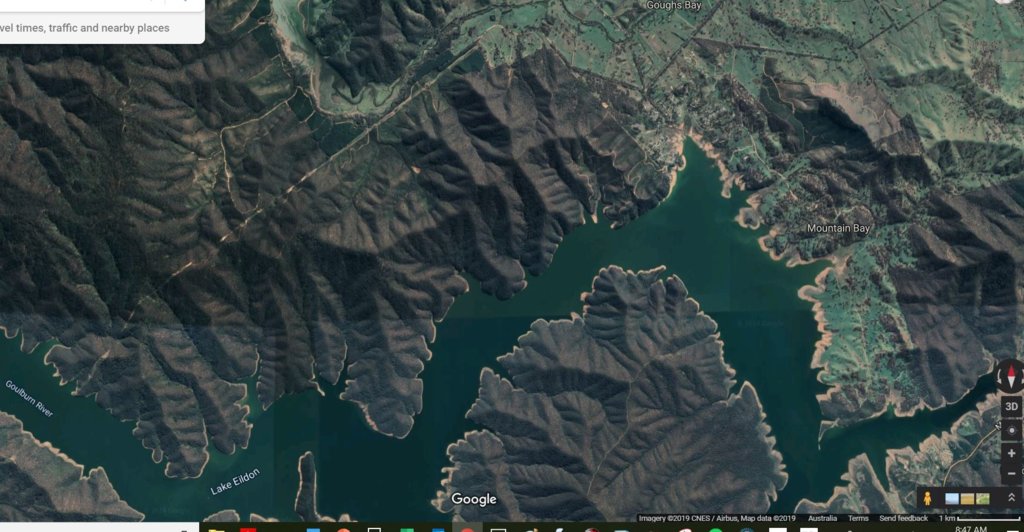
I've spent a lot of time in this area. Eildon is still low, snow melt doesn't start for about two months, but will be different to the date this google map was based on.
The hills around Eildon can be very rugged. A couple a hunter broke his ankle. He was well over-weight and rescuers couldn't carry him up the steep slopes so they called up a helicopter. Somehow he slipped out of the harness on his way up and dropped to his death, so it's not a place to be flying. A few years ago a Cherokee hit power lines killing all on board in the straight marked Goulburn, despite the long blaze going out to the right which you'd think blind Freddie could see. In this case, with the water down paddocks below Goughs Bay may have been exposed, but from the reports this pilot didn't even make the shore. Looks like this will be a good case for a manslaughter charge based on flying below 500 feet.

-
This is a Local Government issue between the Council and the owners/operators, so not a Federal jurisdiction issue.
You would expect the owners/ operators to be able to produce their copies of the documents the Council can’t find, but if that can’t be done there area things like existing use rights. Mornington Peninsula also seems to be the top location in Australia for Adverse Possession, but hopefully this will all sort itself out.
-
1
-
-
This thread is not about Messengers or fetishes it’s about RAA authorizing people to work on their aircraft without demonstration of practical skills. We’ve just seen how difficult it is for people to stay on this simple subject without getting confused. Maintenance is different to building where you are usually adding assemblies to the base frame. Anyone can pull an engine out of a crate sand bolt it into place, but maintenance starts from there, and this thread shows a lot of examples of why the L1 should be suspended until a workable training and assessment regime is put in place.
-
It was built by Bill Vowell who owned a helicopter business. He also built a motel next door and encouraged weekend flights from MoorabbinThis is taken from the Wikipedia entry for the town of Tyabb:The airfield provides access to the area for all emergency services and is an important part of the town's economy being the largest employer in the district.
A reading of the Wikipedia entry suggests that Tyabb, only 60 kms from Melbourne has become a "trendy" destination for Melbournians to sip coffee and buy antiquey stuff. Recent residential development is no doubt the reason for the Council's attack. It seems that caveat emptor is never in the minds of people who want to move to the area.
A look at the layout of Tyabb airfield suggests that it was a wartime field.
This is interesting: TYABB SKIES REMEMBER IN SILENCE – Mornington Peninsula Bandicoot
-
$10 million is too light. Quadriplegic cases are running at about $13 million, so $20 seems prudent. Not much point going for $10 if you have to fork out the last $3 milli
-
1
-
-
I fought anyone will confess now that this has happened.I'm at a loss to understand this. Both previous accidents were due just to inflight forces - but this one was due solely to pre-existing damage from an earlier pilots' mismanagement? Please explain. -
Yes, I took it that a previous pilot had damaged the wing structure. Facthunter is correct. This is a complex aircraft requiring good management skills which can easily be flown outside it’s envelope. Unfortunately sometime people don’t report incidents or aerobatics and the next pilot and passengers pay the price. You could argue that a 206 would be a better choice but application doesn’t appear to be the cause here.The Albany and Darwin accident aircraft had no pre existing faults, this one did is what Mr Nagy is saying -
That's an opportunity for them; Cert IV training for their qualifications, then invoice the pilot for training. Would fit within the existing Company structure. Delete the RA $100.00, do it all through the FTF.Back to the PPL for a moment for a comparison.... a PPL holder is authorised (not qualified) to work on aircraft to the items listed in Schedule 8 Pilot permitted maintenance (which includes doing a daily inspection) and training is not required, just that they be competent and use the approved maintenance data and suitable tools. There is no competency check system. Many PPLs are perfectly capable of doing the basic work, (oil changes, plugs, tyres, etc) but may have no clue where to write it up, or how. Flying schools do not teach maintenance tasks (other than daily inspection). -
That's the "tick the boxes" method which I'd suggest just about everyone here can see straight through.That is a joke..so other words paper work is more important than nuts and bolts.Hence that little story one can not fly the plane till it equal the weight of the paper work. That is quite apparent.
KP
-
That sums it up really.About the only mission critical jobs on a car are ball joints and brakes. Quite a bit more on a plane.There's nothing to stop you having a qualified person inspect/work on the aircraft.
A PPL is not required to have a mechanical qualification to pre-flight an aircraft, but is not qualified to work on it.
If an RA pilot wants to work on his/her own aircraft there should be hands on training as well as theory tests.
Under RA Limited, that would be very expensive.
By returning to an Incorporated Association a volunteer structure could be used to cover the districts with Volunteer training for pilots or Volunteer maintenance qualifications.
I agree that making someone pay $100 per year for a written maintenance qualification if he sticks a spanner on the aircraft and strips a bolt.
-
It was a Savannah VG so probably owner maintained.
If an engine has an aluminium head, the spark plugs are usually a different thread design, require torquing correctly and required anti seize if you want to avoid twisting out a lump of thread in the future.
So even with spark plugs a beginner needs to be taught when a shifter can be used and when a precision procedure is required.
Another example of training is when a standard nut is OK, what a flange nut does, when a nyloc nut can be used and when a castellated nut is required.
Two flyers are dead because someone didn't know that. He may have built the aircraft, but he didn't know that.
-
I would agree with you except that of the 7 forced landings in 912 engined aircraft between May 2007 and March 2012, one was caused by a spark plug falling out.Am I correct that the L1 is also required by those that built their own aircraft under 19 reg. If so then the system is a joke and a money making exercise. If you built it and got it inspected and passed then surely you can change a spark plug safely in the damned thing. Political correctness and empire building gone mad.Other maintenance failures in that time were:
Oil leakage around filter
Circlip incorrectly installed
Carburettor overflowing
Jabiru mixture
in Engines and Props
Posted
There are people here just entering the sport with no practical knowledge and we have an obligation to steer them on to the most economic path.