

turboplanner
-
Posts
24,367 -
Joined
-
Last visited
-
Days Won
159
Content Type
Profiles
Forums
Gallery
Downloads
Blogs
Events
Store
Aircraft
Resources
Tutorials
Articles
Classifieds
Movies
Books
Community Map
Quizzes
Videos Directory
Posts posted by turboplanner
-
-
If the crash timing from the reports is correct, it would have been near total darkness. Official Sunset at Leigh Creek is 17:28, Last Light 17:55.
The caravan park manager witnessed the flight, just prior to the crash, and could only identify a "green light" - and thereby presumed it was an aircraft. It was that dark, he couldn't see the aircraft itself.
Not much chance of sun in your eyes at final approach height, nearly an hour after sunset.
One would have to rate spatial disorientation due to darkness, as a major contributing factor. Why do people continue to do this?
Because they are not being educated, they are simply not aware that they need to do a 180 turn when they see solid cloud 5 km ahead of them, or that when they lose reference due to not turning away from that cloud, or when they are flying over a lake or the sea, and lose reference or they commit to a landing in five miutes but laqst lights in in 4 minutes they could be travelling vertically. I don't believe anyone intends doing it; they just don't know where the boundary actually is on any particular flight.
-
 1
1
-
 1
1
-
-
https://www.avweb.com/aviation-news/airspeeder-racing-coming-in-2020/
should be be interesting to see how people react to the prototype
Another fantasy. Car race tracks are still in existence because we built safety fences and catch fences to protect spectators from flying debris.
Flying above a race car circuit would certainly provide a ready-made venue with parking, seating, eating, toilets etc, but there's no way the aircraft could race above them safely. In some cases there may be tracks where the aircraft could fly outside the circuit so centrifugal force threw any failed aircraft outwards into open land.
Electric RC competition aircraft are sensational to watch because they are so fast, and slot cars were like lightning, so there's no doubt spectacular speeds could be achieved with powerful motors and short races.
-
isn't the exhaust valve the weak link?
The exhaust valve is more related to combustion chamber temp, which is different to Exhaust Gas Temp, and relates more to leanness.
-
I know witness reports are often unreliable, especially second or third hand, and this may have no bearing on what happened here but "plunged 150 metres" would mean this aircraft was not under control at that time, and so the RA safety regulation of low maximum stall speed could not save it from damage close to the ground. The only reason I'm raising this, is that when you go back in history there are lots of very similar reports where RA airctraft dropped, sometimes from above 1000 feet. It's time the "plunging", "dropping", "falling", "spiralling" reports were collated and investigated for training purposes.
-
2
-
-
If I am ever low on fuel I will not make a precautionary landing in a field but will now press on in the hope of reaching a legal landing point. Thanks CASA.
After your three circuits at the levels recommended, your assessment should be reasonably professional, so you might not even be prosecuted, whereas if you opt to push on and force land into a stump you'll cop a fuel exhaustion charge. (I didn't check the exeptions mentioned, but an emergency is always handled differently).
Generall speaking the penalties attached to this regulation are not much different to those on a road, where if you are involved in an accident and bit another car, cyclist, or pedestrian, even when they are at fault and you did your best to avoid them, you will usually cop a careless driving penalty because you couldn't stop in time etc.
-
1
-
-
I came across THIS Part-91 ready-reckoner from our favourite regulator today and had to chuckle. You folks probably will too, when you read Example 1, Regulation 91.410. Or else you'll cry...
Now, the instant you run off the runway, overshoot the far end, or even crash in the trees following an engine failure, you are an instant felon, and probably for most of us, twice over - once as the PIC, the other as the Operator. Per Subregulation 2(a)iv, the place you chose was clearly not suitable, as you crashed trying.
When lawyers draft regulations, they have to use precise definitions to avoid any ambiguity, so sometimes they have to lay down what they want, then they have to lay down the conditions under which they want it, then they have to lay down any conditions under which it doesn't apply. This requires careful reading before you decide what is meant, and what you should do.
Let's consider "a place that is suitable for landing and taking off of aircraft"
That probably wouldn't be where there are wombat holes all over the strip, an irrigation ditch across it, or trees in the splay which are too high.
or,
"aircraft can land at or take off from", and there's even a hint about prevailing weather.
If you're one of the people who has never bothered to learn P&O, or apply it before a flight, I can understand how you might see these clauses as silly and get a good laugh at CASA's expense once again.
However, what that all means is, you have to KNOW, that the airfield hasn't had a Ferris wheel erected in the splay, or a ditch dug across it before the grass was allowed to grow etc.
And you have to KNOW that YOUR aircraft can land at the airfield and take off from it.
One example of non-compliance was a PPC getting snagged in a fence trying to take off from an RC model aircraft runway.
On the take off side, if you've done your P&O and the strip is in the hills and short and those inputs show that the maximum Outside Air Temperature this can be achieved at is 23.4 degrees and it's 35 degrees, and you take off and crash, you not only deserve to be prosecuted under this regulation, but will probably attract a Culpable Negligence charge as well.
One example of that was the property owner in a 172 who flew across to the neighbour's place, to pick up a machinery part, taking his two daughters. He landed in a Claypan, walked to the neighbour's, to pick up the part, talked for a few hours, and when they got back to the aircraft the midday sun was beating down. He failed to abide by the above regulation to ensure that his aircraft could take off from the clay pan (it could easily have done so at his arrival time). When he ran out of claypan he decided not to shut down, but to use the swamp bank as a ramp, and lifted a couple of metres into the air, where he was facing a power/telephone line. He opted to shove it back on the ground and got safely under the line. Not knowing that his P&O figures would have told him he didn't have a prayer of making it fly, he yanked the airctraft back into the air, stalled, and killed himself and his two daughters.
So the bottom line with the raw regulations is you have to read each sentence and ask yourself why these words, and sometimes have to look up the clause or regulation referred to to make sense of it.
I agree it's not easy, but those words remove much of the doubt you get when you read someone else's explanation (which often misses the legal intent) or publications like the VFG, but over time I've come to prefer going to the regulations themselves and finding out what the law really is.
-
1
-
-
That should have been Quest Kodiak.
-
That Kodiak Quest has me drooling not only max cruise 174 kts @ 12,000', 48 gph, range 1005 Nm, but it can land and take off in a post hole, and cmes with optional mudflaps, and just $2.15 m.
-
1
-
-
Hi Frank, I'm not sure how advanced you are, and whether that 3 pointer was just the result of the tight turn for the forced landing, but if you have been landing flat, you'll enjoy it a lot more if you hold the nose higher after the flare. The low wing Cherokee lands in ground effect (Where a Cessna 172 would drop you onto the concrete) so once you're close to the ground, around a metre you can pull the control back and the wing becomes a big air brake to slow you down. The control keeps coming back (as long as the stall warning isn't going), and you should get a nice tyre squeak as the wheels spool up on the concrete, and no bump. After the mains touch, the nose slowly lowers as the speed drops off. Doing it this way, you'll never slip into a wheelbarrow like this one.Yes, a PA28-180 youhave a good eye.If you are learning, don't try to convert without and instructor, but if the flat landing was just because the turn had to be tight, no problems.
-
You have to remember that RC aircraft have a squillion to one power to weight ratio and fly wherever the engine points; I crashed my control line aircraft so often I that I switched to flat basa planks for wings.
Having said that, his reaction time was in 100ths of seconds for the whole quite long display.
Not only that, but every reaction was under perfect control. I can hover a Yak 9 for a couple of seconds...sometimes.
A brilliant RC display.
-
Why would you even think of hybrid for this application? Low power Petrol engine plus batteries plus splitter transmission plus electrical motor plus control system. Looks like someone is out of their depth.
-
Well, I'll give you one word, CHOICE.My point is this; bureaucracy can take a simple three letter word that everybody can understand and turn it into three words that have very little meaning that very few people understand. This is only to the benefit of those who are "in the know" and to make some simple seem complex which to my mind sums up aviation. This is why we are all parked in silos depending on aircraft categories with blatant inconsistencies across the spectrum. Nowhere is this more evident to the different treatment of EAB VH-reg and RAA aircraft when it comes to maintenance and construction. -
Thanks for that Flyboy, it's taken a long time coming out. That appears to be a clear case of Conflict of Interest, and he should now step down pending a thorough investigation.Why have we been heading in this direction?From the airport banter last Saturday. Because Michael M has become the dealer for CT aircraft and it's been in his/their interests for a long time to massage the rules to suit their personally evolving business direction.
The CT NEEDS to be rated at 750 kgs because of its low payload and that's the push on increased MTOW changes. Getting made in China has lifted the empty weight by more than 35 kgs and at 600 MTOW it's really a single seater. I was told other things but i won't mention it here because some was told in confidence but the above is publicly known.
-
2
-
3
-
 2
2
-
-
You're not aware of what China has been doing with our PNG and Pacific neighbours?Why can't Australia's leaders show some backbone in dealings with the Yanks?We cringed with shame over Holt's "All the way with LBJ" but it's still happening.
Instead of standing up to American war mongering, as did NZ's great David Longey, our latest PM grovels to Trump and offers to help him make war on Iran.
-
Yes, what's your point?Hey Turbs, do you know what a “motorized attendance module” is? -
What's stopping you getting an L1?I built my MiniMax from drawings. I modified the design in several areas: I replaced the elevator & aileron Teleflex cable system with push rods & torque tubes; incorporated flaps; altered the empennage profile (but not the tail volume); installed an engine that has never been fitted to a Max previously; and made my own propellor.But I am not allowed to maintain my aircraft as I am "not qualified".
Bruce
-
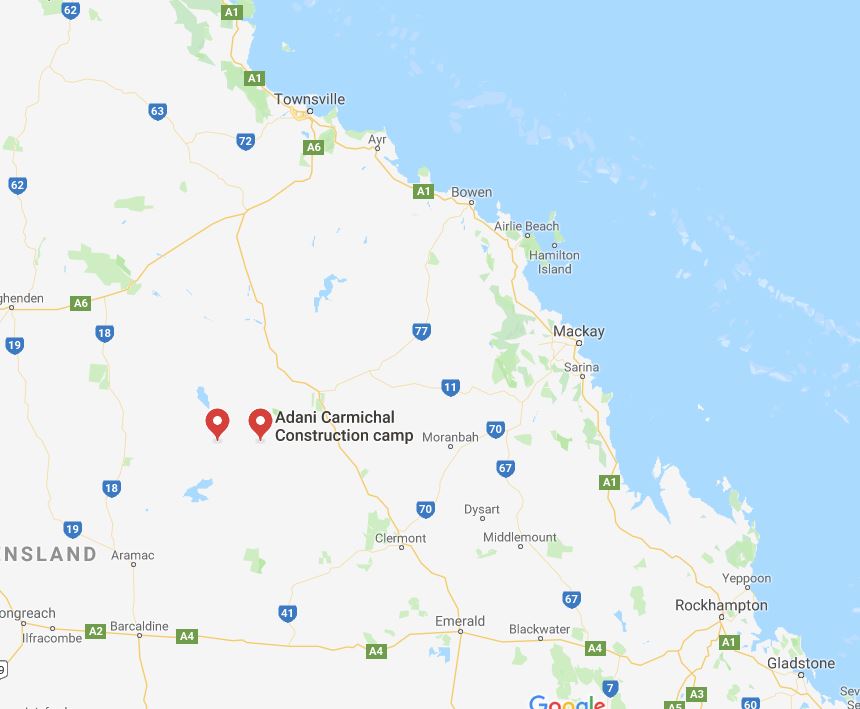
A very odd thing to do, given that Adani and the Queensland Government announced nearly two years ago, that the infrastructure benefits were primarily going to Townsville and Bowen, and Mackay would get less of a share, getting maintenance. When you live there for a while it doesn't take long to see what the fluctuations of these huge industries does to the businesses and residents in the towns. For example one minute housing is affordable based on local wages, next minute houses are selling for hundreds of thousands more due to shortage caused by expension, next minute property owners are bankrupt as renters leave the two to find work elsewhere. And why on erther would a counillor from Rockhampton think that city would get5 a financial payback after the mine has shut down. You only have to look at JG's photos to see that not much other than the dingos howling and a property owner rounding up cattle will be happening. This map shows the big distances involved.Rockhampton Regional Council have allocated 15 million towards the construction budget of the Adani Airport.[/url]https://www.theguardian.com/business/2018/jan/17/queensland-councils-say-they-wont-own-adani-airport-despite-paying-34m
-
In any current fatality the L1 standard is going to be judged by what it is now, who taught the person who failed, and why the person made the mistake.Hopefully the L1 practical competency module becomes more complex as time goes on, to give more credibility to the L1qualification. Maybe include engine and airframe modules, too.
Cheers,
Jack.
You can't say, "we'll just wait until we have time, a few more people might be killed but sh!t happpens."
-
What Bruce is talking about is a principle in his opinion which applies to aircraft where the owners can't maintain them.
That's not the case where people are allowed to maintain their aircraft with L1.
What it does include is all the recreational aircraft in GA.
No one in Government has said they are thinking of changing the law, no one in Government had said they are thinking of changing safety standards.
This is just pie in the sky from one individual.
-
The law is vertically integrated with flying safety. No point in trying to stir up trouble.I find it bizarre that you can " own " a plane and yet you are not allowed to do your own maintenance and servicing of your own property.Is this the nanny state gone mad or something worse where our basic rights ( in this case, to do what you like with an object you own ) are under a cunning attack?
Cunning, because the attack is disguised as " protecting us from ourselves", " for our own good".
If you think for just a few moments, you will see that there are many more ways that people can be protected from themselves.. choices of companions, food, weight, exercise and many other things. Most of these "protections" would be much more effective in disrupting lives than stopping some guy playing with his aeroplane.
Nothing bureaucratic is likely to save lives, because stopping people from pursuing their interests leads to inactivity, which is far more lethal than any pastime.
You have 4 times more mortality risk from inactivity as from flying.
-
1
-
-
Was that a Cherokee?Thanks for your tips. -
Good way to start a pogo.3 point landing!-
1
-
-
And tail wheel configuration to submit passengers to all the old vagiaries of taxying in crosswinds.What a bloody dangerous power set up. Lose one of your wing tip motors for any reason and yo're in a spin drier.This concept fits in the the electrica cars with radiators and autonomous vehicles with cabs and windscreens.
However, for now someone has managed to get it to fly.
-
They’re arising from the transition from “AFFIRMATIVE” to what appears to be the ICAO standard “AFFIRM” which now applies.I know this is a thread revival but...Yes, "Affirm" is a transient verb or some such... but we take it to mean "Yes"
Along the same vein, "Quebec" is a place, and "Romeo" is a Proper Noun, as well as an erstwhile character in a Shakespearean play, but we all know the "code", so I'm not sure where the confusion and the ensueing arguments are arising from.
In Australia there is a near hopeless standard of public service mentality in the people who make these changes and fail dismally to advise them openly, and regularly update the training, and ensure that Instructors, who always seem to be very quiet on occasions like this also get the message through. Our safety levels have dropped as a result of authorities hiding behind the “see and be seen” policy, we know who is responsible and we know who to come after when accidents inevitably occur.
-
1
-
Aircraft down at Leigh Creek
in Aircraft Incidents and Accidents
Posted
NVFR or Night Visual Flight Rules is a method of navigating when there is enough light to see the horizon. With NVFR you give up most of the ability to do a forced landing without serious injury becaise there are other factors when you get down low. It never was a safeguard to help you land after last light, because at that time you have no light for visual reference in the black holes. It also requires separate P&O and Planning to Day VFR, so is usually trained for after a PPL, and would add unnecessary expense to RAA. It costs nothing to flight plan for arrival (incl holding) at least 10 minutes before last light, and making a decision for a Precautionary Landing or closer alternate well before that if you get delayed en route. Ten minutes is the legal limit, not what you'd normally plan for.
http://vfrg.casa.gov.au/pre-flight-planning/preparation/daylight-and-darkness/