

turboplanner
-
Posts
24,367 -
Joined
-
Last visited
-
Days Won
159
Content Type
Profiles
Forums
Gallery
Downloads
Blogs
Events
Store
Aircraft
Resources
Tutorials
Articles
Classifieds
Movies
Books
Community Map
Quizzes
Videos Directory
Posts posted by turboplanner
-
-
RAA is neither an advocate for members [Agreed as it demonstrably advocates for itself] nor a regulator of laws of the Commonwealth [bS Any reading of Part 149 and particularly the current Draft AC149 which is out for consultation clearly details enforcement. As CASA can only approve the Operations Manual if it is consistent with the laws of the Commonwealth (eg Day VFR) the Ops manual becomes subordinate legislation.]
It's structure is spelled out by CASA in writing; it is a Self Administering Organization. [bS the structure is ordained by the incorporating legislation (the Corporations Act) and the rules of the organisation registered with ASIC - CASA issues a Part 149 certificate to the ASAO on the basis of an exposition that details its key personnel capacities, policies and procedures, ie its operations and technical standards. see AC149 page :
"Chapter 6 - ASAO aviation administration and enforcement rules
Chapter 6, comprising section 36, defines, for the purposes of regulation 149.290 of CASR,
further requirements for ASAO aviation administration and enforcement rules. The requirements
relate to the inclusion, in an ASAO's exposition, of processes to report to CASA7 on the:
• management of safety risks arising from the overriding of a safety decision of a member
of the ASAO's key personnel
• notification of CASA by the ASAO, of an ASAO authorisation holder affected by an
enforcement decision of the ASAO of the holder's review rights
• inclusion in an ASAO's exposition of processes to notify CASA in relation to the
exercise of enforcement powers and preventive, corrective, remedial or disciplinary
actions taken by the ASAO."
CASA does the regulating giving RAA some exemptions in return for RAA managing its [aviation related] affairs.
The clause you quoted about liability is necessary in relation to the activities you mentioned because CASA administers the categories mentioned. [You missed the point - I was proposing that CASA should take over the aviation administration aspects of RAAus as has happened in South Africa]
RAA is still comfortably outside that control, and so does not need to be listed in the liability statement, and the only reason more exciting developments haven't occurred is the fault of its leaders who for some years have virtually announced no new policies and have ignored the old ones like developing rag and tube and running successful fly ins. [perhaps you actually agree that RAAus should get out of the regulation business]
I just want to register my disinterest in this nosepicking exercise which could go on forever without ever having any bearing on anything.
The thread is about the coming RAA election, and it's so easy to distract people from the central problem Kasper is facing.
-
 1
1
-
 1
1
-
 1
1
-
-
What KR said if you just want to do a few long flights for the enjoyment or challenge of a Bass Strait crossing plus two different weather zones on route to plan for.
If there was any need to get there and get back without weather lay overs, sometimes of several days at isolated towns, then IFR endorsement, and I still know plenty of pilots who don't like going on rough days. I spent a lot of years trying to work flying into my business trips and mostly had to explain why I wasn't coming or was a day or two late.
Alternatively, using Launceston as the Tasmanian base and Emerald to tie in with KR, you could leave Launceston at 10:45 am on Jetstar, land at 3:45 in Brisbane, have a pleasant sleep over, leave Brisbane at 6:55 am Qantas and arrive Emerald at 8:30 am bright and fresh for $618.00 one way.
And that's with Jetstar and Qantas doing the flight planning, refuelling, and IFR flight if necessary to meet that timetable, no hangarage, no maintenance and no depreciation.
-
5
-
-
It doesnt matter what sort of vehicle is used (company, association etc) it will be less than suitable for the purpose for as long as it is required to be both an advocate for members and a regulator of laws of the Commonwealth ( I can spot the conflict, can anybody else?), especially when those laws may potentially have criminal sanctions.
I often wonder how much CASA spends on regulating private VH aviation compared to the total cost to the community that is subject to Part 149 organisations. I suspect it is less. The RAA functions could easily be accommodated into the CASRs if under 600kg (760?) aircraft were incorporated into CASR 201.003 (my addition in red)
"Commonwealth and CASA not liable in certain cases
Neither the Commonwealth nor CASA is liable in negligence or
otherwise for any loss or damage incurred by anyone because of, or
arising out of, the design, construction, restoration, repair,
maintenance or operation of a limited category aircraft, privately operated recreational aircraft or an
experimental aircraft, or any act or omission of CASA done or
made in good faith in relation to any of those things. "
Together with some tweaking of maintenance regs (similar to what is now happening in Europe for aircraft upto 2700kg) and the pilot licensing similar to the UK and the need for RAAus as a regulator goes away and it can get on with advocacy and education largely free of the constraint of doing CASA's work.
RAA is neither an advocate for members nor a regulator of laws of the Commonwealth.
It's structure is spelled out by CASA in writing; it is a Self Administering Organization.
CASA does the regulating giving RAA some exemptions in return for RAA managing its affairs.
The clause you quoted about liability is necessary in relation to the activities you mentioned because CASA administers the categories mentioned.
RAA is still comfortably outside that control, and so does not need to be listed in the liability statement, and the only reason more exciting developments haven't occurred is the fault of its leaders who for some years have virtually announced no new policies and have ignored the old ones like developing rag and tube and running successful fly ins.
-
Batteries in EV's pose no more fire threat than perforated petrol tanks.
The vehicle designers smartened up their act probably 3 decades ago, in relation to improving fuel tank protection, after quite a number of lawsuits related to fuel tank fires, caused by poor placement of fuel tanks, and inadequate tank protections.
The same design criteria are applied to battery placement in the EV's, it is well protected, and will only get badly damaged in the very worst of high speed major collisions with solid objects, or head-on collisions.
EVs don't pose any higher risk than ICE cars in that respect, but they need a new breakthrough in battery technology to avoid thermal runaway, where there have not been just a few, but many spectacular fires from EVs already. Unless they can can get a battery design breakthrough there will inevitably be design rules in reaction to the fires.
Same reason we're seeing the current pause in autonomous car development until computer capacity can be found to avoid all types of collisions, not just the most obvious - crashing into the car in front etc.
-
Can't help but think as good as that looks it might give some people a false sense of security. I really don't think that would be a great back up plan.
Agree, an IFR pilot has already transitioned his inner ear to the instruments long before the bouncy weather and deteriorating conditions start, and just continues along.
An RA pilot is very unlikely to respect what an instrument panel is telling him when he inevitably gets the leans and does with the seat of his pants, thinking the instrument is wrong.
An EFIS is no different to an artificial Horizon; you can't fly in IFR just on that, you need Vertical Speed Indicator to know whether at this second you are climbing or diving, Air Speed indicator to conform it, rpm etc.
Derek already said he has no intentions of getting into a situation where he might be tempted to tryt it, bit to me the simpler solution is to get out of a developing situation early, so as soon as Last Light of fuel exhaustion creep in as possibilities, amend the flight plan to go to an airfield which puts you back in all the good situations starfting with light, fuel, refuelling and accommodation, and have an uneventfull flight.
BTW the flight plan I talk about is not the one which several people have said is not mandatory any more, it's the calculations and planning you need to do to complete a safe flight, which is pretty much the same, except Airservices no longer have to employ staff to process it.
-
I will neither laugh nor cry.
There are NO written rules for the RAAus elections. I have asked for them every year since the company was created and again yesterday asked M Linke for them so that I could review what’s happening with what the rules are.
The board/CEO position is that the information pack and the emails are the AEC acceptable process.
Personally I expected documented rules setting out items like how communication it to be made. How many days nominations are open. What to do in a tie. What to do if there is potentially defamatory materials presented etc.
if actual rules existed as members we could hold management to account to them and I would not this year be in a position where the board appears to be making up rules as they go along to address an issue that they see.
Frankly not not happy with core processes and documents within RAAus and the direction we have moved over the past 6-7 years which is why I’ve nominated this year.
That's what you get with an Incorporated Association, and had with RAA Inc, albeit needing to cover a lot more issues, but ironically the people who wantyed to change to a corporate company structure, pushed the one message which resonated with people who didn't know anything about administration, when they said RAA wasn't suitable to operate like a cricket club, leaving out any advice that Incorporated Associations were set up for groups of any size which is why you can write your own Constitution for something National, like Sproting Shooters Association of Australia, Inc. or BMX Australia with not only covers the whole country, but nests within a world mamagement structure.
In RAA the "Board" Members were not directors, they were members of a "Board of Management" It was just egos that changed the rules from Committee of Management, so the change from these people all having a hands on management responsibility to Directors, who did not has come as a shock to a few of the people who pushed the organisation into its present position. And of course the well known apologists fir this move have shot through like a Bondi tram.
-
Flying IFR or NVFR requires quite a lot of practical and theory training as well as regular currency training, and also suitably equipped aircraft with TSOd instruments. The reason is that it is necessary to separate the inner ears from the instruments, and that's like learning to walk again, and it's necessary to train for the physical and operational differences like lowest safe altitude and finding your precise position in relation to objects like hills and radio masts at the destination.
After three hours of under-the hood IFR training and doing a couple of landings under instructions I was feeling very comfortable, cocky even which was probably why the instructor asked me to pull the hood off on late final, and I couldn't engage my inner ear to decide what to do next so we went up in a big balloon, and then I had to get it down again. It's a different type of flying for more advanced pilots and aircraft and under those conditions its very safe - the airlines do it every day. However, we don't have a prayer and are much better off with minor injuries if we happen to hit a ditch or stump or fence at 60 kts doing a forced landing before last light.
We've seen from the above posts that there can be quite a
We've seen from the above posts that Last Light can be quite a long time after sunset, but it can also be quite a long time after last light that the moon comes up or the stars provide enough light for night VFR flying, so it's not really going to help you with late arrival attempts, and when you do go up for some training or a ride with an endorsed pilot, you quickly realise that every forced landing is going to be a lucky dip which is why not too many people fly NVFR after their first fright.
Others have mentioned the physical requirements when calculating last light for your destination. Even in your local district, if you usually take off from a flat terrain and fly to another flat terrain, you will be very surprised if you land in a valley or the eastern side of even a small hill, at just how much darker it is, and you may have to allow another half hour or even an hour.
Last light at your destination isn't going to change, but if you're running late, and I've run up to three hours late after a precautionary landing at an alternative airfield, you still have options to land at alternatives well before LL, but it's just a nuisance.
For this reason I always took off the second I could see the end of the runway, untill I started reading about fatal crashes where people had done that only to find they lost ground reference as they climbed, in particular the repeated early morning fatal crashed out of Roma, and other factors like somotographics, which we aren't trained on, so I started sleeping in a bit more, and haven't really been too cramped on long trips.
-
The PAL may be activated but there is no guarantee that the pilot can use it. Flying into a lit runway with nothing else visible is not something you can do easily. Go and try it with the correct plane and gear and an instructor if you want to see how easy it is.
Flying IFR or NVFR requires quite a lot of practical and theory training as well as regular currency training, and also suitably equipped aircraft with TSOd instruments. The reason is that it is necessary to separate the inner ears from the instruments, and that's like learning to walk again, and it's necessary to train for the physical and operational differences like lowest safe altitude and finding your precise position in relation to objects like hills and radio masts at the destination.
After three hours of under-the hood IFR training and doing a couple of landings under instructions I was feeling very comfortable, cocky even which was probably why the instructor asked me to pull the hood off on late final, and I couldn't engage my inner ear to decide what to do next so we went up in a big balloon, and then I had to get it down again. It's a different type of flying for more advanced pilots and aircraft and under those conditions its very safe - the airlines do it every day. However, we don't have a prayer and are much better off with minor injuries if we happen to hit a ditch or stump or fence at 60 kts doing a forced landing before last light.
We've seen from the above posts that there can be quite a
-
turboplanner in Afganistan???
Fopr the moment. Someone helpfully suggested that's where I was, so I didn't want to upset them.
-
That’s what an election is all about
Of course it is! Candidates put forward THEIR views and the electors make their judgement on who is right and who is wrong.
-
4
-
-
Amazing behaviour in an election.
-
2
-
-
a tough lesson to all concerned - my sympathies
since no one has suggested our conjectures are .....................
the PAL thingy is the remote activated lights on the runway ?
wonder why the plane 1 that landed first ? could not reactivate lights for plane 2 - or could PAL be overwhelmed by requests
Can you activate PAL when on the ground ?
We start to get into the area of speculating, which is not a problem as long as everyone knows we are speculating in the interests of preventing a repeat accident and not suggesting this is what happened.
The PAL thingy is what Pilots Licensed to fly IFR and NVFR use to activate the lights from the air. This would never be used by RA pilots because they have not been trained to fly in darkness and have not been licensed to fly in darkness.
Someone suggested elsewhere it is not working properly at tis airfield, and suitable information exists for Enroute qualified pilots to take alternative action, and it has also been suggested that the first aircraft landed to see if he could get the lights turned on, and they were turned on.
-
1
-
-
I'd look down to confirm the Dynon position agreed with the Ipad, look up and I had the 5km, but no discernible horizon, reliant almost exclusively on the AH on the Dynon.
Weather is something that is not discussed nearly enough. You can get the combination you experienced, but that is not mentioned in all the guidelines.
Although you didn't have horizon, it's possible you still had ground reference closer to the aircraft with better vision at the less oblique angle, but I agree it's safer to just do a 180 and not take the chance of a further degrading.
Having said that I much prefer the 5 km to doing the assessment with a layer of cloud 500 feet above the windscreen.
-
1
-
-
The way I see this generally is, IF people make VFR flight plans that run to the limits of the rules.......maybe they should stay on the ground.
10 minitues before last light may be the rule, but why plan right up to that time? Anything could happen to make the flight take a longer time and any margin for change has gone and the time of arrival is extended. I would stay where I was if I could not have a reserve of 1 hours light left at planned arrival time. Gee its not as though they were in an air race, in this case the people were on a flying holiday?
Cheers,
Jack.
That would be the common sense so many people on here say they yearn for.
There are many different pilots who do many different flights. If you are just hoing up for a few circuits or out into the training area, a 10 minute before landing to be back on the ground at the airport it not unreasonable, so it needs to be catered for.
If you are on a cross country flight and hit a head wind, you don't just discover that you're behind time four hours later when you're not going to reach your destination by last light; you know with plenty of time to reach your alternate. On one 3 hour trip I ran about four hours late, but still had plenty of time to assess getting in before last light.
-
1
-
1
-
-
I haven't seen that in the CASA regulations which only say that a day VFR flight can be done at "night" and the definition of "night" is:
Night Flying
Flight time which accrues during the period between the end of the evening civil twilight and the beginning of morning civil twilight.
Is the 10 minutes in the RAAus Ops manual?
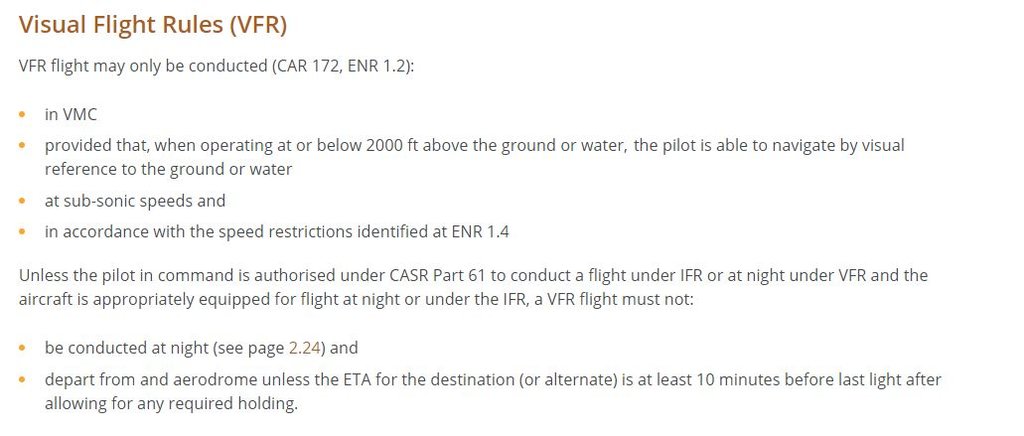
CASA doesn't say you can, it says you can't unless you are endorsed for IFR or NightVFR, and the aircraft is equipped accordingly.
The attachment spells it out
The 10 minute deadline for Arrival is a CASA Regulation you have to abide by (you're flying in CASA Airspace, and it's calculated using Airservices charts (Search for AIP General 23 May 2019 Visual Flight Rules.

-
1
-
 1
1
-
-
About 20 minutes I think it is. Also consider the folly of landing into a setting sun at an unfamiliar aerodrome if that's what the forecast wind indicates. Plan everything in advance, Google earth is your friend. Nev
The mandatory latest time of arrival is 10 minutes before last light, which will probably have you landing after sunset in dusk.
-
The sentiment that Robbos are overly risky is just the helicopter version of the knockers who say Jabiru’s are risky.
The actual fact is that given the numbers in service and the hours flown they are actually pretty safe. This is especially the case given so many of those hours are generated in the highly risky mustering environment.
Yep, they are not as safe as some fixed wings or driving a car, but the overall stats aren’t as bad as some people make out. I have just under a 1000 hours in command in R22 and R44 and never had a major problem.
If you take raw figures, all ATSB Reports which include incidents as well as accidents, the figures are:
Robinson R22: July 1984 to November 2018 - 126 = 3.5 per year
Robinson R44: 1994 to February 2019 - 75 = 3 per year
Cessna 172: July 1984 to November 2018 - 185 = 3.77 per year
-
1
-
-
The lights were on, pilot called a Mayday.
-
1
-
-
There was no cloud involved here, conditions were reported as fine and clear, with light winds. It would appear that simple spatial disorientation in the dark, sucked him into terra firma.
No, no cloud here, I was just using loss of control in cloud and the subsequent drop to the ground as an example of similar aircraft damage.
In this case it looks like the horizon was lost after last light, with the same result - major destruction of the aircraft.
-
Someone might work out what attitude it was in when it hit, and whether there was any direction at the time (some photos show scattered debris), but that's consistent with several hundred cases I've seen.
-
Turbo, I can't see vertical plunge damage here, with the typically concertinaed cabin. The cabin here appears to be folded underneath the fuselage, seeming to indicate the nose went in at a low angle, dug in, and then folded under.
(photo courtesy of Simon Cross)
[ATTACH]39437[/ATTACH]
-
Good God, I don't think I've seen an ultralight destroyed so thoroughly, for a very long time. This has to be a high speed impact, surely? - the Brumby can't be that light in its construction, that it collapses like a pack of cards on impact.
That's typical of the vertical plunge debris which occurs when the pilot loses control in cloud and drops like a rock.
What we've been seeing lately is aircraft doing forced landings and hitting a wing or two in scrub, sometimes even with the undercarriage intacts, and people describing the aircraft as strong and able to take massive punishment, but this was like the photos you see on ATSB files.
-
1
-
-
Because of the number of comments I've just ripped out a few headings from notes: DISCLAIMER This is just an example, not for real time use (but it might head you in the direction of getting some training).
Some of these things you will already be doing before each flight, but others, if you are not doing them would be breaching this and other regulations.
Speeds: The aicraft's set of standard speeds is required to calculate things like endurance and fuel burn as well as handling and navigation.
ALA: You are supposed to know all the dimensions for an ALA you intend to use, so the above legislation is no different to what you're required to comply with now.
Max (and Min) Station Load: Before you take off in a Drifter you might be required to carry some ballast; same with passengers and baggage in six seater aircraft.
Take off Distance: someone in the flying school probably did it for all temps years ago; but QNH could be 990' Elevation could be 3500', Pressure Height could be 4190, Outside Air Temparature could be -6 and Density Height 2630. In this case the cool mountain air is helping the density and lengthening the takeoff, but if OAT was 27 you'd need a LOoong runway. Most people have a scare once they start travelling. Take off Distance is one of the OKtoGo checks.
Weight and balance: A 15 kg tool box placed on the passenger side in a Morgan at one time took it out of control on takeoff and the pilot was only just able to wrestle it to the ground.
If two burly people in an LSA exceed the MTOW you don't take off. All light aircraft up to and including six place aircraft require accurate W&B calculations, which may require offloading some fuel or luggage or passengers to get the aircraft within the flight envelope. In most cases the problem is solved by shorter trip legs. W&B is one of the OKtoGo checks.
Fuel Burn calculation: I've quickly ripped out a rough process below. Fuel Burn calculation is one of the OKtoGo checks
Calculating your fuel burn is done after you've done your Nav Flight plan, so you have a known distance. If you want to have a look around, say, a dam, mine site, National Park, budget for a time spent airworking around, and that can be calculated into the fuel burn. If you go over time at the park you are likely to fail to arrive with your minimum reserve if min was what you planned on, but at least you'll know you're in trouble well before the destination, and can find an alternate airfield. Fuel Burn calculations come together with navigation where you mark off each ten minute segment. That way if something goes wrong like a horrific head wind, you can quickly calculate your endurance and if necessary make a 180 turn and use the tail wind to help find an alternate.
There are heaps of fuel exhaustion cases in RA, mostly because the pilot has no idea what his fuel endurance was.
Performance and Operation Items
Certificate of Registration
Certificate of Airworthiness
Flight Manual
Maintenance Release
Daily and Pre-flight Inspection
Log Books
Speeds
Operational Class
Time Sheet
Category
Fuel Reserve
Fuel Types
Refuelling Precautions
After Refuelling
Pilot’s Responsibility before Flight
Tying Down
Engine Starting
Maximum Range
Maximum Endurance
Landing Distance
Takeoff Distance
Total Fuel, Useable and Unusable
Authorised Landing Area
All Up Weight
Empty Weight
Fuel Weight
Passenger Weight
Maximum Takeoff Weight
Maximum Landing Weight
Effective Operational Length of Runway (EOL)
Corrected EOL
Maximum (Minimum) Station Load (eg baggage locker) structural limitation on airframe
Weight Calculation benchmarks
Datum (VE)
Centre of Gravity (COG)
Station
Index Units
COG Envelope
Loading Graph
Pressure Height and Density Height
Variation of QNH from QNE, calculation of Pressure Height
ISA International Standard Atmosphere
Density Height from ISA
Calculate Pressure Height and Density Height
Weight and Balance calculation
Calculate Takeoff Distance
Calculate landing distance
Calculate Takeoff and Landing speeds
Calculate fuel burn incl reserve
Fuel Burn
Once an aircraft is calibrated for fuel burn in climb, cruise and descent, the fuel burn figure can be calculated quite accurately.
The fuel burn calculations start with the fuel tank contents before the flight, based on usable fuel. Although a fuel tank may have a total fuel capacity of a certain number of litres when filled by the pump, all tanks have part of the system inaccessible to the fuel pickup, and that will be common for every flight, so it is deducted from the full fuel figure and is known as Usable Fuel.
Convert from IAS to TAS and from QNH to Density Height
1. Take Off – refer consumption chart for aircraft, calculate fuel consumed
2. Climb – refer chart, calculate DH of cruise, calculate fuel used to climb to DH
Calculate distance travelled on track during climb by time during climb, speed during climb, use flight computer.
3. Cruise – Deduct climb on track from distance A to B.
Refer Chart, read off GPH/LPH for nominated RPM/TAS
Use computer to calculate duration from TAS/Distance
Use computer to calculate fuel consumed from duration/GPHorLPH
Ensure 45 minutes reserve fuel remains at end of flight.
4. Calculate descent + Approach + landing
Calculate (a) Time for trip (b) Fuel Consumed and including 45 min reserve.
-
2
-
-
Hello Turbo..
P&O = P&O Cruisers........ this is my P&O....So is that what you mean or you have something else in your mind?
KP
Performance and Operations, a set of subjects every pilot is required to calculate before each flight. In some cases, such as training circuits, the basics have been done long ago by the flying school.
RAAus Board Election 2019
in Governing Bodies
Posted
No, Kasper's going to have a hard enough job as it is getting the focus of the members to vote without the confusion of trying to reinvent the wheel, which no one has been invited to do.