
Garfly
-
Posts
3,299 -
Joined
-
Last visited
-
Days Won
87
Content Type
Profiles
Forums
Gallery
Downloads
Blogs
Events
Store
Aircraft
Resources
Tutorials
Articles
Classifieds
Movies
Books
Community Map
Quizzes
Videos Directory
Everything posted by Garfly
-
 This is just a single - very nicely done - shot of a good looking RV-7A landing (leaving only light work for the little wheel).
 -
Yeah, apart from the ASIC issue, as far as I know, you can still access YTWB remaining OCTA, and avoiding the Military Romeo's most of the time. Maybe some locals could fill us in on that. I'd be interested anyway.
-
Wouldn't YTWB be able to accommodate you? Is it because it's a security controlled joint? Or your reluctance to get stuck there by pop-up PRDs? Maybe parking up at Warwick, to start with, and getting old TWB mate to come get you is the way to go. ;- ) Anyway, sounds like a nice trip.
-
Makes me feel a bit better about leaving the 'Ranger alone in the hangar for months on end.
-
LOL ... Yeah, well I guess times have moved on. (Anyway, jeans, sneakers and T's are still the go ;- )
-
Glen did you fly direct YCWR - YMND on this trip? And the northerly route you say you'd take if there was significant cloud ... do you mean like via Mudgee and Warkworth? Would you say the worst of the tiger country was pretty much the area north east of Bathurst and south west of Cessnock? They say that there are times when the Hunter Valley can get socked in for weeks with cloud sitting on the ranges to the north, south and west - even the hills to the east. I remember Old Koreelah telling us here once, that his aero club at Quirindi (on the plains north-west of Scone) offered basic accommodation to encourage visiting pilots bound for the Hunter to stay and wait it out if cumulo granitus was festooning the Liverpool Range.
-
I used to think that the SE2 would qualify us to use Class E. I was encouraged by this: CASA ADVISORY CIRCULAR AC 91-23 v1.0 Excerpt: "Apart from an integrated TABS device able to substitute for a transponder in Class E & G airspace, lower cost options are not intended to overcome any existing requirement to carry a transponder, in any class of airspace.” But on seeking clarification from RAAus I got this response from their Policy section: "An integrated TABS device is not an EC device, such as the SE2. These are two different things. If you take a look at CAO 20.18 Appendix XIII (for integrated TABS) or Appendix XIV (for EC device) you'll see that an integrated TABS device must meet the technical specifications for (E)TSO-C199. and have a SIL of 1." We had a fairly long discussion about this on here a couple of years ago when there was an Airservices Australia proposal to lower the Class E space over much of eastern Oz. https://www.recreationalflying.com/topic/37213-lowering-class-e-between-melbourne-and-cairns/
-
Jim Tweto, bush pilot of ‘Flying Wild Alaska,’ dies in plane crash - The Washington Post WWW.WASHINGTONPOST.COM Jim Tweto, star of the Discovery Channel's "Flying Wild Alaska," has died in a plane crash, along with his passenger, Idaho outdoor guide Shane Reynolds. In this clip from "Flying Wild Alaska" Jim Tweeto bemoans the high fatal accident numbers in Alaskan flying - back then. (And he suffers a broken rudder on take off.)
-
Meanwhile, back at Amberley:
-
This is another oddity from the airline archive. Alistair Cooke, of all people, is our presenter for this TV film about the latest in air safety procedures. The 'talk 'em down the glideslope' ILS procedure at Idlewild is interesting to see. And another film from the same time and place ... but quite a different style.
-
My point was that they're bound to do their informing without prejudice or judgement regarding the actual individuals involved. So we might want to cut them a little slack. In any case, for me, the video of the accident where we see exactly what happened to that nose-wheel (in real time AND slowmo) certainly does inform. An unforgettable image and a reminder to all nosedragger drivers to take good care of the little wheel. Presumably, the accident pilot agreed to share that video of his/her embarrassment for the benefit of the rest of us. I appreciate that.
-
ATSB Quote "encountered a tailwind during landing ... resulting in a hard landing" Yeah, I reckon the ATSB would take your point. At the same time, they probably feel their role constrains them to minimise judgemental language in their general safety messages. (That's what social media is for. ;- )
-
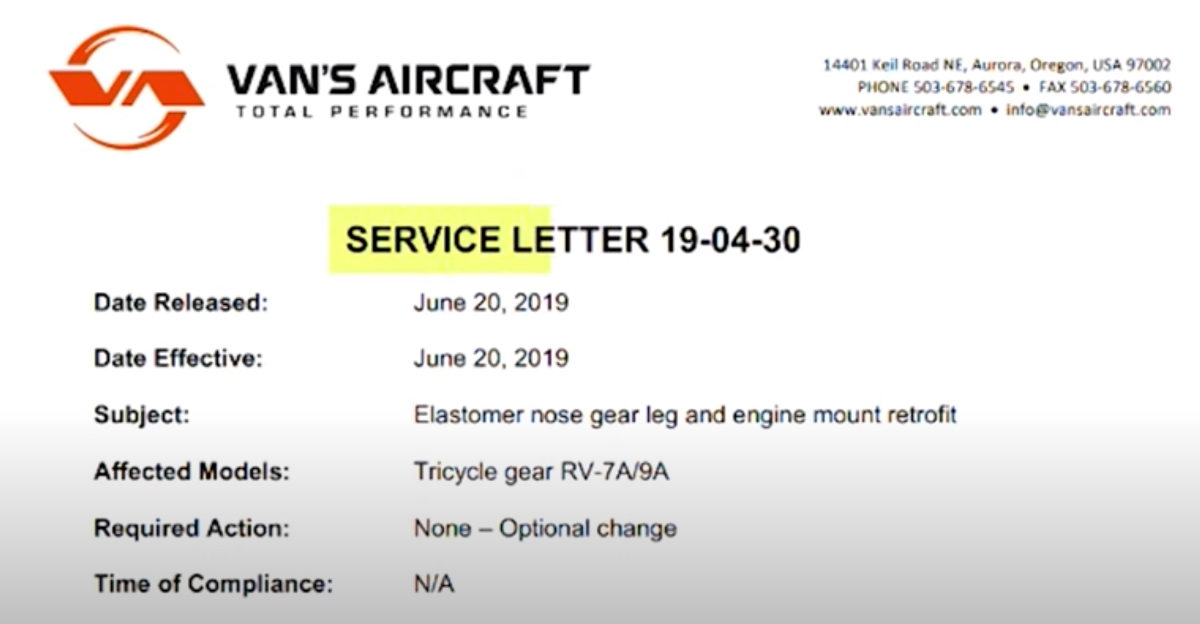
Yeah, anyway, as ATSB says in the YT Description, one of the cases they'd dealt with locally was a 6A: "In January a Van’s RV-9A encountered a tailwind during landing on a private grass airstrip on French Island, Victoria, resulting in a hard landing. The aircraft bounced, and its nose gear then collapsed. The aircraft subsequently nosed over, and came to a rest inverted, resulting in serious injuries to both occupants, and substantial damage to the aircraft. The accident was similar to a few others, including one investigated by the ATSB in 2017. In that accident, the nose gear of a Van’s RV-6A collapsed after the aircraft bounced during a heavy landing on a dirt airstrip in north Queensland. In light of these accidents, the ATSB is urging owners and operators of Van’s RV-6A, RV-7A and RV-9A aircraft to consider Van’s Aircraft Service Letter 19-04-30."
-
Yeah, actually the Service Letter shown in the video mentions only the RV 7A and 9A (the commentary, though, for some reason, mentions "6A") Anyway, I think it's good to see ATSB getting on the front foot with well made safety videos for the home-built crowd. Maybe it will even extend to RAAus-only types.

-
Hey OME, Tooraweenah and Butler get a gig in this one. (I wonder if Aussie airline pilots still mutter "Stone the flamin' crows!" when delayed at the holding point? LOL )
-
Talking about when SYLLABUS meets HUMAN FACTORS: https://www.youtube.com/watch?v=Vv0NNjQOCkI
-
Yes, we can all agree on the Human Factors effect. But when it comes to what coulda, shoulda, mighta been done, absent the startle, I'm still with 'Fred Flintstone' (in the YT Comments): "Without the rudder to counteract the immediate left yaw from applying full power I am guessing this happened very fast. He did not know he lost the rudder but taking out the power and letting the plane go straight would have probably kept him on the airport but maybe not the runway." But that's all conjecture upon conjecture - all apart from the weld failure, that is.
-
Yes, maybe he was going around because he felt his approach was a bit hot. But then his rudder failed, just when he needed it most. If it hadn't, everything would have been fine and dandy. So for me, this one's firmly in the 'mechanical failure' column, sub-section: hidden metal fatigue. In some ways, though, it's the above-mentioned Challenger fatal that hits closer to home. A reminder that as a homebuilt owner/operator it's down to me to keep on top of the issue - hidden or not. (Mechanically challenged or not ;- )
-
Yes, a fascinating read. And here's a video about it:
-
EDIT: Yeah, exactly, and in the church-steeple war-story the pay day loan scheme worked out very well for our intrepid borrower,
-
Yes, it's that sink immediately following the sudden config shift that's the issue (which Cherokees with their simple handle allow but electro-flapped Cessna's don't, so much). As I understand it, the whole lift/drag, AoA/inertia situation takes time to sort itself out; seconds in which you lose lift on the swings before you shed drag on the roundabout. Maybe "dumping" is the mirror image of "popping" the flaps which the STOL mob use to steal a quick lift bonus without paying the drag penalty for the entire take-off run. Also, I remember once reading a story of an aviator who found himself in a pickle on climb out; staring down a church steeple dead ahead, which, it seemed, he wasn't going to clear. With his back already against the power curve, he knew his wings had no more to give - including, I guess, any kind of turn away. Anyway, according to my memory of the tale, he ended up saving the day by resorting to some flap popping. At the very last moment he dropped a stage which instantly bunted his path just overhead the pointy bit. After that, of course, he'd plenty of time to pay off his drag penalty in open air with cleaned up wings.
-
True, but I don't see here (albeit without much to go on) a case for blaming the training, either. I do remember in my own PA28 140 ab initio work in Moresby, yonks ago, dumping flap in a go-around was absolute anathema. (The littlest Cherokee never seemed to have trouble climbing away, 2-up, full flap, despite the heat and the humidity.) To dump flap is to dump lift, was the mantra. The lever had to be left where it was until a positive rate - on runway heading - was established and then, ever so gently, progressively eased off. So if this young chap's training was anything like mine, flap dumping would've been the last thing to have 'kicked in', as they say. Actually, I remember doing just that once, on a go around with an instructor who, as our climb-slope sagged alarmingly, went apoplectic, saying I'd get us killed doing that. On reflection, I realised I'd done it reflexively; the imprint of all that touch-and-go practice, where you usually do need to dump landing-flap quick-smart before powering up again.
-
Anyway, Instructor Google has some interesting insights into the four left-leaning amigos: (Torque, spiraling slipstream, P-factor, and gyroscopic precession) Technique - Left Turning Tendencies WWW.AOPA.ORG
-
We don't actually have much detail to go on regarding what happened in those few seconds between his 100' decision to go around and his ending in the shrubs. Certainly not enough, IMHO, to confidently condemn the young pilot. His decision to go missed in the first place, due an "unstable" approach, may well be counted a 'good' one; reflecting 'good' training and good learning. And then, if the rudder did 'break' right at the point he went max power (with armfulls of forward stick and bootfuls of right rudder - as per propertraining) then who's to say that that wouldn't have caught out a 15,000 hr pilot as much as a 150 hr one? After all, aren't we supposed to add at least 3 seconds for the WTF! factor while practising 'realistic' emergencies. Why not cut this guy at least that much slack?