skippydiesel
-
Posts
8,276 -
Joined
-
Last visited
-
Days Won
84
Content Type
Profiles
Forums
Gallery
Downloads
Blogs
Events
Store
Aircraft
Resources
Tutorials
Articles
Classifieds
Movies
Books
Community Map
Quizzes
Videos Directory
Everything posted by skippydiesel
-
Six Aviation Bluetooth Headset Interface
skippydiesel replied to skippydiesel's topic in Instruments, Radios and Electronics
Can't do a report on the Clear Prop adapter at this time. Silly old fart, waited too long to test the new adapter. Went flying a few days ago - adapter didnt work??? Landed, after a very nice 1.4 hrs, checked AvTraffic connection - free trial had run out the day before. Such is life! Will now have to pay AvTraffic 1 or 12 months subscription. I guess I will go for the single month and see how it works for me in the Sydney Basin. 😈 -
CV 19 ? "The discussion on whether it should be Parkes or somewhere else needs its own thread." Wherever the event is mentioned it deserves to be commented on. 😈
-
"With planning already underway for Fly’n For Fun 2028.........", The above phrase has once again been printed (07/05/26) - I repeat, is this an error or a genuine announcement of intent ie no RAA event in 2027??? Could RAA be starting to get the message - Parkes, along with any other Security Controlled airport, is not the place to hold this sort of event. 😈
-
Oddball, Experimental, or One-off
skippydiesel replied to red750's topic in Aircraft General Discussion
Has a passing resemblance to the Boing Stratocruiser and a similar military origin (I am old enough to have flown in one)😈 -
Holy Micro! Absolute AoA Flight Trial - AvBrief.com
skippydiesel replied to Frank JK's topic in Aviation Enthusiasts
Seems to me the two pilots concerned, responded exactly the way they were trained😈 -
Strange how quickly people forget/accept the status quo - Most publicly accessible airfields, around Australia, (post WW2) were owned by the Federal Government (US!). The Government uses our money to develop/maintain these assets ie nothing is for free. Publicly accessible airfields, do not just serve us (privet pilots) they are a valuable asset to their local community - travel, tourism, emergency service, FIFO personnel, emergency landing and agricultural aviation . THEN the Gov sells or gives them away. The sold ones go to businesses that know they can make a hansom profit from our asset. The now, privately owned airfields have all sorts of user fees applied AND often see non aviation development, that can impact aircraft safety and almost certainly foretells the ultimate goal of the owners - no more airfield. The give away's (transfers) seem to go to rural Councils, that also think there is a few extra $$ to be made. This is where the likes of AvData come in. For the most part the extra dollar expectation is an illusion. If they are lucky, they might come close to breaking even. Councils have had a very rude shock with the ASIC security upgrade costs, imposed by the Gov, on all RPT airfields We think we are hardly done by, with this ineffectual ridiculous cost - imagine if you are a cash strapped council. Paying $10-$50 to land somewhere & park, doesn't seem unreasonable - that is until you have multiples of this cost, on a trip away. There are some Council owners who have a more informed strategy eg Charge only apply to turbine/jet aircraft (ie normally commercial heavy aircraft). Others do not charge for landing and or parking at all. Publicly accessible airfields, do not just serve us (privet pilots) they are a valuable asset, like roads, to their local community - travel, tourism, emergency service, FIFO personnel, emergency landings and agricultural aviation. In the past publicly owned assets were either used "free" or subsidised, as a public good. As a public good they facilitated all sorts of other activities. This is called synergy - Synergy is the combined power or interaction of two or more agents/substances that produces a total effect greater than the sum of their individual contributions . This concept has given way to the shortsighted, regressive, philosophy of "User Pays" (part of Economic Rationalism?), to the detriment of the individual and society as a whole. Recreational /Private aviation seems to be on the decline. I have no doubt there are many factors contributing to this. Cost (which includes land/parking fees) would have to be a major disincentive. 😈
-
You know that the AvData cancer is close to untreatable, when some very "ordinary" dirt strips, with minimal amenities (tin shed) are being administered by the company. The owner (Council?) must be completely nuts, if they think buckets of money are going to descend from the heavens😈
-
Not just on the fee matter. Also you re purchasing a non product ie has no security benefit to you or the country. Ripped off twice by the Government - Thats Australia's version of a democratic process.😈
-
As stated (other thread) I have no problem with the aircraft itself, just the ridiculous hype around an aircraft, that can only be described as a triumph of form over function. A Rotax 912 UL (80hp) will likly match the fuel consumption(7.5L/gr ULP 91 RON ) and depending on airframe, probably in a better all round performing aircraft. If the handsome Spirit meets your expectations- go for it!😈
-
For Australia - I like a high wing, just font belie the Sonex will be a success. It s not just the kit/plans built market its up again, its a host of similar factory builds. Time will tell😈
-
As for Sonex reopening - Good news indeed however I fear that the inability of, consecutive management teams, to move with the times, will see it fold again in the not to distant future (I hope I am wrong). Their focus on a high wing varient of the Sonex, which will face stiff competition from a market already saturated with similar aircraft, rather than adopt the far more cost effective innovations offered by Robin Austin, speaks volumes as to their myopic view of what the customer wants.😈
-
I fear you misquote me - The Spirit is not expensive, as small aircraft go, its an art work that delivers looks, rather than performance, much like the Junker above (which at least has a second seat). For those who value form over function, I have no doubt that the Spirit/Junkers are highly desirable aircraft, worth every penny of posser potential.😈
-
Is wing warping coming back again?
skippydiesel replied to Marty_d's topic in Aircraft Building and Design Discussion
True but is till only mans best effort at emulating what nature has crafted for birds.😈 -
Great information Onetrack. "highway pattern" square shoulder tyre that isn't desirable for aircraft use - you need a round-shouldered profile tyre" I do not disagree with what you have stated (above) but would place the tread type ahead of the "shouldered profile". Leaving aside ply & speed rating for a moment, I would place the centre tyre as near ideal, followed by left, then right. Simple principals - aircraft tyres should not pick up "stuff" to fling up onto wing/flaps, back onto empennage, will ideally slide when subject to side load rather than dig in. Smooth rather than grip type tread is desirable. Aviation tyres are usually horrifically expensive (as with anything labeled "aviation"). If your aircraft is under Max 600 kg take-off weight, with a 40knot or less stall/landing speed, you are unlikly to benefit from such exotic landing equipment😈
-
Started a spare parts list
skippydiesel replied to danny_galaga's topic in Aircraft General Discussion
Fair comment but what of home built? Sure homebuilt have the potential to include concerning quality and divergence from plans, however this should be weighed against the creative expression of the builder, much cheaper construction cost (labour not usually being included), on going lower operating cost and genuine improvements on the origional design (eg Robin Austin Sonerai projects x 2). I am not in a position to make an all of fleet judgement on homebuilt quality but would point out that there is little negative criticism being express in this and other Forums. I am on my second homebuilt aircraft. I sold my first at about 20+ years & 950 hrs of reliable, safe operation. My second - the pre purchase engineers report, commented the construction standard exceeded factory quality. It seems likly that the "consistency" of factory builds, while true, is overblown😈 -
Started a spare parts list
skippydiesel replied to danny_galaga's topic in Aircraft General Discussion
"....factory built is built to a standard design and quality." That what you hope & pay for. Ufortunatly there have been instancess where factory quality was wanting.😈 -
Started a spare parts list
skippydiesel replied to danny_galaga's topic in Aircraft General Discussion
Sorry to hear of the Sportstar's demise. This won't help the Sportstat - Once again, the cost advantage, of a kit/home built, over a factory build, is demonstrated. Its quite likly the Sportstar could be rebuilt but only by expensive, suitably qualified persons, making it uneconomical do so, a "write-off". The home built can be repaired by an amateur for the cost of the materials, which can also be sourced from the lowest cost, suitable supplier.😈 -
Started a spare parts list
skippydiesel replied to danny_galaga's topic in Aircraft General Discussion
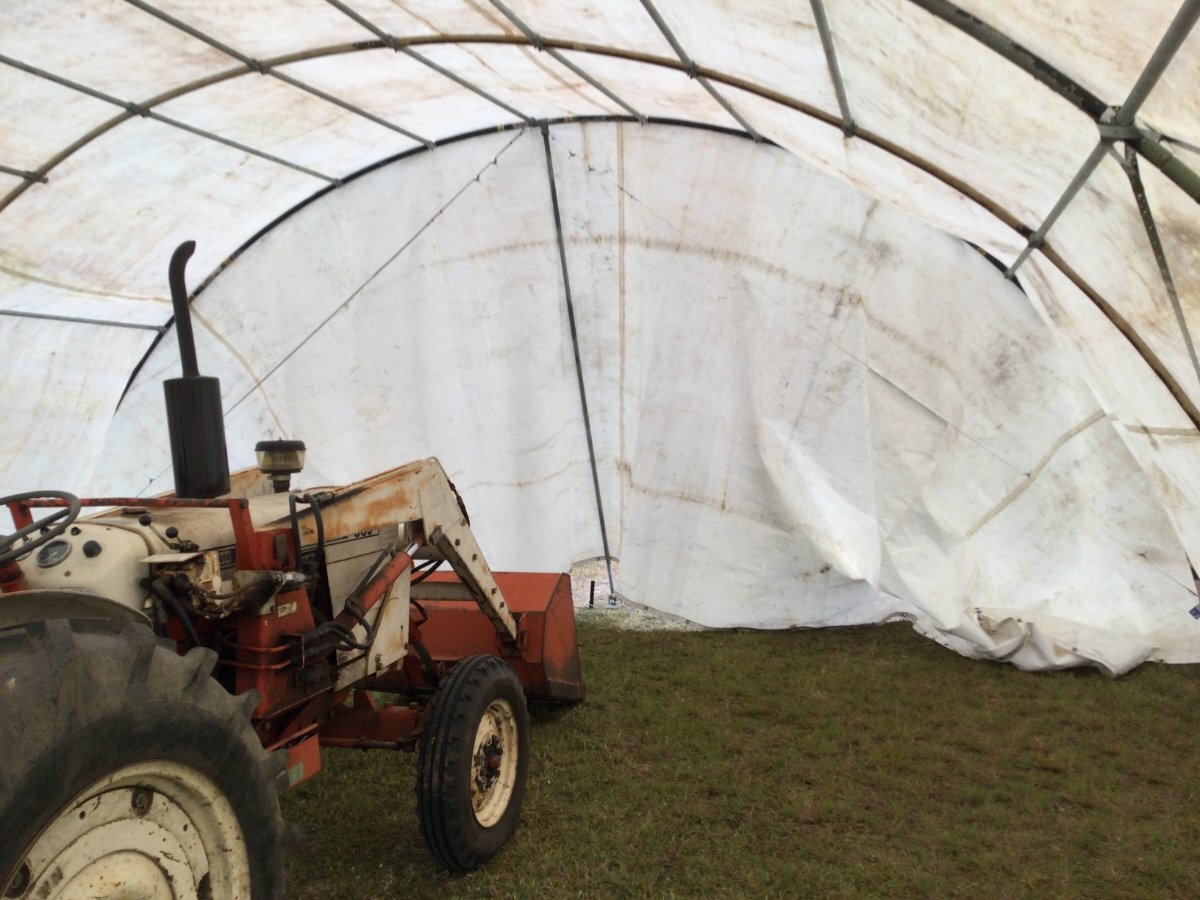
130 Knots / 150 mph / 241 kph - no matter how you express it, that is a gale of a wind. When you say "..we lost the Sportstar and its shelter." what exactly do you mean? Written off? Not many temporary structures will stand up to the above wind. Our prevailing winds are from the WSW. My structure is in the lea of a large vegetative planting and is oriented with open ends north/ south. There are 14 very heavy (two men to lift) concrete anchors that will hold/tension the tarp. The hollow "foot" of each hoop is over a short star picket that has been hammered into the ground. My aircraft, will be secured within the structure, to 3 star pickets, driven deep into the ground, at 45 degrees or better, to the tie down pints. My hope is that being open each end and secured as above, the structure will have less wind resistance than a fully/partially closed structure. This combined with some flexibility will prevent the whole thing blowing away/lifting. I do not have access to a more solid/permanent structure. In my 30 years associated with The Oaks, we have had one destructive wind event & several hail storms. As far as I know the hail cause no damage to the various (composite) Jabs parked in the open - I don't think there were any metal skinned aircraft in the open (as mine currently is). The wind storm was more destructive than the hail, damaging one or more poorly secured aircraft and flattening some makeshift structures.😈 -
Hi Dean, You may want to specify Make & Model. If memory serves oil thermostats, for Rotax 9's, came in at least two temperature opening/ratings. All the best
-
Started a spare parts list
skippydiesel replied to danny_galaga's topic in Aircraft General Discussion
How big is the structure? I am just going through the process of replacing my tarp - highest quote so far for 9 x 11 m HD tarp, eyelets every 0.5m, delivered +GST is $1,200. No back / front wall as this will just turn the whole thing into a parachute, making the need for substantial anchoring/foundations. My structure will have no foundation & be primarily anchored by weights, holding the tarp/structure in place. KISS all the way. My primary interest is hail protection for the Sonex, follower by UV and rain, in the context of me being comfortable. 😈 -
Started a spare parts list
skippydiesel replied to danny_galaga's topic in Aircraft General Discussion
Ye Gads! Bureaucracy/taxation by another name, gone crazy. !0 years - not bad. The tarp shown is far too big and of an unknown age, so will be purchasing a new (fitted) cover, that will likly outlast my flying activity.😈 -
Started a spare parts list
skippydiesel replied to danny_galaga's topic in Aircraft General Discussion
Temporary Hanger ; Planning permission (outside town limits) not usually required😈
-
Started a spare parts list
skippydiesel replied to danny_galaga's topic in Aircraft General Discussion
Have a read: https://pointsforpilots.blogspot.com/2012/12/testing-rotax-912914-generator-and.html 😈 -
Continuing Airworthiness Notice – 57-005 Tecnam P2008 Fuselage Extrusion P/N 28-2-1095-1 Attachment Lugs - Corrosion 7 April 2026 Issued by the Civil Aviation Authority of New Zealand in the interests of aviation safety. A Continuing Airworthiness Notice (CAN) is intended to alert, educate, and make recommendations to the aviation community. A CAN contains information and guidance about an airworthiness concern that does not meet the criteria for an Airworthiness Directive (AD). The inspections and practices described in this CAN must still be carried out in accordance with the applicable NZCAR Parts 21, 43 and 91. CAN numbering is by ATA Chapter followed by a sequential number for the next CAN in that ATA Chapter. Applicability: All Tecnam P2008 aircraft (i.e. certificated, LSA and microlight aircraft) fitted with a fuselage extrusion P/N 28-2 1095-1. Purpose: This Continuing Airworthiness Notice (CAN) is issued to bring attention to defect reports submitted to the CAA of finding corrosion in the attachment lugs of fuselage extrusion P/N 28-2-1095-1 on five P2008 aircraft. For further details of the location of the corrosion found, refer to the photos in this CAN. Background: This CAN is prompted by five occurrences reported to the CAA of finding corrosion in the attachment lugs of the fuselage extrusion P/N 28-2-1095-1. The fuselage extrusion attaches both the LH and RH wings aft spars to the fuselage. The corrosion found in the bolt attachment lugs is intergranular, and had advanced significantly to require replacement. The corrosion was found during wing removal for an unrelated issue. The corrosion appears to have occurred in areas where the protection paint finish was not damaged and also not in areas of dissimilar metal contact (e.g. from the attachment bolts). Recommendation: Operators should follow manufacturers recommendations for corrosion control applicable to operation in high salt/high humidity environments. In the case of Tecnam aircraft, the manufacturer recommends applying anti corrosive to wing attachments every 12 months. The CAA strongly recommends that operators and maintainers of Tecnam P2008 aircraft inspect the attachment lugs of fuselage extrusion P/N 28-2-1095-1 for defects and corrosion. If any defects are found accomplish appropriate corrective actions before further flight. CAA requests that operators and maintenance providers report any cracks, or damage found, via the occurrence reporting process: https://occurrencereporting.services.aviation.govt.nz Tecnam has been notified of these findings. Refer to the photos below for examples of typical corrosion found. This CAN is considered to be an interim action and further CAN, or AD action may follow.
-
- 3
-

-