


old man emu
-
Posts
5,297 -
Joined
-
Last visited
-
Days Won
78
Content Type
Profiles
Forums
Gallery
Downloads
Blogs
Events
Store
Aircraft
Resources
Tutorials
Articles
Classifieds
Movies
Books
Community Map
Quizzes
Videos Directory
Posts posted by old man emu
-
-
It's OK by me for Yanks to use 1/8" and 12 inches to the foot for measurements, and I can accept 1/1000th's for measurements below 1/32", but I wonder why we don't go from 1/1000th's, through 1/100 to 1/10th's. Distance measurements in Imperial or Metric are easy to work with if you stay in one or the other.
What annoy me is the two types of gallon.
1 Imperial gallon = 1.2 US gallons = 4.546 litres., or
1 US gallon = 0.83 Imp gallons = 3.75 litres
1 litre = 0.22 Imp gallons = 0.26 US gallons
1 litre = 1.14 Imp qts = 0.9375 US qts
-
What I don't understand is the odd size of the standard NATO cartridge - the 9 mm Parabellum.
https://en.wikipedia.org/wiki/9%C3%9719mm_Parabellum
Why would you make a cartridge 9 mm instead of 10 mm and 19 mm instead of 20 mm? 9 mm is only a bee's dick thinner than 10 mm and 20 mm isn't that much longer.
-
It must be good software to colour film footage.
It just has to be 24 pictures per second faster. If you think of those PIXAR movies, ans the Super Hero ones with lots of CGI, these movie companies must have computers with dazzling speeds.
-
 1
1
-
-
You can add another factor with a finer pitch, and that is that finer pitch will result in higher clamping forces for the same torque than a coarse thread, and be less likely to come undone for the same reason.
That's also correct. It is usual to use UNF or ISO Metric Fine for fasteners that are clamping two items together by passing through the items, or if the bolt is screwing into steel. The force exerted by the nut on the contact surfaces of the items to be held together, which we measure using a torque wrench (or Mk 1 ham fist), can act over a greater contact area between the threads of the nut and bolt. If the materials are metal, a washer of the same diameter as the width of the nut is used as a sacrificial offering to protect the surfaces of the parts being held together. If the nut and bolt are used to join wooden components, a large diameter (penny) washer is used to disperse the force over a wider area to protect the fibres of the wood from damage.
If the bolt is screwing into materials softer than steel, we use UNC or ISO Metric Coarse so that there is more material between each thread in the softer material. This prevents the bolt tearing out the material between threads and leaving you with a smooth walled hole.
If you want to get right into the nitty-gritty of fastener threads, download this: https://www.swagelok.com/downloads/webcatalogs/en/MS-13-77.pdf
-
 1
1
-
-
OME - And with the last sentence, you opened another can of worms
You are quite correct in raising a point relating to the tensile and shear strengths of fasteners, but that is further down the track than where we left Turbo with self-loosening nuts (No humour intended).
-
I'll come back to this discussion later today
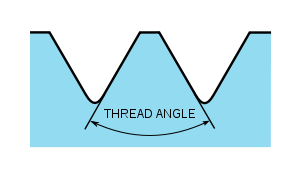
Let's see why Turboplanner has problems with metric nuts coming loose where UNF ones don't. We'll use this diagram as a reference.

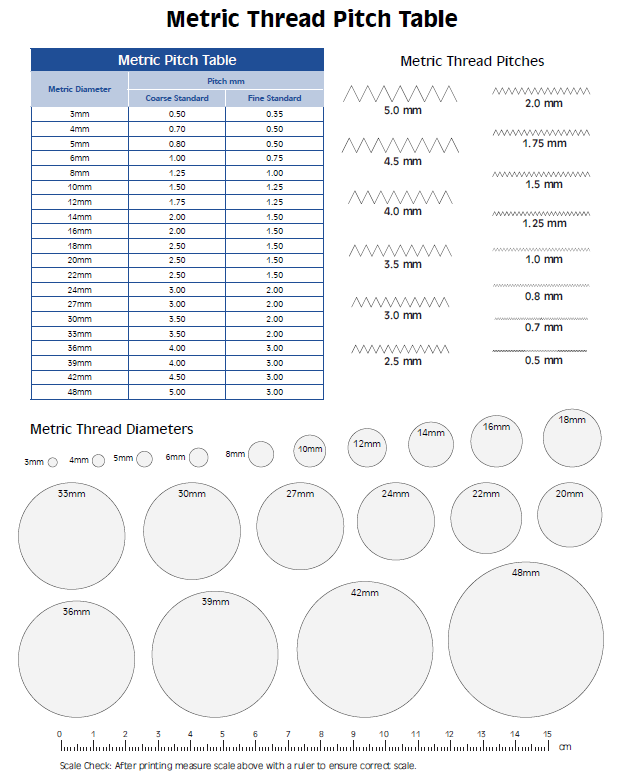
Both an M6 and 1/4" UNF have a 60 degree thread angle, so they are the same in that respect. However, we saw earlier that the distance between two successive thread crests are different. For the M6 bolt, the pitch is 0.75 mm, while the pitch of a 1/4" UNF is 0.9 mm.
That means that for a thread length of 10 mm, the M6 has 13 V-shaped grooves, while the 1/4" UNF has 11. This means that the depth of the groove of the M6 is shallower than that of the 1/4" UNF. Or to put it the other way around, there is more contact surface between the bolt and the nut for the 1/4" UNF than for the M6.
Because there is more contact area, the friction between the surface of the thread of the bolt and the surface of the thread in the nut is higher with the UNF than it is with the M6. With greater friction, the UNF nut cannot release itself as easily as the M6 can.
This opinion assumes that both the M6 and UNF nuts and bolts are made from identical metal, and are both tightened to the same torque.
-
1
-
 1
1
-
-
The expensive ones apparently have a safe life if 5 years so can sit dormant that long with needed to be changed
But in NSW rental properties, the batteries in smoke detectors have to be changed every 6 months, and if there is other fire-fighting equipment, it also gets checked every 6 months. Each year the owner of the premises has to submit a Fire Safety Statement to local government and the Fire Brigade reporting that all equipment is suitable for expected fires and is ready for use.
-
Quick note during smoko
It's all about friction. Tell you more later today.
-
Screw Thread Terminology
Some of the common terms faced when looking into thread types and sizes are summarised below.
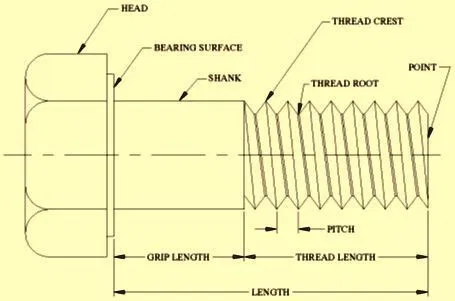
alt=llustration of a threaded fastener with useful terms labelled
https://i0.wp.com/staqoo.ie/blog/wp-content/uploads/2018/01/fastenerwithterms.jpg?resize=455%2C301&ssl=1[/img]
Figure 1: Illustration of a threaded fastener with useful terms labelled (Ispatguru.com, 2018)Major Diameter – Largest fastener thread diameter. For example, in a screw the major diameter would be the diameter of the shaft.
Minor Diameter – Smallest fastener thread diameter. For example, in a screw the minor diameter would be diameter of the inner part of the screw with the exception of the crests of the helix.
Pitch – Linear distance between one thread and the other next to it.
Thread Length – The total length of the threaded part in the fastener.
Flank – The angle at which the thread crest is raised from the thread root.
I still use UNF bolts for race car design in critical areas because the thread locks better and stays tight better, even with a shakeprooof washer, whereas every attempt I've made at getting a metric thread to do the same jobs results in the bolts coming loose, but that's the only exception.That is interesting when one compares the pitch of Metric and UNF. Let's take two similar diameter bolts - M6 and 1/4 UNF. The pitch of the M6 is 0.75 mm, while that of the 1/4 UNF is 28 TPI (which works out to be 0.889 - call it 0.9 - mm). Both bolts have the same Flank angle of 60 degrees, which is not relevant to this discussion.
Let's take the example of bolts fastening two metal plates together. The bolt itself is not doing any fastening, apart from providing a stopper at the head against which the nut is torqued. It is the nut that does the tightening. Let's look at the nut, which has the same pitch as the bolt thread. We'll make the nut 10 mm thick.
Hark! I hear the dulcet tones of SWMBO calling to me like the mournful foghorn call of an Iberian-registered tramp steamer wandering in a Dover Strait fog. I'll come back to this discussion later today - OME
-
1
-
1
-
-
It must be really annoying that the metric prefixes are rooted in Latin
They are rooted in English, too.
-
I've got a set of drills that are the usual Imperial to 1/2", plus number and letter drills.
I really can't see why industry would decide to use drills that are neither Imperial equivalents of metric, nor based on multiples of 1/64". What benefit is there in using say a #31 or #30 drill which are only a few poofteenths either side of a 1/8" drill? There are eight drills available for drilling holes between 3/32" and 7/64" for example.
-
In metrics your diameter and pitch are pretty much your choice. nev
No they are not. You can only get accepted standards, just as you can only get accepted standards in Imperial.
-
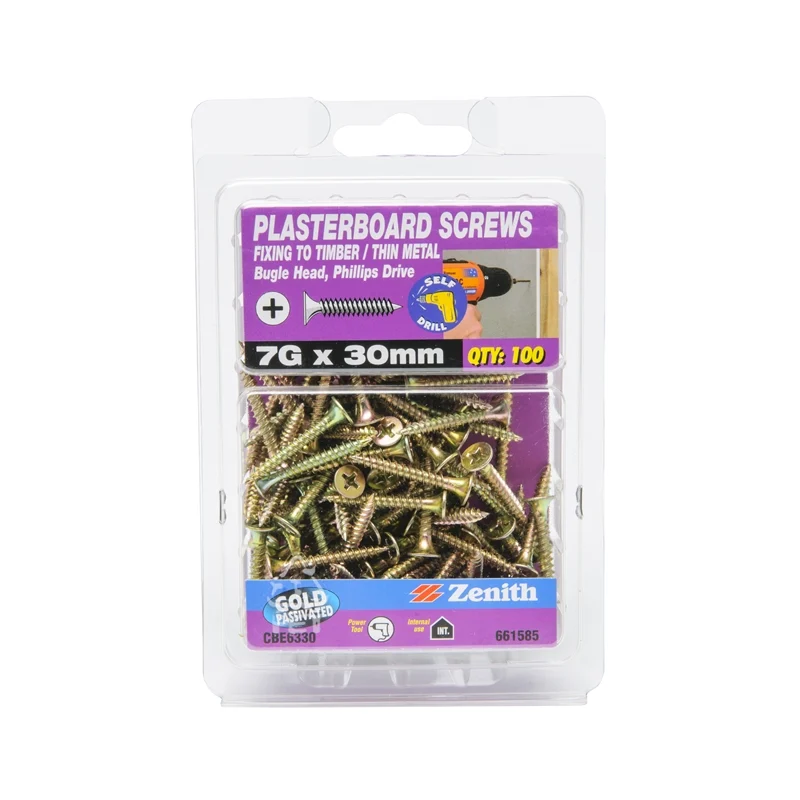
I don't know what you were looking at when you were buying the bolts. I can always find metric nuts, bolts and washers in a separate display bat from the imperial. What gets me is that screws are described by gauge, which is an imperial measurement, and by length in millimetres.
At least with bolts and nut I can go back to AN, MS or NAS and look at the dash numbers.
-
My wife, an English rose, pronounces "auction" as "orkshun", while I, a native of this sunburnt land, say "oxshun"
-
It will come
But is it really worth it?
As an intellectual and technology experiment - YES, but as a practical mass transportation method - NO.
-
 1
1
-
 1
1
-
-
Some form of immediately-applicable reverse thrust could overcome that problem - but there's no need to come to a stop in the air if avoidance systems are perfected.
The Sci-Fi concept, of a mass transportation involving the use of airborne vehicles, is based on replacing ground vehicles with airborne ones, but having them travel on similarly congested routes. We know that it only takes one person to stuff up amongst that congestion for a major pile up to occur. All the CAS in the world won't save us from the self-centredness we see regularly on our roads.
Just imagine a line of airborne vehicles travelling along a congested route all at the same speed. If, for some reason not apparent to the operators of vehicles back down the route, someone slows or stops suddenly, you can bet that there will be rear-enders galore. They don't usually result in serious injury for ground vehicles, but airborne vehicles have that extra bit of the quick stop when they reach the ground.
-
There is one simple thing that will prevent the widespread adoption of flying vehicles of this type: FRICTION.
It's easy to get a vehicle airborne for a sustained period, but use your experience to answer the question: How far will a vehicle travel before stopping without friction. You all learned about emergency stopping distances from various speeds for cars. There the car has the opportunity to have its wheels stop rolling and to be slowed by the friction between the road surface and the tyre. Imagine the situation in your own plane in the air if you were suddenly required to stop its forward motion and could not go left, right, up or down. Could you stop your plane? And therein lies the thing that prevents flying vehicles replacing ground vehicles for common use.
-
While flying cars can be made, and as Tomohiro Fukuzawa says, their commercial viability will depend on the purchase price and endurance, their numbers in practical use would never get much above the number of private aircraft for the simple reason of the stupidity of the population. Can you imaging the annual death toll if people operated flying cars with the lack of skill and consideration that they operate ground vehicles now?
-
3
-
1
-
-
I think Kyle might be your Go-To man as he is in the electrical business.
-
Is anyone looking for hangarage at YMBD
Schmacko, although this is a place for aviators, we are creating a custom to avoid using International Civil Aviation Organization airport codes in thread titles and posts without clarification of the code. The reason is that this forum is read worldwide and unless the reader is already aware where the code stands for, there is a reduction in good communication.
-
2
-
-
Some "leading US Authority on language" has decreed that the correct pronunciation of our famous Australian bird, which appears on our Coat of Arms, the EMU,should be pronounced "EE MOO".
I'm beak-smacked.
-
1
-
 2
2
-
-
At first thought a ballistic parachute on a helicopter seems as useful as a flyscreen door on a submarine.
-
That's a job I can do next week during lockdown. I dropped my box of number and letter drills, so I have to sit down with my vernier calipers and measure each one to find what hole to put it back into.
-
I'll go 50-50 and sup a Rose.



Cessna runway excursion
in Aircraft Incidents and Accidents
Posted
That person has no idea about operating a vehicle. It is so easy to get a vehicle moving, but a hard lesson to learn is how to stop.
He adds power initially, but forgets to take it off. In panic he tries to steer in the same way that he would steer a car, forgetting about using the rudder pedals to steer. The best thing that he does is to try to get some weight off the nose wheel by using up elevator.
You've got to feel sorry for the poor bugger.