


old man emu
-
Posts
5,297 -
Joined
-
Last visited
-
Days Won
78
Content Type
Profiles
Forums
Gallery
Downloads
Blogs
Events
Store
Aircraft
Resources
Tutorials
Articles
Classifieds
Movies
Books
Community Map
Quizzes
Videos Directory
Posts posted by old man emu
-
-
Going back to something in my earlier Post #15 where I said that spending $60K restoring an old Tri-Pacer was no different and outlay than buying one of those useless big crew-cab utes that have no cargo space, I wonder which would be less expensive to operate on an annual basis.
Let's say that the Tri-Pacer and Hilux are owned outright, by a private individual - no tax write-off for depreciation.
The things to put a price on are:
Change in market value, + or - after one year (Guesstimates allowed, but have to be justified)
Maintenance costs if labour is $120 per hour.
Insurance - replacement of vehicle, Third Party Personal and Third Party Property.
Hangarage/Garaging - You have to put a price on the garage space occupied by the vehicle - no parking it in the street.
Oil - Let's allow two oil changes per year for the plane (one during the annual).
Fuel - Let's have 50 hours' flying and 20,000 Kms travel. Plane at 35 litres per hour ($2.50/litre) and ute at 8 litres/100 kms ($1.25/litre)
Things get messy in regards to maintenance costs as most new ground-huggers come with a couple of years' free servicing.
-
Bleriot crossed the Channel in something similar, and he didn't have a windshield. And he had a warped control of direction.
-
 1
1
-
-
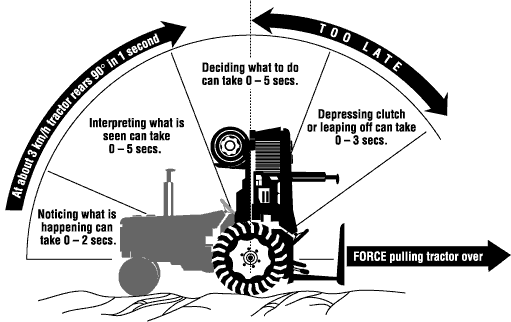
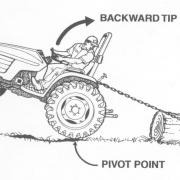
I once had to free the body of a bloke off the gearstick of a Fergie which had rotated around its rear wheels as he was trying to pull and old car out of scrub.
Long, long ago there was a farm safety poster whose message was "Hitch high and die".

-
2
-
 1
1
-
-
My first thoughts when joining this discussion was to lament the fact that whenever a "safety" topic comes up, it always focuses on the "worst case scenario". While those situations have a possibility to arise, one must look at the probability of their happening. A factor that needs to be considered is the frequency for emergency landings in all operations, day and night. Are planes failing in the air at an alarming rate? Modern engine design and construction is vastly different from that of one hundred or so years ago. Many lessons were learned then, and we benefit from them.
As in any activity that requires acquired skills, currency is an essential factor in maintaining a desirable standard. Regular flights at night, even if simply a quick trip to the training area and then back to shoot some circuits, will maintain currency to a degree.
One factor that is out of a pilot's control is the weather. A forecast, and current information from other aircraft operating in the area are important. But atmospheric conditions can change quickly. For example, when I woke this morning, the sky was clear. An hour later the house and surrounds were fogged in. I wasn't expecting that. In relation to night flying, that sort of sudden fog formation would put your local airfield out of service.
It is a shame that on one hand we cry out against the media constantly pushing the idea that anything smaller than an RPT aircraft will plummet from the sky without warning, while those who participate in non-commercial aviation try to promote the idea that it is safer than ground transport. On the other hand, when we start talking about non-commercial aviation amongst its practitioners, it regularly turns to the ways that you can kill yourself doing it.
There's no doubt that being aware of what can cause loss of control, and how to deal with the need for off-field landings are necessary skills, but most pilots will only have to practise responses to them, rather than deal with them in reality. Nearly 100% of the average pilot's flights will be uneventful. Like computer programs, pilots need to have an effective sub-routine for each emergency, but that those subroutines need to be be included in the pilot's programming in the form "If ....., then goto ....."
-
certain elements in the US have learnt that wars are an incredibly efficient and lucrative means of diverting eyewatering amounts of public money into private pockets
It's all part of the concept of trickle-down economics.
-
 1
1
-
-
There was no one to overs-ee the message
-
Errr? Is that so Sir Humphrey?
Yes, Minister. Unfortunately, although the answer was indeed clear, simple, and straightforward, there is some difficulty in justifiably assigning to it the epithet, "clear", you applied to the statement, inasmuch as the precise correlation between the information you communicated and the facts, insofar as they can be determined and demonstrated, is such as to cause epistemological problems, of sufficient magnitude as to lay upon the logical and semantic resources of the English language a heavier burden than they can reasonably be expected to bear.
-
1
-
3
-
-
I think this is it.
If you were issued with a medical certificate between 01/03/2019 and 30/04/2020, that certificate will remain current for 6 months after its expected expiry date. That means that anyone whose certificate was issued between 1st March 2019 and (insert today's date) expired between 1st September 2020 and (insert today's date).
Let's say that you can only get an appointment for a medical with a DAME on the xth of October 2020. Then your annual medical certificate will date from the xth of October 2020 and expire on the xth of October 2021.
Where, in the past, you have been renewing your medical in a certain month, in future you will renew your medical on a date at least six months later in the year (plus a couple of weeks if you can't get an appointment closer to the new renewal date).
If you have been able to get an appointment with a DAME after 1/03/2020 and before 1/09/2020, the expiry date of your medical will simply be 12 months after that date of appointment.
-
2
-
-
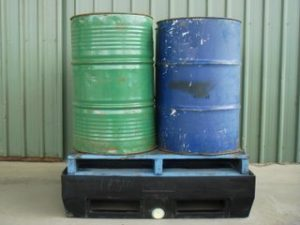
Drums nearly finished so are considering not refilling it and just keep a jerrycan on hand.
It's obviously been convenient for you to have the drum. Why not simply put a bund where the drum is now? A pallet is 1200 x 1200
If you put down a concrete pad 1600 mm x 1600 mm then build a wall of concrete blocks you will have a suitable bund for a drum on a pallet. You would need 16 of 390 x 190 x 190 blocks (@ $3.60) and 16 of 390 x 90 x 190 (@ $3.30). The pad doesn't have to be very thick, maybe 75 mm with some chicken wire laid in for reinforcing.
(Prices at Bunnings)
-
didn't expect to get so many responses
We respond because of that old saying, "There are old pilots, and there are bold pilots, but very few old, bold pilots."
You enquiry is a common one asked by those newly infected by the bug, and we have spent many hours telling those in the early stages of the disease what can be done to ease the symptoms.
Maybe there should be a special section on this forum "FAQ's about buying and operating your own aircraft".
-
2
-
 1
1
-
-
A plane that has not been flown for "a couple of years" is the equivalent to a "barn find". You have to take for granted that it is going to take big bucks to get it into useful condition.
I know of a Piper Tripacer that has been sitting in a shed. for years. What would you pay for it? If I was generous, I might offer about $2K, and that would be for the manufacturer's ID plate and the log books.
Why? Because for starters the engine needs to be pulled down and gone through. The fabric needs to be stripped. The frame needs close inspection and the wings have to come off to replace rotten wood. Then there's checking the fuel system and all the instruments. I'd say that getting it back in the air would cost about $60K+. For something that is probably only worth $30K on the open market.
Funny that. The cost of doing up this plane is about the same as the purchase price of a big ute like a Toyota Hilux. Who says that aircraft ownership is a rich man's game?
-
1
-
-
NUMBER ONE RULE:
Do not buy a plane without first having it inspected by a completely independent and qualified aircraft maintenance engineer.
You will have to pay the engineer to travel to the plane and carry out the inspection. Thuggish will include payment for accommodation and expenses. It will cost you a couple of thousand, depending on how far the engineer has to travel, but if you don't get this inspection, and you are looking at an aircraft that hasn't been flown for a good few years you can reasonable expect to be much, much more out of pocket than the cost of an independent inspection.
The inspection should list the outstanding maintenance items. After you get this list, price it out. It is much better for you to bring a tired plane home on a trailer and get it going under your supervision than it is to get a seller to get it "good enough to fly home".
Don't be a fool, lest you and your money are well an truly parted.
-
4
-
1
-
-
the strip is right next ti row of trees in centre of photo
You don't have problems with windbreak turbulence?
-
These things knock the ars out of seat-of-the-pants flying.
-
$5.50 from OfficeWorks plus a bit of careful work.
https://www.officeworks.com.au/shop/officeworks/p/studymate-self-adhesive-book-cover-roll-450mm-x-5m-clear-sm5450
-
I will look further into my fuel storage situation.
If the drum leaks, you wouldn't want all the fuel to go to waste, would you. At least with a bund you can recover some and use it in your car or lawn mower.
-
1
-
-
Hi OME - I think you will find Camden & Bankstown were sold off, by the Fed's, quite some years ago now. Now in "private" hands, I think Sydney Airports Co.
No, the airports I listed are still "owned" by the Federal Government. They have simply leased them to Big Business who set up management companies like Sydney Airports Ltd. These leaseholders are bound by the Airports Act, and the Airports (Environment Protection) Regulations come under that Act. Other Regional airports have basically been handed over to local government who are the rule makers for their particular airports.
The biggest problem with these Environment Protection Regulations, not only on airports but throughout industrial areas is that the Environment Protection and Biodiversity Conservation Act 1999 (EPBC Act) is the Australian Government's environmental legislation, which came into force in 1999 and was followed by the States and Territories. Before that any rules were not so stringent. Everybody just chucked pollutants on the ground or into drains. Have a look around the old hangars on airports, or around road or rail transport depots. The level of pollution is incredible. Once the EPBC Act came into force, and its daughter legislation in other places, a whole new industry evolved. Like all regulators there are many for whom the rules are black and white. If pollutants are found coming from your premises, you are responsible. Never mind that from the 1900's industrial activity, not necessarily the same as yours, has been carried out on the same site. You might be punctilious now, but what can you do about prior occupants?
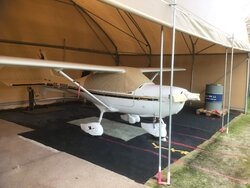
One of my cars holds more than 200l should I always park it over a storage drum??Fuel within the normal fuel tank of an engine, either stationary or as part of a vehicle is not subject to the rules for storage of dangerous goods.
I have a 25,000 liter diesel tank standing out side FFS.Suitably bunded I hope.
Wow you post a cool looking hanger and the keyboard police find an issue with your fuel storage.Crickey! You post a tongue-in-cheek comment and those who don't know the poster's sick sense of humour go off on a tangent.
Actually, I find shajen's solution to hangarage excellent. That looks like a very economical way to protect an aircraft, and the interior is indeed kept very tidy. Kudos to her!
-
2
-
-
Here's the history of this aircraft
https://www.mustangsmustangs.com/p-51/survivors/serial/A68-187
-
Geez, Onetrack! I was only having a poke at shajen in fun, but you do raise some of the flow-on effects of improper handling of dangerous goods of which we should always be aware.
In relation to environment protection, earlier this year I pointed out that in a video posted here a pilot was seen throwing a fuel sample onto the ground at Camden Airport. That video was a bit old, but now due to the Airports (Environment Protection) Regulations, that is prohibited at Camden, Bankstown, Essendon, Jandakot, Parafield and Archerfield, which are all owned by the Federal Government.
I will admit that the probability of a major spill from a drum of fuel located where it is in shajen's hangar is very low, but the possibility is there. The attachment is a Risk Assessment matrix that is used to assess environmental risks.
-
Do these restaurants serve airline food?
-
2
-
-
Are you for real??
I know that it seems so pedantic, but you are in the catchment area for part of the Melbourne water supply. The chances of 204 litres of avgas reaching the dam through the ground water system is probably pretty remote, and there's likely to be more pollutants coming off the roads in the area. However, I posted that half in jest, just to remind people to consider the effects of their actions, no matter what they do.
-
the instructor pointed out to me that the throttle worked the opposite way to a tractor
But it works in the same direction as a car's accelerator pedal.
-
1
-
-
Shajen, The Environmental Protection police are issuing with a caution. A wooden pallet is not a suitable bund for a 204 litre drum of avgas. Please place the drum in a bund of sufficient capacity (110% of the volume of the container) to prevent pollutants entering the soil and groundwater.
-
1
-
-
Do you go forward to get out, or backwards? It's just not clear from the photos.
-
1
-
1
-




CASA confuses me.
in Governing Bodies
Posted
Just on two years since this topic was active.
I was wondering if CASA is still sending out people to do drug and alcohol testing, or was this flurry of activity another Government knee-jerk.
I know some will say that COVID has reduced the number of pilots committing aviation, and that's acceptable, but the maintenance facilities are still operating, and that is a pool if likely lads for testing.
Has anyone heard of a random testing visit of late?