


old man emu
-
Posts
5,297 -
Joined
-
Last visited
-
Days Won
78
Content Type
Profiles
Forums
Gallery
Downloads
Blogs
Events
Store
Aircraft
Resources
Tutorials
Articles
Classifieds
Movies
Books
Community Map
Quizzes
Videos Directory
Posts posted by old man emu
-
-
David,
Don't make ammunition for your opponents. I'd bet that this site is monitored by the media.
OME
-
Well, the dust has settled and it appears that the injured are under good medical care. Bravo for that, but ...
IF, and I strongly preface these comments with IF, an investigation finds that there was a possible infringement of aircraft registration or pilot licensing law, I wonder how keen CASA will be to put the matter before a Court for a determination?
Should we as participants in an activity that is governed by laws made in out houses of parliament, demand that Justice be seen to be done?
I refuse to offer a suggestion as to penalty should a finding of guilt be made on any allegation brought, however, I would like to see a finding of guilt recorded against any person who has committed an offence, should the Court determine that the evidence supports such a finding.
(Please read the above carefully and with an eye to legalese in which it is couched.)
Old Man Emu
-
 3
3
-
-
How to make a small fortune in aviation support:
Create a website

OME
-
OK It's not aviation related, but you'll
OME
-
Here is something to download, print off, laminate and stick to the inside of your toolbox lid.
OME
TORQUE VALUES FOR AIRCRAFT BOLTS (1).pdf
TORQUE VALUES FOR AIRCRAFT BOLTS (1).pdf
-
3
-
-
I had similar loss of connectivity last night and this morning. Tried to upload an 88Kb pdf file and failed.
OME
-
Ian said I can resurrect this thread until such times as he has the "Talk to the Suppliers" bit of the site up and running.
I've still got heaps of certified hardware for your build or regular maintenance. I don't handle chromoly sheet or tube, or aluminium sheet or tube, but I can track down and source anything else you need.
I have a few copies of the MechanicsToolbox for immediate delivery. This CD is a must for anyone building or maintaining aircraft.
I can also supply a digital copy of the book that I call my "Hardware Bible". It is full of information on the sizing of hardware and how to describe an item using the AN, MS and NAS naming systems. It has Cross Reference tables to show what superceded part numbers have become. It also provides information on the materials hardware is made from, and the various finishes it comes in. This CD is a gift at $5, which covers my postage costs.
My pricing policy is that I'll sell stuff to you at a price I'd be happy to pay myself.
So send me a PM from this site, or email me at [email protected]
Old Man Emu
-
If you were near a Miss, Tomo, would it be a hit?
OME
-
3
-
-
The designer lives in Australia and his prototype has been flying since 1968. When the first ones were built they were built in Toronto Canada, the Designer (Tony Shenan) had a lot of problems with his partner and the company that was to build the craft went down.
Things are not all bad as Tony has got a plan, it is to attempt to Kit the aircraft if possible and of course the full building Plans are available from tony via his E Mail [email protected] or see the Beach Boy website for those interested in building one.
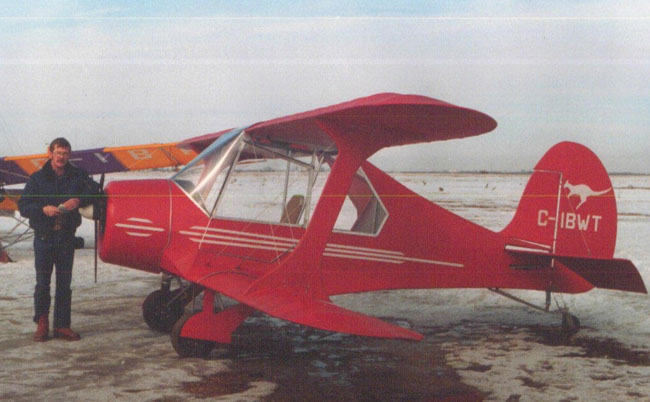
This looks like the single seat prototype. The production model is a side-by-side.
OME
-
1
-
-
I've been trying to post this link:
www.ultralightnews.com/plansbuyerguide/beachboy-airctaftplans.html
but I get a 404 message. Just go through www.ultralightnews.com
-
Here's a link to the Australian Radio Control pilots. There is a For Sale thread where you can advertise what you have to sell. My suggestion however would be to have a local RC flyer look over what you have for sale and possible suggest realistic prices.
http://www.rcgroups.com/australia-307/
Old Man Emu
-
Watch it Maj, you'll open up a Pandora's Box if you start talking about the different types of washer.
I'm just looking at my parts book now and see that there are 6 different material specifications and 5 different finish specifications for NAS1149 washers alone (new code for AN960 washers). Then we can move on to MS20002 countersunk high strength washers; MS27183 & MS15795 general purpose flat washers. Not to forget MS35333, MS35335 and MS35338 lock washers. And bringing up the rear are Countersunk Large Area washers, Flush/and Cup finishing washers, vulcanised fibre and nylon washers.
OME
-
That's me. Nuts about bolts
OME
-
No. Maj is not wrong. He said: "standard set-up is no washer under the head and one under the nut..".
The standard set-up would occur if you were using a nut and bolt to clamp two things together, then you don't use a washer under the head. The maximum torque that you would apply to the nut/bolt combination would be determined by the bearing load of the material the bolt head was resting on, and this is affected by the area of the washer face. Therefore, you don't apply high torque.
If, however, you were bolting things to a wooden spar, which is easily crushed, then you want to spread the bearing load over a wider area. So you would use a penny washer (AN970) under the bolt head to spread the load. This is not what we would call a "standard set-up" under Maj's definition.
What about when you use a nut/bolt combination as an axle for a lever system, like a control column? In this case, you want the one of the parts to move relative to the other. In this case you would put a normal washer (NAS1149F****@) under the bolt head, and maybe washers between the two parts. The washers act as bearings for the parts to rub against. This means that the washers would wear out before the parts would. In this case you would use a bolt with a drilled shank and a castellated nut because the torque is not a factor in the assembly.
Perhaps Maj should have stated which set-up the apprentice was using that caused Maj to be upset.
Old Man Emu
-
1
-
-
Tex,
If you read the article in http://mechanicsupport.blogspot.com/2011/09/aircraft-washer-usage.html you will see how the "bearing area" is used to calculate the load on the surface the bolt is going through.
By having a machined washer face it is possible to calculate the area of the face and from that, and the applied torque, the force that is being exerted on the surface around the bolt hole. If you just relied on the head of the bolt, the surface area could change with damage to the head and this could change the pressure on the surrounding surface.
Old Man Emu
-
Have a look at this link:
http://mechanicsupport.blogspot.com/2011/09/aircraft-washer-usage.html
Old Man Emu
-
1
-
-
This is the response from John Schwaner, the author of Mechainc's Toolbox:
This area is called a "washer face" and defines the bearing area for the bolt head. The bearing area is useful for calculating bearing loads on the washer and/or faying surface so you do not exceed the material's yield strength (crush the joint or washer).
Crushed washer from tightening beyond material's yield strength. Washer resting on washer face.I would guess that it is easier to achieve a specified bearing area by machining a circle than by beveling the edges of the hex nut. Another alternative is this:
-
I agree with F-T. For a prolonged aviation experience, sell the Corella and buy one of the many high wing airplanes of proven design.
There are some things you can tweek to improve your plane, but changing the basic design is a big TWANG!
OME
-
While reading the ATSB report on the Morgan -v- Ferris Wheel collision, we noted that there was a design error that was not commented upon by the ATSB in relation to the control column bracket.
Have a look at the bolt hole through the control column support bracket. See how close to the upper edge of the bracket the hole is?
When a load is transmitted from one part to another through a rivet, bolt, or pin, the fastener exerts compressive forces against the edges of the hole, tending to crush the metal ahead of the fastener or tear the hole out if it is near the edge of the piece.
Standard engineering practice is to have the centre of any hole in metal a minimum of [(2.5 x bolt diameter) + 0.05"] from the closest edge of the metal. The 0.05 allows for maintaining the 2D distance after repair using oversize fasteners, and allowance for manufacturing and repair tolerances.
For composite structures 2.5D + 0.05 inch is used by several manufacturers. Composites are more sensitive to edge distances and hole spacing than metal joints. The brittle nature of composites and the absence of local yielding creates higher peak stresses.
Another thing that could have been done to make the bracket a bit lighter, without affecting its strength, would have been to take the square edges off and make the bracket look like a triangle with the top cut off. ( I think the shape is called a trapezoid)
Old Man Emu
-
This is the British approach to the topic:
EDIT: Bugger! I posted the Monty Python Cockpit Sketch and tehn found I'd been beaten to the punch
OME
-
There is also an AD on the rudder stops. The 150/152s were prohibited from spinning until that AD was completed. There wasn't much involved in doing the mod. We've done a couple in the course of regular periodics.
I'm not an aerobatic pilot, but there is a lot of talk of it in our mealroom. The opinion there is that high Gs do not necessarily equate to good aerobatics, so the Normal Category 152 would not need to be beefed up too much to be approved for aerobatic manoeuvres. The reasons it can't cut holes in the sky like a Pitts is that it has a much lower aileron area to total wing area than a Pitts. Also the power to weight ratio greatly favours the Pitts. Having said that, the 152 is still a useful plane for ab initio aerobatic training.
OME
-
1
-
-
How about an ambiguous one:
"May you have clear skies; the wind at your shoulder, and rudder enough to lay off drift."
OME
-
Best wishes for a happy, prosperous and, especially, safe 2012.
May the skies be clear and the wind at your tail.
Old Man Emu
-
1
-
-
The Piper Tri-Pacer has a flat plate mudguard over the nosewheel, so I suppose something similar over the mains would deflect mud and water spray.
I think that the generally accepted speed gain when spats are fitted is about 3-5 kts, so you have to calculate the value in terms of fuel saved -vs- any additional maintenance time resulting from their being fitted.
OME


3 onboard an Ultralight
in Aircraft Incidents and Accidents
Posted
OME