


old man emu
-
Posts
5,297 -
Joined
-
Last visited
-
Days Won
78
Content Type
Profiles
Forums
Gallery
Downloads
Blogs
Events
Store
Aircraft
Resources
Tutorials
Articles
Classifieds
Movies
Books
Community Map
Quizzes
Videos Directory
Posts posted by old man emu
-
-
I've got a drill set that contains Number drills, Letter drills and standard size drills in Imperial sizes. You can get them from any supplier of industrial tools.
OME
-
Why has the ad been viewed nearly 3000 times and the plane is still not sold?
OME
-
I've been seeing this for some time. I wonder why it has not sold before. It seems to be the equal of many airplanes I have seen advertised around the place, and Boorowa is not a great distance from Canberra, or Sydney for that matter.
OME
-
This is what the Mechanic's Toolbox says:
The fit of bolts and holes can be defined by differences in diameter or by the amount of friction between the bolt and hole. The Air-Force-Airframe-Repair-Course (obsolete) defines a tight fit as "one in which a sharp blow of a 12 or 14 ounce hammer is required to move the bolt.
A bolt that requires a hard blow and sounds tight is considered to fit too tight.
A light drive fit is one in which a bolt will move when you hold a hammer handle against its head and press by the weight of your body.
A bolt which moves when pushed with your thumb is considered too loose.
For all modern repair work, diameter differences are the only reliable method to establish reliable fit.
Looks like the clearance of a lot of bolts is too loose.
OME
-
Tomo,
Good for you. As part of your training you will have to eat lots and lots of carrots to improve your night vision.
OME
PS: I bought the bike in Warwick. Pick it up beginning of April
-
I agree that a knowledge of how Lift is produced by an aerofoil is not essential to the practical piloting an aircraft, but discovering how this effect is produced is an enjoyable journey to be made in the company of one's fellows at the end of a day's flying.
So please don't dismiss this thread as a waste of time, just because you are only interested in the practical side of flying.
OME
-
 2
2
-
-
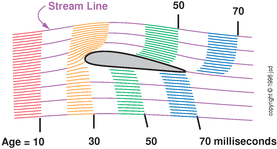
It is really hard to come up with an explanation for the observable facts. Have a look at this snapshot:

The wing is stationary in the middle of a wind tunnel; air flows past it from left to right. A little ways upstream of the wing (near the left edge of the figure) there are a number of smoke injectors. Seven of them are on all the time, injecting thin streams of purple smoke. The smoke is carried past the wing by the airflow, making visible stream lines.
In addition, there are five injectors between each pair of purple injectors. They create pulsed streams. The smoke is turned on for 10 milliseconds out of every 20. In the figure, the blue smoke was injected starting 70 milliseconds ago, the green smoke was injected starting 50 milliseconds ago, the orange smoke was injected starting 30 milliseconds ago, and the red smoke was injected starting 10 milliseconds ago. The injection of the red smoke was ending just as the snapshot was taken.
The snapshot shows that the streams that pass over the top of the wing are travelling faster than the streams that are passing underneath the wing.
The $64 question is: What causes the stream of air to change its velocity?
The only answer I can think of is based on the Law of Conservation of Momentum. As a result of the collision between the air and the leading edge of the wing, there is a change in the velocity of the air on either side of the wing. This explanation requires a page or two of algebra to explain, so I will do that later on.
The snapshot also shows that the distance between succeeding "blocks" of air is greater over the top of the wing than below it. This means that the volume represented by those spaces, is greater than in the air in general, so the pressure is reduced. Likewise,under the wing, there is a reduction in the distance between the spaces, meaning that the volume is smaller, and hence the pressure is greater. This indicates that there is a pressure differential between the upper and lower sides of the wing.
I've discounted the Coanda Effect, because this only exists when a stream of high velocity air is injected into a slower stream of air. There is no means of injecting a high speed stream of air into the air flowing around a wing in the average GA or RAA airplane.
The Bernoulli effect doesn't seem to be involved either.
OME
-
Have a read of this:
http://www.newfluidtechnology.com.au/THE_COANDA_EFFECT_AND_LIFT.pdf
It will put the cat amongst the pigeons.
OME
-
Ergo, "someone convicted of manslaughter is either a simple dumb-ass or a a rule bender."After reading the story, I can only call the pilot a dickhead.How many people with this type of mentality have you come across in aviation, be it General or RAA? This bloke was not Robinson Crusoe.
OME
-
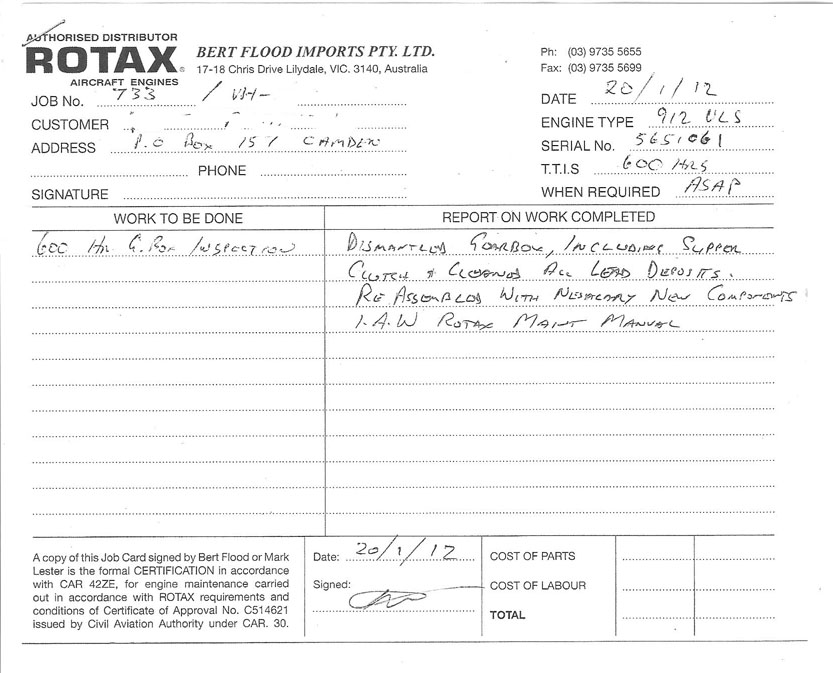
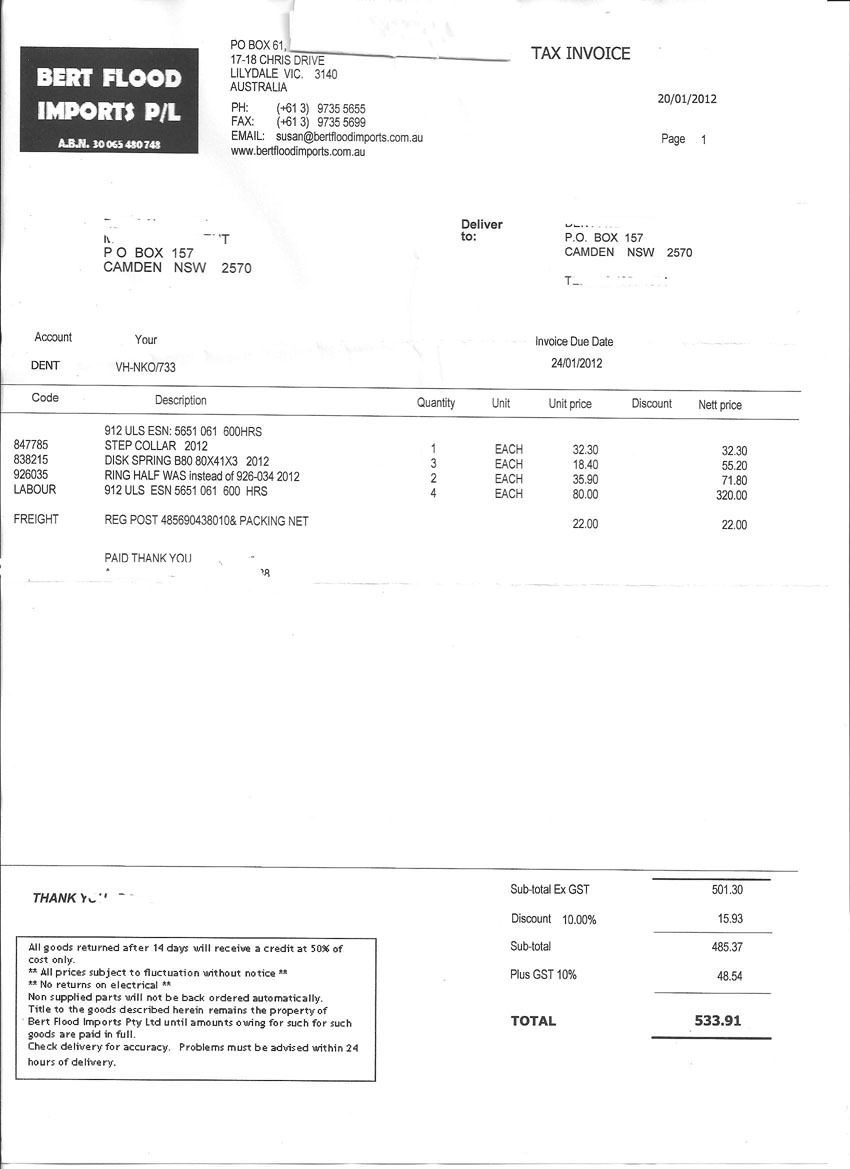
Here are copies of the paperwork we got from Bert Flood
OME
-
You can't try to compare US criminal indictments with Australian criminal indictments. They seem to have a multitude of graduations in their crimes.
As I recall it, the NSW definition of manslaughter involves "a lawful act done dangerously, or an unlawful act done negligently". The underlying assumption that differentiates murder from manslaughter is that murder is the result of a deliberate act (shooting, knifing, bombing, poisoning) done with intent to kill, whereas manslaughter is a killing that results from an act or omission which was done without any intention to cause a death.
Basically you could say that a murderer intends to kill, but someone convicted of manslaughter is either a simple dumb-ass or a a rule bender.
OME
-
1
-
-
Quite correct. No one really thought that the Cherokees would be still flying 40+ years after they were first built, so they were not corrosion proofed. A Cherokee 140 is pretty gutless. They are really only for two medium built people. They were intended as basic trainers to compete with the C150.Dunno who told you they ( the Cherokees) were factory corrosion proofed. The later ones are better but the early Cherokees are quite bad. NevThat having been said, if your flying revolves around you and the missus going for weekend fly-aways with a couple of overnight bags, I suppose a 140 would fill the bill.
As for the Annual costing "many thousands of dollars", a privately owned plane such as these might be pushed to do 50 hours per year, so if your plane is up to scratch, then the annual will be fairly straight forward. We allow 8 man hours for the engine and eight man hours for the airframe, plus filters, fluids and consumables. For that you would be looking at about $1700-1800.
Be warned, though. The first time you bring the plane to your LAME for an Annual, you might find yourself hit pretty hard because a decent LAME will go over the plane with a fine toothed comb so that he really gets acquainted with it, and fixes up any matters that might have been missed in previous inspections.
As the owner of the airplane it is YOUR responsibility to know what ADs apply to your aircraft; which are recurrent, and which are one-offs. You also need to know when your instruments are due for inspection (Inst 8/9), or your radios have to be looked at (Rad 43/47). It really isn't up to your LAME to go hunting through ADs and SBs to find out what is applicable to your aircraft. (This can take several hours, and it would be reasonable for a LAME to charge you for this time)
Caveat emptor: if you don't get a pre-purchase inspection by a LAME who is
1. experienced with Cherokees (or any other type that you consider buying), and preferably,
2. is the LAME who is going to maintain it for you,
then the very heavy outlays you will have to make to get your new toy airworthy will far outstrip the money you might pay for the pre-purchase.
OME
-
1
-
-
That gearbox arrived back from Bert Flood today. 600 hour inspection cost $535 including return postage. If I get a chance I'll copy the invoice and you can see what was done.
That means that gearbox maintenance would cost you just on $1 per hour (including an allowance for inflation).
OME
-
Had an argument with his Friar?
OME
Sorry, couldn't resist.
-
3
-
-
Nah, FT!
There's no trapping of air. The air passing below the wing has slowed due to the change in momentum. You really have to think hard about what those videos are actually showing you. It will all become clear when I publish my theory (I'm being serious here, chaps.)
OME
-
One thing that has been worrying me after I looked at the smoke streamline diagrams was "How do you change the speed of the air without applying a Force to it?"
Newton's First Law: A body travelling at a uniform velocity will maintain that velocity unless it it acted upon by an external force."
I just could not see where this external force was coming from. Then I remembered the Law of Conservation of Momentum. "The Total Momentum of a system after a collision is equal to the Total Momentum of the system before the collision"
I realised that this change in momentum was the source of the velocity change of the air. Major contributed a bit with the Coanda Effect, which leads to the Bournoulli Theorem. Add a touch of Coriolas Effect and I can come up with Old Man Emu's "Theory of Lift Generation by an Aerofoil"
This theory will explain how the velocity of a mass of air is altered when it meets an aerofoil shape; how that change in velocity results in the Coanda Effect upon the airstream, and how the combination of the flow of the airstream and the curvature of the aerofoil produces a pressure variation around the aerofoil.
It is going to take me a couple of evenings to get this all down on paper, so I hope I can publish something by the end of the week.
Old Man Emu
-
What you must realise is that old C150s and Tomahawks are just that: OLD.
If you are looking at one of these in the price range of $25-35,000, you can bet that the engine is almost time expired, so you will be up for something in the vicinity of $30,000 for an overhauled engine. If you fit that (at about $5000 labour and associated replacement parts), who would buy your plane for $60-70,000?
That is only thinking of engine replacement. You would want to have all ADs done, and if you were buying a Tomahawk, you would have to know how much time was left in the various components that have a time limits on their lives. Would you want to pull the wings off a Tomahawk and try to fine a low life time pair to refit?
About the best bet for a GA type purchase is a C172 at about $40,000. But these are like driving around in a white Commodore or Falcon with automatic transmission and a straight-six engine. They don't provide the "wind-in-hair, devil-may-care" type of flying that you would enjoy with an RAA airplane.
OME
-
1
-
-
You are correct there, Powerin. That is indeed the Coriolis Effect, and it is what makes Low Pressure areas generate clockwise winds in the Southern Hemisphere, but anti-clockwise in the Northern Hemisphere.I don't think that is Coriolis Maj. If memory serves that is the force caused by circular/twisting motions such as that caused by the Earth turning.The effect Maj was trying to name is the Coanda Effect which describes why a jet of air will seem to adhere closely to the surface it is flowing over. But yes, it is very important in lift. When the boundary layer separates from the upper surface of a wing (ie...the air stops sticking to the wing) you lose the majority of your lift...which of course is exactly what happens in a stall. It is the basis for an anti-stall device called the Blown Flap developed by the English in the 1950s.
In a conventional blown flap, a small amount of the compressed air produced by the jet engine is "bled" off at the compressor stage and piped to channels running along the rear of the wing. There, it is forced through slots in the wing flaps of the aircraft when the flaps reach certain angles. Injecting high energy air into the boundary layer produces an increase in the stalling angle of attack and maximum lift coefficient by delaying boundary layer separation from the airfoil. Boundary layer control by mass injecting (blowing) prevents boundary layer separation by supplying additional energy to the particles of fluid which are being retarded in the boundary layer. Therefore injecting a high velocity air mass into the air stream essentially tangent to the wall surface of the airfoil reverses the boundary layer friction deceleration thus the boundary layer separation is delayed.
In meteorology, the Coandă effect theory has also been applied to some air streams flowing out of mountain ranges such as the Carpathian Mountains and Transylvanian Alps, where effects on agriculture and vegetation have been noted.
No, that's incorrect. The Coanda Effect only occurs within similar fluids eg gas/gas or liquid/liquid. It does not happen with dissimilar fluids eg gas/liquid.You can see the same effect if you hold the back of a spoon against a stream of water from a tap. The water sticks to the spoon and curves around it.To get back to the original argument, Newton and Bernoulli do not contradict each other. Explanations which are based on Newton's and on Bernoulli's principles are completely compatible. Air-deflection and Newton's Laws explain 100% of the lifting force. Air velocity and Bernoulli's equation also explains 100% of the lift. For the most part they're just two different ways of simplifying a single complicated subject.
For one side of the Newtonian (Angle of Attack) -v- Path Length (Airfoil Shape argument, check out http://www.amasci.com/wing/airfoil.html
http://www.av8n.com/how/htm/airfoils.html has good explanaton obtained from a review if smoke trails over an aerofoil in a wind tunnel.
Old Man Emu
-
I suppose it would be a bit much to ask someone from the RAA Executive who might be following this conversation to make a phone call to the Head Office tomorrow and ask what the RAA has done about these reports.
OME
-
1
-
-
OK. I posted http://www.recreationalflying.com/posts/104289/ in 2010 after I was made aware of it in our shop. I don't know if it was reported to RAA then, as that task is not part of my job (I'm not an L2 or LAME) Now there are other reports and Jabiru has not sent out any SB or AD.
I'm beginning to get the impression that the Jabiru business is imploding and they don't know how to stop it happening.
OME
-
Ian,
Site speed does depend a lot on the computer that is doing the downloading. I've got ADSL2. There are three computers in my SOHO. Mine is the lowest and spec'd is always slower to load than the other two higher spec'd. The computer at work is on a wireless modem, and is nearly as bad as a dial-up. It slows up on initial log-in while it downloads the Smilies.
OME
-
Dunno what they do during a 600 hourly. I just know that the gearbox comes back and is OK for another 600 hours use. That's a lot of years for the average pilot.
OME
-
I was corrected at work today. You are right, the gearbox does share engine oil, and if the fuel used contains lead, the lead does get deposited aroung the oil system, including in the gearbox. The 600 hour INSPECTION is a chance to flush the lead from the gearbox.My understanding is the gearbox does share the engine-oil,The 600 hour inspection also provides the opportunity to check wear and clearances so that your gearbox is returned to you in a "near new" condition.
OME
-
And are these people qualified LAMEs or L2s with a lifetime's experience in the aviation maintenance business where they learned not only the greasy fingers side of maintenance, but also the legal side?I've spoken to a few who have basically said to leave it as it will most likely be fine well past its inspection time.Rotax designed and built the gearbox. Rotax says inspect at 600 hour intervals. Nuff said.
We have arranged this inspection on a couple of gearboxes in aircraft we maintain. We just whip them off, put them in a cardboard box and mail them to Bert Flood. Costs us less than $20 in postage. We haven't had any other expense other than the cost of inspectionHas anyone out there other than David not bothered with it?
That's why you pull the thing off at the recommended intervals and send it to a qualified service centre. Have you ever heard of "A stitch in time saves nine'?Apparently if it starts to get loose you could be in for major repairs and you may not have any symptoms until it starts rattling. By that time it could have already done major damage to the drive shaft on your engine for instance.Bluey.You said, "I'm wondering if it is really necessary to carry it out as specified by the manual when it is running on premium unleaded petrol.". This indicates that you haven't thought about how your engine/gearbox works. The engine burns petrol, be it mogas or avgas. None of this petrol should get near the lubrication system of your engine. The lubrication system is oil. The gearbox does not share the engine oil, so how could the type of petrol have any effect on the lubrication system of the gearbox?
You also said, "I have spoken to a range of other trike operators in and around YWOL and no one else knew anything about it. " It is the owner's responsibility to know the maintenance requirements of the aircraft (but not necessarily how to carry out that maintenance) as well as to know what compulsory maintenance actions are required for the aircraft. If these other operators don't know the maintenance requirements for their equipment, then I would take anything they said about maintenance with a very small grain of salt.
So now you know. The gearbox comes off every 600 hours for inspection by a qualified service centre. End of story
Old Man Emu
-
1
-
Aeropup for Tomo!
in Aeropup
Posted
Tomo,
Just a word of caution if you are going to buy a Texas Taildragger. Find out what type of main undercarriage it has, either flat or tubular. I've been told that those with tubular U/Cs are a real bitch on landing. The legs tend to move backwards and introduce a steering input, making the plane wander all over the place. This doesn't happen with the flat steel legs.
OME