


old man emu
-
Posts
5,297 -
Joined
-
Last visited
-
Days Won
78
Content Type
Profiles
Forums
Gallery
Downloads
Blogs
Events
Store
Aircraft
Resources
Tutorials
Articles
Classifieds
Movies
Books
Community Map
Quizzes
Videos Directory
Posts posted by old man emu
-
-
Couldn't close the canopy because the grin was too wide!
Congratulations on reaching a major milestone in your flying career.
OME
-
 1
1
-
-
When Scotty is doing the cables for his Pietenpol, he will be doing some in situ and a small tool would be OK. However, the advantage of the Nicopress tool is that the jaws go over centre and put more pressure on the oval sleeve, thereby making a better crimp.
I'd advise a search on E-bay for a second hand one, and make sure that it is not of Chinese manufacture.
OME
-
The AN3-4A bolts have not been renamed, but the locknuts are now called something else.
AN365-(XXX)A is now MS21044N(XX), which is a locknut with a nylon lock insert, and therefore is low temperature
AN365-(XXX)C is now MS21045-(XX), which is an all metal locknut for high temperature areas.
I had to check my hardcopy of the CD for the information on the nuts.
OME
-
Thanks for that.
OME
-
I spoke to the Boss this morning. He does not recommend the bolt type swager. He says that you will get the best job from the one you are asking about.
OME
-
The NAS1149 series has replaced the AN960 series in name only. I would agree that there has probably been an improvement in the quality of production of these washers since the 1940's, but you cannot buy recently manufactured AN960 washers. They might be labelled AN960, and if you asked me for AN960s I would know what you wanted, but you would be supplied with NAS1149s.
What you have to consider is that the basic plans for your Van's airplane might have been drawn up before the change in nomenclature came in, and it was too expensive to go through all the drawings and documentation to change things on the plans. I can't explain why Vans would give such an instruction with their plans.
You might be thinking of NAS bolts -v- AN bolts. What they say about interchanging can hold true. NAS bolts are stronger than AN bolts, so in some applications it is essential to0 use the type of bolt called up by the designer.
OME
-
Lots of times I have people contact me to source aircraft hardware and half my problem in supplying what they want is first trying to identify exactly what it is they want.
For example, there are about 20 different types of screws used in aircraft. In each type there are up to six different diameters and thread sizes. After that there are up to 35 different lengths. Then you have to consider bolts, nuts, washers, rivets et cetera, et cetera and so forth.
Then there is the problem of changes to the naming systems. For example, many parts formerly known under the AN system are now known under the MS or NAS systems. They are the exact same item, but with a new number. I often get asked for AN960 washers which ids the way that they are labelled on plans, but these are now known as NAS1149 washers.
The next problem is the measurement system used. In general, aviation uses the foot/pound/second system. That means that measurements for aircraft hardware are given in inches, and 1/8th parts of an inch. That makes it hard to determine the diameter of bolts and screws, and the thread pitch if someone asks for an item that's "so many millimetres" in diameter, and so many millimetres in length. (If you have a European-built airplane, you are on your own. Just don't buy your nuts and bolts from you local hardware or motor parts shop. The quality might not be there.)
So how do we overcome this problem? The answer is education. If you are going to tinker with your airplane you must get a working knowledge of the hardware classification system. But where do you get the information to teach yourself?
When I first started my job as a storeman/salesman in aviation maintenance, I was given a book that contained all this information. Since then, I find I use the book several times each day to check the identification of hardware I am asked for. I couldn't operate without it. I call it my Bible.
I don't have any hardcopies of the book, but I do have it in digital format. If you would like a copy, just email a request and your postal address to [email protected] and I'll mail you a copy. All I ask for it is $5, which covers the postage, the CD mailer box from Austpost, and the cost of the blank CD I will burn a copy to.
Old Man Emu
-
Oooo, ducky. I like to be used by big stwong airplane builders.
-
Scotty,
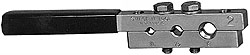
Considering that you will not be doing swaging on a commercial scale, you don't want to spend a couple of hundred bucks on a tool. How about this tool?

To do the swage, you put the wire through the oval sleeve, then put the wired oval into the tool and then make the swage by tightening the bolts. You could get all technical and use a torque wrench to get equal force on both bolts.
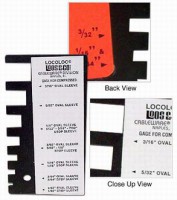
Either way, you'll need a Go-No Go guage, to check if the swages are good.
I can do both items as a package for about $45 +GST and postage. The usual 14 day lead time would apply.
OME
-
For those of you who like to mess about with the oily parts of airplanes, John Schwaner of Sacramento Sky Ranch has just produced an e-Book with all sorts of little tidbits about engines and magnetos and hoses and other oily stuff. There's even a contribution from an Aussie mob which discusses the use of silicone on crankcase joints.
Check out his site: www.sacskyranch.com.
John produces the essential CD "Mechanic's Toolbox", available from a certain supplier well known on this site.
OME
-
1
-
-
Pud,
PM me and I'll send you a u-beaut CD with heaps of hardware information.
OME
-
Scotty,
Load your GAHCo CD that I gave you and look for Oval Splices, MS51844. There is a table there that shows you what the part numbers are for the various cable sizes and plating types. If it says no plating, then these are copper coloured splices. As Maj says, you can have then copper with zinc plating, or copper with tin plating. I've got the unplated ones.
OME
-
-
You've cast me aside for another!I got an order from the last week! All good then.OME
-
I will PM you.Hi omeHow much for the mechanics toolbox CD?Thanks
Bacon
OME
-
The first book I read about a WWll pilot was "I Flew for the Fuhrer", the diaries of Heinz Knoke, a Bf109 pilot who was involved in the German defence of the Western Front from the Battle of Britain to late 1944 when he was seriously wounded and did not fly again. Of course after that I read "Reach for the Sky".
In the late 1950's and early 60s, there weren't very many of these wartime memoirs in circulation. Perhaps the people were still getting over the trauma of those times. The memoir books we see now seem to have been written when these people were in their eighties and wanted to leave behind the story of their exploits as young people.
OME
-
I agreeMany forumites, including self have put forth good, to excellent suggestion on solutions to problems over the past years, with both the 2200 and 3300 Jab engines. These constructive suggestions in most cases have been in response to continued inherent failures of certain engine components within the engines, which continue.
I agree.A lot of critism has also been directed at the manufacturers forA. Not taking some of the suggestions on board and turning them into real engine improvements, and
B. generally continuing with the attitude that there is no reliability problem, and continuing to offer, what is in many eyes now, a faulty product.
These modifications may be OK for RAA registered aircraft, but without the necessary Engineering Orders submitted to CASA, they are unusable to those of us maintaining VH registered Jabirus. Also, we can't have non-certified parts for RAA planes in our stores when we also store parts manufactured/supplied by Jabiru. Our CASA inspector would have a conniption.There are several users in the field who have instigated successfull aftermarket products, or improvements, into the engines, with great success in improving reliability, and general running overall.
Please don't attack the messenger. Feel free to attack the message, but be constructive about it.This site in fact had been a leader in both highlighting failures, discussing solutions, and generally allowing the free discussion (biased or not) on the problems. May this continue until a suitable solution is found. Maj...Old Man Emu
-
On the topic of calibrating torque wrenches:
We have just had a surveillance inspection of our CASA approve workshop by our local CASA man. The topic of calibrating our torque wrenches came up and we showed the CASA man the calibration certificates we had from an instrument calibration company for the tests done on our torque wrenches. Would you believe that the CASA man rejected the calibrations because the company didn't have the right (to him) accreditation.
We have been using this same company for years, and haven't over or under-torqued a bolt yet.
It seems that the Sydney office of CASA has a bee in its bonnet, as this problem does not seem to arise in other States.
OME
-
Let's stop talking about silicone for a moment and take time to look at aero and automotive engines.
The first thing to note is that, in general, aero engines have individual cylinders. Auto engines, with the exception of air-cooled horizontally opposed ones, have a block which contains the cylinders. While you can pull an individual cylinder from the crankcase of an aero engine, you can't do that with an auto engine.
How are aero engine cylinders attached to the crankcase? By bolts from the crankcase, through a flange at the base of the cylinder.
How many bolts hold each cylinder to the crankcase? The Jabiru has four.
What do these four bolts do? They stop the cylinder, and its attached head, from pulling away from the crankcase.
Since the cylinders of an auto engine are integral to the block, we only need to bolt down the head, which in most cases is a block of metal with a combustion chamber for each cylinder cut out of the block (plus holes for lubrication, water cooling etc.)
How many bolts hold down the cylinder head? Probably still four per cylinder, but every bolt helps the rest of the bolts keep the head on the block.
So the difference between an aero engine and an auto engine is that there are more bolts per cylinder in an auto engine working to keep things from being blasted off the block than there are in an aero engine.
As soon as you start interfering with achieving the proper torque on the bolts, you open yourself up to the cylinders being able to move minutely back and forth against the cylinder base bolts with each combustion phase of the cycle. This movement stops then the cylinder base flange hits the nut on the bolt. It is like a blacksmith continually hitting the cylinder flange with a hammer. In most cases, the metal in the bolt is much stronger than the metal in the cylinder, so eventually, the cylinder fails, and those circumferential cracks form and enlarge until the base of the cylinder fails.
There is a trade-off here. If you use silicone on the crankcase/cylinder base interface, it is unlikely that oil will seep out of the joint, BUT your cylinder with fail at its base. On the other hand, if you don't use silicone, oil might seep out of the joint, BUT your cylinder won't fail at the base. You can always wipe seeping oil (which is not there under pressure) with a rag.
I know I'd prefer to keep flying on the smell of an oily rag,
OME
-
 1
1
-
-
A good point made here:Call me stupid, lucky or a magician, but I successfully ran race engines for many years using silicon on those mating surfaces. However, the silicon is applied with a finger, not a caulking gun and is a very thin film. On bolting up, the compression contact is not with the soft silicon but with the high areas of the mating metal surfaces; the silicon fills up the occasional low spot, and defect. The engine will still work without it, or similar sealants, but there is a chance of a small leak through a low spot or fault.So if you want to go there in discussing issues, the discussion should really be, is too much silicon used?If silicon is applied sparingly, it will level off the low spots or defects, and stop those niggling small oil leaks. However, from the photo posted here, it looks like the silicon was applied with a butter knife.
What gets me is that these surfaces should be made without low spots or defects, so the need for a filler is eliminated. Perhaps a bit more attention to quality control is required from this manufacturer.
OME
-
Humble opinion be buggered. This is the first post I have seen in this discussion that points to the problem. It is the sealant at the cylinder/crankcase interface that is the problem. You torque down onto a soft surface. When the engine runs each time there is a combustion stroke, pressure is applied to the piston to move it, and pressure is also applied to the cylinder head (Remember Isaac Newton?)The thru bolt that failed at the base of the nut has clear fret lines.My opinion only: the shims under the barrels idea introduces another weak spot, it has sealant on both sides (not good for rigid torques) and also offers a heat sink for differing thermal expansion properties.Not sure I support the detonation theory as the cast pistons are poor quality and more of a weak link, I lean towards a resonance issue with these bolts. JMHO
The pressure on the head pulls the cylinder away from the crankcase, but that motion is stopped by the cylinder base bolts and the through bolts. That puts stresses on the cylinder base flange, and the cylinder adjacent to it. Repeat this sequence of pull and release thousands of times (eg 2400 RPM = 600 sequences per minute per cylinder) and is it any wonder that eventually something has got to give?
We put our cylinders on clean and we don't have any problems with the engines we have done this to. Engines that are assembled by Jabiru after overhaul etc are the cause of our problems, and economic loss to the owners.
If a Jabiru suffers detonation, it coughs, farts and blows clouds of black smoke, as well as failing to develop full power. As for hot spots in the head caused by carbon deposits, when was the last time you heard of an engine, be it aero of automotive, being pulled down for a de-coke? The fuels we use are a heap better than they were 50 years ago, and the carburrettion of a modern engine is so much better.
If you want to have your cylinders hold together to TBO, get rid of the crap at the cylinder/crankcase interface.
OME
-
Look at the silastic around the cylinder base. How the hell can you torque a cylinder head bolt if you have squishy stuff in between the mating surfaces?For those that are interested, heres what the cylinder looks like when this occurs.[ATTACH=full]17404[/ATTACH]This is what I have said before, and what Motz also said - Jabiru won't listen to those with experience in engine asembly. If they did, they would drop the use of silastic; torqu down onto metal-to-metal, and the problem would go away.
As for detonation - the jabiru con rods aren't strong enough to withstand bad detonation. They would bend.
What's an easy way to see if detonation has occurred? The top of the piston will not have the usual combustion deposits on it because the shock of the detonation will blow the scale off the top of the piston
My Boss is now going to read this thread and may post something over my signature.
Old Man Emu
-
Detonation is NOT the cause of the throughbolt failures. Never was, never will be.
The cause of all these throughbolt failures is Jabiru's insistence in putting silastic on the cylinder bases. It is impossible to torque down correctly where there is a compressible material between the surfaces that should mate together and the joint fastened with a bolt.
Lycoming, Continental and Rotax would have a heart attack if they found out that someone had used silastic on these joints in their engines.
Old Man Emu
This post was made at the request of my boss who has over 40 years' experience as a LAME.
-
1
-
1
-
-
I don't deal in metal, but I handle all the rest of your hardware needs. I often can reduce the cost of imported parts a little bit as I am min abetter purchasing position than a person buying one-off.Hey OME!What sort of stuff do you deal with??? I will be needing a heap of sheets, angle,tubeing as well as rivets, bolts ect for my buildOME



Tachometer for Jabiru 2200 engine
in Instruments, Radios and Electronics
Posted
Virago,
I just bought one from Jabiru for a customer. I think it cost just on $300 with a sender unit. I'll check out the invoice tomorrow and tell you the correct price.
OME