


old man emu
-
Posts
5,297 -
Joined
-
Last visited
-
Days Won
78
Content Type
Profiles
Forums
Gallery
Downloads
Blogs
Events
Store
Aircraft
Resources
Tutorials
Articles
Classifieds
Movies
Books
Community Map
Quizzes
Videos Directory
Posts posted by old man emu
-
-
You bloody beauty!
Sanity prevails. Happy flying, Carl.
OME
-
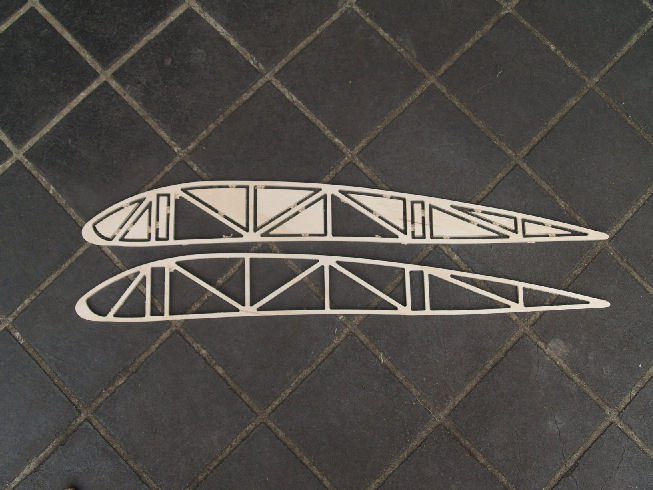
One of our members was good enough to translate my wing rib drawing into CNC machine code and then cut me half a dozen ribs. We decided to use el cheapo 3-ply from Bunnings as these ribs are going to be used to practise building a wing. There are enough to make a 4 foot section of wing, and I will be playing about with strut attachment and internal bracing methods. If I get them right, I'll test out a method for covering the leading edge with fibreglass.

OME
-
Carl,
I'm not a memeber of the RAA at the moment because I'm not flying, but I beg you to reconsider your decision and view the membership fee in light of the membership fees you would pay for other recreational pursuits.
1. NSW Fishing Licence for 12 months: approx $75. No insurance cover for your fishing activity. No monthly magazine
2. Radio Controlled Flying club: $160 for insurance premioum then more for membership to a club. And most of your flying is done in a restricted space.
3. Golf Club. $Lots more
4. Motor Sports Club $?
5. General Aviation Pilot's Licence: $ + $ +$ + $ ad infinitum
With RAA membership you are getting insurance for your activities; an intermediary between you and the powers that regulate aviation; safety monitoring of the airplane types you fly; establishment of good operational standards etc, etc, etc
In the scheme of things, and considering value for money, I'd say that $185 per year is on the cheap side of pretty fair.
Old Man Emu
-
Carl,
I'm not a memeber of the RAA at the moment because I'm not flying, but I beg you to reconsider your decision and view the membership fee in light of the membership fees you would pay for other recreational pursuits.
1. NSW Fishing Licence for 12 months: approx $75. No insurance cover for your fishing activity. No monthly magazine
2. Radio Controlled Flying club: $160 for insurance premioum then more for membership to a club. And most of your flying is done in a restricted space.
3. Golf Club. $Lots more
4. Motor Sports Club $?
5. General Aviation Pilot's Licence: $ + $ +$ + $ ad infinitum
With RAA membership you are getting insurance for your activities; an intermediary between you and the powers that regulate aviation; safety monitoring of the airplane types you fly; establishment of good operational standards etc, etc, etc
In the scheme of things, and considering value for money, I'd say that $185 per year is on the cheap side of pretty fair.
Old Man Emu
-
 2
2
-
-
Where are we up to with Solomon's training?
OME
-
I'd write more, but I've got to go for a slash.
OME
-
1
-
-
Bruce,Anybody?? regards BruceYou really can only get that sort of info from the manufacturer, or retailer. Try asking the retailer first. They should know as they have to put the weight on consignment dockets.
OME
-
There's no one there!
-
I'm de-gaussed - ed that I can't write such a good story as Dieselten.
OME
-
What do you call a person who buys farming land with the hopes of building a wind farm?
An Ohm-steader
-
1
-
-
You will need two AN894-D8- Female Straight to Male 37 Degree unions to connect your fuel lines to the tank.
OME
-
I think I well and truely discharged my duty as a humorist.
OME
-
Should be OK. Let's see what happens when you try the clips I sent today.
OME
-
Then there was the fanatical Greenie who designed and constructed his own electrically powered airplane.
He was really keen about Ohm-builts.
OME
-
3
-
-
I saw the picture. The legs seem to be too long. I posted four clips this afternoon. They should do the job.
What is the diameter of the screw holes in the instruments that you were able to fit the clips and screws into?
Are these Chinese instruments?
OME
-
What is the diameter of the holes in the instrument that the screws have to go through?
Would you post a picture, please?
OME
-
Some of the part numbers given above are out of date
AN365 is now MS21044N(XX)
AN364 is now MS21083N (XX)
AN363 is now MS21045- (XX)
I have a reference book that I use daily to identify and order hardware. I also have it as a pdf file on CD-ROM. If anyone is interested in obtaining a copy, I am happy to send a CD-ROM for the cost of postage and packaging only. That's about $2.50. Just contact me via the Conversations facility of this forum.
Old Man Emu
-
I find it a lot that people are not aware of all the hardware that is available. I suppose when hardware is your business you should know a bit about it.
OME
-
Hey! We are Miss lead.nah......just mislead...........Miss Julia is leading us.
OME
-
1
-
-
Thanks for posting the plan. It helps.
I was going to mention another designation for bolts. This is the NAS system, which is a later system than the 1940's AN system.
The main difference between the two systems in sizing is that AN increases sizes by 1/8", and the size describes the overall length of the bolt. You have to work out the Grip Length by referring to a Table of Grip Lengths. This is OK if you have access to the book, like I do.
NAS sizing describes the Grip Length in increments of 1/16". There are two families of NAS bolts : NAS62xx and NAS66xx. The 62's have shorter thread lengths than the 66's, otherwise the two families are the same.
To fasten material 5/8" thick you could use an NAS6205-10, or an NAS6605-10 bolt.
After looking at the plan you supplied, I was wondering how hot it will get around that mount. You have to remember that the MS21044N5 nyloc nut only has the ability to with stand a maximum temperature of 250F. If it is going to get hotter than that, you could use an MS21045N5 which can take up to 450F.
OME
-
I am bolting 2 bits of alloy bar and angle together, the bar is 3/8" thick and the angle is 1/4" thick.This is a total thickness of 10/16" but I can only get -9 or -11, no problem as I need to use a washer.
Is that correct? An AN960-516 washer is 1/16" thick?
POINT 1:
AN bolt sizes are given in increments of 1/8". They refer to the overall length of the bolt from underneath the head to the far end of the thread. Therefore for a bolt with an overall length of less than 1", the figures used are between -3 and -7 (called Dash3 and Dash7). Once the bolt has reached 1", the length is given as -10. In other words, 1 inch and no eights. After 1" you use the numbers -11 to -17. Then you are at 2" so you go from -17 to -20.
There is no such thing as a Dash 9. It is a Dash 11 (9/8 = 1" + 1/8)
POINT 2:
The thickness of the material you want to bolt together is 5/8" (0.625"). In general, you can only have the unthreaded part of the bolt in the material that is being bolted together. So that means that your Grip Length has to be greater than the length of the hole through the material. But you have to be able to get the bolt torqued down on the surfaces to get the materials properly fastened together. You cannot use more than two washers.
The closest Grip Length that would do the job in an AN5 bolt is an AN5-11, which has a Grip Length of 0.688".
POINT 3:
Describing washers as AN960 is soooo last week. They are now known as NAS1149F-(size).
There are three possible thicknesses you can use:
0516, which is 0.016" thick
0532, which is 0.032" thick, and
0563, which is 0.063" thick.
Now, the thickness of the washer you will need is: Grip Length - Material Thickness = 0.688 - 0.625 = 0.063.
Therefore you need an NAS1149F0563 washer.
POINT 4:
The overall length of the AN5-11 bolt is 1.219", which leaves 0.531" of thread for the nut to run down on. You did not specify where these pieces are going, but if you are going to bolt them together, I imagine that you don't want any movement in the joint. Therefore you could use an AN315-5 nut, or an MS21044N5 nyloc nut.
This nut and bolt combination should be torqued to 100 - 140 lb-in.
Old Man Emu
-
1
-
-
Nev,
The Fokker Triplane actually had canter levered wings and did not require bracing or interplane struts. Any externally visible bracing and interplane struts were put on the plane by Fokker to ease the fears of teh pilots who had not experienced this type of wing design before.
I'm sorry, but I am going to dig my claws in. I don't want to wander too far from the design, which has proved successful. I only want to reduce Drag. Also, I don't want to add too much weight. And finally, I don't have the sheetmetal working skills required to make the fairings out of aluminium.
Therefore, I am going to make the fairings out of Lexan or similar, and I am going to shape them around PVC-coated foam board. I am going to use the formers to attached the fairings to the airplane.
I thank you all for your participation in this discussion.
Old Man Emu
-
Weren't there 12 Apostrophes?
OME
-
Sorry Nev. Your idea was one of many ways to solve the problem of streamlining. However, it does involve some engineering analytical skills which are way beyond me. I agree that your idea would result in the most aesthetically pleasing result, but when you also consider cost and time involved it is not the way to go. Also, I have to make stramlining for the undercarriage legs, so that counts wood out altogether for that bit.Why did I write post 20? I thought it was/is a good idea. Not even an acknowledgement.. NevI also priced aluminium fairing. It's about $100 per foot. Also, if the aluminium in the aluminium flashing is too pure, it would take a month od Sundays to work harden it.
Vacuforming looks great, but still involves a lot of extra equipment.
On a cost/weight basis, the method I outlined wins hands down.
Old Man Emu
RAA Membership $$$$
in Governing Bodies
Posted
You bloody beauty!
Sanity prevails. Happy flying, Carl.
OME