


old man emu
-
Posts
5,297 -
Joined
-
Last visited
-
Days Won
78
Content Type
Profiles
Forums
Gallery
Downloads
Blogs
Events
Store
Aircraft
Resources
Tutorials
Articles
Classifieds
Movies
Books
Community Map
Quizzes
Videos Directory
Posts posted by old man emu
-
-
Well, I couldn't edit my post, so here is the link:
OME
-
 4
4
-
-
Here is an interesting video which shows you how aircraft bolts are made.
Old Man Emu
-
How many 8-32 screws; how long; Pan head or countersunk; CAD lll plated steel or stainless?
You just gotta ask me.OME
-
Well, folks. The holiday has been had and the move has been made. Not that all the unpacking has been done, but that's a job for after work, because
OLD MAN EMU IS BACK IN THE SHOP.
If you were asking me about supplying stuff before I went on holiday, please contact me again so I can get to work getting your plane to work.
Old Man Emu
-
1
-
-
It's all well and good fitting metric hardware to your plane, but it's a bitch for maintenance people who are mainly tooled up for imperial sizes.
OME
-
1
-
-
Eric,
The MUST in fuel management is that you MUST have sufficient for the intended flight plus a reserve. If, at the moment, you are flying with an instructor on a one hour training flight, then you'll need about 20 litres of fuel for that flight. Therfore, you can have a fatter instructor. Same goes for taking a friend on a joyflight.
Once you start going on longer flights, then you have to start accounting for minimum fuel requirements as part of your load. You might have to look at intermediate refuelling stops if you are going long distances.
As for water contamination overnight. If the plane kept out of the rain, then you won't get buckets of water in a daily fuel drain. If you can't hangar your plane, throw a tarp over the centre section where the filler caps are. That should fix rain in flow.
Coming to terms with the reality of a maximum MTOW being affected by pilot/passenger weight and then this weight affecting the amount of fuel you can carry is one of the joys of flying any ariplane. There is one waqy that you can get more fuel in, and that is to throw out all the unnecessary crap you are carrying, like tie-down pegs, spare oil, tools etc, etc. that are not needed for the particular flight. I think that the ability to carry necessary maps, ERSA etc in digital format on an iPad will be of great advantage to those who fly the planes we do.
Old Man Emu
-
Yeah, I'm not at work for another week, but we'd be happy to guide you in he repair. I suggest that you de-rig the stab and come for a drive over to Camden sometime towards the end of next week. The boss will be back from Oshkosh, and can give you either a quote to do the repair, or we could quote give you some instructions so you can do the job yourself.
PM me if you need more info.
Old Man Emu
-
1
-
-
Nah. I've got too much on this year, what with a grandson in the oven and a two month trip to England at the end of the year. We are taking a bit of a break before getting into moving house. This short break near home replaced a week in Tasmania. Maybe I'll go next year. Old Ma Emu seems happy with that idea.
I got a bit of the Oshkosh feel this afternoon as I watched a Stearman doing some lazy aeros off the beach at Shellharbour near Albion Park.
OME
-
Did anyone go to Oshkosh this year? If so, where are the posts?
Old Man Emu
-
1
-
-
WHOA!!!!!We operate a 38 year old C172, and for the past decade have made a practice of lubricaticating the aileron cables and pulleys with generous lashings of ACF 50. I don't think there are too many aircraft that will ever drown from a surfeit of ACF 50, though it does have the disadvantage in a dusty environment in attracting nearly every dust particle.Don't leave your cables and pulleys awash with lubricant! They are meant to run dry, and you've said that yours attract dust.
DUST = GRIT= ABRASIVE COMPOUND = PREMATURE WEARING = SHORTENED SERVICE LIFE
Only use a light weight lubricant, and use it sparingly. You don't want your cables slipping on the pulleys. There are design parameters which take into account some degree of friction between the cable and the pulley. Also too much oil might cause softening of the pulley material and lead to failure of the pulley.
Sometimes, if a little is good, a lot can be bad.
OME
-
What RAA Mag? This is the only real-time info source for Recreational Pilots!
OME
-
1
-
-
-
Elsewhere I've mentioned that there has been a spate of reports of worn control cables in GA airplanes, and have suggested that you inspect those in your airplane. To those of you who have dived into the dark recesses of your airplane, did you happen to inspect your pulleys while you were there?
Sure signs that your pulleys haven't been looked at for yonks are painted over screws on inspection panels. Even if you know that the panels have come off at every periodic inspection, how do you know that it was the pulleys as well as the cables that were inspected? While replacing cables and pulleys is a job for an L2 or LAME (because it involves disconnecting primary flight controls), there is nothing to stop an owner from inspecting these items and if a problem is noted, reporting it to someone qualified to fix it.
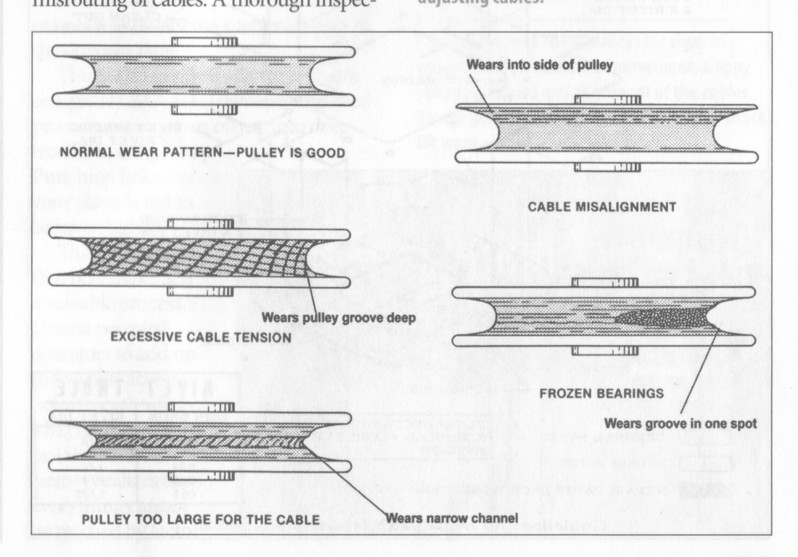
Pulleys are meant to rotate a little to ease the direction change of cables. If they stick, then cables and the pulleys themselves will wear and may eventually fail. Most commonly, a pulley will stick because the grease inside the pulley's bearing begins to dry out and harden. As the grease dries, the pulley stops moving freely and its "working arc" gets shorter until it finally stops moving and the length of the arc gets towards zero. After the pulley stops rotating, any movement of the control cable will be on one spot, and the cable will start cutting into the groove of the pulley. As the cable cuts down into the pulley, the tension on the cable will lessen, making control systems sloppy.
What can an owner/pilot do to remedy the situation? The first thing to do find out which pulleys are stuck. This is a two person job. Have a helper move the cable by operating the stick, rudder pedals or whatever controls the cable while you watch each pulley in turn to see that there is movement. If you are doubtful about a pulley, hold it between your index finger and thumb and have your helper move the control, or try to rotate it yourself.
If a pulley is stuck the next step is to get it rotating again. A squirt of penetrating oil such as WD-40 or Mouse Milk will help to soften the grease. Work the pulley back and forth with your hand until it is moving freely. Don't go undoing anything. If the pulley is held in a bracket by a bolt that acts as an axle, then a properly operating pulley will rotate on the axle. A bit of penetrating oil on the axle can assist movement. If the pulley still doesn't come free, back out and call for your maintenance person to go further.
It is going to be normal to get wear in the groove of the pulley where the cable runs over it. In a properly operating pulley this wear spot will be an arc which is only part of the circumference of the groove. To get full life out of your pulley, just rotate the pulley 180 degrees so a fresh part of the groove is exposed to the pulley. I suppose you could just go 90 degrees and get four times the wear from one pulley.
While you are looking at the groove in your pulleys, you should be on the lookout for abnormal wear. If you spot it, call in the experts because abnormal wear is a sign of more extensive trouble than mere frozen bearings.

How often should you inspect your pulleys? The first inspection should be just before you close up the fuselage or wing during construction. Then it should be done at every periodic inspection, whether that be annually or for well used airplanes, every 100 hours. If you are building your own airplane, whack in inspection panels so you can access the pulleys. Make sure you add "Pulley Inspection" to your Schedule of Inspection.
Old Man Emu
-
4
-
-
To all of you who are loyal customers, I just want to inform you that I'll be off the net (NO! That's not a spelling mistake!) for two weeks. I'm taking a week's holiday by the seaside to do some work on a book I want to publish, then Old Ma Emu and I are moving house.
We are moving to a 5 acre property on the Razorback between Camden and Picton. It has a four car garage which will give me plenty of space to set up a workshop for all the projects I want to start (sorry no plane). There's also a four bedroom house with swimming pool, but that's not important.
So while the move is on, I won't have the Internet. I'll attend to all outstanding orders etc when we are connected again.
Old Man Emu
-
3
-
-
I've got onto a supplier who will supply me by the foot, not 100' rolls. He will also dispatch straight to you instead of to me then I add postage to your place.
Look at the Announcements Thread.
OME
-
A word of caution:
If you are going to buy cable for use in control systems, but aviation certified stuff. Certified cable is made to a standard, not a price. It may cost a few cents more per foot, but any savings you make buying uncertified cable won't go far in reducing your funeral expenses.
OME
-
Just a word of caution:
If you are going to use any sort of cable in an airplane, make sure that you use certified material. It may cost a few cents more per foot, but you can be assured that the cable has ben made to a standard, not a price. Saving a few cents or a couble of dollars on a component of a primary flight control is not sane economy. The savings won't go far in paying for your funeral.
OME
-
1
-
-
It's your choice whether to use stainless or galvanised cable.
Just bear in mind that we are finding accelerated wear of stainless cables in Cessna and Beechcraft products. The stainless steel is not as amenable to flexing as is galvanised cable.
OME
-
Thanks, Scotty.
I'll chase a "per foot" price on Thursday. Just so I know.
Old Man Emu
-
No. The water is the product of the combustion of the hydrocarbons which make up petrol. I've forgotten the general ratios of the atoms in a typical fuel hydrocarbon (carbon:hydrogen: oxygen) but in general, burning a hydrocarbon fuel produces carbon dioxide and water. You should also remember that there are molecular impurities in fuel which introduce nitrogen and sulphur to the mix, and as a result of their combustion, nitric and sulphuric acids form part of the exhaust gas mixture.Doesn't the moisture come from the atmosphere?OME
-
1
-
-
Then there's that wartime favourite, "Comin' in on a Wing and a Prayer"
Here's the link:
OME
-
2
-
-
Ben,
Get some more bracing on that table's legs. You want it as solid as a rock.
The CX4 looks like a real pretty plane, with a good touch of cruise speed. What is the endurance supposed to be?
OME
-
Yenn,
It doesn't matter if your engine is in the middle of a desert, or a jungle, one litre of fuel will produce the same amount of water. Some of this combustion byproduct will find its way into the crankcase. If the crankcase ventilation works, the water vapour escapes into the atmosphere. When the engine is shut down, there will be vapour in the crankcase that hasn't vented. It will condense and sit on top of the oil. During the next start up sequence, this water can be stirred into the oil by the moving engine parts. If this happens enough, the water will remain in suspension in the oil.
Water does not maintain a neutral pH. It can dissociate into acidic hydrogen ions and alkaline hydroxyl ions, thereby making the oil/water mixture chemically active on metals. That's what causes the corrosion of the surfaces of crankcase components.
OME
-
1
-
-
When you quote a price for an oil analysis, that's just the price the lab charges. Don't forget to factor-in the cost of collecting the sample and getting it to the lab. Plus the down time waiting for results on which to base a decision. Also if you were thinking about doing an analysis, you were intending to do the change anyway.
3 litres of oil costs $30, plus $5 for a filter; downtime 1 hour. Why add the costs equal to another oil change?
The best guide to the engine's wear is to make sure you always CUT OPEN THE OIL FILTER AND INSPECT THE FILTER MESH.
Old Man Emu
How bolts are made
in Aircraft Building and Design Discussion
Posted
Thanks, everyone. We are trying to see if we can source our hardware from this mob so that we can get our prices lower. Talks are continuing.
OME