Ian
-
Posts
519 -
Joined
-
Last visited
-
Days Won
11
Content Type
Profiles
Forums
Gallery
Downloads
Blogs
Events
Store
Aircraft
Resources
Tutorials
Articles
Classifieds
Movies
Books
Community Map
Quizzes
Videos Directory
Everything posted by Ian
-
As far as I'm aware the pace of innovation has been particularly slow. The alloy used in lycoming engines castings appears not to have changed in the last 50 years and that alloy closely resembled the one used in the 1940s. Sodium filled valves are WW2 innovations. Roller tappets or liftes are the latest innovation, this became commonplace in cars in the 1970s. Unleaded fuels are only just being approved in some Lycoming engines. Chromium or nitrided engine bores are very old technologies. I haven't seen BAM, hypereuctectic pistons, sintered pushrods or other technologies which have appearred in the last 30 years in car engines either increasing longevity, lowering costs or decreasing weight. I'd interested in knowing where you think that the innovations in engine design have actually occurred. Water cooled planes were commonplace in WW2 the spitfire and the P38 were both highly efficient water cooled engines. Most of these engines also had reduction gearing.
-
The concept that auto engines can't cope with high load for extended periods is a bit of a furphy. High constant load is often significantly easier on the engine and water cooling as all car engine are now keeps the temperatures lower. All modern automotive engines are tested at full load for extended periods and also in start stop cycles where the engine is allow to get up to thermal equilibrium stopped and actively cooled to room temperature across hundreds of cycles. One of the best examples extended high loads is https://www.torquenews.com/1084/subaru-history-how-they-set-2-world-records-and-13-international-records-set-same-time-video Subaru drove multiple vehicles with their turbocharged engines at full throttle for 100,000km with an average speed of 223km/h If you look at the failures of automotive engines in airplanes the vast majority of the failures are related to installation, cooling and gearbox reduction units. When the engine fails almost invariably the engine has been rebuilt and tweaked. These engine fail in planes because they're on off installations. If you look at marine engines such as outboards in many cases they're simply modified car power plants, for example Honda outboards pretty use the same parts as their automotive engines with things like sump modifications and special coating on the coolant channels. They went after this market because it was large enough to be worthwhile and it didn't have the liability issues of the aviation industry. I have no doubt at all that given the right incentive modern car makers could product an aircraft engine with a reduction gearbox which would be significantly better than our 1950 tech air cooled clunkers in all the measures that matter such as power, weight, economy, price and reliability and this would probably be an automotive clone. Unfortunately the market returns don't justify the risks, so we're stuck with either expensive clunkers or DIY. The one aero market which might make a difference is the drone market for long endurance flight. Turbine engines don't throttle well and fuel economy really makes a difference if you want multiday missions with extended loiter times.
-
Anyone using automotive cable for their starter motors?
Ian replied to danny_galaga's topic in Engines and Props
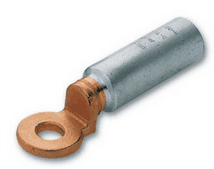
Aluminium can be worthwhile from a weight and cost perspective however you need to be mindful of its weaknesses. The piper issues appears to have been with bimetallic corrosion, if you really want to save weight look at lithium batteries first. You can buy aluminium to copper crimps. Bimetal corrosion is still an issue however oxidation within the cable lug is prevented by protecting the internal surface with a specific grease with a very high dropping point.
-
Flight optimisation by altitude and vectors
Ian replied to Ian's topic in Aircraft General Discussion
I do like whizz wheels, however I believe their place in the industry is somewhat overemphasised. They're a calculator that doesn't require batteries For example the current ban on being able to use trigonometric functions such as sin and cos during navigation exams is absurd. No you have to use a whizz wheel. At one point there was resistance in the school and university system to getting rid of slide rules and log tables. High school and further maths tends to spend a bit of time working around the unit circle where values like 1/sqrt(2) (0.0707) and sqrt(3)/2 0.87 and their inverses which can provide you with some of the approximations that you need, at some point I developed a habit the habit of mentally checking calculated values with approximations. If you understand how the values change between these points you can generate better approximations if required. Given the error values associated with the actual wind values your error bar isn't that bad. It relates to what you said in the exercise above, if you make your mental model incorporate something like the unit circle then it also incorporates vector arithmetic. -
Flight optimisation by altitude and vectors
Ian replied to Ian's topic in Aircraft General Discussion
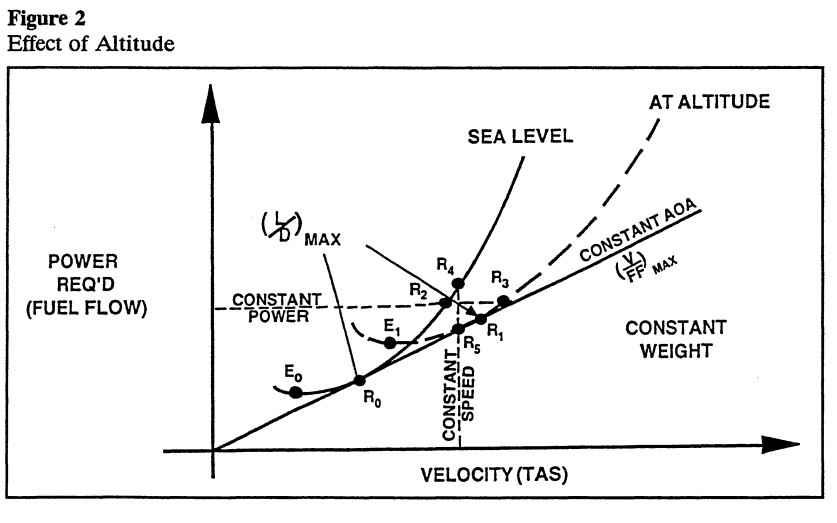
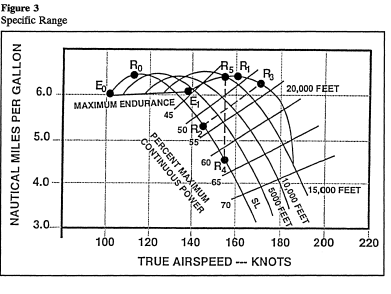
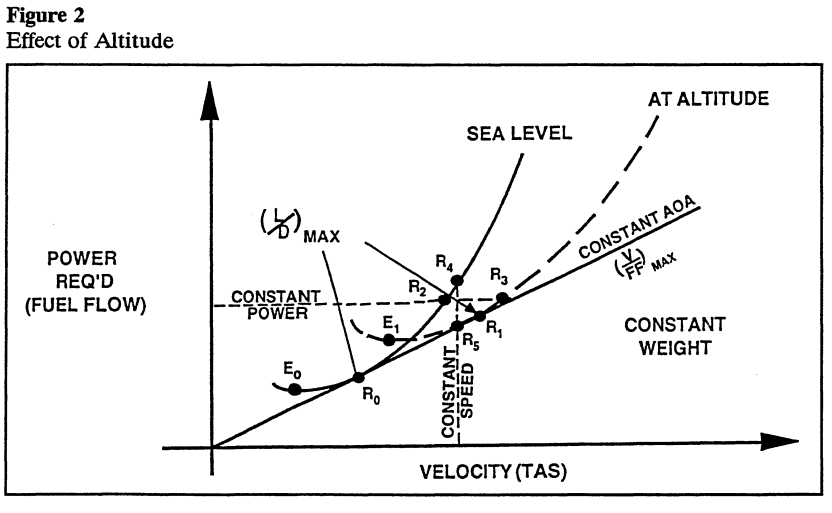
The approximation that you're talking about isn't a lost art, generally it's basic maths. However it is significantly different from an optimised curve through 3d space which a half decent algorithm can achieve with the correct inputs. Anyone with half decent maths ability and an understanding of vectors can do most of the calculations which a whizz wheels do in their head. Personally I'd like to be able to instantly have an optimised path through a range of altitudes and vectors. Personally I think that whizz wheels are due for the dustbin, fun to use but no more relevant than the cavalry in WW2. There is a significant lack of understanding in relation to how planes actually work. If you ask most people why planes fly high they'll say because it's more efficient. The reality is that if you fly at the best L/D ratio this is your minimium fuel consumption, however altitude impacts your speed or time in the air. The diagram below shows that range isn't impacted by altitude. Jets are a bit different because turbine are terribly inefficient at part throttle. The american turbine powered tanks were terrible at idle.
-
Flight optimisation by altitude and vectors
Ian replied to Ian's topic in Aircraft General Discussion
Yes but while artillery tables could be calculated manually this is the type of thing that can be automated and parameterised pretty simply. Sites like windy provide far more granular data than a WAC chart, where every pixel colour is a speed associated with a vector. While some people have fond memories of slide rules they're an anachronism in the present day and age. I know that someone mentioned that "Fuel and airframe time" were the most important thing in aircraft operations, and yet we're counselling people to optimise with a bit of paper and a slide rule? -
Flight optimisation by altitude and vectors
Ian replied to Ian's topic in Aircraft General Discussion
Not being particularly practical didn't stop facebook or twitter! 😉 -
Hi All, Given variations in wind speed at altitude the "shortest" path between two points is may not be a direct route especially on longer flights. Does anyone know of software or other tools so optimise flight paths, engine time and fuel use?
-
Nuts, bolts and washers. Help please.
Ian replied to flying dog's topic in AUS/NZ General Discussion
Not sure if it's been mentioned however one of the key benefits of wired or pinned crown nuts is that they can be verified as "locked". Far more difficult with locktite or similar. -
Yes, From the diagram (which may or may not be accurate), the rear of the wing is attaching to the fuselage in a section which is reducing. ie both sides are converging towards the tail. To reduce drag the section should be attempting to remain straight. The sections for the pictured wing root appears to be trying to achieve this straight line effect but its a bit hard to actually assess.
-
Looking at the Sonex shaped in the image below, the base of the wing might be making a high drag expanding "nozzle" mentioned in the video. To reduce the drag flattening this section until the end of the wing might help. A somewhat quick and dirty approach using something like CNC machined foam or 3D printed parts might be a lower labour approach. Using something like freecad could facilitate this approach. Another quick and dirty would be model some foam and cover it with duct tape.
-
If you're going down this path you probably want advice from someone who's already devoted a good chunk of their life to minimising drag. Around the 37 minute mark is where he gets into shapes to minimise drag. I think that fact that he managed to exceed 200mph with less than 65hp is a pretty good reference.
-
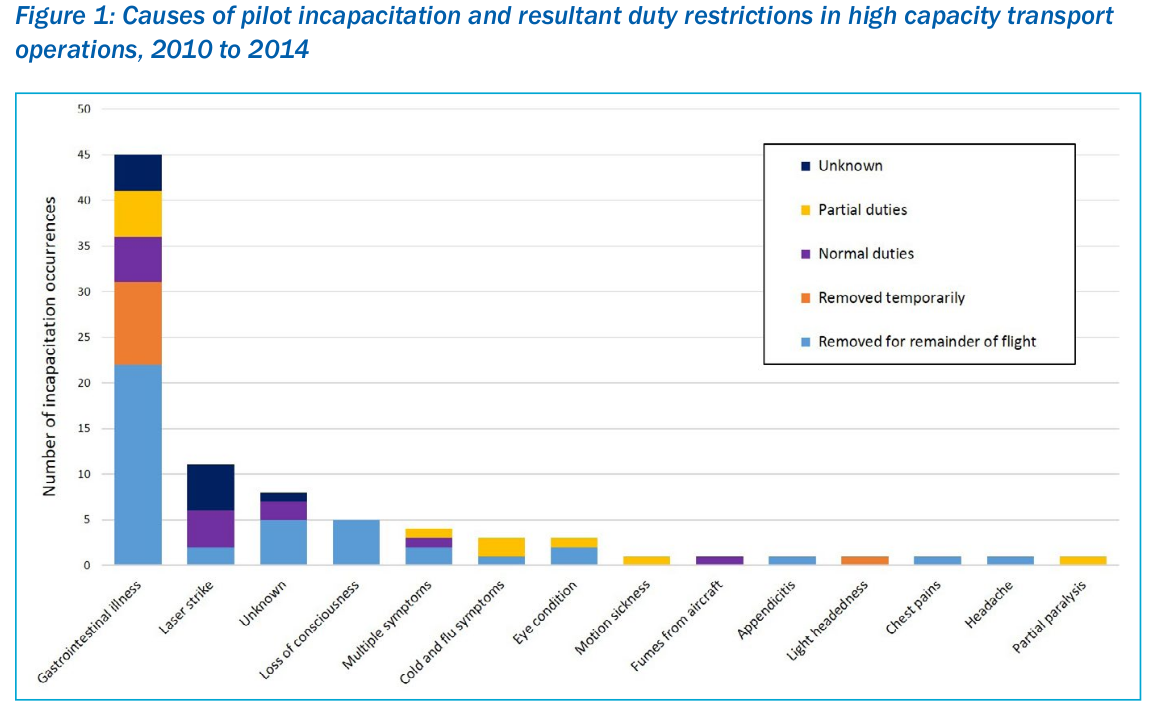
The current state of medicals in Australia is a bit of a farce. It is arbitrary, lacking a risk based approach and only serves to prop up the field of "Aviation medicine". https://www.casa.gov.au/basic-class-2-medical-certificate-fact-sheet-pilots Both ATSB and FAA have published papers on pilot incapacitation events over extended periods of time and it is both interesting and informative to understand the what, why and how these incidents occurred. However based upon these events it is unlikely that there is any differentiating factor where a DAME rather than a GP would have made a difference in any of the incidents. One of the biggest risk factors was food poisoning or flu or respiratory infections. Incapacitation events increase with age which is pretty much as you'd expect. Given that laser strike got such high ratings it should be considered against the backdrop of https://nbaa.org/aircraft-operations/safety/in-flight-safety/laser-strikes/aeromedical-effects-of-a-laser-strike/ and https://pubmed.ncbi.nlm.nih.gov/26651301/ From one article, "Significant injury resulting from a laser strike is unlikely." That's not to say that the morons doing this shouldn't be held accountable for being nuisances. However the key thing to keep in mind is, given the cost and relative ineffectual nature of this control, is whether these resources would be better spent elsewhere.
-
Is the turbulence associated with flying in the jetstream worthwhile given the fuel, time and airframe hours? I'm still waiting for someone to do some dynamic soaring near the jetstream as the delta V should be great enough to support it. The turbulence might be an issue though.
-
The article attached previously has a couple of "rules of thumb" which provide information on getting the most from your plane. Simply put it's angle of attack which largely dictates efficiency, going slow at low level or faster at altitude. Big wings and lightweight implies a higher optimal cruise ceiling. As you go higher the maximum power available to maintain the optimal angle of attack will be the limiting factor. This is what facthunter has been alluding to however hopefully he finds the article a good read. The other point is that you can push slightly faster without much of a fuel flow increase and hence a less full blader. Again as facthunter stated in the real world headwinds/tailwinds impact this however there's also a rule of thumb for calculating optimal speeds.
-
Yes I understand physics, however I was simple responding to the comment that Which wasn't quite correct, yes you'll have less power however some piston naturally aspirated planes have high ceilings and do get up there.
-
Headwinds and tailwinds are a factor however that's a bit of a red herring. By being able to use altitude you can fly high to get/avoid a tailwind/headwind. I'm not saying always fly high, however having more options provides advantages. Pistons get just as much of an advantage in trip time as a jet (up to a point), aerodynamics and physics don't change. However the limitations are Vne so the airframe designer simply hasn't made the airframe safe at speed and you also start running into the limitations of propellers and compressibility drag. You can keep stacking on compressors or use higher compression pistons to compensate. The key point is that a given airframe + load will use a set minimum amount of fuel per NM and this is dependant upon the minimum L/D. By going high you can reduce your trip time using the same amount of fuel. The attached article provides more concisely argued stance. To reduce your fuel consumption below this point requires you to change the physics of your plane. Ground effect is one way to do this and this was used by WW2 pilots getting home with low fuel. ps Jets are a bit different because turbines can't throttle like piston engines, their efficiency falls off a cliff. So they need to run near full power and hence they need to fly as high as they can to maintain the best angle of attack. Piston Airplane Cruise Performance.pdf
-
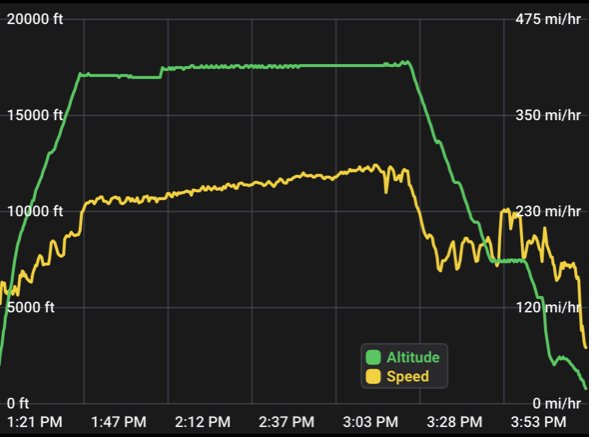
I agree that it might be a little monotonous, however the image posted earlier is a NA plane climbing to 17500 pretty easily and if you're going from point A to B you might be willing to accept the monotony. The longez service ceiling is 27000 feet which is also a naturally aspirated plane https://en.wikipedia.org/wiki/Rutan_Long-EZ Cabin heat or being impervious to the cold might be a good idea. Zooming along at low levels is a lot of fun however there are risks associated with not having altitude. Altitude also gives you more options especially if you're flying over unforgiving terrain, your options increase at the square of your altitude, Low = Increased risk.
-
One think that people don't appear to understand well is how altitude impacts efficiency. You will burn the same amount of fuel regardless of your altitude if you are flying at your best L/D ratio ie best glide ratio. Your most efficient flying speed is your best glide speed which is generally a bit slow so people fly much faster and burn lots more fuel. This best glide speed is your optimal angle of attack at which drag is lowest. However you best glide speed increases as your altitude increases, effectively your drag remains constant so the higher you go the shorter your trip time. However your fuel burn remains constant (ignoring climb and descent phases) Energy = Force X Distance (drag is constant and Distance is constant so energy remains the same) There are a couple of flies in the ointment through, engines lose power as altitude increases limiting your maximum altitude and secondly your flutter speed Vne remains at altitude even though the air is thinner. The other fly in the ointment is where to buy oxygen at a price at low cost. Unfortunately there doesn't appear to be many options.
-
There's no requirement for IFR, IFR is required for class A airspace which is Above FL245 outside radar coverage Above FL180 within radar coverage So the opportunity to expand your horizons is simply limited by oxygen and your aircraft. The chart below is an example of a really good resource provided to the flying community. https://www.casa.gov.au/australian-airspace-structure
-
The graph shows a defiant which is NA and while the rate of climb is slowing it remain adequate up to FL180. Agree completely on the risks associated with icing, weather and the lack of effective mitigations on GA aircraft. It's somewhat ironic that on planes where rejecting heat is often an issue that the cold is a problem in other areas.
-
There's a few reasons. Oxygen improves awareness even at lower altitude, fly to 10000 feet and take a few maths questions, you'll be surprised at how slow you become. Speed, efficiency and angle of attack, your most efficient speed occurs at the optimal angle of attack so you can minimise flight time and fuel burn by going high. weather, sometimes the weather is just bad on the way and good at either end. A bit of altitude might be all you need. Some people swear by the fact that oxygen makes them feel more refreshed even after a flight below 10000. Tailwinds.
-
Like many things it depends on the dose, oxygen toxicity results from inhaling oxygen as higher partial pressures, so inhaling higher concentrations of oxygen at altitude is a good thing if the partial pressure is equivalent to sea level oxygen. 100% oxygen at sea level not so good, even worse if you're diving. U2 pilots have been doing it for decades however their problems recently have related to the bends due to higher operational tempos. https://www.smithsonianmag.com/air-space-magazine/killer-at-70000-feet-117615369/ With the little blood oxygen sensors becoming readily available you can monitor your oxygen levels with little trouble. Even simple maths can become harder at altitude.
-
I was never sure how the non-aviation O2 concentrators coped with altitude, for example the "Inogen One At Home" system is rated to 8000 feet". Even with an oxysaver cannula you need about 1.6L/m to maintain blood oxygen. https://www.peter2000.co.uk/aviation/oxygen2/index.html If someone want to buy and test them that would be good 🙂
-
I was wondering what the best valve types and cylinder sizes for oxygen were. And is getting refills for your own cylinders available in Australia or more specifically Canberra or Sydney. The market appears to be dominated by companies only doing refills on their own cylinders. The US market cylinders have CGA-540 male fittings and the Australian market has CGA-540 female fittings. If I bought pin indexed CGA-870 valved cylinders am I going to be able to get them filled with industrial/veterinarian oxygen? There's an interesting article on the supply of oxygen here https://www.avweb.com/features/pelicans-perch-13getting-high-on-welders-oxygen/ Not sure that it's true but it's food for thought. I've always thought that the options that oxygen provides would be beneficial There are a few more articles on oxygen here https://www.kitplanes.com/homebuilt-o2/ https://www.kitplanes.com/military-oxygen/ https://www.kitplanes.com/how-to-use-your-oxygen-system/