RFguy
-
Posts
3,542 -
Joined
-
Last visited
-
Days Won
49
Content Type
Profiles
Forums
Gallery
Downloads
Blogs
Events
Store
Aircraft
Resources
Tutorials
Articles
Classifieds
Movies
Books
Community Map
Quizzes
Videos Directory
Everything posted by RFguy
-
Lyndon, also consider my viewpoint with my answers- I'm involved in GA maintenance...... but I also have a RA plane also, so I see both ends of arguments. what are you building? EDMO isnt expensive. you are not putting in 100km of wire.... doesnt really matter if you buy 20 different wires in 10 foot lengths of 100 foot lengths - all same price. Some coloured stuff is 50' minimum. I'd recommend using coloured stuff where you can for avionics, it will be much easier on your brain. Or, invest in a effective cable labelling tool (or labeller with those laminated print roll up wire sleeves.....) -glen.
-

Strobe, landing and wig wags questions
RFguy replied to Lyndon's topic in Aircraft General Discussion
good point Nev Most people i know in GA are installing the LED replacements for their sealed beams - I have a PARMETHEUS G3 SERIES LED LANDING LIGHT 01-0772102-10. which draws about one third of the current of the incandescent light with more light and far far less heat... Got from CJ Aerospace. skippy you dont take off from a real airport. LOL. a landing light on the glideslope at noon with the sun out is chalk and cheese. -
Strobe, landing and wig wags questions
RFguy replied to Lyndon's topic in Aircraft General Discussion
I think a bright headlight is very effective for seeing an aircraft coming down the glideslope , when when waiting at the holding point or turning at the runway end I run my headlight whenever the plane is on the runway or airborne. and its bl00dy bright. The headlight I have is excellent. I think they should be compulsory and an airworthy requirement. As for strobes on the tail and wings- I'd suggest the flashtube type........ LEDs are half arsed at best IMO, for wide throw strobes. The Blondel-Rey equation is not a good fit , despite this is what the LED people will have you beleive- as it was primarily for very short durations. looking around the net for something so I dont have to write all about it I find : https://airbornelights.wordpress.com/lighting-technology/at-what-cost-will-leds-replace-flashtube-lights/ certainly the LED beacons and anti-collision lights meet the FAA requirements but they're pissweak IMO compated to a flashtube. The manufacturers for the LED beacons are also cagey about their tech details ..... go figure https://rosap.ntl.bts.gov/view/dot/9071/dot_9071_DS1.pdf -
and no guarentee it is even what it is claimed......and I am guessing that it didnt come with release paperwork either... suggest EDMO. they're good to deal with.
-
Aero Ex - Valkyrie 1 Design
RFguy replied to Peasant_Pilot's topic in Aircraft Building and Design Discussion
between- as in forward, aft of mainspar of person CoM on the spar? What's the CoG location look like with no fuel in the fuel tanks (assuming forward of mainspar) and max people and baggage ? I see a few low wing aircraft that with nothing in the tanks(which are often forward of the mainspar) and full peeople and baggage, marginal CofG condition. -
Aero Ex - Valkyrie 1 Design
RFguy replied to Peasant_Pilot's topic in Aircraft Building and Design Discussion
have you got pilots sitting over the wing spar, in front, or behind ? I'd also like to see +6g for these planes, so the Va doesnt get too low. IMO, that's a potential hazard in these land-slow but fly-fast slippery airplanes. 120 kts (IAS) is not that much use if Va (clean , at half fuel and 1 POB) ) is 75 kts etc. -
Aero Ex - Valkyrie 1 Design
RFguy replied to Peasant_Pilot's topic in Aircraft Building and Design Discussion
How many sqft of wing do you have at the moment ? Lancair of course is not in the same race / category at what you are proposing , a different beast. The Lanceair foil, type NLF-0215 is worth studying. it is a new foil from the 1980s. Have a look at NASA technical report 1865 . (June 1981 ).. it is in there.... it isn't all plain sailing though, the super-duper airfoil is quite sensitivie to flow disruption (bumps turbulence etc etc) https://www.n91cz.net/Interesting_Technical_Reports/NASA-81-tp1865.pdf Retract : Cirrus does pretty well with non retract, I'd suggest same. Many small GA planes are retract just so they can be commercial trainers. Hanging around a maintenance facility, I can tell you that retractable gear systems - is probably problem child #1 and in general, never quick to solve due to the sheer numbers of joints, switches, pressure sensors, pumps, motors, relays O.M.G !!!!! -
Aero Ex - Valkyrie 1 Design
RFguy replied to Peasant_Pilot's topic in Aircraft Building and Design Discussion
well, this is a Lanceair 320/360, for reference. 76 sq ft of wing.... there were a couple of different wings.
-
Aero Ex - Valkyrie 1 Design
RFguy replied to Peasant_Pilot's topic in Aircraft Building and Design Discussion
I love my Stabilator (PA28) but I love complexity.... Stuart is right about the anti servo tab linkage.... there is a bit to it.... Stabilator is more efficient, for sure, and more effective.... but at considerable complexity... Like I love my multi-link Oleos on my PA28, great on the rough, and like I love the stabilator- so much range. But the Oleos are a maintenance PITA . As I also have aJabiru - I appreciate the simplicity of the jabiru control surfaces and cable system, and I appreciate aircraft using spring steel or 'glass etc sprung main gear (Cessnas, Jabirus) . I only really appreciate the simplicity after running maintenance on the Piper for a couple of years. Sure they're really nice to use, makes the airplane super nice....(Oleos, Stabilator ) makes for a royal aircraft..... but at maintenance PITA which I would not recommend for an RA-aus level of maintenance and $$$ spent. -
Aero Ex - Valkyrie 1 Design
RFguy replied to Peasant_Pilot's topic in Aircraft Building and Design Discussion
My 2c: *** Ideally the aircraft should have PLENTY of elevator authority in hand at stall / low speeds, this will enable better flare control in the landing, to keep the pressure off the nosewheel during run out and taxi. I've flown a couple of aircraft that had nothing left in the tail when they got slow in the landing phase, seems not ideal. tailwheel has quite a bit of rough strip advantage. although, I dont see many (any?) damaged Cherokee nose gear due to rough strips as it is built like a brick sh1thouse ( PIO / porpoising excluded) There is alot you can do to look after a nose wheel on rough terriain. Good landing technique will go a long way, (slow , keeping nosewheel away from the ground as long as possible) cherokee has heaps of H-stab authority before it even flys. As Yenn said in 2010: "Posted November 17, 2010 The reason the taildraggers have safer landings than nose wheel types, may be more to do with pilot inputs than aircraft configuration." I'd like to see the RV6A have a bit more authority in the rear to keep that fragile nosewheel away from the ground for longer. But that probably depends on how nose heavy that particular RV is. Stuart, on paper, your's is a bit heavy in the nose I thought from the W&B with the CS compared to some POH I have looked at (online) with fixed pitch O320s engined machines which are likely to be 'just right'. -
Aero Ex - Valkyrie 1 Design
RFguy replied to Peasant_Pilot's topic in Aircraft Building and Design Discussion
My 2c worth is 1) that common areas that might need repairs try and keep as fibreglass, or at least replaceable whole regions--- as structural carbon fibre repairs are not a beginner's pasttime.... 2) consider what metal or wood ablative charing layer or fire retard on the fibreglass etc / resin you want up front such that an engine fire is survivable...... glen. -
The SP I know is a very different beast from a 230C or 230D. Ask the factory for specifics for your SN aircraft What year built ? What is the MTOW that it is placarded for ? sure it is a "230SP" not a "SP" or "SP470 "? oh its a USA airplane. ask Nick, the local factory rep. There were a few different naming differences in different regions. between legs throttle or panel throttle ? header tank under seat or beyond rear bulkhead ? what wingspan ? how deep chord ? 1m ? what tail width? winglets ? what max flap angle setting (measure) ? what width between the mains? what empty weight ?
-
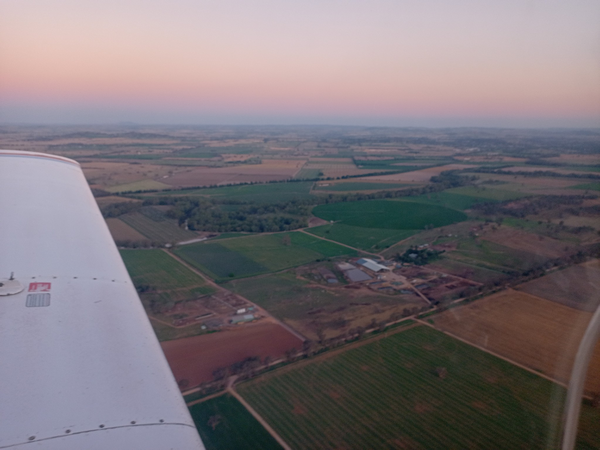
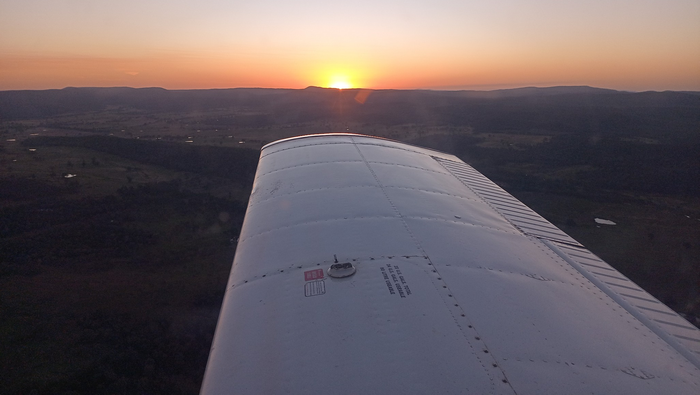
evening summer flying. Oh the enjoyable long days and twilight. plenty of time for flying after 6pm or even 8pm this time of year. A mix of cut and uncut paddocks. Had a look at Thruster's farm. no longer underwater. I really am paying attention. although- it does fly hands-off better now than it ever did before. (post re rigging the ailerons) Hmmm time to find an airport. I can see the reflection of my tail strobe on my instrument panel.
-
E-Props ...who has first hand experience with these
RFguy replied to eightyknots's topic in Engines and Props
It's an interesting engineering problem, to put in in tech terms, in most applications, the internal state is much larger (has more degrees of freedom) than the few observable parameters which are measured (by the accelerometer). -
Kuntzleman Red LED tail beacon fault
RFguy replied to RFguy's topic in Instruments, Radios and Electronics
Hi Jim. yes. you can send me the decapitated kit, or, do we make some new led assys.... I got one of those lens, its around somewhere. I think a small xenon flashtube beacon might be easier, all in the lens . I'll talk to my LED man do see if he has any super high brightness sticks, also, tomorrow I will investigate if I can get a flexible circuit board done at a reasonable price , essentially high brightness leds on a tape so it can be wound helically inside. -
and stabilator needs to be pulled right back (control column full back) so water can drain. I had the covers on the stab and tail, but that requires the stab to be at neutral position, and that means water cant get out.... so, leaving those covers off...
-
yeah, well no hangar space currently available at Cowra. I was in one, but that hangar is now getting lunch room, toilet etc and no room for my plane . CLub hangar isnt any good as the door opening isnt wide enough.... hangars should be built so their doors open to the edge of the hangar !
-
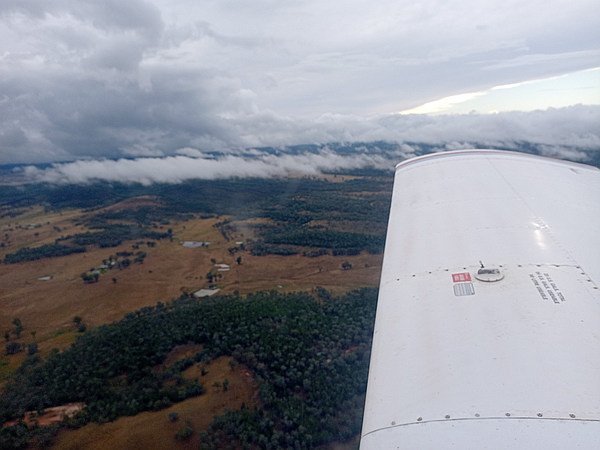
2nd day in a row of heavy rains. Recency is king so had to fly (7 day cycle) . Including 55mm that day, and 30mm in the previous 2 hours! The airport looked like an inland sea. Finally, late afternoon with cup of tea in hand at the clubhouse, several hours of waiting.... at 1715 the rain stops & I can see the mountains (so I can see to at least 750'AGL) and to the NW where the weather is coming from, blue sky. A few kg of water in the H-stab, glad I tipped that out , might have been a CofG surprise. plane is outside with large body canopy + wrap around engine cover over it at the moment, Just a 0.7 in the Piper , but most enjoyable. Flying after heavy rains in the summer, no bumps ...is delightful...... and those interesting low lying cloud clumps. Flew 15nm NW up to Thruster's farm to look at his half-cut wheat crop with the header parked.... where it was brilliant wall to wall blue sky . flight was 750-1100 ft AGL at a nice and sedate 100 knots at 25 lph , just poking around , looking at the puddles and places to land. relaxing . Bit of carb heat required at times in the 17degC misty skies. Not a single other aircraft heard. No one around...so conducted NDB approach (in visual). Blue sky edge of weather visible in top right hand corner of photo.
-
Skippy, really ???? ? I think I provided quite useful advice , having seen this sort of fault PRECISELY AS DESCRIBED !
-
sounds like carb probs. float bowl float needles..... With alot of vibration, this might flood the float bowl, or otherwise have it 'not to spec' I venture a guess that vibration and the sputter are unrelated except that vibration (due to maybe mismatched carb operation (needles, float height ) causes the sputter also, check floats actually float the correct height while you are there. Nev is right with the Dashpot question. have these carbs had an overhaul kit through them ?
-
well done. airplane climbs like a scalded cat without instructor aboard eh ?
-
3 more gone too soon. Near Maffra 16/11/24
RFguy replied to BirdDog's topic in Aircraft Incidents and Accidents
was the pilot the original builder ? Otherwise up to the original builder to do the test flying and V speeds, and the new owner to trust but verify...... -
3 more gone too soon. Near Maffra 16/11/24
RFguy replied to BirdDog's topic in Aircraft Incidents and Accidents
just come to look at this.... some numbers.... 800kg and only "7.92 m (26 ft)" wingspan, only 110.5 sq ft ????? it would need a very high lift wing to make 35 kts, and thus to do 115 kts cruise, would need a big engine. which it doesnt have. calculating..... I estimate, with that engine, and that wing and that weight, something like about ... ~ 55 knots stall speed clean...... **Brendan - I think the numbers , where ever you got them they are KTS not KM/H - then the stall speed makes sense. a 30 deg bank would increase the clean stall to 59kts. so perhaps just another boring stall spin story, nothing to see here.... -
mode S doesnt mean ADSB. ADSB is a Mode-S extension. it's quite fine to have Mode S transponder (plain vanilla Mode S, not Mode S including ADSB) and ADSB OUT (skyecho) going.
-
Bathurst Mt Panorama incident 13th Oct 2024.
RFguy replied to Thruster88's topic in Aircraft Incidents and Accidents
We'll see how dark the ATSB roast him. Can't have been a guy that does any maintenance. Working on planes you realise just how light and thin stuff is made....(skins, ribs, control surfaces) ....and how easy it is for controls to jam. replacing aileron cable and re rigging (wings) from scratch the Piper has taught me to be quite afraid (wary/cautious) of the potential for control surface jams and failures. The Jabiru push pull Teleflex is oh so much simpler and I thinik far less chance of anything going wrong, if you don't mind the slop. (which you get used to)