
RFguy
-
Posts
3,528 -
Joined
-
Last visited
-
Days Won
49
Content Type
Profiles
Forums
Gallery
Downloads
Blogs
Events
Store
Aircraft
Resources
Tutorials
Articles
Classifieds
Movies
Books
Community Map
Quizzes
Videos Directory
Everything posted by RFguy
-
There are minimums to get an RPL. 5 hours in command. You'd want to have your navs done, also, which will mean you certainly have 5 hours in command. https://www.casa.gov.au/licences-and-certificates/pilots/pilot-licences/getting-recreational-pilot-licence-rpl
-
ADSB rocks. But - The other day I was on a 'air highway' and on my ADSB-IN on the tablet, I saw another aircraft flying right down my throat at same altitude 10nm ahead, they were flying the wrong hemispherical, I called them on centre (where they should have been) , no response, so I called them on the last CTAF I guessed they'd been on, contact established, and they descended . System works. HOWEVER, after the electronics did the job for me , as I was patting myself on the back for that, and thinking I just had to land in these windy condix, nothing else to worry about, I remarked,. to myself, as I joined circuit not to forget that there are plenty of aircraft still without ADSB, so not to get too fixated on the tablet for traffic. Sure enough, two aircraft coming into circuit just behind me , neither with ADSB. But, more and more aircraft are joining the club daily, it seems.
-
What are the device model numbers?
-
Casuarina beach NT 29/03/24 Textbook forced landing
RFguy replied to Reynard's topic in Aircraft Incidents and Accidents
so if VH-KER comes up for sale, beware ! S/N 32-7640035 -
yes, you are right, the topic has to be read in full, there are all sorts of if that not if this but that type of things apply. IE my quote is not the full story.
-
actually, in my above post, I said it was 30 minutes after departure that the weather at the departure aerodrome needs to be good for after you depart to be able to return. Casually revising through the VFR rulebook- ,I am in error It's in the event of no destinatiuon forecast being available, you must be able to return for up to 60 minutes "Flights unable to obtain an authorised weather forecast before departure (CASR 91 MOS 7.03) ---If a weather forecast or report is not available, you may depart, provided you reasonably consider that the weather conditions at the departure aerodrome will allow you to return and land safely within one hour after take-off; however, you must return to the departure aerodrome if you do not obtain a weather forecast within 30 minutes after take-off.
-
Compass requirements for 19 rego
RFguy replied to danny_galaga's topic in Instruments, Radios and Electronics
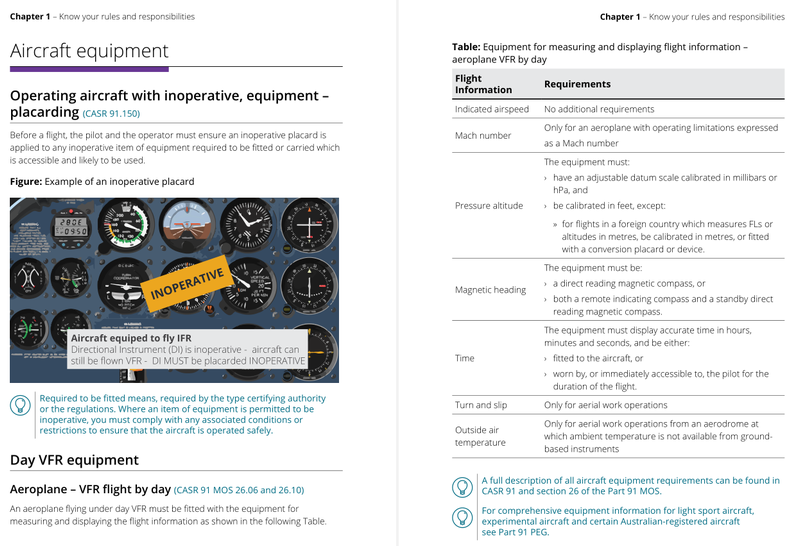
it's still minimum VFR equipment Day VFR equipment Aeroplane – VFR flight by day (CASR 91 MOS 26.06 and 26.10) An aeroplane flying under day VFR must be fitted with the equipment for measuring and displaying the flight information as shown in the following Table. VFRG version 7.1
-
I dunno.... I'd be looking for bad-luck particles still attached to the cover. If you can, find out of the cover was put on the aircraft after the incident. If so, you'll need to soak the cover for 48 hours in LL100, then another 48 hours in a strong detergent, agitating from time to time. When you can apply a match to the cover and it doesnt burn, you're done.
-
Casuarina beach NT 29/03/24 Textbook forced landing
RFguy replied to Reynard's topic in Aircraft Incidents and Accidents
A nudist beach ? sounds like a setup to me. -
ROC (gross) falls from 630fpm to 450 fpm.
-
35 deg C at Goulburn.... 998 hpa ... not unusual for summer. altitude 2139 ft. std temp = 15-4 = 11C 35 deg above 11 = +24 above std temp x118.8 = 2851 1013-998 = 25hpa x 30 =750' total DA = 2139+750+2851 = 5740' . quite alot eh my 50' altitude T.O. distance increases from 579m at 11degC & std pressure to 854m. (at gross). quite a bit. about 50% increase.
-
You are right about luck/skill... The other day I encountered prop wake turb landing right behind a cessna 206 that had done a short fielder (dragging it in at probbaly high thrust) and then go around (all thrust) . There was nil wind, and when, in the flare with power off, I got tossed around--- right at the time I was the most vulnerable (low control authority, low speed) . I was like 'WTF ?! I was tossed around in roll and yaw. was quite a surprise. I applied a little bit of power to stabilize, and almost not quite enough as I got lifted up 10 feet in some wierd turb gust and then almost ran out of airspeed . I should have applied full power and turned it into a go around, or at least got airspeed all the way back up and had another go at the landing (there is 1600m of runway ) . I used up a bit of luck..... I've only encountered such turb once before a couple of years ago with some mech turb from a line of hangers downwind somewhere else next to the runway ..... Which brings me to this- that it's important to fly regularly- because the more often you fly , the more often you encounter adverse conditions, and the more likely you will have recency - to competently handle whatever has been thrown at you. That is to say, if you fly not often enough, you might encounter that prop wake turb once every year, which is not often enough that your brain has recency to deal with it competently / instinctively. Fly once or twice a week, and you are more likely to encounter that type of adverse condition often enough that it has not been too long since you last dealt with something like that... if that makes sense.
-
the history books are replete with people loading up their airplane at high aerodromes with high DA and crashing into the opposite mountain.... It's easy enough to make a laminated table on the back of your checklist. I can and do-do DA in my head before takeoff (ability to depart on intended path) and landing (in order to consider the go around scenarios) . On the back of my checklist is a table of weights, DAs driving that points to climb rates, runway rolls, stall speeds, TOSS and bank speeds. I have a postit note I stick on my instrument panel that I write the above for planned TO and landing.
-
eh I'm in Canberra skip,. My planes are all over the place.
-
some practice is required. but its not that hard.
-
I have a professonal balancing instrument skip, you want to borrow it ? One person has it right now.
-
I was working on a plane recently , without a working voltmeter, and a USB car voltmeter plugged into the "cigarette lighter" is what we used ..... It's showing master bus voltage of course, not battery. Could be maybe half a volt different from battery voltage depending how it is wired However it does work to tell you if you are charging, or in discharge . > 13V probably charging. <13V. probably discharging. . ==13V ? wait another minute .
-
Cirrus 22M Shelter Cove Airport, CA
RFguy replied to red750's topic in Aircraft Incidents and Accidents
getting out of the sydney basin is not too bad, in favourable condix. Just pick your day so that you can get some altitude (not squashed down by clouds) and there are routes that have paddocks here and there. Likelihood is you are flying something in RA that can land in a paddock, IE you're not flying a Lanceair . As Nev says, there are ways to do things with less risk. Flying is about the highest risk activity that is legal, a friend said to me. somewhat true. If you must fly, then you'll have a RPL or higher and get a clearance above it all. -
The bulk of this post is that it rings true of what my instructor , Rob Glenn, once said. "Pilots are decision makers : any buffoon can land a plane, but the decisions you make will have a bearing over whether you live to tell the tale " Cowra YCWR (central west, inland) to Goulburn YGLB 125 Magnetic, (located near the coast on the great divide) . 76nm over undulating tableland farmland . needing to swap some planes around, getting a lift in another plane at GLB then somewhere else. Day before the GAF looked positive and nice. but the GAF at 6am was troublesome. 4 hours of fuel on board for the 45 minute flight - plenty for a diversion that I anticipate as there is PROB30 for fog at goulbourn until 10am and thus I MUST nominate a viable alternate with a TAF and carry fuel . (Bathurst YBTH, 60nm from track) Goulburn is famous for its fogs but usually clear by 0900 local. A big mass of NS and CB with heavy showers (per the GAF) from the west and vertical development chased me out of Cowra at 0900 , I departed VC AD at 100 kts climb (500 fpm) to get away from it, knowing that I would not be immediately want to use it as an return , or indeed any nearby ADs as alternates. By the book, the forecast at the AD has to be good for 30 minutes after departure . So sort of broke that rule but technically there is no TAF.... but its pretty obvious (without a TAF) what was coming to a reasonable person. Get to 7500 ' . temperature +1C. smooth, clear over ground, under the next layer of cloud at 12,000-15,000 estimated. it's a little misty outside . humidity is up... there is a cold pool of air up here. was warm on the ground at Cowra ! Got about 1/2 the way , near Crookwell , where I have landed before, and there is a sharp line where a sea of low level cloud about 700' above all terrain begins . As far as the eye can see to the east, and south down the range and north up the range. There is no way I can land anywhere over that whole region. While according to the METAR, the is patches of blue sky over Goulburn, It's one thing to duck through 1000' of cloud that has bases at 7500 and tops at 8500, its another thing to do with the 100' thick cloud at 750' AGL in the mountains....... With a 100' thick layer at 700 AGL, and you are above it all, if you have an engine failure anywhere over any of that expanse of land and cloud, I guarantee you will die because you'll only know where the ground is when you hit it. So, I do a 10nm orbit think for 10 minutes, reduce fuel flow from 31 lph (67%, @peak EGT, 2450, 105KIAS 1900lbs AUW@ TO) to 25 lph , and I get a tiny bit of roughness and 20-30 RPM lost....troubleshoot by applying a bit of carb heat , it's likely to be a bit of carb ice..... since conditions are favourable and I have a high manifold vaccum......... so no big deal, I can see the ground still. No need for carb heat in this case, the high manifold vaccum is obviously causing some low temps, so I increase fuel flow to 28 lph (~ 98kias) and it goes away but will keep an eye on it..... I start to head north for my alternate, 60nm.... clear and nice - as my closest ADs at cowra, young, parkes, orange, are all under rain on the radar, and it looks imposing out the window. I dont want to go near the CB and TC . flyng for a short time, METAR at Goulburn looks better, hmm, alright lets have another look. so head back that way to the edge of the cloud. Nope doesnt look any different. In fact I can see higher cloud behind it to the coast. Mark texts me and says its raining lightly to the east of goulburn. nail's in the coffin. Turn back. head NNW, descent to 6500 , toward Cooming Park ALA, dodge a few heavy rain bands , after 15 min, I notice that it's cleared around Cowra now (I am east of Cowra now north of Wyangla Dam) so then I turn west direct to cowra. For all the rain and dark clouds, it is suprisingly smooth. I did stay at least 10nm away from ANY of the shower activity and heavy cloud, so that's a good thing. Uneventful landing.... WIll try another day. glen.
-
Cirrus 22M Shelter Cove Airport, CA
RFguy replied to red750's topic in Aircraft Incidents and Accidents
Looks like a good outcome to me. I would have done the same. You're not going to glide your way out that one. compared to this pilot the other day 500' over the tops of the Wollomi national park, a large region of sandstone bluffs and deep ravines. .. What was he, scared of heights ? flying under low cloud. insanity ? I fly over that extreme tiger country region in my Archer but only when I can get > 5500 feet OVER the tops of the hills, (IE 8500 west or 9500 east) then I have a survival chance and I know all my decision points and which paddocks I am going to they are marked on my map and ozrwy map. If I was flying at 500' above the hills in that region, I'd be so horrified by the view that I would put my hood on and go onto instruments so I didnt have to look outside.
-
I think 30V on a 40V is OK, that's plenty of headroom even under elevated temperature.
-
too many engineers have never been technicians dont put diodes in parallel, they DO NOT current share. but by all means put two in parallel for redundancy, just rate each diode at the full requirement Diode- use a diode with a Vr of around 40V. that will have a far lower Vd than a 150V diode. If you like Vishay, suggest https://www.vishay.com/en/product/97219/ https://www.vishay.com/docs/97219/vs-175bgq045hn4.pdf At Tj=125 and If of 20A, it will have a Vforward of about 0.3V, IE about 7Watts to dissipate. bolt to a chunk of aluminium, at least 20 sq inches surface area, 3mm thick. it will need a silicon washer and bush under the tab against the heatsink, since the tabs are live.
-
From my rather critical POV, the UL twin problem indicates the these issues are ahead / beyond the UL staff and the buy is goign to need ot odo their own system design , and perhaps get advice .... My thoughts are , isnt this an obvious failure mode / system design problem that should be a well worn path by now for UL. Beware of twin of anything in electronics, same goes for everything else. Ultimately, the error though lies with the pilots not doing their checklist (check alternator contribution / battery voltage post start)
-
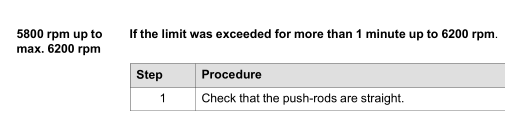
5800 is normal TO max. anyway, enough, we are polluting Mike's thread. No more rotax talk
-
Advice on idle : (documentation : ROTAX OM915, 912 "Section 2.1 " engine start : for iS engines -Section "3.4) After engine start" "Set linearized throttle position in a way that the engine runs at approx. 2000 rpm for approx. 2 minutes." then "Set linearized throttle position in a way that the engine runs at approx. 2500 rpm until oil temperature reaches 50 °C (120 ° F)." If you run a 912ULS at 1400rpm you'll foul up the plugs because the mixture between front and rear cylinders goes wild. (one end goes rich - front ? cant remember) .