

turboplanner
-
Posts
24,367 -
Joined
-
Last visited
-
Days Won
159
Content Type
Profiles
Forums
Gallery
Downloads
Blogs
Events
Store
Aircraft
Resources
Tutorials
Articles
Classifieds
Movies
Books
Community Map
Quizzes
Videos Directory
Posts posted by turboplanner
-
-
Well, everyone can settle down now; the pilot has reported on prune that it was a maintenance issue, not a mechanical fault.
-
 1
1
-
 1
1
-
-
Why not just comply like most people?
There are some people who want to fly RA on CTA; you're one of the ambassadors for the "no" vote.
-
 1
1
-
-
What's interesting is that you have it backwards. The reason you are not hearing the first word at times is because the other person was not trained properly not to speak until the button is fully depressed. If you have been properly trained, everyone else will be hearing your first word and you will just be confusing them.I will continue to say "traffic" as my first word and I would be amazed if a court of law found it to be a safety hazard. -
I would've looking at how much in YOUR day does CASA intrude. That might lead to asking why others have problems, and what problems they may be.
-
I wouldn't get too excited about it; just the usual prune subjects gnashing their teeth
-
1
-
 1
1
-
-
He probably didn't just park for a p break; two RPT diverted to look for him and an RA AC went up from Wagga.Interesting. Jab in a paddock and it's already reported as an engine failure ... there are lots of reasons to be in a paddock that are not engine failure and whilst it is more likely than not engine related the posting on pprune already on that thread are horrific to and about the rep of the engine even before they know the cause! -
It matters, and in some cases it may be critical. Your radio may not be transmitting at optimum level, or someone else's radio maybe off. If the phrases are being used at the correct location and in the correct phrase order, and only syllable noise is coming through you can still identify where someone is in the circuit.Yes that makes sense, but the format taught now is "Bullamakanka Traffic" with "Bullamankanka" the last word at the end of the message, just in case, as you said, you miss the first part.... That is how I was taught throughout my entire flight training and supported by all the study material, which was within the last year and a half ....I hear the traffic first format a lot. I don't think it matters much, as long as the message is out there and being understood by everyone.There aren't that many to learn to be professional.
-
The photo I posted is #46; looks a clean wing.
-
1
-
-
I stalled it power off and power on with a pronounced nose up attitude many times (in the straight ahead position) and can't remember any wing drops.
-
See post #63
-
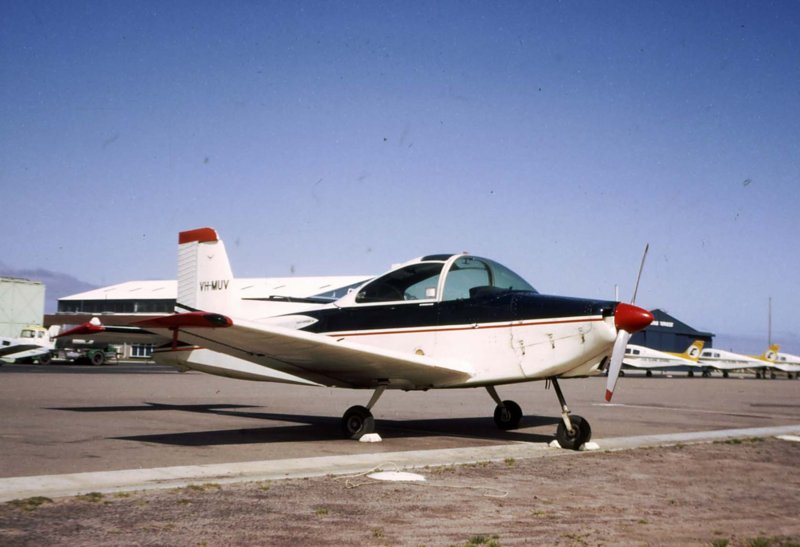
OK, haved a close look at the V115 I posted; I can't remember whether there was anything special at the wing root, just remember a normal join with non-skid material glued to the top surface for a walkway.
While it had a short wingspan, it was a very stable aircraft to fly, and I stalled it power off and power on with a pronounced nose up attitude many times (in the straight ahead position) and can't remember any wing drops.
-
1
-
1
-
-
It guess you'd relish them even less with a hostile on your lap!
-
Logic.Why should RA-AUS exist at all? Why shouldn't everyone have to buy VH and get a PPL?Why shouldn't you be restricted to 500ft over your own land? Wasn't that what AUF was all about?It's about giving people choices, no one is making you get a CTA or modifying your aircraft to meet CTA standards. Why is your right as a member to have RA-AUS advocate on your behalf greater than mine?
-
2
-
-
This model didn't look too bad with the bubble canopy. Very reliable engine, aerobatic too; nothing like going out in the early morning for 30 minutes of throwing it around the sky.Victa, what a godawful looking aircraft, at least you can see where the design for the lawn mower came from..........................
-
5
-
-
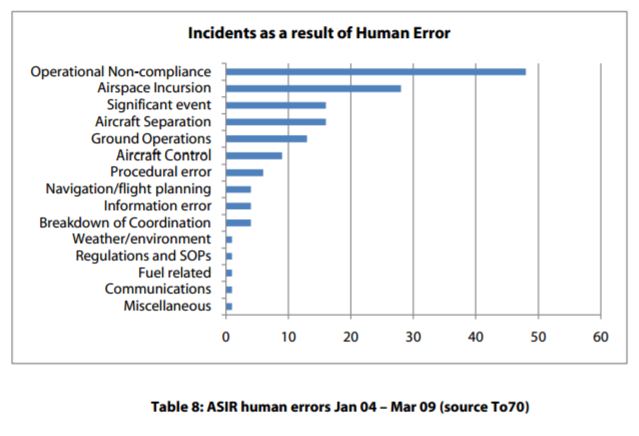
Just staying on a medium volume airport like Tamworth; about 19 of the top bar is not complying with ATC - shows you what happens when pilots are untrained, nervous, non-current for CTA. And, SQ, just for you, this chart includes GA pilots only. If the bars suddenly go out with newly released RA pilots, you can bet your boots the scrutiny will be on ALL RA pilots.
-
1
-
1
-
-
I was just responding to the statement: "I can't see the logic that CTA is less safe?"Also just a note, I am very low hours and Nev and turbs have many more hours than me so I definitely am not trying to defend myself but more so RAA cert holders as a whole. Ironically even though I have flown into and out of tamworth a fair bit in training and once under my own steam since, I wouldn't be comfortable getting a cta endo without a lot more experience. It's just I don't see how getting my ppl and a cta endo would be better than just getting a cta endo with Raa.Also note, even though I like the idea of a cta endo (tamworth is only 20 minutes away in my slow plane!) it wouldn't really benefit me too much as I fly a 19 reg. I don't think the requirements for planes needs too much adjustment but I do think it makes sense to have a level playing field when it comes to pilots.
All participants referred to were PPL and above, so no aspersions on RAA pilots.
I just covered some of radio and situational awareness, but to that you can add non-compliant circuits, jockeying for landing position, queue jumping, and even failure to find reporting points. On one occasion I was inbound and almost at the reporting point when I saw a 210 tail fin pass at around 90 degrees to me from left to right, in the lower sight line.
You've probably summed it up nicely, and that's just based on Tamworth.
Tamworth, in the 12 months ending June 2009 had 90,402 movements.
This compares with:
Moorabbin 2009 310,000
Bankstown 2011 243,126
Jandakot 2011 275,506
Archerfield 2011 140,000
Essendon 2012 57,000
A CTA endorsement is a little like a Command Instrument Rating; first there's a cost, then there's more cost to keep yourself current (safe), then there's an aircraft cost.
-
1
-
-
When you fly in it for a while, and see what comes into it and what they do, it becomes obvious.I can't see the logic that CTA is less safe?The thread on Ozkosh radio use was one example of how circuit and radio procedures can trip people up whose training to that point has only been out in the country.
I've had one at Moorabbin responding he was on downwind, when in fact he was heading stright for me heading upwind; that's not a mistake he might make at Gunnedah, but the pressure had clearly got to him and the tower controller worked him round into position and helped him down - but that stuffed it for the rest of us.
-
3
-
-
-
7
-
-
If you're learning Navs, do it thoroughly, learn NAIPS, learn Navigation, get that base under your belt before looking for short cuts. One guy, who is no longer with us didn't bother with that, so he missed the "severe turbulence" in the NAIPS warning, which is aviation orientated, and snapped his wing off. By all means check a couple of apps, but always get the NAIPS forecast before you leave. Surely your instructor is saying this?can anyone recommend an android app that I could use to look up the weather?-
1
-
-
It means you're not someone to be trusted.Can someone explain to me what it is with this 'caution' tag that appears ocassionally on posts? What exactly is it supposed to mean or imply?-
1
-
 1
1
-
 3
3
-
-
The closer to your departure time, the more accurate the forecast; and vice versa.basic question, I know. I go to NAIPS, log in, get an area briefing, cut and paste it into the plain English converter, and it only gives me weather until 12.30 am tomorrow, even tho' I typed 24 hrs validity into NAIPS. I changed that to 48 hrs but no joy. How do I get the weather forecast for 10am tomorrow?thanks -
Ah good, a day to comment, and I've just finished a one hour presentation where about 3,000 pages had to be checked and commented on to catch the cunning trucks of the villains, the latest ojne being, when I say something is black; "There's nothing in there to say it's not white".
-
1
-
-
Well Bruce, you might be just the man to sit down and see what the legal obligations, compare that with what they are asking, and negotiate to ensure the legal obligations are met, but that great ideas are paid for.I have a lot of respect for Don Ramsay's comments but I have to say I'm horrified that we are spending 1.8 million on appeasing CASA.I call it "demanding money with menaces" which is illegal unless done by the government.Why not give CASA what they pay for and no more?
-
1
-
-
You're a bit too late.
-
1
-


Speaking on the radio
in Student Pilot & Further Learning
Posted
Note in the link below:
CAAP 166C clause 7.2.1 says:
"Effective radio communication requires the pilot to use standard aviation phraseology as detailed in the CASA Flight Radiotelephone Operator Licence Syllabus of Training and in the AIP. Positional and other broadcasts necessary to minimise traffic conflict should be made, for example: ‘joining circuit’, ‘turning base’ and ‘clear of all runways’. Effective communication and increased traffic awareness will help prevent a collision or an Airprox event. In addition, avoid the use of local terminology in position reports, for example use ‘Bundaberg’ instead of ‘Bundy’."
If there is a lawsuit or you are charged as a result of an accident, remember this word "requires", and its aviation meaning (which is the same as "must".)
How many people involved in these radio discussions have been through the Syllabus of Training and actuall have a Flight Radiotelephone Operator Licence?
The Positional reports have changed several times over the last forty years, but it would appear from the CAAP, that just the three are considered necessary and you go upwards of that if there is a potential collision issue.
That also clears up the discussion about the "clear all runways" call.
If you're in the circuit for a while, "base" is plenty to tell you where the other aircraft are in the pecking order, "clear all runways" tells you when someone is going out of the circuit and you don't have to worry about him being on your tail etc. and "joining circuit" tells you to be aware that someone may push in front of you or come up behind you.
For the OP, who was asking about none of this, I've always had the same problem, and found two ways to fix it were:
1. Type the location/events line by line on a spreadsheet, with the phrase on each following line. That way you create the element of surprise.
2. Record the locations/events on a CD with the answers a convenient period behind, leaving a big gap at first, then reducing the gap gradually to real time; you really want the standard phrases to be coming out of your subconscious rather than the coupole of seconds it takes to think. Just be tatient becaise that will take quite some time.
requires; my emphasis
https://www.casa.gov.au/sites/g/files/net351/f/_assets/main/download/caaps/ops/166-1.pdf