

turboplanner
-
Posts
24,363 -
Joined
-
Last visited
-
Days Won
159
Content Type
Profiles
Forums
Gallery
Downloads
Blogs
Events
Store
Aircraft
Resources
Tutorials
Articles
Classifieds
Movies
Books
Community Map
Quizzes
Videos Directory
Posts posted by turboplanner
-
-
Mayday is the term that authorises override authority, not a casual conversation.Why would regulation changes influence pilots more than the risk of accident due to running out risking injury?Id reckon if you entered CTA in low fuel state you might let ATC know that you are in risk of running out in 30 min....not a mayday.The more regulation users consider useless, the tendency is to ignore it and other regulation.
-
Perhaps too many people who quietly used the reserve had too many discovered incidents perhaps even stuffed up the forced landings and produced some real statistics.It was a regulation for GA. I don’t know about RAAus. Private ops had to have 45 mind reserve and commercial ops had to have 45 mins plus a variable reserve ( I don’t recall exactly what the variable requirement is as I’m not commercial) then on top of that if the destination airport has an INTER weather forecast then need 30 mins extra and if a TEMPO then you need and extra 60 minutes reserve.The diffrence now is that once you reach your reserve you have to tell the world about it by calling Mayday! Before this you could just quietly use your reserve knowing that you had it for a reason.
I think the Mayday call has been introduced for Airservices, so they can trigger a full priority for the aircraft. You only have to read through this thread to see the reluctance to call a Mayday or even a Pan.
In that case, how would a CTA tower controller know to give you preference to other aircraft.
I've mentioned a classic case before where a pilot was unable to get into his home field not far from Moorabbin few years ago, o he came on down only to be told by the tower that the airfield was closed due to weather, so he turned away and went looking for other alternatives, so he returned to Moorabbin, now very short of fuel. The Tower controller told him the airport was closed, they got into an argument which ended with him saying he was coming in whether it was closed or not! He knew he was out of fuel and stressed beyond recognition, but he hadn't told the tower controller. The ATSB after investigating the incident pointed out that the pilot could have landed at Moorabbin the first time, rather than risk his life running out of fuel, if only he'd called a Mayday On receiving that call the tower controller and services would have immediately done their best to assist him down. This change trips that switch, making things safer for the pilot. As someone said, the Pilot then has to go through the paperworkmill. However, anyone getting into a situation with less than 30 minutes fuel left deserves to have to explain himself. I can understand to thinking of guys here who mainly fly local, but even if a person flight planned a three hour flight leg, and logged fuel burn every ten minutes, flights often encounter issues like wind strength/direction, engine tuning problems, redirection for some reason, and GA aircraft have big tanks that allow you enough safety margin to virtually never put yourself into this 30 minute situation. Some people just can't help themselves and wing it, and I guess this regulation provides more of an incentive not to make a fool of yourself.
-
Apparently you can.Tongue firmly in cheek!! You cant tell the masses this isn’t going to be considered until the next round of reg’s become effective, then turn around and tell us it’s all good now. -
If that is true, then I can imagine flying schools using Cessna 152s as the tough trainers they are, signing off students, and those newly qualified pilots jumping into a Jab, without endorsement, as they entitled to do.Anyway, they confirmed they have the 750kg but it wont be for LSA. All LSA stay at 600kgs. I guess they now have to change all the manuals to suit so it may take a while to come through. Flying schools will have to use LAMEs for the higher MTOW, but owners will still be able to do their own maintenance.What could possibly go wrong?
-
He was probably riddled with bullets, then thrown into jail, then being prosecuted for a million infringements and I would be left destitute and in jailDoes anybody know what happened to that old man? -
Great record, and shows that doing what you do works.I've had 4 engine failures in an ultralight. One at 1000 feet AGL. 3 at less than 200 feet AGL. Flew home after a field repair after 3 of them, and trailered the plane after the other because it got too dark to fly. I do a short soft field landing nearly every time I land. Not because I need to but to keep in practice. Engine failure at 1500 AGL training did not prepare me, except for the stick forward as soon as the noise stops part. Being vigilant regarding wind direction and staying away from tiger country certainly helped. Practice practice practice landing without touching the throttle also certainly helped. As this thread states. Engine failure should not reusult in a fatality as long as you prepare, train, and anticipate that it will happen to you one day. -
That's good; teaching yourself subconscious actions triggered by an event, if you put it in your brain over and over again can get your physical reaction time down to between 20/100 and 60/100 of a second vs two to three seconds if you have to think about it and it's driven from your brain.Gliding taught me instant response to the "nose down" after loss of the/O thrust. There was no room for a wtf moment, it was a trained instant movement, perhaps a mental connection between hearing the windspeed, and the hand.I was in a cable break in a Blanik, and by the time the bang had finished the instructor already had the nose pointing at the runway and the landing was 10/10.
So you have two reaction times - subconscious and when you have to think. The three seconds is still a good idea in case you have the third reaction "this can't be happening....."
-
It became clear several pages ago that this subject has no relevance to recreational flying.
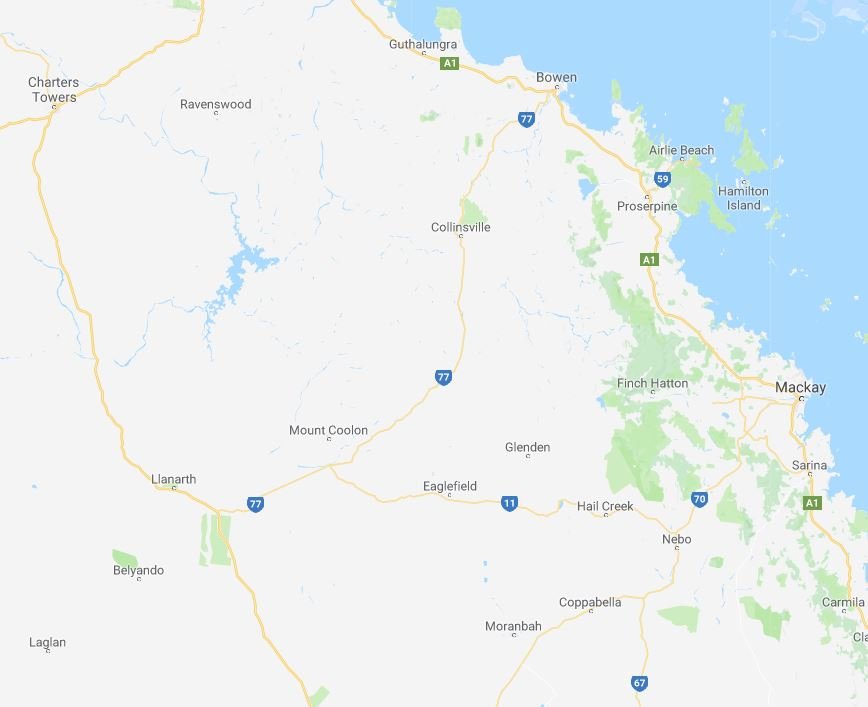
A proposed airfield/airport at the Adani mine site was dragged in as an excuse.
This airport would be located approximately directly south of Charters Towers and west of Moranbah
On Google Maps that scales out to just over 300 kilometres from the COAST, let alone the reef.
If people want to spout BS and theories about the environment, that's up to them, but this proposed airport is not going to affect the reef.

-
Good practice; I would add one element, and this one with an instructor to give you a random start signal. At the signal, count 3 seconds before doing anything, then start the EFATO. The three seconds is the "this is not happening to me period" delay which catches many people in all sorts of accidents.It sure does...nose down quick and keep the aircraft flying. Low level doesn’t give time to do much...carby heat, fuel tank, mags. Best glide may not always be sufficient and more speed close to the ground is your friend but treat the relationship wisely. Speed can be traded for height to clear an obstacle or even a turn if circumstances permit.Practice the impossible turn at 3000’ and work out what height you need to land back in the opposite direction, crosswind or to complete a circuit. Add at least 100’ to it and imprint that as your decision heights for an EFATO. But you must know your aircraft and have a clear plan before you firewall the noise knob.
Be prepared to wreck the machine rather than attempting to save it. Stretching the glide can be fatal.
kaz
-
Cow dung can be used as fuel too; there are literally hundreds of products which can be turned into fuel for internal combustion engines, however in relation to the down to earth subject of this thread, buying a can of two stroke to fill the fuel tank of the type of aircraft bull was talking about is neither expensive, nor difficult.
This thread has at times shown flickers of making a difference; "the time" is not even close to having gone, with plenty of aircraft still flying out there and plenty of others in sheds able to fly after refurbishment.
It just needs people to promote the sector, and it needs RAA to get out there and support what it was set up for.
-
There's no committee; just one person, with a lot of IT knowledge working a lot of hours for free. I'm having as much trouble as you are, but it's not the site owner, it's software progress, and the changing nature of social media. If he doesn't make the change now, and keep up with the linking technology it would be like having an Iphone 1, or trying to get today's programs operating on Windows 3.Who screwed up this formerly great web site? I knew it, and stated it months ago, that when a Committee takes over that things will go to pot.I like to reply to the top of a question, putting the question below my reply. Now I get a stupid box that outlines my response & gets the response all squirrely. And where is "Reply" when you want to REPLY to someone?It's like everything else. Just when some great, intelligent, hard working individual makes something work perfectly, a committee has to be appointed to screw it up.
I think I just figured out how both our countries got so fu-k-- up.
However, the good news is that things are falling into place day by day as the program loads history and gets our cookies sorted out.
So relax; it's costing you nothing for a great resource.
-
On a per trip basis, In GA, I agree, and in RA for minor incidents with nil or low grade injuries I’d also agree, but for serious injuries/ fatalities, I suspect the majority are en route.All take offs are recorded in the aircrafts log book. They get this information. I would think. The take offs and landings are probably the most risky periods of the flight. Nev -
Don’t worry Callaghan, liquor has become so expensive here that it’s cheaper to go to Church for it.You guys sound like you're drunk? Am I the only sober one here? It's usually the other way 'round.I wish I had the ink to tell you some of the rules I've broken & gotten by from Federal and local law enforcement. They call me Slick Willy too. We had a saying in Vietnam: "What are they going to do? Draft me & send me to Vietnam?"Exactly.
-
How are you FFS?Should have added yourself to the sale list. You are a bit of an ol stud. Ho Ho Ho Ha ha ha ... lover yer week HH. -
It’s not a Met subject; it is part of Performance and Operations, which seems to be missing from the RAA syllabus."Density Altitude relates to your aircrafts and engines PERFORMANCE. Even on a warm day at sea level you will be affected by it. It's more likely to surprise you when you fly from an aerodrome well above sea level or try to climb over a Mountain range en route. All Lift formula's have a symbol for air density in them. Density is a measure of the actual weight of the air molecules in a given volume of air.. It affect the prop the wings and the engines ability to do their jobs.. Mass airflow (not volume airflow) gives power.. I don't see this as a Met subject. Nev.Take off with a full load on the coast at day break, fly inland where the temperature has been rising, take off again in hot weather and if the strip is short, you’ll know all about density altitude. The calculation is relatively simple to tell you how much runway will be required, to quite an accurate length, or whether you’ll actually get off by the end of the runway. If you can’t it’s just a matter of checking the temp as the day cools, as long as you have the requisite daylight available.
-
That wasn't what was written; it was "Despite landing upside-down, a male pilot managed to walk away from the plane unharmed, according to police. "What an idiot report - "The plane landed upside down." It landed then flipped. If not for the culvert, he may have pulled off a good forced landing, despite the length of the grass.That is correct colloquial English, as in "the car rolled over, landing in a ditch", or "the student didn't do his homework and landed up in trouble, the word "landing" being the equivalent of "finishing up".
And it wasn't one report, it was a summary of updates, where more and more details were provided as people on the ground were able to provide more information.
-
This subject belongs on the other site where all the Great Minds can chew over it.
-
Container of new oil, chainsaw bar lubricator pump, press the button every time you update your flight chart - improves the average oil quality, rather than deceases it.........simple.
-
Don
Don’t get excited there Bruce, you’re already way ahead in terms of freedom compared to having to go through the process to get a Class 2. This doesn’t affect the RPC.Even if you stay in bed all day, there is some risk. Personally, I choose activities which are fun and so I choose to accept a higher level of risk than staying in bed. To put it more strongly, I reckon extremely risk-averse people actually have a mental health problem.Nobody on this forum falls into this category, but there are actually some people who rarely venture outside their houses because the world out there is so dangerous.So I am going to continue to do things like fly friends in my Jabiru even though turbs is right and there are dire consequences if things go wrong. I reckon the risk is small and the fun is big so the risk is worth taking.
That last sentence could be among a list of famous last words huh.
-
While nothing happens nothing happens, unless Casa get wind of it and pounce. However if they kill or injure someone due to a medical issue they can face criminal charges in addition to being sued, and their insurance cover may be denied. I agree finding and seeing a Dame and going through the current process is the most difficult and inconvenient process in flying, and would be far worse if it involved a couple of days travel to a capital city.And by the way - a few GA guys out back, who own their aircraft and flown for years now fly without any BFR or Medicals. It is not relevant to them and is just hoops to jump through with CASA, which they now refuse to do. -
Once again, the implication of what has happened, and the AOPA reaction has sailed straight over a number of heads. Your loss.I reckon Turbs lives in a theoretical world where every judge is wise and fair and Jaba lives in the real world. -
"Deepest pockets is deepest guilt" is just BS and should be on Snopes; I've read many cases where the negligent person had very few assets, and was pursued based on blatant negligence.For those who don't understand the principles, the key points which decided the cases are often missed based on their own day to day values. Not saying this is what happened in this journal article.“Deepest pockets is deepest guilt”Bad outcome equals negligence in most people’s minds.My latest copy of my medical defence journal carries a salutary story where a surgeon was found negligent this year for not using a particular technique in a hernia repair. Two “experts” gave opinion it should have been done a particular way. Two others said it was standard modern technique to NOT do it that way. ( and I gas for at least one hernia a week with about 5 different surgeons and not one has used that technique as standard for a decade or more. ) But the court found surgeon negligent for not doing the technique even though no currently accepted reason to do it.The literature is full of similar stories.
The two doctors who gave Barry Hempel the medicals prior to his crash where a passenger died were pursued for about a decade and they just fulfilled the old style medical without making a detirmination of his fitness to fly.
It doesn't surprise me that the CASA bashing just rolls on, even when a great opportunity comes up.
Take up or not doesn't really matter to CASA; if the doctors don't want to take advantage of the protection available under this system, they can simply post the rules, and step out of any involvement at all
-
Disclaimer; I am not a lawyer, I'm only generalising on my previous experience. They may all receive communications from the plaintiff's lawyers, but it usually quickly becomes obvious particular people are worthwhile pursuing. For example, if I was suing someone, and they were able to show that their actions complied with a recognised standard, they would be unlikely to take it anyfurther.But when a bad outcome happens everyone involved is lumped together. Regardless of common sense everyone gets tarred as being culpable. The less input you have the less risk you carry.So make no decisions you carry much less risk.Hopefully when the rules come out, the DAMES can relax, and we will have a simpler system available.
-
The list, along with any other Australian or International standards become the benchmarks. If you check the pilot against the list and he/she met the criteria, the relatives fight is with the criteria, in other words with CASA, not you.But CASA does not let the doctor actually decide.......The doctor doesn’t actually decide you are fit to fly, he decides if you fit the list defined by CASA.
New fuel laws
in Governing Bodies
Posted
Facthunter was referring to situations in CTA where the tower controller is setting priorities; so the "many here" would never be in that situation EXCEPT, if someone lands gear up or a student crunches the nosewheel on a country strip, the aircraft could be sitting there when you arrive, so you'll have to divert, or there could be a million other reasons where you'd be down to 30 minutes.
Think of it as just a mic change, which alerts others .